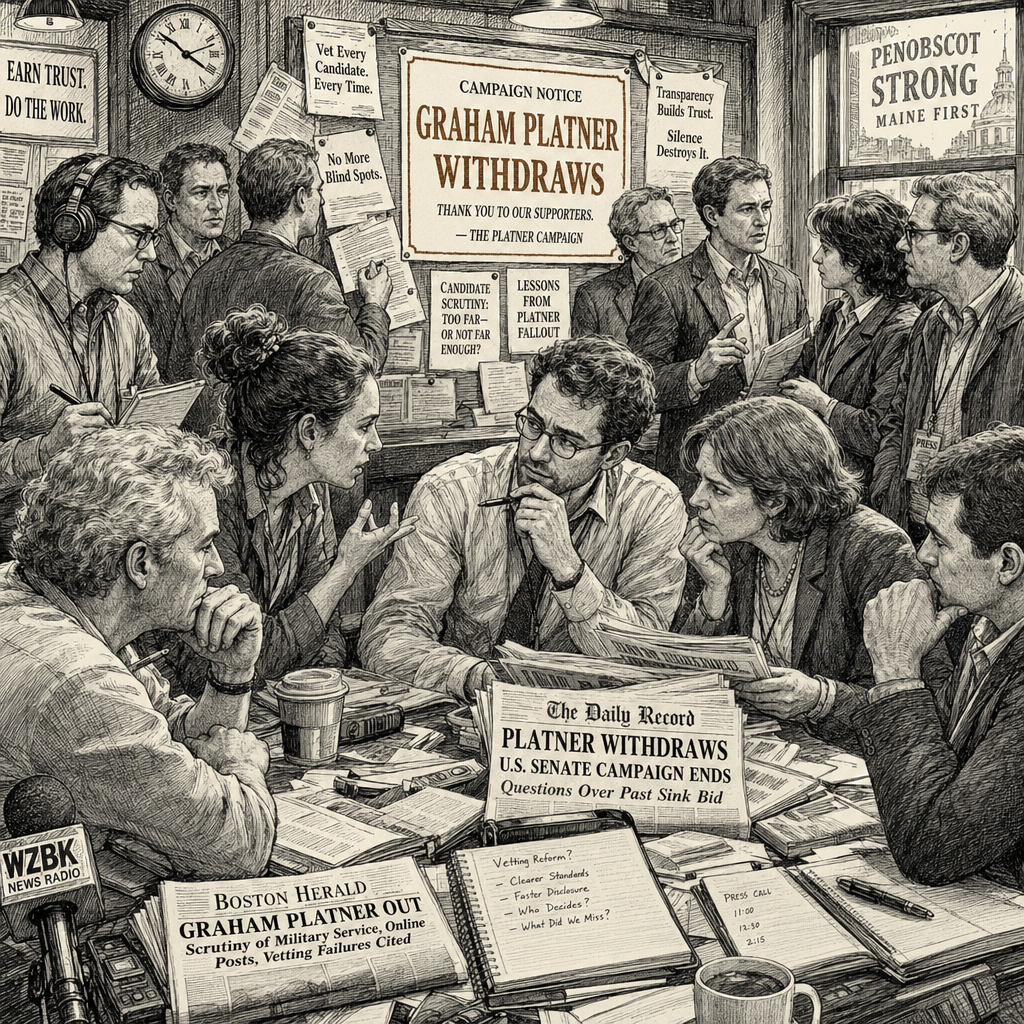
Graham Platner, a Marine veteran and oyster farmer, remained viable in the Democratic primary for U.S. Senate in Maine through four categories of personal controversy: online posts the Guardian characterized as racist, sexist, and homophobic; a tattoo widely recognized as a Nazi symbol, which he later covered; sexually explicit messages sent to other women while he was married; and allegations from former partners of toxic and threatening behavior, which he denied. Only a rape allegation — which he also denied — ended his campaign. Sara McGee, a Democratic state House nominee in Texas, pre-emptively disclosed a teenage drunk-driving offense, a divorce from a violent partner, and old debts that ended up in court, fearing these would tank her chances. The contrast between these two trajectories is the Democratic Party’s candidate vetting problem in miniature: the same conduct, or less severe conduct, produces different outcomes depending on whose conduct it is.
The root of the asymmetry is not bad actors or malice. It is the absence of codified, enforceable disqualification thresholds in the party’s candidate development pipeline. Platner’s controversies accumulated across four categories over time, and no formal party mechanism triggered a mandatory re-evaluation at any threshold. No party body convened a formal review after any of the four successive disclosures. The pipeline is candidate-initiated and resource-gated, an institutional design that treats candidate supply as exogenous — no institutional entitlement to run, no proactive search that compensates for asymmetric risk-bearing. The causal chain runs from that design through self-censoring at the recruitment stage and elimination at the vetting stage, producing a narrowed, less diverse slate.
Amanda Litman, co-founder of Run for Something, has observed that women and candidates of color “self-censor” at higher rates because they expect harsher scrutiny. She compared Platner’s leeway to “the Fyre fest guy or Adam Neuman,” citing an “inherent trust and faith in capabilities that they don’t have to prove.” Chris Rabb, a Pennsylvania state representative who won a closely watched Democratic primary, said that left-of-center white men get “far more leeway” than Black progressives, adding that if he had a problematic tattoo, “the money would not be there to run the campaign.” Michelle White, executive director of Emily’s List, framed the effect from the funding side: “time after time, we have to watch strong women candidates get dismissed and treated like a backup plan, while some disastrous men take up all the oxygen — and ultimately make it harder to win the seats we need to take back our country.” These are not isolated complaints; they describe a systematic pattern in which the same behavior is treated as a manageable risk for white male candidates and as disqualifying for everyone else.
Kelly Dittmar, a scholar at the Center for American Women in Politics at Rutgers University, has documented the mechanism: the “character pedestal” identified by the Barbara Lee Family Foundation means voters expect women to be more honest and trustworthy than men, making “the fall from the pedestal … longer and harder.” The pedestal operates in two directions — outward toward voters and donors, and inward toward potential candidates themselves. Research on state legislators, which Dittmar cited to the Guardian, shows that women describe their decision to run as “relationally embedded,” weighing how a campaign would affect their families, communities, and careers, while men run “simply because they wanted the job.” This means the asymmetry operates before candidacy begins: women and candidates of color apply the higher standard to themselves before the party or electorate has a chance to. Annie Andrews, the Democratic Senate nominee in South Carolina, captured the effect in a single post: “I’m just a girl, running for the US Senate, with a medical degree, a record of service, and a non-problematic past.” The compounding effect is that the pipeline narrows at both ends — fewer women enter, and those who enter face a steeper climb.
The different meanings of “disqualifying” reveal the structure of the debate. In a meritocratic-individualist framework, disqualifying is a property of the conduct itself — a Nazi tattoo, a rape allegation — and the standard is identity-blind. But this framework cannot account for the observed differential outcomes: McGee’s teenage DUI was treated as a threat to her candidacy, while Platner’s accumulated controversies were treated as survivable. The structural-disparity framework accounts for more of the evidence: disqualifying is a property of the interaction between conduct and candidate identity, and the same conduct produces different outcomes depending on whose conduct it is. The electoral-pragmatist framework — disqualifying means “costs more votes than it is worth” — is the mechanism through which the asymmetry operates, not a competing explanation. The fact that the most compelling evidence for the structural-disparity claim is electoral-pragmatist evidence — Platner advanced, women are dismissed as backup plans, candidates of color cannot raise money — reveals something important about the legitimacy structure of the debate: the meritocratic framing is so effective at legitimizing decisions that the only way to challenge it is to show it produces bad electoral outcomes, not that it is procedurally unfair.
The power-inversion pattern in the debate means that the parties with the deepest stake in reforming candidate-vetting norms hold limited power over those norms, while the parties who control the norms face little pressure to change. The quoted voices — Litman, White, Rabb, Dittmar, Andrews, McGee — are candidate-recruitment professionals and officeholders who form a coalition around the claim that the scrutiny regime is racially and gender-biased. The parties most directly affected by the asymmetry are absent from the public conversation: the unnamed woman who accused Platner of rape has no public voice in the debate over what counts as disqualifying; general-election voters are unrepresented in a discussion focused on primary dynamics; Democratic donors, who in Rabb’s account enforce the double standard through resource allocation, operate behind closed doors with no on-record position on vetting norms; survivor-advocacy organizations are relevant to the assault-allegation dimension but not framed as candidate-scrutiny stakeholders; and the self-censored women who chose not to run are, by definition, an invisible population whose absence is itself the most direct evidence of the asymmetry’s cost. Reform proposals emerging from this debate will be shaped by the parties with institutional access — Litman’s Run for Something, White’s Emily’s List — rather than by the parties who bear the cost. Opposing-party strategists, who have no stake in the fairness of Democratic vetting, benefit from the current system’s opacity; surviving male candidates with comparable baggage have no reform motivation. The absence of any countervailing coalition means the asymmetry persists because it serves the interests of the parties who control the pipeline.
The convergence of two causal chains — the self-censoring chain at the recruitment stage and the process-rejection chain at the vetting stage — means that fixing only one is insufficient. Both are shaped by a shared upstream variable: whether the party signals to donors and aspirants that personal scrutiny will be identity-neutral. When parties do not signal neutrality, funders and potential candidates both factor demographic risk into their decisions, compounding the effect. The structural gap is actionable. A transparent electoral risk rubric applied across aligned PACs and state party committees would ensure that identical controversies trigger identical procedural responses regardless of candidate identity. Equity-weighted support allocation in candidate training and fundraising infrastructure would offset the higher scrutiny tax women and candidates of color bear. The absence of such mechanisms is not a neutral design choice; it is a structural feature that reproduces the existing power distribution. The asymmetry is not an accident of the pipeline — it is a consequence of it.
Analytical techniques used in this piece
This analysis applies the methods below. Each links to a short, plain-English explainer you can read and reuse.
- Root-Cause Analysis
- Traces a symptom back along its causal chain to the conditions that actually generated it.
- Stakeholder Mapping
- Charts the parties to a situation — their interests, power, and alignments.
- Worldview Cartography
- Maps the clashing worldviews underlying a dispute.