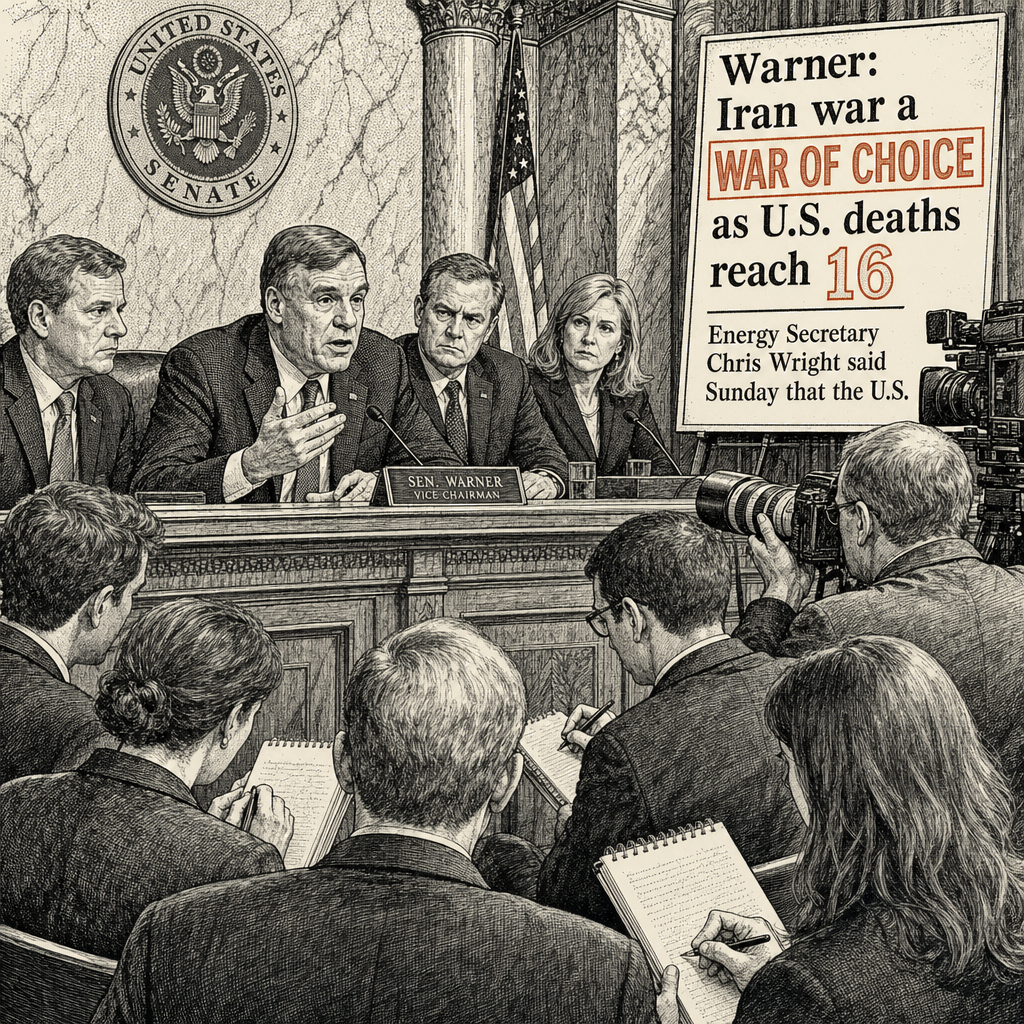
In a war approaching its fifth month with 16 American dead, the question of which objectives define success is not academic — it determines who bears accountability for a conflict that has cost lives, reshaped a region, and now risks becoming open-ended. When an administration redefines its own mission mid-war, the old benchmarks do not vanish. They migrate from the operating plan to the opposition’s scorecard, and the administration loses control of the ruler by which the public measures it.
Energy Secretary Chris Wright made the pivot explicit on ABC’s “This Week” on July 19. The U.S. mission in Iran, he said, has shifted to “assuring that oil and gas and other products can flow through the Strait of Hormuz with or without Iranian cooperation.” The shift followed Iran’s rejection of a diplomatic pause. But the move from three maximalist objectives to one achievable one was not a pivot to a new strategy so much as an arrival at the only strategy the military posture could deliver.
The benchmarks that wouldn’t die
On the same broadcast, Sen. Mark Warner of Virginia used each of the three abandoned objectives as a failure metric. Regime change: “We got a worse crowd than before.” Enriched uranium: “still there.” Missile and drone capability: “obviously, we’ve not been successful there.” Warner called the conflict a “war of choice” launched without an imminent threat, and said “the continuation of this war, at this pace, will be a continuing disaster.”
A relationship map of the conflict’s structure shows why the old benchmarks persist. The administration entered the war radiating three causal edges toward Iran — regime change, missile and drone elimination, and enriched uranium security — and one pivoted causal edge toward the Strait of Hormuz. The structural pattern is itself a finding: the original three-edge bundle targeting Iran has been replaced by a single edge targeting a chokepoint, with the original objectives now functioning as a critic’s evidence base rather than the administration’s operating mission. The hub at the center of the map — the administration — cannot control the reference frame against which its performance is judged.
Warner’s enriched-uranium claim anchors the gap in operational reality. Recovering the material would require “a minimum of 15,000 troops on the ground for a week to try to take these canisters, which are quite volatile, out of their bunker.” The figure transforms an abstract failure — the uranium is “still there” — into a concrete ground operation the U.S. has not launched and shows no signs of launching. The gap between what was promised and what is being pursued is no longer a matter of interpretation. It is a measurable distance in troops, weeks, and political will.
The critic and the defender describe the same empirical pattern — original objectives are unachievable on the current trajectory — but assign opposite valences to it. Wright’s defensive framing on the same program does not address the benchmarks Warner named. The structural convergence of both readings on the same facts is itself a finding.
Why the pivot is rational and why that makes it unusable
A game-theory read of the conflict explains both the logic of the shift and the reason the administration cannot openly claim it.
Working backward from current military realities — deriving the subgame-perfect equilibrium of this sequential, repeated game via backward induction — the U.S. launched the war in February 2026 with maximalist goals. Five months of fighting produced regime survival, intact uranium stockpiles, degraded but functional missile capability, and 16 American deaths. At each stage, escalation to achieve the original objectives carried costs that exceeded the expected payoff. A ground operation to seize enriched uranium would require 15,000 troops. Regime change had already produced what Warner called a “worse crowd.” The rational endpoint of this backward analysis is the narrow objective Wright announced: oil flow through the Strait, with Iranian capability degraded but not destroyed.
This is the equilibrium both sides can sustain. The U.S. cannot profitably escalate — the costs of 16 deaths, a “continuing disaster” framing from sitting senators, and a “worse crowd” outcome exceed the benefit. Iran cannot profitably reject the oil-flow arrangement — it would lose the narrow corridor of cooperation that prevents a ground invasion. The standoff is stable.
But the administration cannot narratively commit to the equilibrium without conceding that its original war aims were unachievable. Wright’s statement performs the pivot in operational terms — the mission has “pivoted,” he said, after Iran “proven unwilling” to agree to a pause. The pivot is presented as a reaction to Iranian intransigence, not as an admission that the maximalist goals failed. Yet the logic is identical: the original objectives cannot be reached at acceptable cost, so the administration pursues what it can reach. The gap between the operationally rational move and the publicly stated rationale is the credibility wound at the center of the strategy.
The subgame-perfect equilibrium assumes rational actors, but both sides show systematic deviations. The administration exhibits an anchoring-plus-sunk-cost pattern — Wright’s earlier prediction that the war would have ended by now suggests the administration locked onto an initial estimate and has been slow to adjust. Iran shows evidence of loss aversion: the rational equilibrium has Iran accepting a diplomatic pause in exchange for oil-flow access, but loss-averse leadership over-weights the value of relinquished assets relative to secured revenue, producing continued resistance at higher cost for both sides.
Under a competing Schelling-style “chicken” framing, the U.S. partially swerved by dropping regime change while Iran held position. The pivot functions as a “threat that leaves something to chance,” delegating escalation control to shared risk in a congested chokepoint. Under this framing, the standoff persists at elevated risk of accidental escalation because neither side has made an irreversible commitment.
The casualties and the loop they feed
The cycle connecting military operations to political constraint tightens with each death. Two U.S. troops were killed in Jordan on July 17, bringing the total to 16. The U.S. launched retaliatory strikes on July 19 against Iran’s Revolutionary Guards. After the troop deaths, Defense Secretary Pete Hegseth wrote on social media that the service members’ “sacrifice only stiffens our resolve.”
The statement attempts to reroute the dynamic: casualties do not constrain — they energize. But the loop’s structure is indifferent to rhetoric. Deaths feed political pressure. Political pressure narrows strategic options. Warner’s “continuing disaster” and Hegseth’s “stiffens our resolve” frame the same 16 deaths through opposite political logics, but the underlying dynamic — each loss constraining the administration’s room to maneuver — continues operating regardless of which frame prevails in public discourse.
A stakeholder map of the conflict underscores the constraint. The U.S. military and its families occupy a position of high legitimacy and very high urgency but low institutional power — they bear the costs but depend on civilian leadership to act on their stake. Congressional Democrats, represented here by Warner, hold high legitimacy and high urgency but lack the unilateral votes to halt the conflict. The administration’s threats sort cleanly along this axis: oil-flow protection is an observable commitment device backed by sustained military presence; the regime-change threat was always cheap talk, with no commitment device, sunk cost, or future-shadow grounds. Iran has demonstrated willingness to absorb military costs to maintain its position; its retention of enriched uranium and its capacity to disrupt the Strait are credible. Warner’s criticism is a credibility signal rather than a threat — it indicates that domestic political cost is rising, which constrains the U.S.’s ability to maintain a credible commitment over time.
The sanctions cross-link
Trump’s July 19 Truth Social post — “Republicans should add Iran to the Russian Sanctions Bill. That’s what Lindsey wanted to do, and it was going to happen. IMPORTANT!!!” — opens a structural front that extends beyond the war itself.
The proposal would cross-link two previously separate geopolitical tracks: the Ukraine sanctions regime and Iran policy. Attaching Iran to Russia sanctions legislation would create a legislative lock that structurally dismantles the June memorandum of understanding between the U.S. and Iran. That MOU included an agreement to end sanctions. The new legislation would override it through Congressional action rather than diplomatic renegotiation. Iran policy becomes collateral of the Ukraine track, and the diplomatic track is being structurally destroyed through a legislative cross-link that the administration itself is driving.
The post invokes Sen. Lindsey Graham, who died July 11, as its authority. Graham was the hawkish coalition-builder for the sanctions path — the political infrastructure that moved legislation through committee and secured votes. His death removed that infrastructure. Trump’s framing uses a deceased ally’s name to fill the gap, but the name supplies no votes, no committee management, and no deal-making capacity. Without Graham’s coalition-building, the expected probability of Congressional passage drops, making the announcement a credibility signal weaker than the policy it describes.
Who is absent
The coverage centers a Warner-versus-administration axis. Absent from the frame: Congress as a constitutional body with the power to authorize, fund, or constrain the war. The Iranian civilian population, whose lives are shaped by both the fighting and the sanctions — Energy Secretary Wright invoked “the Iranian people” as having rejected a diplomatic pause, but no Iranian source appears. European allies, whose energy supplies run through the Strait of Hormuz. The Gulf Cooperation Council states and Asian oil-importing nations — China, India, Japan, South Korea — whose economies face the most direct exposure to the chokepoint disruption the mission pivot is designed to address. The Strait handles roughly 20% of globally traded oil; the bulk of it heads to those four Asian economies. Their absence from the domestic political frame is a finding in itself: a war fought over a waterway that serves global energy markets is being debated as a bilateral U.S.-Iran question.
The nuclear nonproliferation framework that originally justified the enriched-uranium objective surfaces only as Warner’s talking point. It does not appear as an independent institutional stake, despite the fact that the material Iran retains — the uranium Warner described as “still there” — represents a proliferation risk that does not expire when the administration redefines its mission.
Each of these absent parties has a mapped position in the conflict’s stakeholder architecture. The Trump administration, Iran’s government, and the Asian oil-importing nations hold high power and high interest, placing them in the “manage closely” quadrant of the power-interest grid and the “Definitive” class of the Mitchell-Agle-Wood salience framework. Iran’s Islamic Revolutionary Guard Corps holds high power and high urgency with no legitimacy in U.S. framing — a “Dangerous” stakeholder, an actor using force outside recognized channels. Congressional Republicans hold high power and moderate interest as gatekeepers of the sanctions bill, a “Dominant” position that controls the legislative path. Congressional Democrats, with Warner as the vocal proxy, hold low legislative power but high legitimacy and high urgency, a “Demanding” position that relies on oversight hearings and public criticism to raise political costs.
The most structurally significant absent party is the U.S. Congress as an institution. No senator other than Warner is quoted; no House member appears. The constitutional body with the power to declare war, fund operations, and conduct oversight sits in the “Dormant” quadrant of the salience framework — high constitutional power and high legitimacy, zero exercised urgency. Its absence from the frame is not a coverage gap; it is a structural silence that normalizes the war by not contesting it. The Iranian civilian population is classified as a “Non-stakeholder” within the U.S. decision framework — zero power, zero formal legitimacy, yet the population with the highest urgency of all, bearing the direct effects of combat and sanctions. European allies occupy a “Dormant” position, excluded from the frame despite being directly affected by oil disruption and Strait security — their absence from the U.S. burden-sharing frame is itself evidence that the conflict is being prosecuted as a unilateral enterprise. Gulf Cooperation Council states sit at the boundary of “Dangerous” and “Dependent” with moderate power but very high interest from geographic exposure along the Strait. The map’s classificatory structure makes the exclusion visible: the parties most affected by the pivot are the parties least present in the frame deciding how it executes.
Three questions to carry to the next story
-
The administration’s oil-flow-only rationale is already a half-dead thing — will the next wave of casualties or the November 2026 midterm deadline finish it off, or does sunk-cost delusion keep the original objectives alive on a life-support system the administration can no longer publicly maintain?
-
Graham’s grave lies empty of the coalition his name now props up — can Trump’s podium fill it, or does the sanctions path die with the man who built it, leaving the June memorandum of understanding more durable than a Truth Social post?
-
As the casualties climb and the political clock narrows, does the strategic equilibrium collapse toward an oil-flow mission the administration can actually name, or does the same anchoring-plus-sunk-cost logic that delayed the pivot for five months push this war past the point where any objective — stated or abandoned — defines its end?
This analysis describes conduct and structural relationships reported in source materials. It makes no claim about the intent of any party.
Analytical techniques used in this piece
This analysis applies the methods below. Each links to a short, plain-English explainer you can read and reuse.
- Relationship Mapping
- Extracts the network of ties among people, institutions, and entities.
- Stakeholder Mapping
- Charts the parties to a situation — their interests, power, and alignments.
- Strategic Interaction (Game Theory)
- Models a situation as a game — players, moves, payoffs, and likely equilibria.