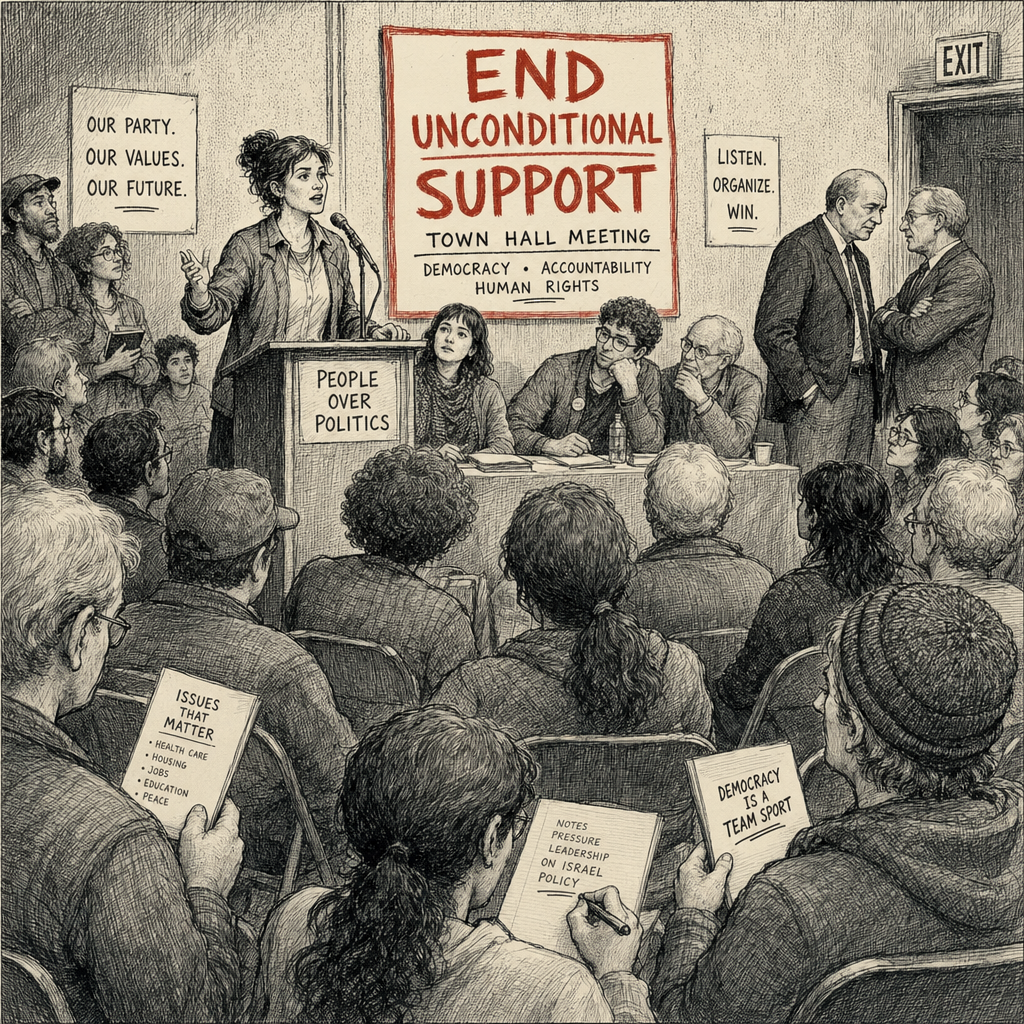
The July 15 House vote exposed a structural fault line in the Democratic Party between leadership’s pro-Israel posture and the surging opposition within its own caucus and voter base. The gap between the 74 percent figure and leadership’s posture is not new, but the July 15 vote rendered it in a form difficult to dismiss: a roll-call tally, not an opinion survey. 103 House Democrats — nearly half the caucus — voted to block $3.3 billion in military aid to Israel on July 15, 2026, defying a July 14 “dear colleague” letter from Minority Leader Hakeem Jeffries opposing the Massie amendment. The amendment failed 104-314-10. A New York Times/Siena poll from May 2026 found 74 percent of Democratic voters oppose additional economic and military support for Israel, with large majorities across all age groups. The 74 percent figure is independently corroborated across NYT, Times of Israel, Al Jazeera, New Republic, Roll Call, and The Intercept. Question wording specifies “providing additional economic and military support” not necessarily all existing aid. The vote count (103 Democrats), date (July 15), and amount ($3.3 billion) are confirmed across Guardian, Politico, CBS News, The Hill, and Haaretz. Norman Solomon called the moment a “mutiny” in a July 20 Guardian commentary. The label is structural description of a caucus fracture, not metaphor.
The architecture of the gap
The Democratic Party has no binding mechanism — no caucus rule, no platform requirement, no membership referendum — that forces leadership to reconcile its stated positions with demonstrated voter preference. Jeffries’s letter was a request, not a whip. The whip system operates through interpersonal, letter-based, broadcast one-directional communication. The only formal feedback loop connecting membership preference to leadership posture in U.S. political parties is the primary election, and that system permits incumbents to survive challenges on foreign policy when the issue is not the determining factor for most primary voters. U.S. parties are structurally weak by design. No party rule, caucus resolution, or platform requirement demands binding reconciliation between leadership posture and caucus preference. This is structural design, not human error.
The whip infrastructure was built for an era when leadership and voter consensus were broadly aligned and has not been updated because the case for rebuilding requires recognizing the breakdown leadership has not acknowledged. The absence of the tooling removes the signal that would justify building the tooling — the blind spot is its own perpetuation. The 74 percent figure has no formal trigger mechanism linking polling thresholds to leadership-position reviews. A measurement-to-action pathway is structurally absent.
A root-cause analysis applying a manufacturing-systems diagnostic framework (6M: Man, Machine, Method, Material, Measurement, Mother Nature) traces the fracture through six categories. The framework was chosen over a 4P political framework (People, Policy, Process, Politics) because its finer-grained distinctions — particularly the separation of Measurement from Method, and Machine from Method — better capture the self-reinforcing institutional dynamics. The deepest single causal chain, reaching five levels beneath the symptom, lives in the Method category: (1) Jeffries and Schumer opposed the July 15 aid cutoff despite 103 Democratic votes; (2) leadership believes the pro-Israel stance is strategically necessary for coalition management; (3) donor networks and suppression mechanisms have historically incentivized and enforced pro-Israel positions; (4) no formal process forces leadership to update position when 74 percent of voters and 47 percent of the caucus express contrary preference; (5) U.S. political parties are structurally weak by design.
Five root causes converge on a single pattern: institutional design fails to bind the leadership tier to membership/voter preference on this issue. Removal of any one root would reduce recurrence probability; removal of the Why-5 structural-insulation root would most comprehensively prevent it.
The relationship map: two readings of the same event
Two competing topologies surface from the same material and neither is eliminable. (A) Hub-and-spoke: the July 15 vote is the single hub; every spoke (voter opinion, defection, leadership positioning, electoral risk, mechanism decay, Pelosi’s pivot, DNC opacity) connects through it. (B) Two-hub network: leadership hub (Jeffries, Schumer, Martin, pre-2026 Pelosi) held together by institutional habits and residual antisemitism-labeling fear; shift hub (74 percent of Democratic voters, 103 House Democrats, Casar, Solomon) connected by the July 15 vote and NYT poll. Pelosi’s 2026 vote acts as a cross-link between the hubs.
The hub-and-spoke reading centers the legislative event as the single moment that exposed every failure. The two-hub reading centers the leader-vs-base tension Solomon used to organize the entire commentary. Both readings surface from the same material and neither is eliminable.
The map excludes: views of Jeffries, Schumer, or Martin in their own words beyond Jeffries’s letter; quantitative detail on the NYT poll beyond the 74 percent headline; role of AIPAC or pro-Israel donors; Republican positioning on Israel; substantive policy content of the $3.3B package; whether the 103 votes reflected genuine policy conviction or safe-seat posturing; congressional district-level data linking the 74 percent figure to actual voting patterns by member.
Pelosi as structural signal
Former Speaker Nancy Pelosi’s vote for the aid cutoff — contrasted with her 2018 Israeli-American Council statement that “if this Capitol crumbled to the ground, the one thing that would remain is our commitment to our aid, I don’t even call it aid – our cooperation – with Israel” — signals that individual lawmakers have adapted faster than the party’s institutional machinery. Pelosi’s vote carries significance beyond the single tally. Her seniority means the vote functions as a permission signal for other lawmakers, not a cause of their votes. The same event carries two different structural meanings depending on the target — a signal to peers and a measure of how far behind the institution has fallen. Solomon treats her vote as a “weathervane.” The relationship map confirms its dual function: permission signal to members weighing their own votes, and diagnostic of institutional lag — the gap between individual adaptation and party-level response. The lag is itself a structural finding: individual-member adaptation has outpaced the party’s institutional machinery.
The operating frame and its decay
Solomon identified a specific mechanism that historically held Democratic lawmakers in line with the party’s pro-Israel leadership posture: the social cost of being labeled antisemitic. He argued the “dramatic shift in public attitudes toward Israel has notably reduced their intimidating power.” The cost-benefit calculation is not uniform. Lawmakers in safe districts face lower reputational costs for dissent than those in competitive ones. The deterrent has not disappeared, but its reach has narrowed — concentrated now in competitive districts where the electoral calculus still favors caution over realignment. The pre-2023 consensus, crystallized in Pelosi’s 2018 remarks, treated unconditional support for Israel aid as a permanent feature of the Democratic Party’s identity. Solomon characterizes leadership’s current posture as “a wet blanket on a party that should be vibrant” — a frame claim that the leadership’s operating picture is a carryover from an earlier era.
Per analytical context (Haaretz), the July 15 defections included “some of Israel’s staunchest supporters,” suggesting the cost-trade-off shift extends beyond deep-blue districts where safe-seat positioning would predict clustering. Progressive Caucus Chair Greg Casar publicly supported the amendment while Jeffries and Rep. Pete Aguilar opposed. DNC Chair Ken Martin has not publicly addressed the Israel issue within the committee. The mid-August DNC meeting is predicted to be a “scene of subdued discord.”
DNC governance cross-link
DNC officials were asked to sign nondisclosure agreements before a June 25, 2026 meeting. A DNC spokesperson confirmed “all senior staff at the DNC are party to confidentiality agreements.” Independent sourcing: Axios. NDAs were adopted for financial reasons (debt, fundraising disadvantage, donor frustration). They carry a collateral effect: officials bound by confidentiality cannot publicly surface internal disagreements about policy positions, including Israel. The policy-silence effect is collateral rather than intended. Solomon links Ken Martin’s use of NDAs to the party’s substantive foreign-policy paralysis — a non-obvious cross-link between internal governance procedures and a substantive alignment failure.
Analytical tensions
The preference-salience distinction is the primary analytical vulnerability: 74 percent may measure shallow stated preference rather than vote-shaping intensity. If leadership rationally discounts the poll on salience grounds, the gap is defensible strategic calculation rather than process failure. Alternative framing: leadership maintains stance because shifting would alienate centrist voters and donors whose support is more reliable than that of an anti-war base that may not vote on the issue. The electoral-risk-calculation chain directly challenges the process chain. Convergence flag: the process chain and the electoral-risk-calculation chain may converge. Leadership may be weighing two incentive sets (donors vs voters), and the absence of formal process lets donor-side incentives dominate by default. The breadth of the July 15 defection — crossing safe-seat and competitive-district lines and including staunch Israel supporters — cuts against a purely tactical reading but does not resolve the question. Definitive resolution would require district-level polling correlated against defection patterns, not available in source material. Confidence in the dominant chain is moderate; reduced by the donor-pressure inference vulnerability and the preference-salience distinction.
The donor-pressure inference is the strongest explanation for why the process gap produces the specific observed outcome, but rests on structural alignment of donor interests (AIPAC, pro-Israel PACs) with leadership action, not on direct evidence of donor contact in source material. Structural alignment is not direct evidence of donor contact.
Frame attribution
Solomon’s commentary comes as progressive advocacy. The “mutiny” language, “weathervane,” “wet blanket,” and “moral bankruptcy amounting to political malpractice” are interpretive claims that the analytical frameworks treat as load-bearing. The analysis advances Solomon’s structural argument while flagging where its evidence is interpretive rather than observed.
Forward-looking: scenario planning
Two predetermined elements frame the planning horizon. Base opinion shift: cross-cohort, documented across six independent sources, will not reverse in planning horizon, may deepen as younger voters age in. Confidence: high. Leadership fracture demonstrated: 103-vote, Pelosi defection, Casar position, Jeffries letter failure. Confidence: high.
Two critical uncertainties define the strategic space. Axis X: leadership accommodation (low) ↔ leadership resistance (high). Axis Y: progressive mobilization compounding into Israel electoral cleavage (low) ↔ dissipation or displacement by other issues (high). Independence rationale: leadership responsiveness depends on internal party dynamics (donor relationships, institutional norms, primary-risk calculations); grassroots mobilization and electoral centrality depend on activist infrastructure and candidate emergence that can persist independent of leadership decisions. Historical decorrelation: 2020 Democratic primary featured a range of Israel positions among candidates while leadership remained consistent. Within-politician decorrelation: Pelosi’s simultaneous 2026 cutoff vote and 2018 institutional statement shows the two dimensions can move independently inside a single politician.
Realigned Coalition (X-low/Y-low). Leadership legitimizes shift; progressive candidates win competitive 2026 primaries; an anti-establishment candidate runs on conditioning aid in 2028; the party’s identity reorients. This is the scenario Solomon is advocating for and the one in which his predicted 2028 lane opens most clearly.
Party Mutiny (X-high/Y-low). Leadership maintains traditional support; base pressure generates primary challenges to establishment Democrats; the 2028 primary becomes a contested proxy war over the party’s moral identity; intra-party polarization intensifies. Solomon’s “mutiny” language directly describes this quadrant.
Quiet Shift (X-low/Y-high). Leadership makes tactical adjustments to neutralize the issue without structural change; voters return to economic and domestic concerns; the 2028 primary avoids Israel as a defining cleavage.
Status Quo Holds (X-high/Y-high). The 103-vote becomes a historical marker without lasting institutional impact; the 2028 primary is fought on other terrain; the party’s Israel stance remains unchanged.
Leading indicators for each scenario:
Realigned Coalition — Concrete legislative commitments to reduce Israel aid in Democratic platform; a major 2028 candidate explicitly calls for cutting Israel aid in a launch speech; DNC platform committee includes language critical of Israel policy; progressive grassroots candidates winning competitive primary races in 2026. Threshold: at least 2 of 4 by end of 2027.
Party Mutiny — Primary challenges to Jeffries- or Schumer-aligned incumbents in 2026 cycle; declining party unity scores in congressional elections; grassroots candidate endorsement lists expanding; Jeffries continues to send “dear colleague” letters opposing aid cuts; August 2026 DNC meeting becomes a public confrontation. Threshold: at least 3 of 5 by end of 2026.
Quiet Shift — Subtle DNC policy adjustments that stop short of platform shift; declining social media engagement on the issue; candidates avoiding Israel as campaign point; Israel drops in voter priority rankings in successive polls. Threshold: at least 3 of 4 by mid-2027.
Status Quo Holds — Absence of primary challenges; no significant discussion of Israel vote at August 2026 DNC; party messaging remains focused on economic issues; 2026 midterm results produce no clear mandate on the issue. Threshold: all 4 persist through end of 2026.
Robust strategies and contingent actions
Three strategies work across all four scenarios. Build a decentralized donor network to fund progressive candidates without relying on the DNC, reducing dependence on institutional leadership decisions. Establish a joint progressive media platform — a podcast network, newsletter coalition, or coordinated social media infrastructure — that sustains issue salience through 2028 regardless of leadership messaging. Build a broad coalition that is not single-issue on Israel-Palestine, and frame the party’s posture in terms of US national interest rather than donor pressure or activist demand alone.
Scenario-dependent strategies vary. If leadership accommodates: push for concrete platform commitments and legislative changes (Realigned Coalition). If leadership resists: focus on primary challenges and grassroots mobilization as a counterweight (Party Mutiny). A full embrace of conditioning aid works in Realigned Coalition but is disastrous in Status Quo Holds. Resisting the shift works in Party Mutiny only for the resistance leader.
Contingent actions tied to specific leading indicators: if primary challenges materialize (Party Mutiny leading indicator), allocate resources to support those campaigns; leadership should convene a task force before the 2028 cycle begins. If primary challenges do not materialize (Quiet Shift or Status Quo Holds), redirect resources toward 2028 primary positioning. If a major 2028 candidate explicitly calls for cutting Israel aid in a launch speech (Realigned Coalition leading indicator), accelerate platform drafting and donor mobilization in coordination with that campaign.
Wild cards
Four events sit outside the matrix because each would change the salience and framing of the issue itself, not just position along either axis. U.S. military confrontation with Iran over nuclear facilities would reframe the Israel debate as a national-security imperative, collapsing the leadership-adaptation axis by making dissent politically untenable. A binding ICJ genocide finding would accelerate the base shift beyond current trajectory and force leadership accommodation by changing the legal and moral framing. A terrorist attack on U.S. soil linked to the conflict would re-empower pro-Israel hardliners overnight. A broader Middle Eastern war could re-empower pro-Israel hardliners (if framed as Israeli self-defense) or accelerate the base shift (if framed as U.S. complicity in escalation). Early-warning signals: U.S.-Iran diplomatic posture, IAEA findings, ICJ rulings, intelligence assessments of terror threats.
Forward-looking questions
Does the August 2026 DNC meeting produce any visible adjustment in the party’s Israel posture, or will the structural insulation hold? Do the 103 July 15 votes represent a durable voting bloc or a one-time expression of frustration? Can any 2028 candidate build a coalition broad enough to make conditioning Israel aid an electoral asset rather than a liability? When the next aid package reaches the floor, will the gap between leadership and caucus widen, narrow, or hold where it is? Does any external event — an Iran confrontation, an ICJ finding — change the axis positions before the party reaches its own inflection point?
Analytical techniques used in this piece
This analysis applies the methods below. Each links to a short, plain-English explainer you can read and reuse.
- Relationship Mapping
- Extracts the network of ties among people, institutions, and entities.
- Root-Cause Analysis
- Traces a symptom back along its causal chain to the conditions that actually generated it.
- Scenario Planning
- Builds a small set of distinct, plausible futures to plan against.