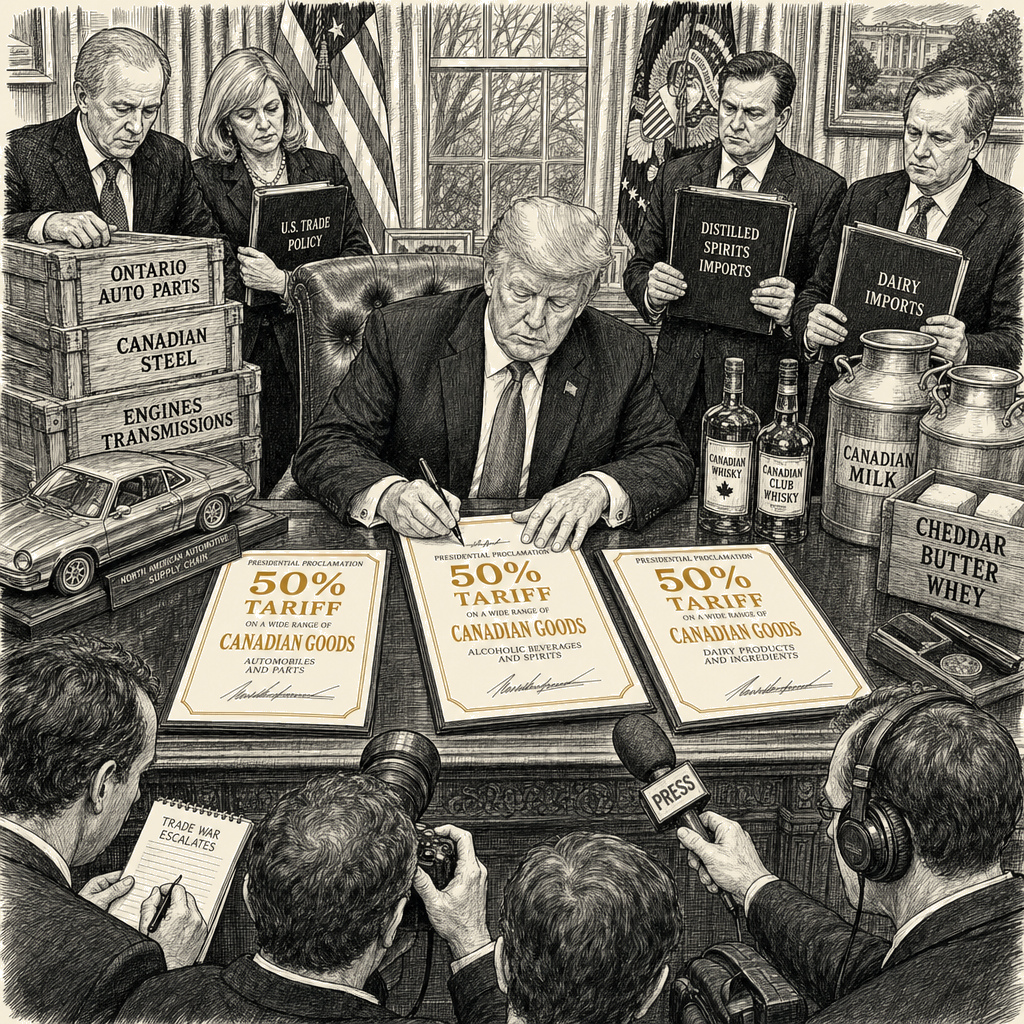
The retaliatory cycle that produced the July 20 proclamation is the core structural feature of this escalation. The Associated Press explicitly reports that Trump’s argument “rests in large part on retaliatory actions taken by Canada after Trump imposed tariffs” — an observer-level recognition that the stated rationale is inseparable from the escalatory pattern the U.S. itself initiated. The sequence: U.S. tariffs imposed on fentanyl-smuggling grounds → Canada imposes a 25% tariff on non-USMCA-qualifying U.S. motor vehicles starting April 2025 → all but two Canadian provinces and territories halt purchase and retail of American alcoholic beverages beginning last year → Trump signs three proclamations under Section 338 of the 1930 Trade Act imposing 50% tariffs on a wide range of Canadian imports, effective August 19, citing those Canadian responses as the basis for the new duties. An anonymous administration official reinforced the frame on a call with reporters by grouping Canada with China as “one of the only nations other than China that retaliated” — pairing, in a single formulation, the retaliatory move with the original provocation. The dairy grievance is structurally distinct in origin: Canada’s supply-management system and tariff-rate quotas are a pre-existing structural barrier, not a response to U.S. tariffs. Bundling it alongside retaliation claims creates ambiguity about whether each element of the proclamation’s grievance has the same causal origin, but the pattern across autos, alcohol, and the official’s own framing points to one conclusion: what the proclamation presents as initiating “unequal treatment” is, in the reported record, largely a response to U.S. action.
The USMCA non-renewal is the structural gap that made Section 338 the available escalation route. The 2020 USMCA was not renewed by the United States in July 2026, removing the bilateral dispute-resolution framework that previously channeled trade disagreements. Democratic lawmakers had introduced H.R.2464 in March 2025 to repeal Section 338, characterizing it as an outdated tool that could “destabilize the economy” — exactly the tool the July 2026 proclamation activates. The non-renewal triggered a new round of negotiations that could run until 2036, leaving a long-duration policy vacuum. The 50% tariff fills that vacuum, operating without the procedural constraints USMCA imposed. The tariff action pre-empts the negotiation track’s credibility before binding force can attach: one process constructs conditions for agreement, the other destroys them.
The carve-outs in the proclamation are as informative as the inclusions. Energy products, potash, critical minerals, and fish are excluded. The administration does not publicly explain the reasoning, but the pattern reflects U.S. supply-chain dependence: potash is critical for American agriculture; Canadian energy flows supply a significant share of U.S. consumption; critical minerals feed defense and technology supply chains. The exclusion list functions as a map of U.S. vulnerability — it tells Canada exactly where its leverage lives. The tariff regime concentrates costs on sectors with less political leverage (wine, cement, hockey sticks) while sheltering sectors whose exclusion would cause the most immediate domestic disruption. For Canada, the exclusion is both relief and instruction: Alberta and Saskatchewan’s energy and potash sectors are insulated; Ontario and Quebec’s auto assembly and aluminum smelting face direct retaliation exposure. The internal split maps onto existing provincial political tensions about the federal government’s trade posture.
The stakeholder field reveals a sharp asymmetry between petitioners and cost-bearers. The American auto, dairy, and alcohol lobbies are beneficiary petitioners whose grievances anchor the proclamations; their interests are structurally privileged over downstream constituencies. American construction firms and homebuilders face compounding input costs — 50% on commercial cement stacked onto an existing 35% on softwood lumber — without having petitioned for either tariff. Wine importers, hockey equipment retailers, and their downstream buyers are direct casualties of duties they did not trigger. American consumers, especially low-income households that spend proportionally more on food and building materials, face regressive cost exposure with no organized presence in either government’s decision-making structure. Canadian export workers in auto assembly, aluminum smelting, and forestry face direct employment consequences from escalation but appear in neither government’s public framing. Indigenous border communities whose cross-border trade patterns and food systems are disrupted by the escalation are structurally absent from the coverage entirely. The costs of a dispute framed as protecting American businesses are distributed across populations the protective frame does not name. In Mitchell-Agile-Wood salience terms, American consumers broadly, Indigenous border communities, low-income American households, and Canadian export workers each rate as Definitive stakeholders — high legitimacy, high urgency, but zero organizational power — placing them in the same salience bracket as the Trump administration (high power, contested legitimacy, high urgency) but without the institutional machinery to convert their stake into influence.
Trump’s wildfire-smoke tariff request demonstrates that the trigger set for new tariffs is operationally unbounded. He raised the issue with Prime Minister Carney at the July 19 World Cup final, telling reporters afterward: “I told him, I mean, ‘You got to stop these fires from coming in and, you know, poisoning our air. Our air has been poisoned.’” The administration directed aides to “look into” additional tariffs on Canada over wildfire smoke drifting into the United States. The request carries no signed executive order, no statutory trigger, no announced timeline, no specific duty level — it functions as cheap talk, a rhetorical escalation signal without a binding commitment device. But it demonstrates that there is no defined terminal concession that would halt escalation: the grievance set can expand into any domain the administration chooses to invoke. For the stakeholder landscape, the rationale introduces air quality and public health communities as a potential new category with untested trade-law standing: if the rationale gains traction, it creates a new path for environmental-externality grievances into trade disputes, establishing a new stakeholder class for future disagreements.
The interaction classifies as a repeated sequential game with incomplete information, not a one-shot Prisoner’s Dilemma, and the distinction matters for understanding trajectory. Tariff levels and effective dates are public, but neither side can fully observe the other’s retaliatory menu in advance. Canada has retaliated in every prior round of U.S. tariff escalation — steel, aluminum, vehicles, alcohol — establishing a pattern that makes non-retaliation now appear as capitulation. At each decision node, Canada’s best response has been retaliation; the U.S., anticipating that response, imposes tariffs anyway because the domestic political credit from visible protectionism exceeds the bilateral economic cost of counter-escalation. The equilibrium is mutual defection at every subgame. The discount factor governing the calculation is political, not economic: midterm cycles compress the time horizon over which bilateral economic costs matter; the 2036 renegotiation horizon extends the period over which the president can claim political credit for toughness. Both push toward continued defection. The equilibrium is unstable in magnitude: the U.S. demand set expands by grievance without a defined terminal ceiling — wildfire smoke has been brought into the trigger set — so the cycle drifts upward until Canada triggers a mutual-escalation spiral on energy or until U.S. domestic political costs exceed the benefits. Canada’s implicit threat to expand retaliation to energy is credible — energy is Canada’s strongest bargaining chip, and the U.S. exclusion of energy from the new tariffs signals U.S. recognition of this vulnerability. The product of strategic interaction is a higher-tariff steady state with periodic narrow deals: composite Canadian tariff burden of approximately 50% and up on targeted goods, with periodic narrow deals reducing specific lines (such as alcohol, where provincial bans are politically costly for Canada) while the broad 50% layer persists.
The only domestic mechanism capable of shifting the equilibrium is organized mobilization by U.S. downstream industries that absorb compounding input costs without having petitioned for these tariffs. Downstream firms bear costs of action they did not trigger — a structural misalignment between petitioners and cost-bearers. If downstream firms successfully lobby to repeal Section 338 or to channel relief via loan guarantees, the U.S. payoff for tariff imposition decreases. Such mobilization could convert the equilibrium from mutual defection to tit-for-tat — conditional cooperation rather than automatic escalation. Without a new commitment device — a bilateral agreement with enforcement teeth, or a WTO-panel process that raises the cost of unilateral escalation — repeated-game logic guarantees continued retaliation, and the expanding trigger set guarantees widening scope each successive round.
Third-country trade partners are collectively exposed to the Section 338 precedent without new statutory authorization — a precedent applicable to any U.S. trade partner. Each partner has incentive to wait for another to challenge the precedent, creating a collective action problem: no single actor mobilizes first, but the latent exposure applies to the entire class. The scope boundaries of this analysis: specific economic impact on Canadian exporters and U.S. consumers, the full Canada policy response beyond existing counter-tariffs and provincial alcohol bans, WTO or USMCA dispute-resolution procedural mechanics, U.S. domestic political dynamics behind the Section 338 repeal attempt beyond the legislative text, specific sectoral price and supply-chain impacts, and the broader U.S. trade posture including simultaneous Section 232 actions are not specified in the source material and are not claimed here.
Analytical techniques used in this piece
This analysis applies the methods below. Each links to a short, plain-English explainer you can read and reuse.
- Relationship Mapping
- Extracts the network of ties among people, institutions, and entities.
- Stakeholder Mapping
- Charts the parties to a situation — their interests, power, and alignments.
- Strategic Interaction (Game Theory)
- Models a situation as a game — players, moves, payoffs, and likely equilibria.