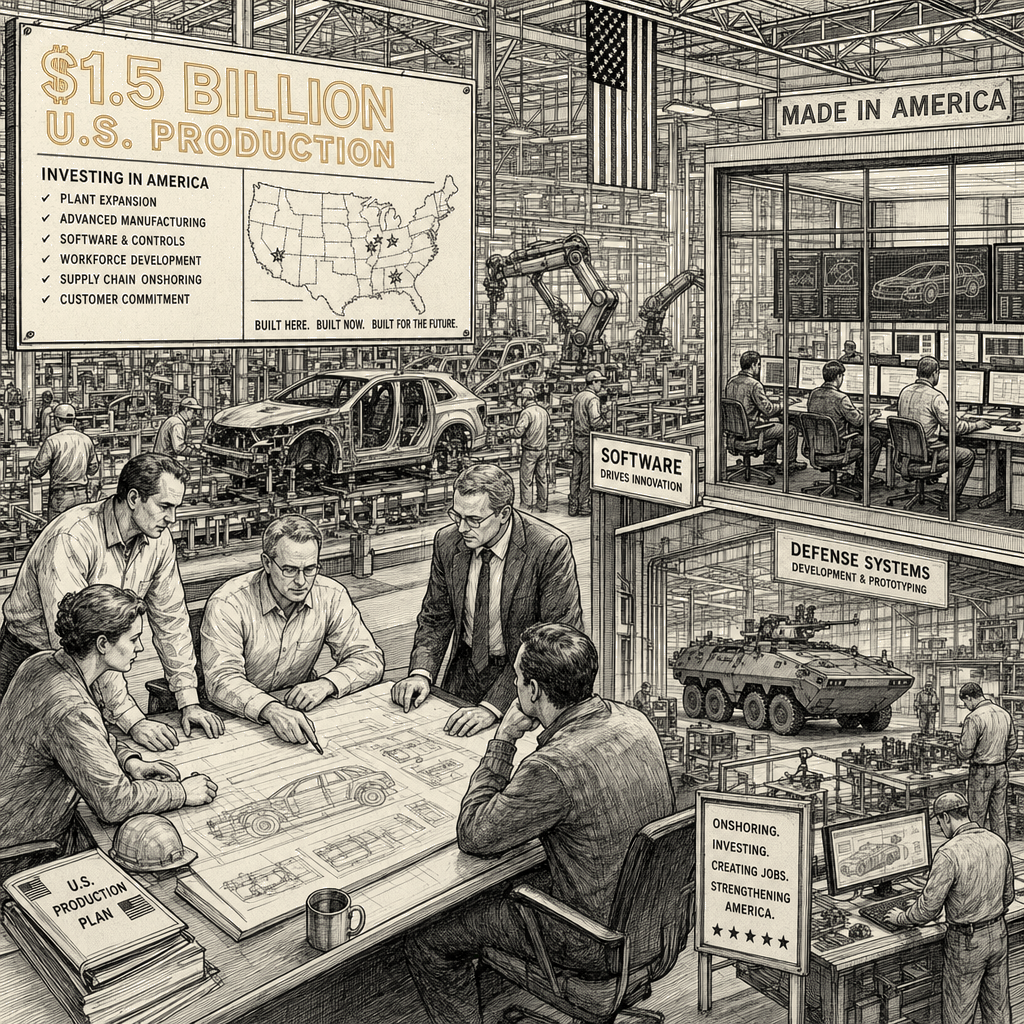
General Motors’ $1.5 billion onshoring investment is the most capital-intensive move in a transport landscape splitting into two kinds of sectors: those tilting into surplus and those repositioning around policy shock. The automaker is pulling production into the United States while absorbing $2.3 billion in EV-related restructuring charges and targeting roughly $700 million in defense revenue — two capital demands pulling from the same balance sheet. The same week, UBS flagged the container shipping industry’s order book at roughly 40 percent of the current fleet, and Bernstein warned that European airlines face a fuel-cost shock that will hit weaker carriers first.
These are inverse faces of the same global logistics shift. GM’s investment to shift production to the United States reduces demand for container shipping from Asia to North America, which is the very load the container fleet is being expanded to carry. UBS analyst Cristian Nedelcu wrote that the container order book stands at a historically high level. “In the context of supply exceeding demand by 2027/28, we expect free cash flow burn across the industry,” he said. GM CEO Mary Barra said the onshoring push will lift U.S. production capacity to more than 2 million units next year, directly reducing tariff exposure. CFO Paul Jacobson said global deliveries fell 7.2 percent to about 1.43 million vehicles in the second quarter.
A second structural parallel runs through GM itself: the $2.3 billion in EV-restructuring charges and the roughly $700 million defense revenue target draw from the same finite capital and shared manufacturing footprint. The EV charges broke into $900 million in supplier-related cash charges, $700 million in cash charges for right-sizing the battery supply chain with joint venture partners, and $700 million in non-cash write-offs. Jacobson said these actions “substantially complete the material cash charges” the company expects to incur as it aligns EV capacity with regulatory policy changes. Barra framed the defense push as a separate growth line, citing a collaboration with Lockheed Martin and a growing backlog built against depleted stockpiles from the wars in Ukraine and Iran. The two programs are parallel — but they rest on the same financial foundation and the same assembly lines. GM’s balance sheet can absorb both draws simultaneously; its production schedule cannot run two products at once. Whether those lines compete is a question the earnings call structured around rather than resolved.
Software adds a third draw on the same foundation. Barra projected more than $3 billion in recognized revenue next year, built on 1 million new subscriptions expected this year. The framing treats software as a margin story — high-margin recurring revenue layered on a hardware base — but does not specify the per-subscription economics. If the $3 billion target reflects revenue from both the 1 million new subscriptions and the existing installed base, the per-subscription figure is moderate; if it flows primarily from the new additions, the implied per-subscription revenue substantially exceeds industry norms for connected-vehicle services, suggesting the figure includes deferred recognition from prior-period subscriptions or a mix of high-ARPU fleet and defense contracts alongside consumer subscriptions. The claim is not self-interpreting.
The shipping oversupply timeline points to 2027 or 2028 as the inflection point. Nedelcu lifted his Hapag-Lloyd price target to 102 euros from 96 euros — a paradoxical move given the bearish structural thesis — because near-term earnings are still supportive after the carrier upgraded its full-year guidance. The market’s 0.9 percent gain on the day suggests the near-term signal dominated the structural warning, a pattern that will resolve one direction or the other when the surplus capacity either materializes or does not.
Bernstein analysts said European airlines face a different sequence: rising fuel costs will land on weaker balance sheets first. “That raises the risk of industry capacity rationalization near term: either voluntary schedule reductions, or involuntary ones as airlines fall into bankruptcy,” Bernstein wrote. This balance-sheet filter is the same resilience pattern GM is navigating in reverse. GM absorbed its $2.3 billion shock in a single quarter because it had the balance sheet to do so; the weaker European carriers Bernstein warns about do not. Dublin-based Ryanair, with higher margins and a stronger balance sheet, is structurally better positioned.
Bernstein also flagged competitive pressure on European automakers from Chinese brands. Volvo Car lost market share in Europe in the first half, and the bank said the wave of new competition is not slowing down. The forthcoming EX60 ramp will only materially affect the fourth quarter, and reduced year-on-year cost-savings plus raw material headwinds compound the pressure. Bernstein reiterated an underperform rating on the stock.
A separate cross-link connects GM’s onshoring to Goldman Sachs’ initiation of coverage on four Indian auto parts makers. Goldman said those companies are shifting into adjacent supply chains including semiconductor wafer fabrication equipment. The vectors — GM pulling production home, Indian suppliers moving up the value stack into components that are themselves subject to onshoring pressure — describe a supply-side mirror. They will meet in procurement negotiations. Goldman gave buy ratings to Sansera Engineering and Craftsman Automation and neutral ratings to Samvardhana Motherson International and Bharat Forge.
On the opposite pole from European airline stress, Morgan Stanley’s Qantas call illustrates the same two-speed pattern in a different form. The analysts said the airline’s embarkation on nonstop ultra long-haul flights to Europe and the United States should serve as a catalyst for the stock to re-rate, lifting the price target 18 percent to A$12.50. Where European airlines face a fuel-cost filter they cannot dodge, Qantas is investing in a product that commands pricing power on routes where competition is thin — capacity investment that creates structural advantage versus capacity surplus that destroys it.
The transport cluster is rearranging itself along a structural divide. The sectors with the most committed capital — shipping’s fleet expansion, GM’s capacity buildout — are on opposite trajectories driven by the same underlying realignment of trade routes and manufacturing geography. The companies that survive the crossing will be those whose balance sheets can absorb the shock while weaker competitors face capacity cuts, bankruptcies, or sustained margin compression. Hapag-Lloyd cannot un-order container ships that have already been commissioned. Volvo Car cannot un-enter a European market where Chinese brands are gaining share. GM’s capital-versus-footprint tension is the most consequential of the cluster because both programs depend on the same finite resources — cash flow today, assembly lines tomorrow.
Analytical techniques used in this piece
This analysis applies the methods below. Each links to a short, plain-English explainer you can read and reuse.
- Relationship Mapping
- Extracts the network of ties among people, institutions, and entities.
- Root-Cause Analysis
- Traces a symptom back along its causal chain to the conditions that actually generated it.
- Stakeholder Mapping
- Charts the parties to a situation — their interests, power, and alignments.