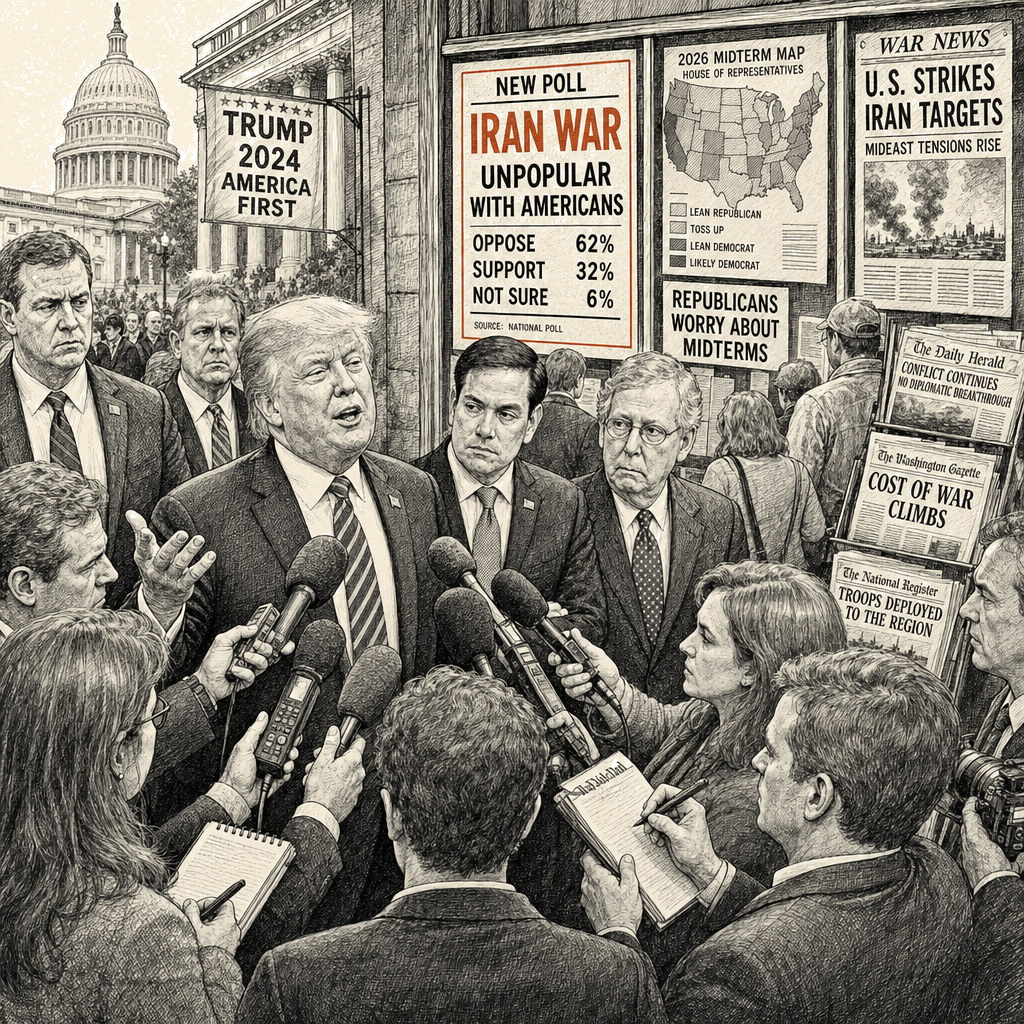
Trump’s war is destroying the GOP — and he doesn’t care
There is no political system better designed to translate popular anger into policy correction than the American one. Vote against the incumbent. Watch the incumbent adjust. That feedback loop is supposed to be the whole point.
Donald Trump has broken it.
The Iran war is the most politically catastrophic military engagement of the modern presidency, and the man who started it has no personal consequences left to absorb. He is in his second term. He cannot run again. He cannot be primaried. He cannot be voted out. The voters who despise the war cannot reach him with a ballot, so the cost has to land somewhere else. It lands on every Republican candidate who has to defend an engagement the country has rejected. That is the scandal. Not the war. The fact that the president can wage one indefinitely, with no personal penalty, and watch his party pay for it at the polls.
Look at the numbers. Sixty-eight percent of Americans say the war is not worth fighting. Twenty-eight percent say it is. Most say his leadership has weakened the country. Only a fifth say they are financially better off than when he took office. The war-opposition figures are worse than the worst readings recorded during Vietnam in 1971 or Iraq in 2007. Both of those wars forced their presidents to absorb the cost personally. One president withdrew from his re-election race rather than face certain defeat. The other watched his party lose both chambers of Congress and never recovered the political capital to recalibrate. Their numbers were better than Trump’s current numbers, and they were destroyed anyway. Trump’s structural position is the only thing protecting him from the same fate.
The cost is real and it is mounting. Thirty-seven and a half billion dollars spent so far. Eighty-eight billion more requested from Congress as supplemental funding. Gas prices above four dollars a gallon, up from about three when Trump took office. The mechanism is straightforward: voters feel the cost, voters blame the war, and the war becomes politically toxic. What makes the current moment unusually dangerous for the president’s party is that the voters doing the blaming are his own.
Fifty-seven percent of self-identified MAGA voters — the core coalition the party depends on for midterm turnout — attribute the gas price rise to the war. Thirty-seven percent say they support continuing the war only if costs do not increase. That is not a committed base. That is a conditional one. The conditions for breaking it are present in every weekly gas price report.
A few weeks ago, one of the most reliable defenders of the president in conservative media broke from that pattern. She warned her audience that the midterm elections were a little more than a hundred days away, that Republicans were getting nervous, that the war was already unpopular and could not be allowed to become an indefinite drain on the party’s message. The warning was directed at the party’s electoral prospects, not at Trump personally. That is the tell. When a loyalist shifts from defending the president to warning the party about the president’s war, the political cost has migrated downstream. It is no longer the commander-in-chief’s problem. It is the problem of every congressional candidate with an R next to their name.
This is not a generic story about an unpopular war. There have been plenty of those. This is a story about the specific design flaw in the American political system that allows a second-term president to wage an unpopular war indefinitely, with no personal penalty, while the cost is distributed to a party that cannot abandon him without splitting the coalition. Trump’s personal income last year was more than two billion dollars, most of it from businesses that depend on the regulatory environment he controls. He has no fundraising pressure, no donor revolt, no constituency he needs to placate beyond the slow erosion of voters who may or may not show up for his party in November. The impeachment threat from a hypothetical Democratic House is procedurally toothless — the Senate would not convict, and the proceedings would not unwind the war even if it did.
The case for any meaningful change before November is, on the most generous reading, one in three. Trump has signaled in the most explicit terms that political consequences are not in his calculus. His public posture is that the war’s effect on the elections will not affect his decisions. The eighty-eight billion dollar supplemental request is the operational confirmation of that stance — it is not the budget of a president who intends to wind anything down. The historical record from Vietnam and Iraq is unambiguous: second-term presidents with this kind of public opposition and this kind of personal insulation do not reverse course in the home stretch. They finish the term and leave the wreckage for the next occupant.
So the war continues. The money flows. The prices rise. The base frays. The candidates panic. And the president watches, because nothing in the system can reach him. The case is straightforward enough that no adversarial review is required to identify the load-bearing failure. A hundred days out from the midterms, the voters have made their judgment. The candidates know what is coming. The only person in the system who does not have to make a calculation is the man who made the decision in the first place. That is the design. That is the flaw. That is the story.
Analytical techniques used in this piece
This analysis applies the methods below. Each links to a short, plain-English explainer you can read and reuse.
- Probabilistic Forecasting
- Puts calibrated probabilities on what happens next.
- Red-Team Assessment
- Models a capable adversary probing a plan for the seams they would exploit.
- Relationship Mapping
- Extracts the network of ties among people, institutions, and entities.