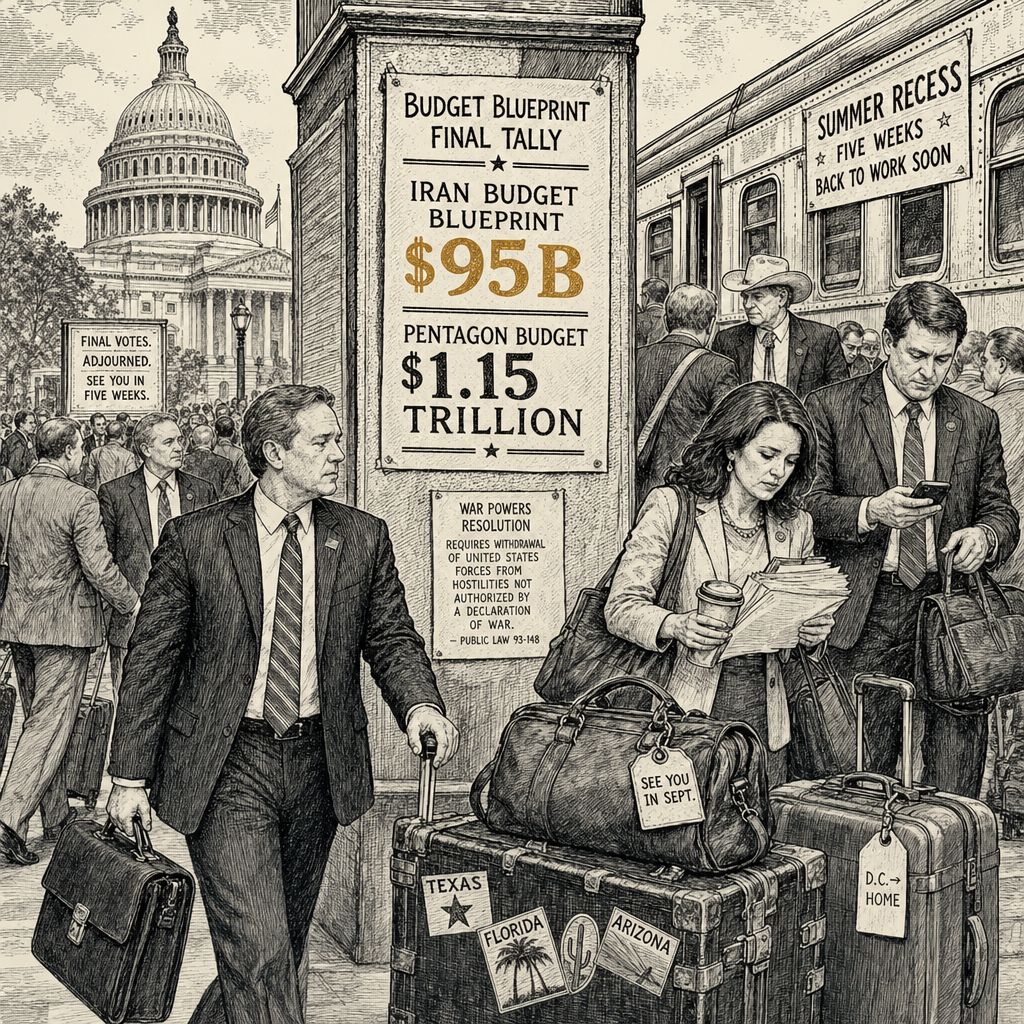
How a story is framed determines who appears to be winning. In the final week before a five-week summer recess, House Republicans pushed through a $95 billion Iran conflict budget blueprint and a $1.15 trillion defense authorization bill, then watched four of their own break ranks to pass a war powers resolution demanding President Trump withdraw forces from combat against Iran. The same session produced two party-line legislative victories, a symbolic bipartisan rebuke, and a procedural hold from Senate Majority Leader John Thune that achieves the identical funding pause without public embarrassment. The frame applied to this week shapes how voters interpret the party’s record heading into midterm campaigning — and the frame applied matters because it determines which detail carries forward as the defining one.
The victories the headline buried.
The House approved its $95 billion budget blueprint along party lines. The chief Republican budget writer, Representative Jodey Arrington of Texas, described the spending without directly naming the Iran conflict: “Just baseline battlefield readiness — bullets and bombs to finish the job and come home safely and victoriously, strengthen our food supply, and ultimately safeguard the integrity of our elections.” The chamber also passed a $1.15 trillion version of the National Defense Authorization Act, which Speaker Mike Johnson merged with the Save America Act — legislation backed by Trump that would ban mail-in ballots and impose new voter-identification requirements. After the votes, Johnson told reporters: “Many of you like to say that major legislating can’t happen in an election year. We just proved you wrong.”
These are the majority’s signature accomplishments of the week — both passed along party lines, both attached to must-pass vehicles. Neither is treated in the opening frame as a victory. The article’s lede anchors a reading of defeat and uncertainty, closing with “the burst of activity ended with a bipartisan vote against the party’s leadership on war powers and with questions over whether the chamber’s signature spending plans will survive in the Senate.” To produce a different picture, Johnson’s legislative wins and the procedural reality of the spending passage would need to move to the lede. The telling as published advances the Democrats’ campaign-trail narrative and subordinates the majority’s legislative record.
Two pauses, one frame.
Less than twenty-four hours after the spending votes, four Republicans joined Democrats to pass what the article calls a “symbolic war powers resolution” calling on Trump to withdraw U.S. forces from combat against Iran. Representative Jason Crow, a Colorado Democrat, told reporters the vote reflected a message Democrats intend to emphasize on the campaign trail: “You’re about to have hundreds of members of Congress go home to their constituents, and a lot of folks are about to get crushed, rightfully so, by their constituents — supporting $100bn for another endless war in Iran that’s not making us safer, and contributing to the woes of the American people.”
Senate Majority Leader John Thune said he would put the budget blueprint on “hold,” citing “potential leverage in negotiations over government funding beyond the September 30 expiration.” This sentence is the entire treatment of the Senate pause. Both actions achieve the same substantive outcome: Iran war funding remains unresolved when Congress leaves town. The war powers resolution absorbs roughly five paragraphs — Crow’s electoral threat, the vote count, the political context, and the campaign implication. Thune’s hold occupies one sentence.
The difference is the cost to the party. The war powers vote is a public bipartisan break with the majority’s stated policy — a rebuke Democrats can cite on the campaign trail. Thune’s hold is a party-internal procedural move that produces the identical delay without public embarrassment. Both stall the money. The five-to-one paragraph allocation privileges political embarrassment over legislative consequence. It makes the majority appear weaker than its own leadership’s actions would suggest. The hold is arguably the more consequential mechanism: the non-binding war powers resolution does not by itself force a policy change, while Thune’s hold directly determines whether and when $95 billion moves through the Senate.
The $5 billion gap the article leaves unresolved.
Crow told reporters that voters were asking “why the hell are you supporting $100bn for another endless war in Iran.” The article reports the budget blueprint as $95 billion. The $5 billion gap — roughly 5% of the headline figure — is not explained or reconciled. Crow may have been rounding up, including ancillary costs that the budget excludes, or citing a different baseline. The article does not say. The absence of a reconciling note means the article itself supplies a loose number that a politically motivated reader could treat as evidence of either understatement or exaggeration, depending on preference.
The electoral math dispute the article stages but does not resolve.
Crow predicted that war-funding supporters are “about to get crushed” by their constituents in the midterms. Representative Richard Hudson of North Carolina, who chairs the National Republican Congressional Committee, offered a directly contradictory structural analysis: “If you look at the seats that are up for grabs, it’s a majority of Democrats in Trump seats. For the Democrats to pick up the majority, they would have to win a lot of Trump seats, and that’s just not going to happen.” Hudson’s structural counterargument occupies a different part of the article, unconnected to the war-powers discussion. The article’s structure privileges Crow’s reading: the electoral threat is climactic, Hudson’s counterpoint is background color buried in the final paragraphs. If both predictions are presented, the article has an obligation to stage the disagreement — not let one frame the story while the other disappears into the closing paragraphs.
The unnamed four — rebellion or release valve?
The four Republicans who voted for the war powers resolution are not named or identified by district. Without names, a reader cannot evaluate whether the defectors were vulnerable moderates in competitive districts or members with safe seats acting on conviction. Representative Don Bacon of Nebraska — who represents one of the few districts Kamala Harris won in 2024 — is quoted elsewhere in the article but not as a defector. Bacon, who is not seeking reelection, offered a cautionary assessment of Trump’s approach: “The go-it-alone approach fails us in the end. We need their help, and so I think he should lean in to working across the aisle more.”
The article presents the four war-powers votes as dissident behavior — members breaking with their party on a question of war and peace. It does not consider whether leadership tolerated or coordinated the defection. The resolution is non-binding — it carries no legal force and is a statement of sentiment. Leadership routinely tolerates, and sometimes coordinates, defection on such measures as a release valve for members who need to show independence back home, while demanding party discipline on the binding budget vote. The resolution’s non-binding status makes the managed-release hypothesis more plausible than the article’s unexamined rebellion frame. No leadership statement on the vote is documented in the article. The account settles on one reading — bipartisan rebuke — without acknowledging the gap. An alternative reading, in which the four defectors were given permission to vote their districts on a symbolic measure while the majority held firm on substance, would materially change how the vote is assessed.
The war behind the budget — absent from the story.
For an article organized around $95 billion in conflict spending, the Iran war itself receives no substantive description. No details on what U.S. forces are doing, how long hostilities have lasted, the legal basis for military action, or conditions on the ground. Representative Ralph Norman of South Carolina predicts Trump “is at the cusp of ending this thing with Iran, and he’s doing the right thing.” Representative Bacon urges bipartisan cooperation on the conflict. Neither the article’s own voice nor any cited source provides the factual foundation a reader would need to evaluate whether the spending under debate is proportionate, strategically sound, or operationally necessary. This absence sits underneath every other framing question. Whether the week’s legislative record registers as victory, defeat, or legislative noise depends on what the money is for. Without that context, the political frame operates in a vacuum — readers can assess who outmaneuvered whom in the House chamber but not whether any of it matters for the conflict the budget is meant to address.
Additional considerations
The article’s own subject matter places this story in the immediate aftermath of a legislative session in July 2026, a future context that cannot be independently verified from the provided material but which is internally consistent within the source package. The Washington Post-Ipsos poll is cited without specific numbers — “highly motivated voters are eager to back Democrats” and “the party holds only a narrow advantage” — limiting the reader’s ability to assess the poll’s strength. The $95 billion figure is described as a “budget blueprint,” but the source does not specify whether the figure covers mandatory or discretionary spending, leaving unresolved whether the allocation is binding or aspirational. Thune’s “hold” rationale is stated as leverage over government funding past September 30, but the specific trade he intends to negotiate is not provided. The legal status of the war powers resolution — whether binding, advisory, or carrying enforcement power — is asserted as “symbolic” by the source but is not independently verified in the article’s text. Confirmation would require CRS analysis of the specific resolution. The managed-release hypothesis (that leadership coordinated the four dissident votes as a release valve on a non-binding measure) remains a structurally plausible alternative reading that requires domain knowledge about party discipline and vote-whipping norms to assess fully; the source material does not supply documentation of the four defectors’ identities or any leadership statement on the vote. The article’s omission of the Iran conflict’s scope, legal basis, and current status is inherited from the source article and cannot be filled from within this analysis.
Analytical techniques used in this piece
This analysis applies the methods below. Each links to a short, plain-English explainer you can read and reuse.
- Red-Team Assessment
- Models a capable adversary probing a plan for the seams they would exploit.
- Relationship Mapping
- Extracts the network of ties among people, institutions, and entities.
- Stakeholder Mapping
- Charts the parties to a situation — their interests, power, and alignments.