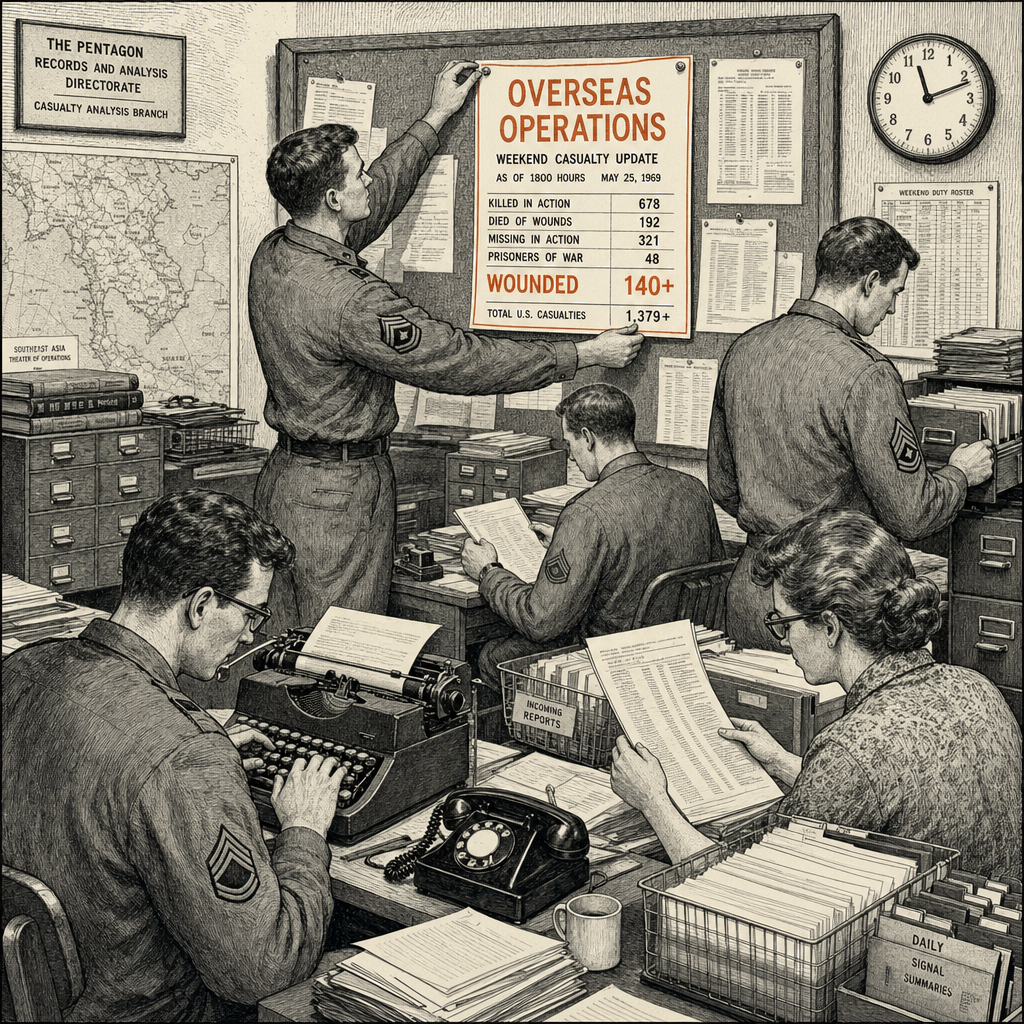
The Pentagon updated its official war casualty database over the weekend, adding more than 140 wounded service members and introducing a new casualty category labeled “Overseas Operations” for personnel killed and wounded starting July 7. Combined with updated Operation Epic Fury totals, the database now shows 18 U.S. troops killed and 624 wounded since the war began on Feb. 28 — but those figures are split across two administrative categories, making the full total visible only by cross-referencing.
The change is not merely a record-keeping adjustment. It is the administrative mechanism for a legal argument: that the renewed military campaign, which began July 6 after the April ceasefire collapsed, is a separate conflict from the original Operation Epic Fury. If accepted, this classification resets the 60-day War Powers Act clock, giving the administration additional time before congressional authorization is required.
Rep. Thomas Massie (R-Ky.) responded to the updated numbers by calling the category split an “absurd ruse” in which the Pentagon is “pretending there have been two Iran wars separated by a brief cease-fire.” He argued that by going more than 90 days without congressional authorization, Defense Secretary Pete Hegseth “IS BREAKING THE LAW and must be held accountable.”
The numbers themselves are not in dispute. Both sides accept the same combined total: 18 killed and 624 wounded. The disagreement is about what the numbers mean — whether a ceasefire that paused combat operations for roughly two months created a genuine legal break, or whether it was a diplomatic interval within a single continuous conflict.
The four soldiers caught between two categories
The administrative seam between the two accounting frameworks is visible in the treatment of four soldiers who died after the April ceasefire. The Pentagon’s official online list of service members killed in the Iran war omitted them from the Operation Epic Fury death toll, reducing it from 18 to 14. Their names appeared instead in a separate Pentagon press release announcing the formal transfer of their remains.
This dual-record status creates an information asymmetry: a reader consulting only the online database sees a lower death toll for the “original” conflict, while the full accounting requires cross-referencing with a separate press release. The same four soldiers also become the test case for the legal timeline question — if they died after the ceasefire collapsed, their deaths count against which phase’s 60-day clock, determining how much statutory time remains before congressional authorization is required.
Why the category split works as a legal argument
The War Powers Act of 1973 requires the president to end military operations within 60 days unless Congress authorizes an extension. The administration has argued that the April ceasefire paused the clock on May 1, and that the resumed hostilities beginning July 6 created a new 60-day window, pushing the deadline into September.
The legal environment creates the incentive for the reclassification. Congressional authorization for an already-politically-contentious war is uncertain. The War Powers Act places the burden on Congress to assert its own authority — a collective-action problem the executive can exploit by moving fast. The statute’s trigger depends on the executive’s own characterization of the conflict, with no neutral verification mechanism.
The Pentagon’s new “Overseas Operations” category is the administrative evidence base for the claim that the renewed campaign is a separate conflict. The database transforms physical injury — 140-plus wounded — into administrative justification for extended military action without congressional authorization. The policy position is shaping the official record, inverting the typical event-to-documentation direction.
A classification void at the center of the dispute
No statute or regulation defines precisely when a “hostility” ends and a new one begins under the War Powers Act. The determination is left to the executive. Congress has never written such a definition into the War Powers Act or defense authorization bills, relying instead on presidential reporting that is not independently audited. Congress has not created an independent arbiter because doing so would require admitting the 60-day clock can be gamed — an admission that would force a politically painful debate about war powers.
This classification void gives the Pentagon unlimited discretion to relabel operations, nullifying the War Powers Act deadline in practice. The database’s operation-based structure enables the split, and no independent body validates category changes. No congressional notification requirement or public justification mandate exists for retroactive casualty reclassification.
The quiet release and the transparency dimension
The database update was released over the weekend and first reported by The Guardian. The Pentagon has held far fewer press briefings during the Iran war than during previous conflicts — eight briefings in the first six weeks, then over two months without a media briefing under Hegseth, the most recent on May 5. This pattern narrows one traditional scrutiny channel, removing a procedural check on administrative decisions.
The net-zero accounting paradox adds another layer: the death toll was reduced from 18 to 14 through reclassification while the total casualty count simultaneously rose to 624 wounded with the “Overseas Operations” addition. Headlines referencing “14 killed” and “18 killed” can both be sourced to the same database depending on which category the reader examines. The apparent reduction in killed provides the administration with a publicly defensible figure for the “original” conflict’s cost, while the combined total absorbs the full accounting in a less-scrutinized category.
What the dispute is really about
The apparent disagreement about casualty numbers is a proxy conflict over War Powers Act enforcement. The numbers themselves are not in dispute. What is in dispute is whether an administrative category change has legal force sufficient to reset a statutory clock. The casualty database has become a venue for constitutional argument: the institution that counts the dead is being asked to settle a question about the separation of powers.
The competing frameworks are irreconcilable on their own terms. The Executive-Administrative paradigm holds that the ceasefire created a genuine operational break justifying separate administrative phases. The Legal-Constitutional paradigm holds that the ceasefire was a pause within a single continuous war, and the category split is a legal maneuver. The Bureaucratic-Institutional paradigm treats the database as a record of categorized administrative facts where the category split reflects institutional logic. The Transparency-Accountability paradigm holds that the quiet database update and reduced briefing tempo constitute a transparency failure that undermines democratic accountability.
Each paradigm has blind spots. The Executive-Administrative view underplays the legal consequences of administrative category choices. The Legal-Constitutional view does not account for operational realities that might justify administrative separation. The Bureaucratic-Institutional view underestimates how category labels carry legal and political weight outside the database. The Transparency-Accountability view risks conflating legitimate institutional housekeeping with strategic obfuscation.
The residual incommensurability — whether the ceasefire constitutes a termination of one conflict or a pause within a single conflict — cannot be resolved by database analysis or journalistic investigation. It requires a legal determination by courts or by congressional action about when a ceasefire becomes a cessation of hostilities under the War Powers Act. The Defense Casualty Analysis System can count; it cannot adjudicate.
Analytical techniques used in this piece
This analysis applies the methods below. Each links to a short, plain-English explainer you can read and reuse.
- Relationship Mapping
- Extracts the network of ties among people, institutions, and entities.
- Root-Cause Analysis
- Traces a symptom back along its causal chain to the conditions that actually generated it.
- Worldview Cartography
- Maps the clashing worldviews underlying a dispute.