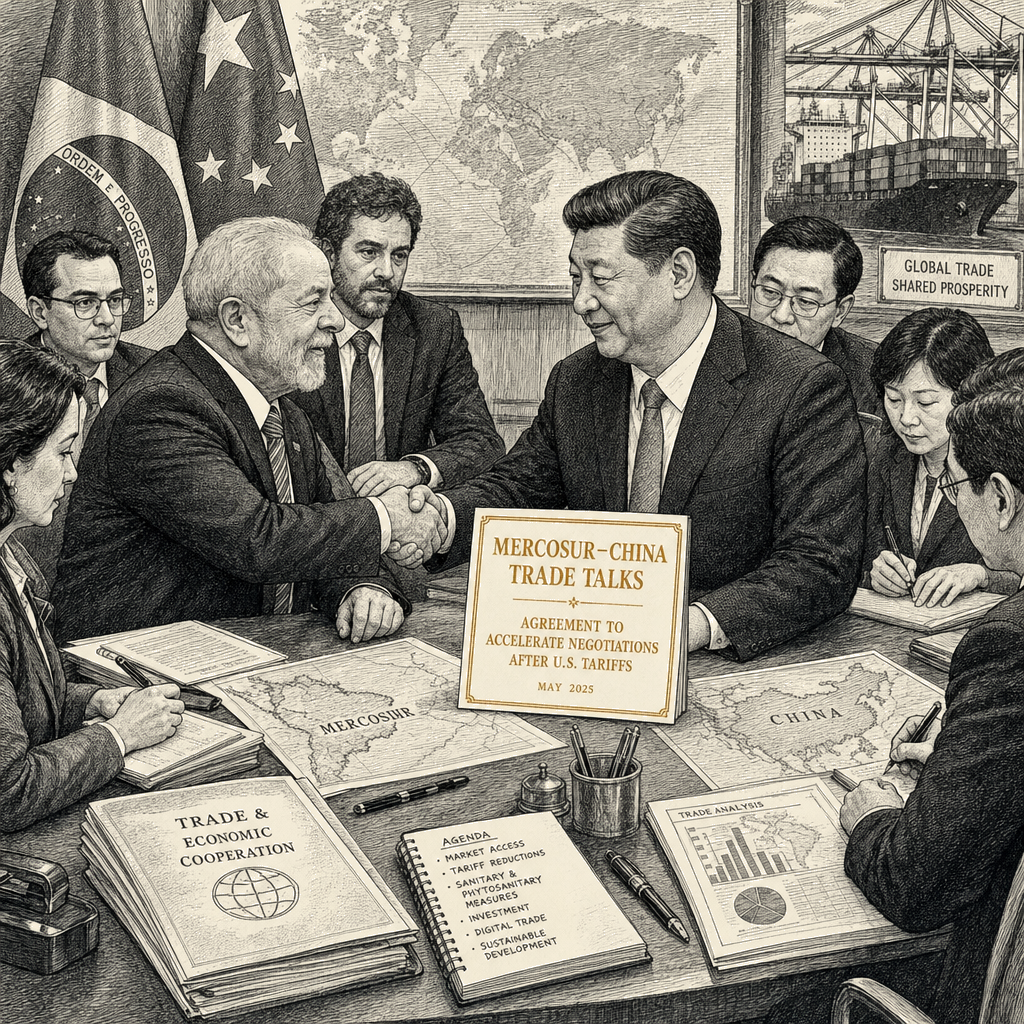
The 25% U.S. tariff on Brazilian exports was supposed to be a unilateral correction. Instead, it became the opening move in a multi-player game whose second move — Brazil’s accelerated pivot to China — has already redrawn the board. The tariff came first; Brazil responded not by negotiating with Washington but by deepening ties with Beijing. That sequence creates a sequential game with incomplete information: Washington didn’t know how far China was willing to go; Beijing didn’t know whether the tariff was a one-shot or the start of a longer trade war; Brazil didn’t know whether the U.S. would eventually soften.
The phone call on July 27, 2026 between Lula and Xi, lasting more than an hour, produced an agreement to accelerate negotiations on a Mercosur-China trade agreement and to expand cooperation in artificial intelligence, satellites, critical minerals processing, and fertilizer trade. Xi rejected external interference in Brazil’s electoral process and expressed China’s willingness to support Lula’s government, according to Xinhua. Both leaders criticised the UN Security Council’s ineffectiveness and agreed to coordinate through BRICS and the United Nations. They also discussed restrictions on freedom of navigation through the Strait of Hormuz and the Bab el-Mandeb. The political declarations were loud. None of it was binding.
The equilibrium, derived backward
Backward induction runs as follows. China’s final move is to offer accelerated Mercosur-China talks plus political support, conditional on Brazil accepting the diplomatic alignment. Brazil’s response is to accept — the 25% tariff is a real ongoing cost on Brazilian exports, and Lula’s high discount rate (he faces re-election in October 2026) makes short-term market access and political support more valuable than long-term strategic flexibility. The U.S., anticipating Brazil’s limited alternatives, imposes the tariff anyway — but miscalculates China’s willingness to fill the gap. The tariff harms Brazil; it does not secure American market access. The equilibrium is stable as long as the 25% tariff remains and China offers concrete terms; it is efficient for China and Brazil in the short term and a costly miscalculation for Washington.
Brazil could deviate by refusing the China deal and negotiating directly with the U.S., but that requires a credible U.S. offer to reduce tariffs — which is not on the table. China could deviate by withholding the deal, but that loses the chance to expand influence into South America. The structure holds. The key assumption is that Lula’s discount rate is high enough to prefer short-term gains over long-term diplomatic costs. His present bias is visible in the aggressive “strategic mistake” framing in his Washington Post article and his rush to declare alternative markets — the behaviour of a rational but impatient player.
What the analysis understates: the substance gap
The strategic reading correctly identifies the asymmetry in strategic horizons — China can outlast any Brazilian administration, and its patience becomes a bargaining asset. But it understates the fragility of the China offer itself. Xi’s public declarations are dense with political language — non-interference, Global South solidarity, international justice — but empty of binding trade terms. No tariff reduction schedule. No investment floor. No commitment to buy Brazilian soy or lithium beyond existing contracts. The acceleration Lula and Xi agreed to is a commitment to talk faster, not a deal. That gap between signal and substance makes Lula’s pivot more of a diplomatic hedge than a strategic realignment, and China’s credibility rests on material terms that have not been specified.
The players not at the table
The phone call and the agreement to accelerate Mercosur-China talks treat the South American trade bloc as a single actor. But Mercosur negotiates as a bloc. Argentina, Uruguay, and Paraguay were not represented in the Lula-Xi exchange and their interests may diverge from Brazil’s.
Argentina has historically pursued closer ties with Washington and may resist deepening economic ties with Beijing. Uruguay and Paraguay, smaller and more exposed to U.S. pressure, could slow or block a Mercosur-China agreement. Brazil can accelerate bilateral cooperation with China on AI, satellites, and critical minerals, but the trade agreement Lula emphasised requires consensus. The game is not three-player; it is at least six-player, and the absent players may hold veto power.
Credibility of commitments
The credibility of what was said and agreed varies sharply. Lula’s commitment to diversifying markets is credible — the 25% tariff imposes an ongoing cost on Brazilian exports, making diversification rational regardless of any formal agreement. His “strategic mistake” framing is a credible threat — it signals to the U.S. that Brazil will not absorb the tariff passively, raising the cost of not negotiating.
Xi’s rejection of external interference in Brazil’s electoral process is cheap talk — no commitment device or enforcement mechanism. His willingness to support Lula’s government is mixed — the political declaration is cheap talk, but the trade-deal acceleration gives it a material component. The “Global South” framing functions as a focal-point device, making defection publicly costly, but it is not backed by binding commitment.
The historical record sharpens the read. China provided loans and infrastructure investment to Venezuela in exchange for oil concessions; that support has since declined as returns diminished. China has offered diplomatic support to Russia without military commitment. The pattern is increasingly transactional — support flows when it pays, retreats when it doesn’t. Brazil’s pivot sits inside that pattern.
Both leaders’ criticism of the UN Security Council is cheap talk. No alternative institution was proposed; no commitment to reform was made.
Where the equilibrium could break
The current equilibrium holds under two conditions: (1) the U.S. tariff persists without a credible offer to reduce it, and (2) China’s trade terms, once specified, are not so onerous that Brazil would rather absorb the tariff. If either condition changes, the equilibrium shifts.
A U.S. signal — even a conditional one — that tariff reduction is available in exchange for limiting the Mercosur-China deal would improve Brazil’s outside option. Lula’s “strategic mistake” framing is itself an invitation: it names the policy as an error, which implies a correction would be welcomed. Brazil could probe that opening quietly while still talking to China.
China’s credibility is also vulnerable. Xi’s cheap talk on non-interference and sovereignty costs him nothing. But if the trade deal ultimately delivers less than advertised — tariff preferences that exclude key Brazilian exports, or investment commitments that never materialise — Lula’s successor may reverse the pivot.
Alternative structures and what they change
The dominant reading treats both games as repeated — Brazil-China through BRICS, UN, and ongoing negotiations; U.S.-Brazil through institutional channels. But a split-game classification is equally plausible: the U.S.-Brazil tariff is a one-shot move unlikely to be rescinded soon, while the Mercosur-China relationship is repeated. Under that classification, the equilibrium is the same, but the strategic recommendation changes. The dominant reading also holds under a one-shot reclassification (if the tariff were temporary, Brazil might prefer direct U.S. negotiation) and under a Tit-for-Tat framing (Brazil accepts the China deal now but signals willingness to return to U.S. trade if diplomatic conditions become onerous — but the U.S. has offered no such signal). Across all three alternative framings, the dominant equilibrium — Brazil accepts the China deal — survives.
What the players should do
- For China: Political declarations buy goodwill, but only material trade terms create binding alignment. Commit to a tariff reduction schedule on Brazilian soy, iron ore, and processed critical minerals, with a binding investment floor in lithium processing capacity and a clear timeline. Without those, the pivot is reversible.
- For Brazil: The China deal is a hedge, not a home. Lula should publicly state — parallel to his Washington Post article — that Brazil remains open to normal U.S. trade relations if tariffs are reduced, converting the public charge into a conditional offer. Brazil should also seek a sunset clause in the Mercosur-China deal (a five-year term with automatic renegotiation) to limit China’s ability to exploit its higher discount rate. If China resists, that resistance signals that China’s primary payoff is long-term diplomatic alignment, not short-term trade.
- For Brazil additionally: Probe the U.S. for a conditional tariff reduction in exchange for limiting the scope of the Mercosur-China deal. The 25% tariff, framed as a “strategic mistake,” is leverage in a negotiation, not a verdict.
- For the United States: The 25% tariff assumed Brazil had no alternatives. That assumption was wrong. A rapid conditional offer — tariff reduction in exchange for limiting the scope of the China deal — could still recover leverage before the Mercosur-China terms are finalised. Every day the tariff stands without a counteroffer deepens the realignment.
Bottom line
The tariff was the first move. The Lula-Xi phone call was the second. The third move — the specification of trade terms, the U.S. response, and the reaction of Argentina, Uruguay, and Paraguay — will determine whether this is a realignment or a passing hedge. The game is far from over, and the player who mistakes a phone call for a conclusion has already made the next mistake.
This analysis describes strategic positions and their structural consequences; it does not assert intent on the part of any named actor.
Analytical techniques used in this piece
This analysis applies the methods below. Each links to a short, plain-English explainer you can read and reuse.
- Relationship Mapping
- Extracts the network of ties among people, institutions, and entities.
- Stakeholder Mapping
- Charts the parties to a situation — their interests, power, and alignments.
- Strategic Interaction (Game Theory)
- Models a situation as a game — players, moves, payoffs, and likely equilibria.