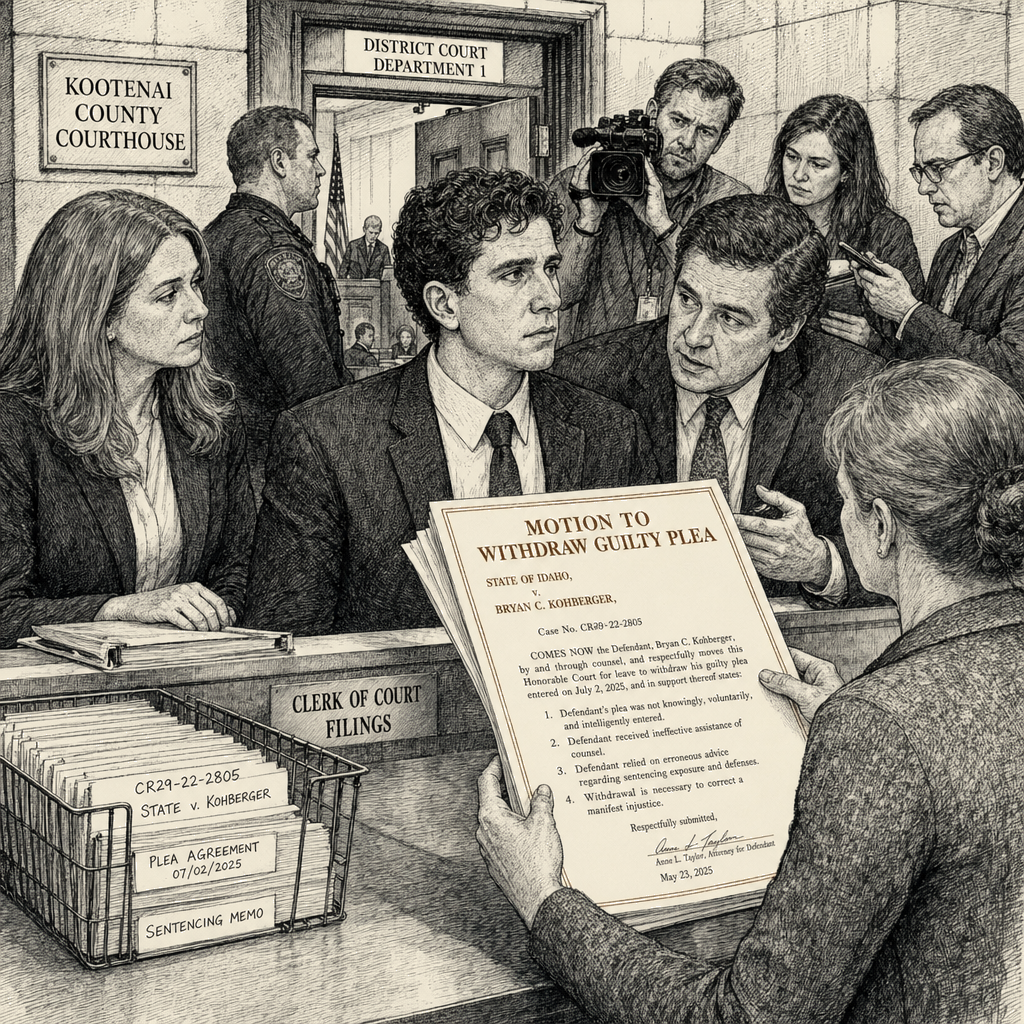
The central tension in Bryan Kohberger’s petition to withdraw his guilty plea is not whether he is innocent. It is whether a defendant who told a judge, under oath and with counsel present, that he was pleading guilty because he was guilty can now ask a different court to disbelieve that statement — and whether the grounds he offers are sufficient to open that door. The reporting on the petition gives the reader Kohberger’s “actual innocence” declaration at length but little material to evaluate it, and the emotional response from victims’ families fills the analytical vacuum the reporting leaves open. The story is told in a way that produces an assignment of responsibility — to Kohberger, for the painfulness of relitigation as much as for the murders themselves — without ever articulating the procedural mechanics that actually produce that assignment.
What the petition says — and what it does not
Bryan Kohberger was convicted of breaking into a six-bedroom house in Moscow, Idaho, in 2022 and killing four University of Idaho students — Madison Mogen, 21; Kaylee Goncalves, 21; Xana Kernodle, 20; and Ethan Chapin, 20 — all found with dozens of knife wounds. Goncalves additionally showed evidence of asphyxiation and blunt force trauma. He was sentenced to four consecutive life sentences without parole, plus ten years for burglary. Months later, representing himself, he filed a petition for post-conviction relief in Ada County district court. In a statement provided to the New York Times, he wrote: “My actual innocence is my truth, and the plea, hinged on by false promises and blatant disinformation, MUST be withdrawn.” He declared his intention to enter a not-guilty plea and invited the state to again seek the death penalty.
The reporting cluster reproduces the petition language but treats it as a black box. The articles name no Idaho code section invoked, no specific false promise alleged, no source of the disinformation, and no legal argument beyond the declaration. A reader cannot assess whether the filing has any non-frivolous basis.
Idaho’s post-conviction relief statute provides specific grounds on which a convicted person may challenge a plea after sentencing, including constitutional violations, jurisdictional error, excessive sentence, newly discovered evidence, and innocence of the offense. Each ground requires factual allegations particular enough for the court to determine whether a cognizable claim exists. The petition language available to the public does not meet that threshold. Kohberger alleges “false promises and blatant disinformation” — but the available excerpts name no one who made the promises, no date or context for the promises, no content of the disinformation, and no causal link between either and his decision to plead guilty. Under established habeas standards, even a self-represented petitioner must allege facts sufficient to support a cognizable claim. Courts have held that pro se petitions receive liberal construction, per Haines v. Kerner, 404 U.S. 519 (1972) — but liberal construction does not supply facts that the petitioner does not allege.
What Kohberger does not offer is equally notable. He presents no alternative defense narrative — no alibi, no misidentification theory, no claim of self-defense. He asks the court to vacate a plea on a bare assertion of innocence while the evidentiary record includes DNA matching his profile on a knife sheath recovered at the scene, surveillance video of a white Hyundai Elantra matching his vehicle passing the house multiple times, his cell phone powered off during the window of the killings, and weapons, gloves, and a facemask recovered from his person and family home at the time of his arrest. The petition, as publicly quoted, functions more as a declaration of belief than a legal application. Idaho courts do not overturn guilty pleas on unadorned accusations of unfair dealing, and the gap between “I am innocent” and “my plea was constitutionally involuntary” is the gap between a press release and a habeas petition.
The Guardian includes the observation that “It is rare for convictions entered on a guilty plea to be overturned, though courts have allowed challenges based on new evidence or claims of ineffective legal counsel.” That sentence appears without linkage to the petition’s actual claims. The only counter-argument in the cluster comes from the Goncalves family’s statement: “He never cried foul, never claimed he was uninformed or pressured…He admitted his guilt.” A non-neutral source is performing the legal analysis the reporting itself declines to make. Who benefits from the framing? The absence of independent legal analysis means the petition’s structural weaknesses — no alternative narrative, no particularized factual allegations — are not articulated by the reporting. The victim’s family performs that function instead, giving their critique the weight of a dispositive legal conclusion while it carries the credibility of a grieving parent speaking from loss.
The credibility barrier the evidence already created
The structural problem for Kohberger is not new evidence or new law. It is his own prior statement. At the plea colloquy, the judge asked whether Kohberger was pleading guilty because he was guilty, and Kohberger answered “Yes” — under oath, in open court, with counsel present. That transcript will be the first document the state files in opposition to the withdrawal petition. Post-conviction courts treat a defendant’s sworn allocution as carrying significant evidentiary weight. The legal question is not whether Kohberger is innocent now but whether his plea was knowing, voluntary, and intelligent at the time he entered it. To answer that question, a court must find specific factual allegations that something about the plea proceeding was deficient — coercion, misleading information from counsel, misunderstanding of the charges or consequences. Kohberger’s petition, as quoted, offers none of that. Courts are extraordinarily reluctant to allow a defendant to contradict sworn statements made in open court absent specific and credible allegations of coercion or ineffective assistance pleaded with particularity. The Goncalves family’s observation that Kohberger “chose not to leave his fate – or the facts of the case – to a jury” underscores that the plea was a strategic choice, not a coerced confession.
The evidence sequencing in the reporting reinforces this credibility barrier without the articles owning that judgment. Immediately after Kohberger’s “actual innocence” declaration, the cluster presents the circumstantial evidence: DNA matching Kohberger’s on a knife sheath left at the scene, surveillance video of a white Hyundai Elantra matching Kohberger’s passing the house multiple times, Kohberger’s cell phone turned off during the murders, a survivor’s description of a shadowy figure, and a pistol, knives, gloves, hat, and facemask found at the Pennsylvania arrest. A stakeholder map of the relationships shows the evidentiary record bears a structural incompatibility with Kohberger’s innocence claim — the evidence points toward guilt, but the petition’s mechanism does not challenge the evidence. It targets the procedural adequacy of the plea hearing itself.
The Guardian reports that “No motive for the killings has ever been established or provided by Kohberger” — attributing the motive absence to Kohberger personally rather than to the state’s case as a whole. The conviction is treated as effectively proven, with no acknowledgment that this was a circumstantial case — DNA on a sheath found on a victim’s bed, a car matching Kohberger’s on camera, a phone switched off, without a direct witness placing Kohberger inside the house or forensic evidence directly transferred from victim to defendant. A circumstantial case in which no motive was established at trial is a different proposition from a defendant who declined to offer one, and the distinction matters for a reader evaluating the strength of the conviction Kohberger now asks to undo.
The procedural isolation Kohberger occupies
The court docket shows Kohberger is representing himself. A relationship mapping of the case reveals him as the central hub in a hub-and-spoke topology where every other named actor — the court, the Goncalves family, Idaho Attorney General Raúl Labrador, the evidentiary record — connects to him, and all point in the same direction. This structure implies Kohberger is institutionally isolated against a convergence of evidentiary, procedural, and public-opposition pressures.
Self-representation carries specific procedural implications the reporting does not address. Pro se petitioners face strict requirements — service rules, filing deadlines, evidentiary standards — and the reports do not state whether the petition has been filed correctly, whether standby counsel has been appointed, whether the state has responded, or whether a hearing has been scheduled. If the petition is dismissed on procedural grounds, a reader not given those details would see that as a substantive rejection of the innocence claim rather than a technical failure.
The relationship mapping also identifies a non-obvious structural connection: the timing of the petition — months after sentencing, not during the direct-appeal window — shifts the operative legal frame from error-at-trial to collateral attack. Kohberger waived direct appeal as part of his original plea. By dismissing his own attorneys, he opens a potential later claim that the plea was coerced by their bad advice — a claim the Strickland standard (1984) makes difficult for the state to rebut once counsel is gone. The Goncalves family’s critique that Kohberger “never suggested there were problems with the discovery materials he and his counsel had reviewed for two years” addresses this directly: the two-year review period during which Kohberger raised no objection to his counsel’s work or the discovery materials is drawn from the procedural record itself.
A further structural observation surfaces Kohberger’s invitation to the state to “again, file for the death penalty.” By extending this invitation, Kohberger implicitly concedes that the core DNA, surveillance, and weapons evidence is admissible and attributable — because a state cannot re-file a capital case without admissible evidence to support the charges. This cross-link between the legal-claim branch and the evidentiary branch is the case’s most counterintuitive finding: the same filing that declares “actual innocence” is structured in a way that assumes the state’s evidence is sound enough to support another capital proceeding. The invitation undercuts the innocence claim more effectively than any single piece of forensic evidence could, because it comes from Kohberger himself. Idaho Attorney General Raúl Labrador’s response — that his office “stands ready to do whatever is necessary to ensure justice is fully carried out” — leaves open whether the state would accept the invitation. The posture creates a reputational dimension for the state as well: pursuing the death penalty against a man who claims innocence, while the conviction rests on a plea he now contests, would require the state to argue simultaneously that the plea was valid and that it is willing to retry the case without it.
How the coverage assigns responsibility — and to whom
Two framing devices in the reporting cluster do the assignment.
First, the evidence sequencing after the innocence declaration functions as implicit rebuttal. The cluster presents the DNA, surveillance, phone records, weapons, and eyewitness account immediately following Kohberger’s declaration — a construction that guides the reader toward skepticism without the article owning that judgment. The reader who absorbs this sequence is more likely to assign responsibility to Kohberger for making an unsupported claim than to the state for the evidentiary gaps in a circumstantial case. A reader encountering the same declaration followed by a description of what the petition actually alleges (which Idaho code section, which specific factual allegations) might hold a different assignment — one that centers the question of procedural adequacy rather than the question of factual guilt.
Second, the only assessment of the petition’s legal basis comes from a non-neutral source. The Goncalves family’s statement performs the legal analysis the reporting declines to make: they name the two-year discovery review, note that Kohberger never previously challenged the evidence, and conclude that he admitted guilt. The structure assigns to the family the role of procedural gatekeeper — their critique fills the analytical vacuum, and in doing so assigns responsibility for the litigation’s painfulness to Kohberger, not to a system that allows post-conviction challenges. A reader who encounters this framing without a parallel assessment from an independent legal source receives the family’s critique as dispositive.
These two devices together ensure that the reader who finishes the coverage holds Kohberger responsible not just for the murders but for the procedural burden of relitigation. The reporting structure and the legal reality are aligned — Kohberger’s petition is almost certainly on weak ground — but the coverage makes that alignment feel like the natural order of things rather than a construction. The Goncalves family’s visible pain from repeated litigation is already being extracted in public; they will be active participants in the public dimension of this litigation, and their credibility with the public is high. Idaho’s legal position is that the conviction is final; Labrador’s statement leaves room for either outcome on the death-penalty question, and the political optics of executing a man who claims innocence while offering no new evidence against him would constrain any aggressive posture the state might otherwise adopt.
Questions the reporting does not ask
A reader carrying the coverage alone cannot answer several questions that would determine whether this petition has any non-frivolous basis. Which Idaho post-conviction relief statute is cited? Is the claim ineffective assistance, prosecutorial misconduct, or newly discovered evidence? What specific facts support the “false promises” allegation — who said what, when, and how did Kohberger rely on it? Did the defense contest the touch-DNA characterization at any pre-trial hearing? Has the Ada County prosecutor filed a response? Has the court appointed standby counsel? Did the original plea agreement include sentencing concessions or a stipulated factual basis?
The reporting itself does not provide these answers. At a post-conviction hearing, what a court will need — particularized factual allegations supporting a cognizable claim under an identified statutory ground — is the same thing a reader needs to assess the filing for themselves. Neither has it. The analysis is not about whether Kohberger’s petition will succeed; it is about what shape a reader’s understanding takes when the procedural dimensions are left to be filled by victims’ families, when the emotional weight of vivid language carries more rhetorical force than a single procedural hedge, and when the evidence sequence after the innocence declaration functions as implicit rebuttal without the reporting owning that judgment. The petition now enters a procedural sequence that will unfold over months, and the families of the four victims face the prospect of relitigating the case in court and in public — but the readers who will form judgments about that process have already been given a frame, and the frame was built without their input.
Analytical techniques used in this piece
This analysis applies the methods below. Each links to a short, plain-English explainer you can read and reuse.
- Red-Team Advocate
- Argues the adversary’s case in full to expose what a plan underrates.
- Red-Team Assessment
- Models a capable adversary probing a plan for the seams they would exploit.
- Relationship Mapping
- Extracts the network of ties among people, institutions, and entities.