Summary
- Reproductive Freedom for All’s endorsement of Troy Jackson, paired with Planned Parenthood Super PAC’s $600,000-plus ad commitment, designates the Maine Senate race as the abortion-rights coalition’s “critical path” to a Senate majority capable of restoring a federal right to abortion.
- Jackson’s documented voting record — a 100% rating from the Planned Parenthood Maine Action Fund since 2017 and his 2023 co-sponsorship of Maine legislation expanding post-viability abortion access — anchors the coalition’s support in concrete legislative conduct rather than campaign pledges.
- The endorsement recasts Jackson’s pre-2017 votes restricting abortion access as authentic evolution rather than disqualifying baggage, positioning him as a messenger able to reach independents and Republicans who now support abortion access but once felt conflicted.
- Senator Susan Collins’s 2018 vote to confirm Justice Brett Kavanaugh structurally links her tenure to the 2022 Dobbs majority opinion and the wave of state-level near-total abortion bans that followed, reactivating a vote she has said she does “not regret.”
- Strategists in both parties identify Collins’s five terms of seniority and the federal dollars she has steered to Maine as historic incumbency protections that may mute the Kavanaugh vote’s ballot-box salience in a midterm shaped by inflation, affordability concerns, and the military conflict with Iran.
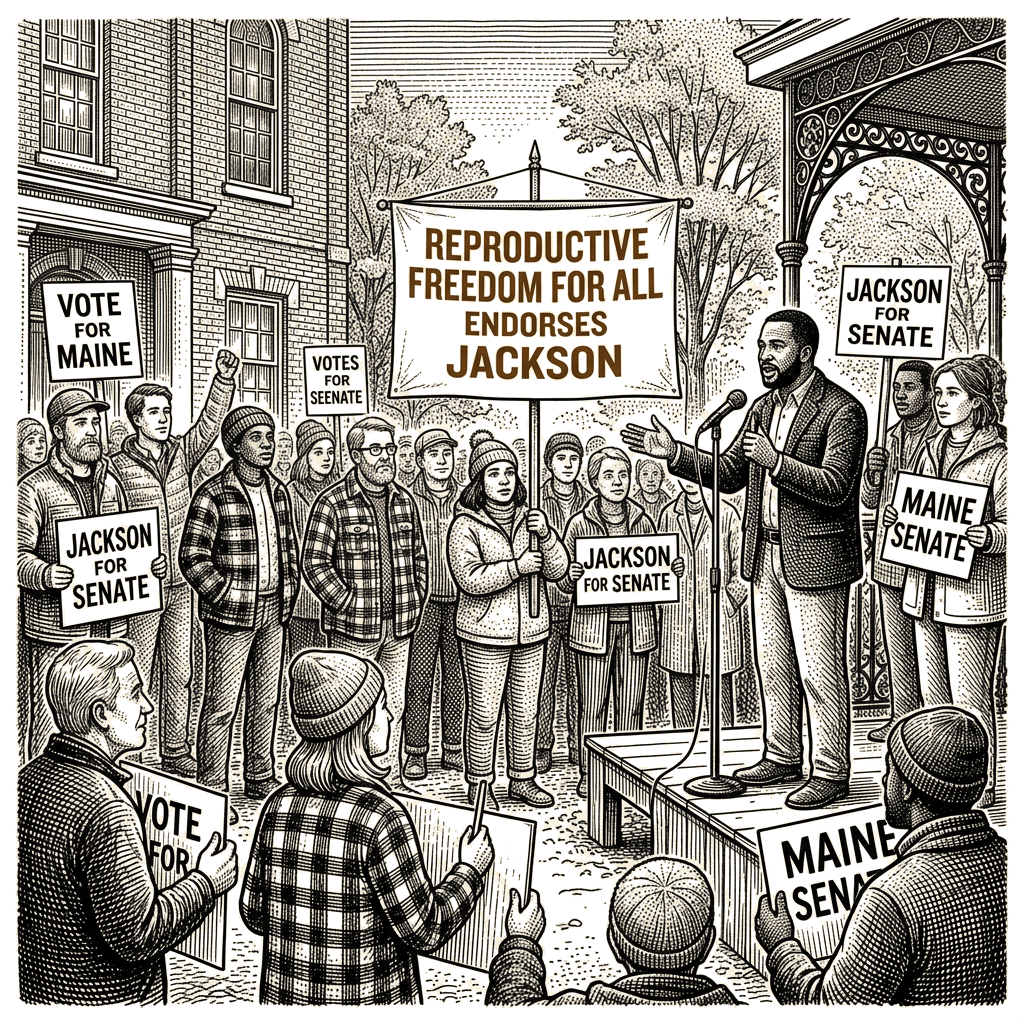
The Maine Senate contest was already a five-term incumbent’s reelection fight. After Reproductive Freedom for All endorsed Democrat Troy Jackson this week, with coverage first reported by The Guardian on Wednesday, the contest crystallized into something narrower and heavier: a coalition-designated hinge of national strategy, in which one state’s outcome is treated as the lever that determines whether a federal right to abortion can be restored at all. Mini Timmaraju, the group’s president, told The Guardian that “flipping the Maine Senate race is a critical path to winning a Senate majority, and we do not restore a federal right to abortion without flipping the Senate majority.” That framing — one race carrying the weight of a national policy outcome — is what reshapes the contest’s asset-and-liability balance. The question for readers is not whether Collins is vulnerable on the issue (her 2018 Kavanaugh confirmation has been a documented campaign target since well before this cycle) but whether the issue can move enough voters in a midterm crowded with other concerns to overcome the structural protections a five-term incumbent builds from seniority and federal deliverables.
A coalition-designated “critical path”
Three signals land together. Reproductive Freedom for All — one of the oldest abortion-rights organizations in the country — formally endorsed Jackson. Timmaraju is scheduled to join him Wednesday evening in Brunswick for the launch of his Women for Troy coalition. Earlier this month, Planned Parenthood’s Super PAC committed more than $600,000 to an ad campaign criticizing Collins’s abortion record.
A relationship map of the contest shows four actors operating in formal opposition to Collins: Reproductive Freedom for All, Planned Parenthood’s Super PAC, the Jackson campaign, and the broader Democratic infrastructure represented by former Vice President Kamala Harris’s late-July endorsement, issued two days after the snap convention that nominated Jackson. Timmaraju functions as a broker between national-rights-group infrastructure and a state-level race that lost its original nominee in July, when Graham Platner exited amid sexual-assault allegations he denies. The article does not name a countervailing anti-abortion Maine organization active in endorsing Collins, which is itself part of the contest’s current coalition shape.
The asset side: Jackson’s record and the reframe
Jackson’s coalition value does not rest on his July nomination alone. The article details a documented voting record: a 100% rating from the Planned Parenthood Maine Action Fund since 2017, and his 2023 co-sponsorship of Maine legislation expanding abortion access to include medically necessary procedures after fetal viability. The second fact is the structural anchor. The first post-Dobbs year produced legislation in Maine that explicitly extended the legal scope of post-viability care, and Jackson’s name sits on it. His prior tenure as Maine state Senate president adds a credibility layer for state-level legislative work that no challenger in this race can claim. The coalition’s investment rests on a paper trail, not a promise.
The endorsement simultaneously recasts his pre-2017 record — votes restricting abortion access, and a stated prior belief that abortion should “never be legal” — as biographical evolution. In a July interview with MS Now, Jackson said he had been “wrong” and described “a lot of conversations” with “women, doctors, community members” as the path to his current position. Timmaraju, quoted in the source, framed Jackson as a messenger who can “talk to his Republican colleagues and talk to some of those moderate Democratic colleagues who don’t have the same courage that he has” — a coalition-utility argument aimed at voters who themselves once felt conflicted. The reframe is observed in the source; whether independents in Maine respond to it as the source describes remains an open measurement question.
The liability side: the Kavanaugh vote as 2018 anchor
The coalition’s attack on Collins runs through a documented 2018 vote, not a generalized accusation. Collins voted to confirm Kavanaugh; Kavanaugh joined the Dobbs majority in 2022; more than a dozen states have since enacted near-total abortion bans. The two-step chain — confirmation vote, then majority opinion, then state bans — is the only path through which the 2018 vote becomes a 2026 issue, and it rests on the Senate roll-call record rather than interpretation.
In June, Collins told reporters she does “not regret that vote”; the source does not specify the venue of that remark. Jackson’s campaign has tied the comment to the Trump administration’s anti-abortion agenda. The article quotes Jackson’s stated counter: he is running “to restore and expand the federal right to abortion and make damn sure politicians never again get to take this freedom away from Mainers.” The structural feature of the exchange is that the older vote cannot be revised; Collins’s defense can only be reiterated or walked back, and she has chosen reiteration. Planned Parenthood’s $600,000-plus ad commitment is built to keep that reiteration under sustained pressure through the campaign’s final weeks.
Stacked-shock attention: why the issue may not move the ballot
A root-cause analysis of the race’s underlying dynamic identifies a structural condition the coalition’s strategy cannot control: voter attention is finite, and the 2026 midterm is crowded. The article explicitly frames the cycle as “shaped by record inflation, affordability concerns, and the military conflict with Iran.” Strategists in both parties, quoted without specific attribution, argue that Collins’s Kavanaugh vote “may not be top of mind for many Mainers weighing their choices at the ballot box.”
The cause-of-the-cause matters here. Inflation and the Iran conflict compete for finite attention not because abortion is unimportant but because the 2026 environment stacks compounding shocks — persistent prices, foreign-policy anxiety, and a post-Dobbs legal landscape — onto a single ballot. The coalition’s response, visible in the article, is paid-salience compensation: the $600,000-plus ad buy and the Brunswick coalition launch are consistent with the analyst’s reading that the coalition intends to use national media salience to compensate for muted organic attention, but no source explicitly attributes that strategic intent. Collins’s protection runs in the opposite direction. Her five terms of seniority and the federal dollars she has steered to Maine are what the article calls “historically proven difficult to beat.” That description is a correlation across many cycles, not a demonstrated 2026 mechanism, but it captures the structural insulation an incumbent of two decades accumulates.
Who speaks in the article, and who does not
A stakeholder map of the contest shows the named voices concentrated on one side of the framing. Collins speaks through her June “do not regret” statement and her long-casted self-presentation as a moderate Republican supportive of abortion access. Jackson speaks through his July MS Now interview and his campaign statement. Reproductive Freedom for All speaks through Timmaraju’s two quotes. Planned Parenthood’s Super PAC speaks through its ad-buy commitment. The article does not name a Collins campaign response to the Reproductive Freedom for All endorsement, an on-record Maine anti-abortion organization active in the race, or any Maine physician performing post-viability procedures.
The constituency Timmaraju explicitly names — “independents and Republicans in this country who now support abortion rights, but might personally have felt conflicted in the past” — is itself voiceless in the source. So are the low-income and rural Maine women whose concrete access interests the race most directly touches, and the physicians whose scope of practice the 2023 Maine bill expanded. The structural omission is itself part of the framing: the parties whose stakes are most concrete are the parties the article does not quote. A reader tracking whose account the telling advances should note that the source over-indexes on coalition-aligned voices and under-indexes on both the affected population and the opposing coalition.
Four questions for the next story
- Does the Reproductive Freedom for All endorsement, combined with Planned Parenthood’s $600,000-plus spend, raise the abortion issue’s salience above the inflation-and-Iran threshold the strategists describe, or does it merely ensure paid coverage in a race where organic voter attention is elsewhere?
- How does Jackson’s biographical evolution read in Maine independent precincts — as authenticity, as evolution, or as disqualifying baggage the source does not capture?
- Does Collins’s continued defense of the Kavanaugh vote survive contact with sustained ad-funded attack, or does the structural insulation of seniority and federal deliverables protect her vote share regardless of message?
- Which other states in the “small number” of competitive Senate races receive comparable coalition investment, and what does that pattern say about the abortion-rights movement’s national resource allocation in this cycle?
The Analysis explains the dynamics of a news story. It does not argue for a position. Facts not in dispute are stated as such. Where framing choices are described, the description names what the text does, not what its authors intended.
Analytical techniques used in this piece
This analysis applies the methods below. Each links to a short, plain-English explainer you can read and reuse.
- Relationship Mapping
- Extracts the network of ties among people, institutions, and entities.
- Root-Cause Analysis
- Traces a symptom back along its causal chain to the conditions that actually generated it.
- Stakeholder Mapping
- Charts the parties to a situation — their interests, power, and alignments.