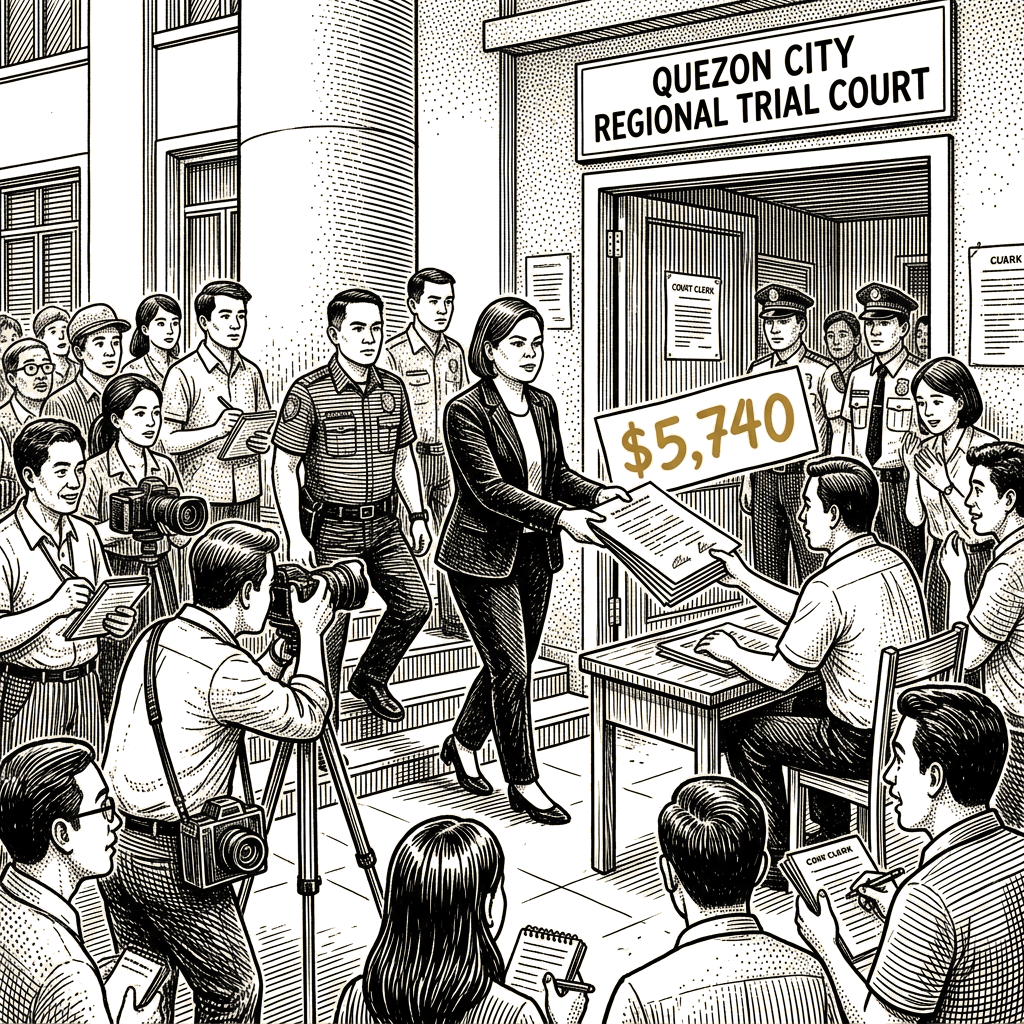
The Quezon City Regional Trial Court’s acceptance of 360,000 pesos ($5,740) bail on Saturday, Sept. 5, 2026, places Sara Duterte in an intermediate legal position: the court had issued an arrest warrant the previous day and later lifted it after the bail was posted, while the three grave-threat counts continue in the reported case. The source presents the payment as a procedural step, not as a verdict on the allegations. That distinction matters because the remarks that produced the case are connected to both a criminal proceeding and a separate impeachment track.
The account’s causal structure has a clear central node: the conditional statement Duterte made during a 2024 online news conference. According to the account of the event, she said she would have President Ferdinand Marcos Jr., his wife, and then-House Speaker Martin Romualdez killed by an assassin if she herself were killed, and she said she was not joking. The report says the remarks set off a criminal investigation and national-security concerns. It also identifies the threat comments among the allegations on which the House impeached her. Removing that statement would disconnect both documented branches of the story. The bridge concept is institutional escalation: a statement made at a news conference becomes a criminal matter, and that matter becomes linked to an impeachment proceeding. The political background—Duterte and Marcos were running mates in 2022, their alliance combined two formidable political dynasties, and the House is described as dominated by Marcos allies—supplies context, not a causal finding. Duterte has denied the allegations and said she was expressing concern for her own safety; the article does not resolve that conflict.
Reading the reported sequence as a strategic interaction—with the conditional statement as a player action and the warrant, bail, and impeachment moves as institutional responses—allows the framework to register the formal-legal track and the parallel-impeachment track in a single frame. The repeated-game or backward-induction reading begins with the 2024 conditional statement. Drawing on the cheap-talk distinction Vincent Crawford and Joel Sobel formalized in their 1982 work on costly signalling, the report says Duterte was not joking, but it supplies no evidence of an operational commitment, a capacity to carry out the threat, or a payoff structure that would make her statement a credible commitment device in Thomas Schelling’s sense. The next documented move is the investigation and the court-issued warrant, a formal legal act about which the report does not state the evidentiary record, the legal standard applied, or the conditions of bail. Her attorney’s statement that she would fight the charges and continue to use legal remedies describes a future procedural position; Duterte’s appearance and the posted bail are observed actions, not a guarantee of the case’s eventual result. In parallel, the House’s May impeachment vote and the Senate’s July opening of the trial are documented formal acts, but the Senate’s outcome is not reported.
The current endpoint is therefore a temporary continuation equilibrium, not a resolved one. A fully specified Nash equilibrium, in John Nash’s 1950 sense as Reinhard Selten extended to subgame-perfect equilibrium in 1965, cannot be derived from one news account because it supplies no payoff matrix, probability estimates, or complete action history. The documented sequence nevertheless shows that formal action can keep a dispute active across separate venues without deciding its political result. The article reports no direct response or personal strategy from Marcos, so attributing the court or House actions to him would go beyond the evidence.
The courthouse scene gives this institutional sequence a spatial form. In Kevin Lynch’s legibility terms from The Image of the City (1960), the Quezon City Regional Trial Court is the principal node in Duterte’s reported journey; the route from the court toward her car is a path; the exterior crowd is a gathering space and an edge between the institution and the public; and the court order lifting the warrant functions as a portable cognitive landmark. In Jay Appleton’s prospect–refuge theory, advanced in The Experience of Landscape (1975), the supporters provide a visible form of social refuge, while Duterte’s description of police personnel at her home identifies a perceived hazard. Her request that reporters surround her on the way to the car is consistent with that reading, but it does not establish the actual level of danger or whether the route was protected.
The substrate carries no designed spatial solution, no interior nesting imagery, and no restorative-environment evidence, so the Christopher Alexander pattern-language check, Rachel and Stephen Kaplan’s restorative framework, Christian Norberg-Schulz’s genius-loci reading, and Gaston Bachelard’s topoanalysis register as not-applicable rather than as confirmed.
The 2024 conditional statement is therefore the hinge, while the warrant, bail, impeachment, Senate trial, and the possible consequence of permanent public-office disqualification and a bar on seeking the presidency in 2028 are dependent tracks. The courthouse does not settle the dispute; it makes the continuation visible. The supplied evidence supports that sequence and its immediate spatial setting, but it does not determine the legal merits, the basis for the warrant, or the Senate’s eventual result.
Analytical techniques used in this piece
This analysis applies the methods below. Each links to a short, plain-English explainer you can read and reuse.
- Domain Induction
- Builds a working mental model of a domain from the ground up.
- Genius Loci — Sense of Place
- Reads the character and felt quality of a place.
- Strategic Interaction (Game Theory)
- Models a situation as a game — players, moves, payoffs, and likely equilibria.