Summary
- U.S. agencies’ accusation against six Chinese AI firms operates as a calibrated signal layered on interest overlap, industry split, and summit timing rather than as a one-shot enforcement action.
- The dispute runs through five interest clusters with overlapping but divergent stakes — Chinese firms preserving access to frontier-model outputs; closed-model developers protecting training investment and terms-of-service precedent; U.S. security agencies signaling enforcement capacity; Treasury Secretary Bessent establishing a sanctions threshold; and Nvidia–Microsoft signatories preferring targeted frameworks over sweeping restrictions.
- The accusation arrives weeks before the Trump–Xi meeting, sequencing a public commitment that conditions sanctions on conduct Bessent characterized as crossing “the line into IP theft” — threshold language that preserves diplomatic leverage without immediate enforcement.
- Legal leverage for U.S. closed-model providers depends on terms-of-service enforceability across jurisdictions, with the source describing evidence as difficult to obtain and litigation as slow in a quickly-moving industry — while the Nvidia–Microsoft coalition’s preferred equilibrium of “targeted legal and commercial frameworks” preserves both the closed-model distinction and the China-exposed chip and cloud business.
- Three observable tests would resolve the equilibrium — whether Treasury issues Entity List designations against named entities, whether terms-of-service litigation produces public liability rulings, and whether the summit yields any bilateral framework on AI conduct.
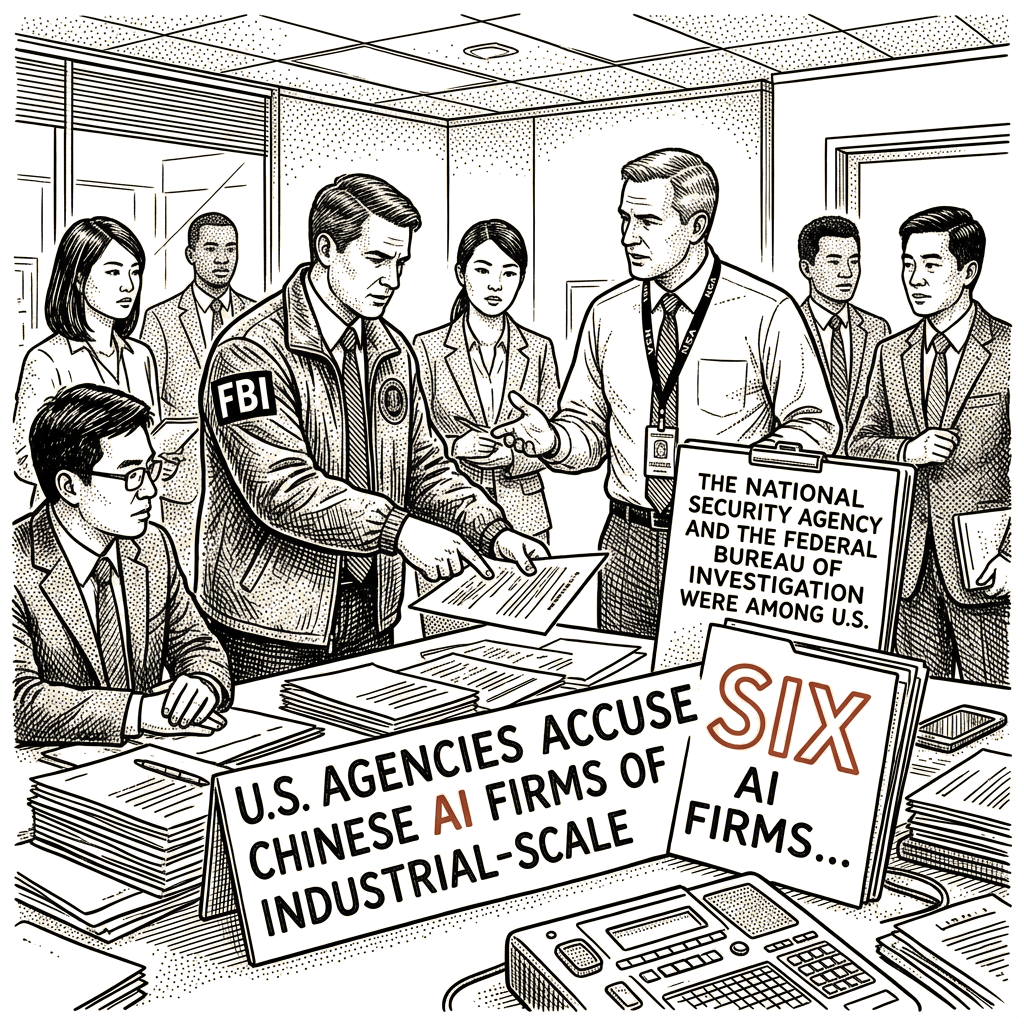
The National Security Agency, the Federal Bureau of Investigation, and other U.S. agencies accused six Chinese AI companies of conducting “aggressive, malicious, and targeted distillation activities at an industrial scale,” alleging millions of exchanges with frontier U.S. models including Claude, ChatGPT, Gemini, and Grok. The accusation arrived weeks before a meeting between President Trump and Chinese leader Xi Jinping that the source reports is scheduled for late September in Washington, with AI issues that could be on the agenda. The dispute operates less as a single enforcement question than as a layered contest — one in which closed-model providers seek terms-of-service precedent, infrastructure firms preserve access to Chinese customers, security agencies signal enforcement capacity ahead of the summit, and Treasury holds sanctions as contingent threshold language rather than imminent action. The equilibrium will be set not by what distillation technically is, but by which of four interests — IP protection, market access, national security, diplomatic management — carries the most weight in the bilateral track.
What distillation actually involves
Distillation, as defined in the source, is a standard training technique in which engineers prompt an AI “teacher model” for answers and explanations, then use those question-answer-reasoning sets to fine-tune a “student model.” The process is widely accepted in some forms — Apple’s distillation of its own model to run on phones, and distillation from open-weight models — both cited as legitimate by the source. The dispute turns not on distillation as such but on which specific techniques, conducted by which actors, cross a line; categorization, not categorical prohibition, is what the parties are contesting.
Who benefits — five interest clusters
Cluster 1 — Chinese AI firms. The surface position is denial. A Moonshot AI executive told Chinese media in July that the Kimi K3 release’s “breakthrough performance” was based on “fundamental innovations, not distillation or copying.” A Chinese foreign ministry official said the same month that foreign countries were “hyping the concept of distillation from malicious motives.” The substantive economic interest is continued access to frontier-model outputs that compress development cycles; the procedural interest is avoiding Entity List designations that would cost global customers; and a security interest running opposite to U.S. agencies — continued access to compute, talent, and component supply chains — coexists with Beijing’s push for technological self-reliance. The denial posture preserves optionality across those fronts simultaneously, and the denial itself is the visible conduct through which the cluster defends its public standing as original developers.
Cluster 2 — U.S. closed-model frontier developers (Anthropic, OpenAI, Google, xAI). The commercial interest is protecting the training investment that closed models represent. The legal interest is establishing terms-of-service enforcement precedent before Chinese rivals reach competitive parity. Anthropic’s terms of service bar Chinese companies from using Claude, and “other firms have similar restrictions,” the source reports. Anthropic said in February that Chinese operators used “fraudulent accounts and proxy services to access Claude at scale while evading detection,” and in July an Anthropic executive said distillation had helped China narrow the gap with the U.S. from 12 to 18 months down to roughly six to nine months. The “millions of exchanges” claim cited by U.S. agencies is consistent with the Anthropic framing but does not independently verify the specific campaigns attributed to the six named firms.
Cluster 3 — U.S. security agencies (NSA, FBI, and counterparts). The interest set runs from constraining technology transfer to a strategic competitor, to signaling enforcement capacity ahead of the bilateral summit, to preventing adversary leapfrogging via covert means, to formalizing industry-government cooperation. The agencies’ call for “closer cooperation between companies and the government to defend against large-scale distillation” indicates a relational interest in partnership rather than litigation alone — a posture that converges with the closed-model developers on the goal of enforceable boundaries while diverging on whether the enforcement vehicle should be sanctions or contractual action.
Cluster 4 — Treasury Secretary Scott Bessent. The interest is making sanctions and Entity List designations contingent on conduct characterized as crossing “the line into IP theft.” Bessent wrote on X in July: “When PRC [People’s Republic of China] firms conduct covert, industrial-scale distillation attacks that cross the line into IP theft, sanctions and Entity List designations will be on the table.” That threshold language establishes a demonstration burden Chinese firms must show they are below — a public commitment structure rather than a near-term enforcement action.
Cluster 5 — U.S. industry signatories of the July open letter (Nvidia, Microsoft, and others). The commercial interest is preserving broad AI ecosystem access and continued access to Chinese customers for chips, cloud, and services. The technical interest is preserving distillation as an accepted research technique. The letter cautioned against “sweeping restrictions on techniques that play an important role in AI innovation” and asserted that unlawful distillation “should be addressed through targeted legal and commercial frameworks.” The preferred equilibrium — “targeted legal and commercial frameworks” — is the rule shape in which both spokes of the U.S. coalition can co-exist.
Beijing (state-level). Protecting the AI sector’s commercial momentum, maintaining negotiating leverage ahead of the summit, and reinforcing a sovereignty-and-self-reliance narrative at home are the operative interests. The denial posture preserves optionality across those fronts simultaneously.
Internal divergences. The Nvidia–Microsoft open letter and Anthropic’s February statement both rest on the premise that some distillation is acceptable. Agencies and closed-model providers share an interest in establishing enforceable boundaries on Chinese distillation but diverge on whether enforcement should be sanctions-based or litigation-based, with the open-letter signatories preferring the latter. Chinese foreign ministry and Chinese AI firms share an interest in denying the accusation but diverge on whether commercial terms-of-service compliance is acknowledged as binding on Chinese-domiciled operators.
How the parties are framing the dispute
The U.S. agencies’ framing — industrial-scale, malicious, security threat — is paired with the closed-model developers’ framing of training-investment protection and terms-of-service enforcement. Anthropic’s February disclosure placed the issue in security terms rather than purely commercial ones, a posture consistent with the agencies’ characterization. Chinese denial frames the issue as homegrown innovation and accuses foreign countries of “hyping” the concept from “malicious motives.” Legal specialists quoted in the source frame distillation as probably falling short of actionable infringement by itself, with model output unlikely to be copyright-protected “the way a book or a movie is” and distillers described as “not copying output outright, merely using it the way an aspiring writer learns by reading books” — a framing that raises the bar for what conduct, if any, crosses into actionable IP infringement. OpenAI executive Dean Ball, cited in the source, sits between the agencies’ industrial-scale framing and the Chinese innovation-narrative framing, saying distillation may have helped Chinese companies earlier in the AI race but “isn’t the main reason for their recent advances.”
What happens next — calibrated escalation
The dispute has the structure of a calibrated exchange with overlapping interests and incomplete information, not a one-shot enforcement action. Bessent’s threshold statement functions as a public commitment that shifts the burden of demonstration — by conditioning sanctions on conduct that “crosses the line into IP theft,” his July statement establishes a threshold Chinese firms must show they are below. The threat’s timing, weeks before the Trump–Xi meeting, is consistent with a commitment calibrated to the bilateral track rather than a near-term enforcement action. The agencies’ Tuesday release identifies conduct but does not announce sanctions — sequencing that preserves the threat without immediate enforcement. The Chinese response mirrors the structure: public denial paired with summit willingness preserves diplomatic space while resisting the IP framing.
Outside options run in both directions. U.S. agencies could escalate to Entity List designations. U.S. firms retain the option of private litigation, though the source describes that path as evidence-poor and slow. Chinese firms retain the option of continuing distillation through proxies and intermediaries, accelerating self-reliance, or retaliating through adjacent domains such as rare-earth supply or anti-monopoly action. The Nvidia–Microsoft coalition’s outside option runs through regulatory-frame shaping: broad restrictions would constrain the legitimate distillation practices their products and platforms depend on; targeted enforcement preserves both the closed-model distinction and the China-exposed chip and cloud business.
Three observable tests would resolve the equilibrium — whether the U.S. threat produces compliance, evasion, or escalation. First, whether Treasury issues Entity List designations against named entities. Second, whether terms-of-service litigation produces public rulings establishing liability standards. Third, whether the Trump–Xi summit produces any bilateral framework on AI conduct. Three summit outcomes correspond to substrate signals already on the table: specific sanctions would track Bessent’s threshold language and the NSA/FBI accusation; a negotiated boundary would track Beijing’s denial posture paired with summit willingness; a quiet pause would track the open letter’s “targeted” framing and the agencies’ deferral from specifying sanctions.
Structural levers — proxies, copyright doctrine, and the Entity List
The dispute sits inside a hub-and-spoke configuration centered on the U.S.–China AI competition, with the NSA/FBI accusation as a focal event. Closed-model developers occupy one spoke, their commercial position resting on protecting the gap between their models and replicated competitors, with terms of service giving a contractual hook the agencies can invoke. Infrastructure and platform providers sit on a different spoke, with commercial interest running through access to Chinese customers and the coalition preferring targeted enforcement over broad restrictions. Six Chinese AI companies occupy another spoke — with Moonshot AI’s public denial serving as the visible rebuttal — alongside a wider ecosystem of users, intermediaries, and state-aligned actors. The reference to “fraudulent accounts and proxy services” identifies a layer of middlemen that complicates attribution and makes enforcement evidence-dependent rather than categorical.
Legal leverage depends on terms-of-service enforceability across jurisdictions, with the source noting that evidence is difficult to obtain if conduct was hidden via middlemen overseas, and that a lawsuit could be slow in a quickly-moving industry. If the Treasury threat is carried out, “U.S. and foreign users might lose access to the Chinese models,” the source reports — a structural exclusion mechanism with bidirectional costs that would also hurt Chinese developers. Adjacent domains — chip export controls, IP doctrine on model outputs, and standards-setting bodies — sit just outside the immediate dispute but shape each side’s leverage.
Until at least one of the three observable tests resolves, the threat structure remains in a pre-commitment state in which both sides have stated positions without action revealing which stated interests are operative. The dispute’s near-term shape will be set by the relative weight of four interests — IP protection, market access, national security, and diplomatic management — in the bilateral conversation that follows, not by the technical question of what distillation is.
Analytical techniques used in this piece
This analysis applies the methods below. Each links to a short, plain-English explainer you can read and reuse.
- Interest Mapping
- Separates parties’ stated positions from their underlying interests (Fisher & Ury).
- Relationship Mapping
- Extracts the network of ties among people, institutions, and entities.
- Strategic Interaction (Game Theory)
- Models a situation as a game — players, moves, payoffs, and likely equilibria.