Summary
- Justice Flávio Dino of Brazil’s Supreme Federal Court ordered secrecy lifted on Sept. 13, 2026 in a corruption probe targeting presidential candidate Flavio Bolsonaro, placing documentary records that Brazilian media describe as alleging $24 million in transfers to U.S. accounts tied to people close to the Bolsonaro family into the public record roughly three weeks before the Oct. 4 first round.
- The disclosure’s substantive content travels under two evidentiary statuses: Justice Dino’s judicial characterization of cell-phone material pointing to a “sophisticated scheme” to divert public funds alongside his “possible link” assertion regarding the First Capital Command, paired with Liberal Party federal deputy Mário Frias’s denial characterizing the probe as a “smokescreen” and asserting a legitimate social purpose for the funds.
- The described causal chain — public-fund allocation through a film-financing vehicle to deposits in U.S. accounts tied to associates of the Bolsonaro family, with a possible PCC connection — compresses three inferential rungs (the magistrate’s characterization, chain-of-custody verification for the U.S. account destination, and PCC-link substantiation) into a single presentation step, each rung verifiable in principle but subject to alternative explanations the source documentation does not foreclose.
- The procedural choices — transferring cell-phone material to the Federal Police to prevent “selective leaks” and merging the Flávio probe with a second biopic-financing investigation into former banker Daniel Vorcaro — produce structural effects on the public record that the source does not examine as such, while leaving filmmakers, U.S. account holders, the specific public-fund program, and an institutional Liberal Party response unrepresented in the reporting.
The disclosure and its two evidentiary tracks
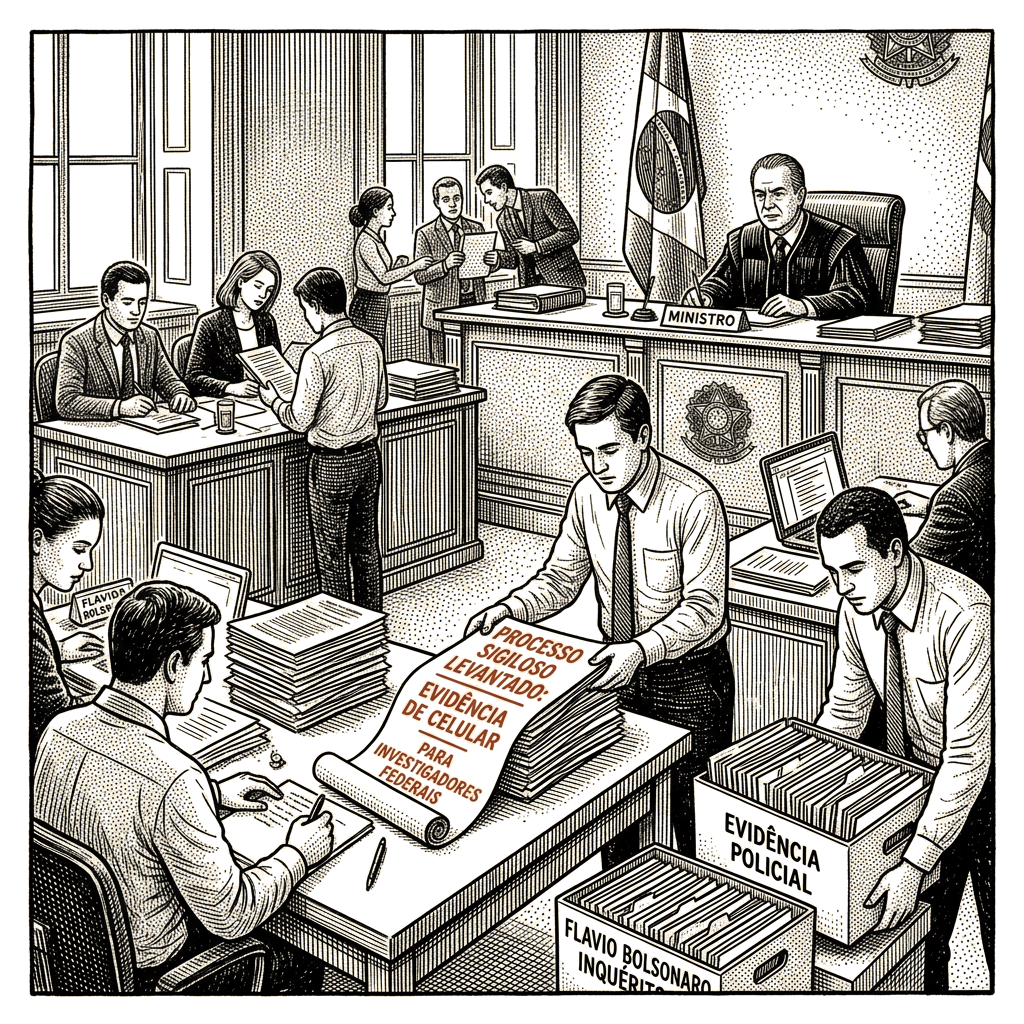
Justice Flávio Dino of Brazil’s Supreme Federal Court ordered secrecy lifted on Sept. 13, 2026 in a corruption probe targeting presidential candidate Flavio Bolsonaro, transferring cell-phone evidence to the Federal Police and merging the case with a parallel investigation into the financing of “Dark Horse,” a biographical film about Flavio’s father, imprisoned former President Jair Bolsonaro. The disclosure, reported by CNN Brasil and the BBC, was issued roughly three weeks before Brazil’s Oct. 4 first-round presidential election and placed a documentary record in the public domain that Brazilian media describe as alleging Flavio Bolsonaro negotiated the transfer of $24 million to U.S. accounts belonging to people close to the Bolsonaro family. Dino’s ruling characterizes the evidence as pointing to a “sophisticated scheme” to divert public funds and suggests a “possible link” to the First Capital Command, which the source article characterizes as “Brazil’s largest and most powerful transnational criminal organization.” The procedural rationale Dino named — preventing “selective leaks” — joins an electoral-calendar consideration that the source names only as background context; the disclosure lands in a polling environment in which incumbent President Luiz Inácio Lula da Silva holds a 3-to-6-point lead over Bolsonaro, with a statistical dead heat indicated in the likely runoff.
The disclosure’s content admits two framings that travel under different evidentiary statuses. Dino’s ruling characterizes the cell-phone material as pointing to a “sophisticated scheme” to divert public funds and flags a possible link to the First Capital Command. Liberal Party federal deputy Mário Frias, the film’s executive producer and a subject of the investigation, has denied the accusations and characterized the probe as a “smokescreen,” asserting the funds served a legitimate social purpose. Dino’s framing is a judicial finding; Frias’s is a denial from a subject of the investigation. The two stand alongside each other in the source reporting while the underlying records remain independently unverified.
The disclosure organizes itself along two tracks. The alleged-conduct track carries Dino’s “sophisticated scheme” characterization together with Brazilian media’s reporting of documents allegedly showing Flavio Bolsonaro negotiating the $24 million transfer. The disclosure-context track carries the procedural rationale for the secrecy lift (preventing “selective leaks”), the merger with the Vorcaro probe, and the electoral calendar. The structural effect is an attribution asymmetry: alleged-conduct claims travel under magistrate authority and reported-document attribution, while disclosure-context claims travel as background paragraphs. Frias’s denial appears in the same factual block as the alleged-conduct claims, with the alleged-conduct claims established first in the reader’s framing.
The causal chain and the inferential rungs it compresses
The document record describes a causal chain running from public-fund allocation through a film-financing vehicle to deposits in U.S. accounts tied to associates of the Bolsonaro family. Four elements carry the chain: (a) Dino’s finding that evidence points to a “sophisticated scheme” to divert public funds; (b) documents allegedly showing Flavio Bolsonaro negotiating the $24 million transfer; (c) the alleged destination — U.S. accounts belonging to people close to the Bolsonaro family; and (d) a possible link to the First Capital Command.
At observation level, (b) and (c) are alleged together in the disclosed materials; the negotiation and the U.S.-account destination are reported in the same documentary record. What remains absent from the article’s account is chain-of-custody verification for (c) — confirmation that the funds identified in (b) actually reached the named U.S. accounts and remained there — and substantive PCC-link substantiation for (d). Dino’s (a) is his characterization of (b), (c), and adjacent evidence; treating the four elements as a single causal chain compresses three inferential rungs (the magistrate’s characterization, the chain-of-custody question, and the PCC connection) into one presentation step.
Each link in the described chain is independently verifiable in principle — phone records, banking records, and incorporation filings can be cross-checked — but each is also subject to alternative explanations that the source documentation alone does not foreclose. The $24 million figure could reflect documented investment flows whose source and destination differ from what the cell-phone evidence is reported to allege. Three plausible alternative chains the alleged transfers would have to be distinguished from: legitimate film-financing routed through overseas production accounts; family remittances unrelated to the film; and prior contractual obligations. Each would require its own documentary corroboration to rule out.
The PCC characterization, if sustained by the Federal Police review, would raise the stakes considerably; absent authentication, it functions in the public record as a serious but unverified attribution from a sitting justice. The cell-phone handover appears designed to close this evidentiary gap, but that gap will only be closed once the underlying records are cross-checked against banking and corporate filings — work the source article does not report as completed.
Procedural moves and the costs they impose on the record
The cell-phone-handover order reads as a deliberate choice by the court. Dino’s stated rationale — transferring the raw material to the Federal Police to prevent “selective leaks” — names a failure mode that Brazilian media have documented across previous high-profile Bolsonaro-family cases: partial circulation of investigative material to outlets before defense review. The merged-probe order consolidates two investigative threads into a single decisional frame and consolidates duplicated investigative work. It also produces a practical effect for the public record: distinct fact patterns alleged against distinct actors (Flavio Bolsonaro and former banker Daniel Vorcaro) become harder to evaluate separately once they share a procedural envelope, and the merged investigation will be reported as a single object in the pre-election news cycle even if the underlying evidence supports narrower or broader claims than the unified framing implies.
The procedural timeline presents its own structural feature. The Supreme Federal Court first opened the probe in July 2026; it became public only on the Friday before the Sept. 13 secrecy lift. The secrecy-lift rationale of preventing “selective leaks,” reported as Dino’s stated consideration, is named explicitly. The equally available consideration that disclosure lands roughly three weeks before the Oct. 4 first round is named only as background context. The source reports the tradeoff between preventing selective leaks and managing electoral timing as fact; it does not examine it as a structural choice.
The disclosure structure simultaneously addresses two risks — selective leaks, named by Dino, and compressed electoral timing, named only by background context — without resolving the tradeoff between them. The substantive questions — whether the $24 million was diverted from public funds, whether the U.S.-account deposits reflect the structure alleged in the documents, and whether the PCC characterization survives authentication — will be answered, if at all, by the documentary record that follows the order, not by the order itself.
Stakeholders absent from the reporting
The source reporting leaves several stakeholders unrepresented. Filmmakers and cultural-fund administrators whose disbursement decisions would authorize the underlying transactions are not named, nor are the specific U.S. account holders whose accounts the documents reportedly identify — only the generic reference to “people close to the Bolsonaro family.” The specific public-fund program, agency, or disbursement mechanism alleged to have been misused is also not named. The PCC, whose “possible link” is asserted by the magistrate but not established by the disclosed documents on the article’s account, is similarly absent from any institutional response.
The article carries Frias’s personal denial — his “smokescreen” framing and his claim of a legitimate social purpose — but does not report an institutional Liberal Party response, party statement, or formal defense of either Flavio Bolsonaro or Frias in his party role. The absence of institutional voice alongside Frias’s individual denial shapes the disclosure’s effect on the political environment in a way the article does not flag.
On the Vorcaro probe: the source identifies Daniel Vorcaro as a “former banker” whose “actions” are under investigation but does not specify what those actions are. The merger of the two probes therefore reads as procedural in the article even though the merger implies a substantive connection between the two strands. What that connection is — whether Vorcaro’s role concerns the same U.S. account structure, separate transfers, or the chain of disbursement authority — remains unspecified, and the source does not describe the second probe’s substantive content.
The downstream electoral environment
The timing sits within a polling environment in which incumbent President Luiz Inácio Lula da Silva holds a 3-to-6-point lead over Bolsonaro ahead of the first round, with a statistical dead heat indicated in the likely runoff. The downstream political consequences of the disclosure — whether the public release of the cell-phone material alters the runoff margin, whether it produces a coalition-rallying effect around a shared judicial target, or whether the records are absorbed into an already polarized information environment in which each side reads the same documents through opposing interpretive frames — are not identifiable from the disclosure alone. Polling data does not isolate the effect of a single disclosure event on voting intention when the disclosure coincides with a campaign already saturated by competing narratives.
Political-science research has documented a body of work on the effects of pre-electoral information on voter behavior, including studies of how disclosures issued close to an election can shape the information citizens receive before they vote. Allegations that cannot yet be tested against defense evidence enter the public record carrying the magistrate’s institutional framing during this window.
Limits of the substrate
- The source article does not adjudicate the authenticity of the documentary record; the Federal Police review could materially shift authentication status in either direction.
- The alternative chains (legitimate film-financing, family remittances, prior contractual obligations) are named as plausible; whether any holds in fact cannot be determined from the substrate and would require banking records for the U.S. accounts, corporate filings for the film-production vehicle, and Federal Police review of the cell-phone material.
- The second probe’s substantive content is not described in the source; Vorcaro’s specific alleged role and the asserted connection to the Flávio-direct strand remain unspecified.
- The PCC-link basis asserted by the magistrate is not documented in the source; the underlying evidence Dino relied on is not described.
- The specific public-fund program or disbursement mechanism alleged to have been misused is not named.
Analytical techniques used in this piece
This analysis applies the methods below. Each links to a short, plain-English explainer you can read and reuse.
- Argument Audit
- A full structural audit of an argument’s premises, inferences, and load-bearing assumptions.
- Causal DAG
- Maps cause and effect as an explicit directed graph, exposing confounders and mediators (Pearl).
- Red-Team Assessment
- Models a capable adversary probing a plan for the seams they would exploit.