Summary
- The BBC’s September 16, 2026 report “Why Trump is all-in on AI despite the warnings” documents presidential social-media framing on AI and informal industry-administration channels displacing congressional deliberation on AI guardrails, the legislative pathway the “pro-human” conference speakers advocated.
- Two operative frames occupy the documented contest: the Trump-Johnson “AI hoax” frame — collocated with prior documented BBC-reported uses of “hoax” by President Trump for theories of human-driven climate change, Russian election-meddling investigations, and first-term impeachment drives — and the Bannon-Sanders “pro-human” frame identifying congressional inaction as bipartisan governance failure coupled with executive indifference.
- The ING finding that tech investment accounted for more than a third of Q2 2026 US economic expansion, and the BBC-reported linkage to corporate valuations and retirement portfolios, register economic-structural pressure against the regulatory pathway the conference framed.
- Industry handoffs to the administration — David Sacks through formal PCAST and media circuits, Elon Musk through documented shaping of administration direction despite adversarial positioning, Dario Amodei through adverse Pentagon conflicts that reportedly reduced presidential receptivity to slowing-AI arguments, and the documented inauguration-seating figures Sam Altman, Jeff Bezos, Mark Zuckerberg, and Tim Cook — comprise a heterogeneous access structure in which regulatory posture is reported as not predicted by access alone.
The BBC’s September 16, 2026 report from Washington documents a contest in which the standard channel for AI policy — congressional deliberation leading to guardrails legislation — is reported as functionally displaced by three non-legislative channels: presidential social-media posts functioning as policy posture; informal advisory relationships between the administration and tech executives; and corporate positioning by industry figures in media venues. The displacement is the central analytical phenomenon the report documents, and the report’s foregrounding of it — selecting in the conflict between presidential authority and congressional deliberation as the primary angle, while selecting out the technical content of AI risk and the specific regulatory architectures under debate — shapes what registers as the contest at all.
Frames in the documented contest
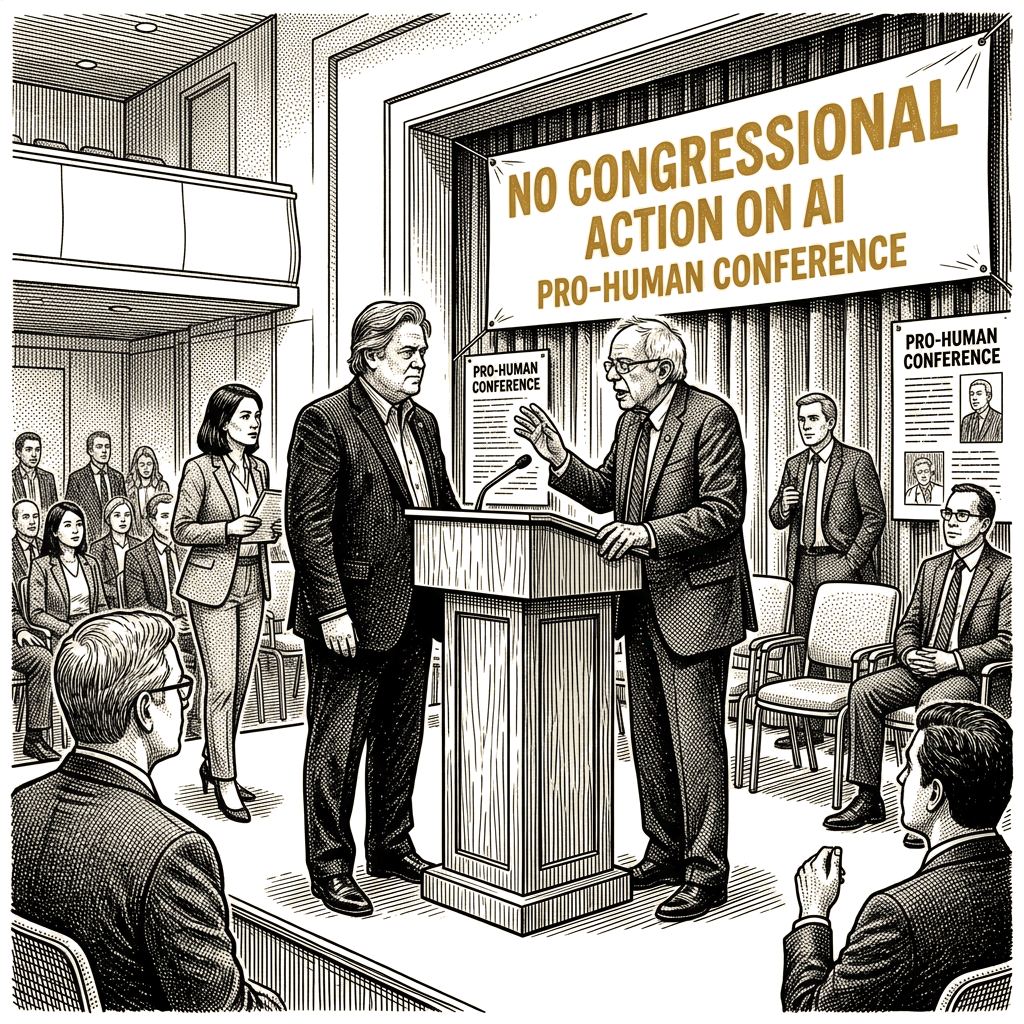
Two frames operate across the BBC’s reporting. The first, attributed to President Donald Trump and House Speaker Mike Johnson, characterizes AI warnings as a “hoax.” The BBC notes that Trump “typically reserves” that word for theories of human-driven climate change, investigations into Russian election-meddling, and the first-term impeachment drives — reproducing the term with prior usages visible to the reader rather than as an isolated utterance. The second, attributed at the “pro-human” conference to former Trump adviser Steve Bannon and Senator Bernie Sanders, characterizes congressional inaction as governance failure. Sanders is reported as identifying a “potentially catastrophic consequence” of unregulated AI; his reported statements — “Congress under both Democratic and Republican control has been asleep at the wheel” and “And now we have a president whose ignorance regarding this issue is truly embarrassing” — frame the question as bipartisan neglect coupled with executive indifference. Bannon’s reported “We’re not going to give these guys a carte blanche” and “There’s been no debate” register as a treatment recommendation: congressional deliberation, withheld.
The salience asymmetry between the two frames is documented. The “hoax” frame is reported as a singular social-media intervention issued on Monday. The Bannon-Sanders frame is reported as a coalition moment, with participants identified by explicit political markers: Bannon as “former Trump adviser” and Sanders, identified by the BBC as a “democratic socialist.” The conference naming itself — “pro-human” — presupposes that current AI development is anti-human, and frames regulation as moral posture rather than technical policy preference.
Trump’s reported linguistic moves complete the framing work. His “robots will be marching into our cities and getting rid of us all” deploys an invasion-frame metaphor that converts abstract risk into visceral imagery. The US-China competition is reported as a zero-sum contest — Trump: “We’re leading China in AI, and frankly, I want to keep it that way, because whoever wins AI wins.” This claim presupposes that national stakes preclude domestic regulatory deliberation. His self-identification as the “hoax buster” and the assertion that “the only control or ‘guardrails’ that AI needs is a STRONG AND SMART (High IQ!) PRESIDENT, and the U.S.A. has that, in spades” relegate treatment to personal authority. Trump added, “We already have tremendous CRIMINAL and REGULATORY power over these companies.”
How the two frames operate
Robert M. Entman’s framing-functions framework — problem definition, causal interpretation, moral evaluation, and treatment recommendation — inventories each frame’s operations across the BBC’s coverage as follows. The Trump frame: problem definition, alarmism threatening “the greatest economic development engine in history”; causal interpretation, attributed by the BBC to David Sacks on CBS News — “I think this is becoming a panic. We’re in an election season, and there is an incentive for political actors to try and amplify the fear”; moral evaluation, defenders rational, critics in panic, Trump self-identification as “hoax buster”; treatment, trust in presidential authority per the formulation above.
The Bannon-Sanders frame: problem definition, unregulated technology with “potentially catastrophic consequence”; causal interpretation, bipartisan congressional inaction combined with executive indifference; moral evaluation, Bannon’s reported “we’re not going to give these guys a carte blanche” and his “there’s been no debate”; treatment, congressional deliberation.
Norman Fairclough’s intertextual reading, applied to Trump’s “hoax” reproduction, positions the AI posture within a documented pattern rather than as an isolated utterance — the BBC’s reproduction of the term alongside the prior climate, Russian-meddling, and impeachment uses makes the pattern visible to the reader. Teun van Dijk’s ideological-square operation positions the US positively as leading and China negatively as lagging, with AI as decisive terrain — Trump’s “whoever wins AI wins” articulates this directly. Shanto Iyengar’s episode-versus-theme distinction is operative in the BBC’s own reporting: Trump’s intervention is reported in episodic form (Monday social-media posts), while the economic stakes are reported in thematic form (ING Q2 2026 figure, retirement portfolio attribution). A passivization in the BBC’s own register appears: “the ranks of AI doubters have been growing in recent weeks.” The agent and mechanism of the growth are unspecified.
Industry-to-administration handoffs
The industry-to-administration channels are documented as four differentiated pathways. The first is formal advisory: David Sacks as co-chair of the president’s Council of Advisors on Science and Technology and the BBC’s description of him as “informal AI tsar”; Sacks appears on the visible media circuit, including the CBS News weekend appearance quoted above. The BBC reports that Sacks’s “publicly aired scepticism of AI regulation mirrors recent comments made by the president.” Second, the “shaped direction” pathway: Elon Musk, “despite a rocky relationship with Trump,” is reported to have “shaped the direction of the administration.” Third, the access-blocking pathway: Dario Amodei, head of Anthropic, whose conflicts with the Pentagon over the unrestricted use of Anthropic’s AI models “could have negatively affected Trump’s reception of arguments for slowing AI development.” Fourth, inauguration presence: Sam Altman of OpenAI, Jeff Bezos of Amazon, Mark Zuckerberg of Facebook, and former Apple chief executive Tim Cook, documented as having “prominent seats at Trump’s inauguration” but for whom the BBC reports no specific operational reach in the substrate.
The BBC reports that these executives “hold a range of views on the necessity of greater AI regulation and have differing levels of access to, and influence on, the president.” Access is not predicted by regulatory skepticism; the documented correlation runs in one direction only — Sacks’s posture mirrors the president’s, while Amodei’s adverse Pentagon event runs counter to the executive-action pathway. Altman’s reported statement that the public is “right to be afraid” of AI alongside the assertion that the public should “trust the companies building it” surfaces a tension between public acknowledgment and a corporate-trust appeal without resolving it. The institutional correlation between access and regulatory posture is reported as heterogeneous.
Documented process versus actual process
The reported trigger is AI technology development and infrastructure investment. The ING forecast supplies the documented quantitative anchor: tech investment accounted for more than a third of Q2 2026 US economic expansion. The BBC further reports that “much of the rise in corporate valuations — and, by extension, the value of many Americans’ retirement portfolios — has been attributed to massive spending on computer chips, data centers, and other AI infrastructure.” Trump reportedly considers this growth a hallmark of his presidency and a key to his political legacy, and, according to the BBC, “anything that threatens this growth… quickly draws his suspicion.”
The documented process is congressional debate leading to AI guardrails legislation. On Tuesday, the report states, prospects for that legislation “appeared stalled.” The actual process, as the BBC documents it, runs through three non-legislative channels: presidential social-media posts functioning as policy posture; informal advisory relationships between the administration and tech executives; and corporate positioning by industry figures in media venues.
The sequencing constraint the BBC’s reporting makes visible is structural. Industry advice reaches the administration through access-dependent channels. Administration framing reaches Congress through partisan alignment. Congressional action depends on administration tolerance for legislative encroachment. At each step the bottleneck is authority concentration in the presidency rather than capacity or information in the legislature. The BBC characterizes Trump’s AI posture as “a desire for centralized presidential authority,” “a familiar theme of his second term in office, similar to his outlook on immigration and trade, where he believes he should have the sole power to decide who can enter and remain in the country, and when and where to impose tariffs.”
Decision points and bottlenecks
The first decision point is whether congressional action is feasible. Republican House Speaker Mike Johnson “appeared to back away from earlier openness to congressional action and instead echoed Trump’s ‘AI hoax’ rhetoric.” The reported echo signals that Republican leadership’s willingness to entertain legislation is contingent on the president’s posture rather than on legislation’s merits.
The bottleneck is the midterm congressional election. The BBC reports: “Candidates from both parties are wary of ending up on the wrong side of public opinion, which polls show is skeptical of the promised benefits of AI.” Republicans face an additional constraint: they are wary of crossing Trump on an issue the BBC reports has become “a political touchstone for the president.”
The bottleneck has feedback dynamics. If public skepticism intensifies, the electoral incentive for individual Republican members shifts away from the “hoax” frame Johnson echoed; the echo becomes unsustainable; Johnson’s posture breaks; the legislative pathway opens. The bottleneck is contingent on polling pressure and is reported as not static.
The BBC identifies an unused residual. Appian chief executive Matt Calkins, quoted in the report: “It is possible that events in the future might electrify the public, and then positions — and talk — might not be so cheap.” Calkins separately frames the issue as one “the industry has long expected… to enter politics,” and reports that it “has not yet become politically decisive.”
Cross-coalition convergence at the conference
The conference stage-sharing between Bannon and Sanders operates as a keying transformation in Erving Goffman’s sense: participants from opposing primary frameworks act within a shared one without dissolving their underlying commitments. The BBC identifies the participants with explicit political markers and registers the convergence as evidence that AI skeptics “now span industry insiders and politicians from both parties, including figures within Trump’s own Republican Party.”
Dennis Chong and David Druckman’s emphasis-and-equivalence framing makes the agenda-salience function visible: the Bannon-Sanders stage-sharing is a high-salience event that elevates AI skepticism in the news agenda. The BBC reports that Trump, by “fully joining the AI fight,” has elevated the issue “to the forefront of American politics, even at the risk of crossing longtime allies.” The convergence is reported as incomplete but functionally significant. The possibility of a regulatory coalition running across the conventional left-right axis, while documented by the cross-coalition alignment, is a finding the BBC’s venue framing does not foreground.
Social-movement framing analysis gives the convergence a structural reading. Diagnostic framing — AI as dangerous, Congress as failed — is shared across the conference speakers. Prognostic framing — debate, guardrails, regulation — is partially shared. Motivational framing — public skepticism, polls, possible “electrifying” events — is reported as external pressure. Calkins’s reported observation, quoted above, functions as a motivational-framing pivot.
Counterframes in the BBC’s reporting
Several counterframes surface from the BBC’s own reporting. The first is the industrial-policy / winner-selection frame. The BBC reports that Trump “often touts a conservative view that his opponents on the left are against the free market and economic liberties and rely on alarmism to justify greater government intervention and control,” while characterizing Trump as “hardly a traditional small-government conservative,” citing his reported partial US ownership of US Steel and the semiconductor manufacturer Intel, and his having “no qualms about picking winners and losers in the American economy.” The “alarmism versus realism” polarity loses purchase; “winner-selection versus competitive markets” becomes visible.
The second is the corporate-access frame. Amodei’s reported Pentagon conflicts become the entry point. Treating administration posture as responsive to specific corporate access rather than generalized AI evangelism changes the analytical question.
The third is the labor-displacement frame. The BBC distinguishes between “anxiety over the disruptive nature of the technology — if not worries about potentially civilisation-threatening danger,” indicating that the two are analytically separable in the source itself. Under this frame, AI expansion registers as an industrial-policy choice with concentrated benefits to capital and diffuse costs to displaced labor.
The fourth is the market-concentration frame. The Sacks-Amodei access differential and Trump’s partial-ownership rhetoric toward US Steel and Intel become consequential. Executive access reads as a market-structure problem rather than a persuasion problem; the “alarmism versus realism” polarity loses traction against market-power questions.
Selection in, selection out
The BBC’s reporting selects in: the conflict between presidential authority and congressional deliberation. AI debate is treated as primarily an extension of Trump’s rhetorical patterns, an extension of his relationships with tech executives, and a function of midterm electoral positioning. The BBC’s reporting selects out: the technical content of AI risk and the specific regulatory architectures under debate. Operative as well, though not foregrounded by the venue, is the analytical question of whether the contest between “hoax” and “pro-human” framings is itself a substitute for the deliberation Bannon and Sanders assert is missing.
Documented contradictions in the reporting
The BBC’s reporting registers a documented contradiction in Trump’s posture. The BBC reports Trump “often touts a conservative view that his opponents on the left are against the free market and economic liberties and rely on alarmism to justify greater government intervention and control,” while the same BBC report characterizes Trump as “hardly a traditional small-government conservative,” given the executive intervention described above. A second documented contradiction runs across the substrate: Trump’s “hoax” rhetoric on AI sits alongside his earlier signaling, channeled through Speaker Johnson, of openness to congressional action; Johnson’s reported “echo” of the “hoax” frame on Tuesday registers as that openness closing.
Residual constraints and documented pivots
Public opinion is reported as a residual constraint in a dormant state with latent capacity. Calkins’s framing — “It is possible that events in the future might electrify the public” and his assessment that the issue “has not yet become politically decisive… but could shift quickly” — constitute the documented pivot point in the BBC’s reporting. Trump also reportedly “tout[s] partial US ownership of US Steel and the semiconductor manufacturer Intel” while having “no qualms about picking winners and losers in the American economy” — the BBC reporting treats this as the second-term pattern around presidential authority over economic outcomes.
What remains open
The BBC documents a contest with at least three documented resolutions: legislative action; continued executive action; cross-coalition electoral repudiation. Bannon’s reported warning that “the administration was not being given unlimited authority over the technology’s development” functions as documented but partial countervailing force; the BBC notes that political decisiveness has not yet crystallized. The standard handoff from congressional deliberation to legislation being unavailable under current conditions shifts the channel balance toward executive action; when economic dependence on the regulated activity intensifies, structural pressure against the regulatory pathway is documented. The Bannon-Sanders stage-sharing, reported as unusual within the documented partisan structure, registers as a non-standard channel in the policy process whose future incidence remains open. The contest of framing authority, as the report documents it, remains open.
Analytical techniques used in this piece
This analysis applies the methods below. Each links to a short, plain-English explainer you can read and reuse.
- Frame Audit
- Surfaces the frame an argument adopts and what that framing quietly includes or excludes.
- Process Mapping
- Lays out a process end to end — steps, hand-offs, and bottlenecks.
- Confirmation Bias
- Seeking and overweighting the evidence that confirms what one already believes.
- Nash Equilibrium
- A standoff where no party can do better by moving alone, so the stalemate holds.