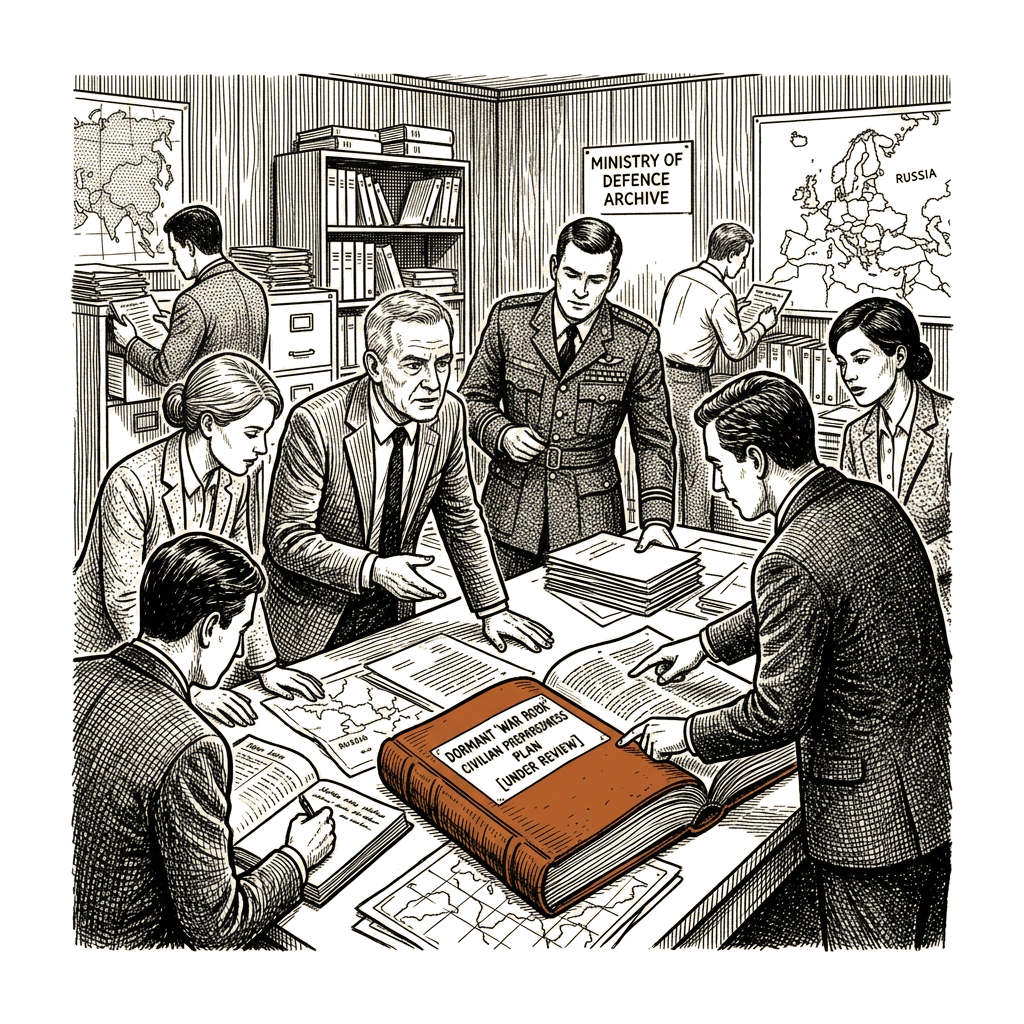
The conflict in the substrate is unusual in form: it is not a dispute between two parties but a societal fault-line between two framings of the future. On one side stand figures including Chief of the Defence Staff Sir Richard Knighton and the retired General Sir Richard Shirreff, who argue that Russia poses the most serious threat of recent decades and that the United Kingdom is psychologically and materially unprepared. On the same side, with a different framing, stands the strategic-studies scholar Andrew Michta of the University of Florida, who argues that Western European leadership elites have succumbed to a decades-long “crisis of disbelief.” On the other side stands, most prominently, the University of Birmingham psychologist Jim Orford, who characterises public contemplation of war as “simplistic thinking” organised around “enemies and heroes.” The third side — the civic body of institutions, professions, neighbourhoods, and ordinary citizens — is the social fact in which the fault-line runs. The question the substrate raises is which of William Ury’s ten third-side roles that body is currently playing, which it has left vacant, and which cannot yet be activated at all.
The surrounding community in this case is unusually broad. It includes the United Kingdom’s 66-million population, its professional armed forces of around 70,000, broadcasters whose reporting Knighton’s intervention prompted, the universities named in the substrate (Birmingham, the Stockholm Centre for Eastern European Studies, the Hamilton School at the University of Florida), the system of local government — one plausible channel through which any revived “war book” would be operationalised — the war memorials that the substrate records as touching every community in the land, and the connected populations of Finland, Sweden, Norway, the Baltic states, and NATO that constitute the wider civic ring.
Ury groups his ten roles into three clusters. Each maps onto this substrate with a different status.
In the prevention cluster, the provider role addresses frustrated needs that drive conflict. The frustrated need here is not classical material deprivation but a felt absence of civic meaning and psychological security. The substrate records the historian Margaret MacMillan’s observation that “British society had come to treat peace as the normal state of affairs,” and Orford’s diagnosis that the contemplation of war requires “simplistic” thinking. Defence chiefs provide one strand of an alternative narrative; the dormant war book, now being revived, suggests another. The provider role is partially active. The teacher role gives skills for conflict-handling. The substrate is explicit about this role in the Nordic model. The retired Finnish three-star general Arto Raty is quoted saying of his country’s annual courses for “members of parliament, government ministers, chief executives of private enterprises and public utilities, the health service, NGOs and churches”: “We train them in crisis management, so that they understand how society will work in a crisis. We’ve been doing it every year since 1960.” In Sweden, the analyst Minna Alander reports that the country has been “identifying civil engineers with some relevant skills in, say, electricity supply who could be exercised in case of disruption.” The teacher role is therefore active in Finland and Sweden; it is needed but unfilled in the United Kingdom. The bridge-builder role develops relationships that pre-empt conflict. NATO is the most visible bearer: the substrate records a thousand British troops in Estonia and German troops now back on Lithuanian soil. Bridge-building across the United Kingdom’s own civic fault-line, between the alarmed and the dismissive, appears less developed.
In the resolution cluster, the mediator role facilitates communication. The BBC article in which the substrate originates is itself one such mediator, putting alarmist and sceptical voices side by side. Parliamentary debate, if it occurs around the war book, would be another. The role is partially active; what is missing is an institutional mediator capable of translating defence-establishment threat assessment into the terms Orford’s critique can engage with honestly. The arbiter role judges when self-resolution fails. International law, NATO consensus, and the United Nations are the formal arbiters. The role is not yet relevant, since there is no active dispute to judge. The equalizer role democratises power asymmetry. Orford’s critique functions, in effect, as an equaliser — pointing out that war preparation involves “simplistic” framings imposed on the public by elites. Michta, by contrast, accuses those same elites of failing to address their publics in a way that would honestly state the gravity of the situation. Both critiques are, in different directions, equaliser arguments: the public’s voice is being squeezed either by alarmism or by silence. The role is needed but unfilled: there is no formal channel by which ordinary citizens are brought into preparedness decisions rather than briefed at. The healer role addresses injured emotions and broken relationships. The substrate records that one in eight of the men who enlisted from the United Kingdom in 1914 “left their bones in the fields of Flanders and France, Mesopotamia and Gallipoli,” and that the survivors “carved their unspeakable grief into the landscape” with thousands of memorials. The memorial culture is active. What is needed but unfilled is a comparable vocabulary for what Michta calls the post-Cold-War “crisis of disbelief” — a way of metabolising three decades of strategic drift that does not collapse into either denial or panic.
In the containment cluster, the witness role pays attention so that escalation has consequences. The witness role is active: the BBC’s reporting is itself an act of witness, and Knighton’s intervention is partly one. The revived war book, once issued to households, will extend witness into the home. The referee role establishes rules for a fair fight. International humanitarian law, NATO procedures, and the United Kingdom’s own parliamentary defence-spending votes function as referee mechanisms, and the role is active. The peacekeeper role interposes when violence threatens. It is not yet relevant: there is no violence to interpose against, and the forces deployed in Estonia and Lithuania today operate as deterrents rather than peacekeepers in Ury’s strict sense.
The substrate itself draws a distinction the role-mapping above must take into account. The historian Margaret MacMillan argues, the substrate records, that the threat most analysts now take seriously is not a conventional invasion but asymmetric operations — “It’s the cutting of cables on the ocean floor. It’s the hacking into systems on which so many things depend.” The substrate frames the war book’s stockpile-and-resilience focus as calibrated against this asymmetric threat rather than the conventional-invasion scenario the substrate itself describes as “vanishingly remote.” Shirreff’s national-service argument, by contrast, is keyed to the conventional threat. The civic body the third-side frame addresses is therefore being asked to prepare for two different threat profiles at once, and the role-mapping above cannot resolve which one civic preparation should track.
The substrate supports three concrete third-side interventions keyed to the role-gaps above. First, a standing civic crisis-management course along the lines Raty describes — drawn from members of parliament, ministers, chief executives, hospital directors, water-agency heads, church leaders, and NGO heads — would fill the teacher and equaliser gaps simultaneously. Raty’s testimony is that Finland’s version has run “every year since 1960” and that “every single hospital has its crisis tasking. Every water supply agency.” Replicating that institutional scaffolding in the United Kingdom would address Orford’s concern that public discussion is “simplistic” by embedding ordinary civic leaders in the operational reality of preparedness. Second, a register of civilians with strategic skills, modelled on Sweden’s identification of civil engineers with relevant expertise, would fill the provider gap. As Alander notes, Sweden can now “access this pool of civil engineers [who know] what they could do and how they could be activated.” Third, the dormant war book’s revival — the policy the substrate reports the government beginning — would activate the provider and healer roles at the household level by giving families a constructive civic task rather than a vague anxiety.
The third-side frame has real limits in this case. The first is the asymmetry Ury himself warns about: when one party to a “conflict” is the state and the other is the public, the mediator can become cover for the state’s preparation going unchallenged. Shirreff’s call for “some form of call-up” cannot be mediated into existence; it is a policy that requires democratic authorisation, not facilitated conversation. The second limit is parties’ agency. Orford’s diagnosis and Shirreff’s prescription are not positions that can be split-the-difference between — one says public discourse is too warlike, the other says it is not warlike enough. The third limit is that some situations require confrontation rather than mediation. If the threat assessment Knighton, Shirreff, and Michta describe is accurate, the work of war preparation cannot wait for the civic fault-line to be healed; it must proceed while the healing is attempted in parallel. The third side’s role in that case is not to mediate the question of whether to prepare but to widen the circle of who helps to do the preparing.
Analytical techniques used in this piece
This analysis applies the methods below. Each links to a short, plain-English explainer you can read and reuse.
- The Third Side
- Takes the vantage of the surrounding community that has a stake in resolving a conflict (Ury).
- Creative Destruction
- Innovation that grows the economy by dismantling the incumbents it displaces (Schumpeter).