Summary
- South Korean President Lee Jae Myung on Friday declined war-deployment to the U.S. Iran conflict while preserving a shipping-protection track, structuring the decision as a separable multi-criteria outcome rather than as a flat refusal.
- Lee’s announcement architecture separates the war axis from the shipping-protection axis, permitting Seoul to retain credit on the lower-stakes navigation-protection criterion while declining the higher-stakes war-deployment criterion.
- The explicit constraint language — “There won’t be deployment that would involve or enter war. I can tell you that very clearly” — functions as a binding ceiling that caps any future perturbation short of intensified domestic protest or trade-deal linkage.
- The United States, framing Seoul’s posture as “insufficient support” and having scaled back major joint military drills this summer, raised the alliance criterion through rhetorical and operational weight-setting rather than through treaty-grounded demand.
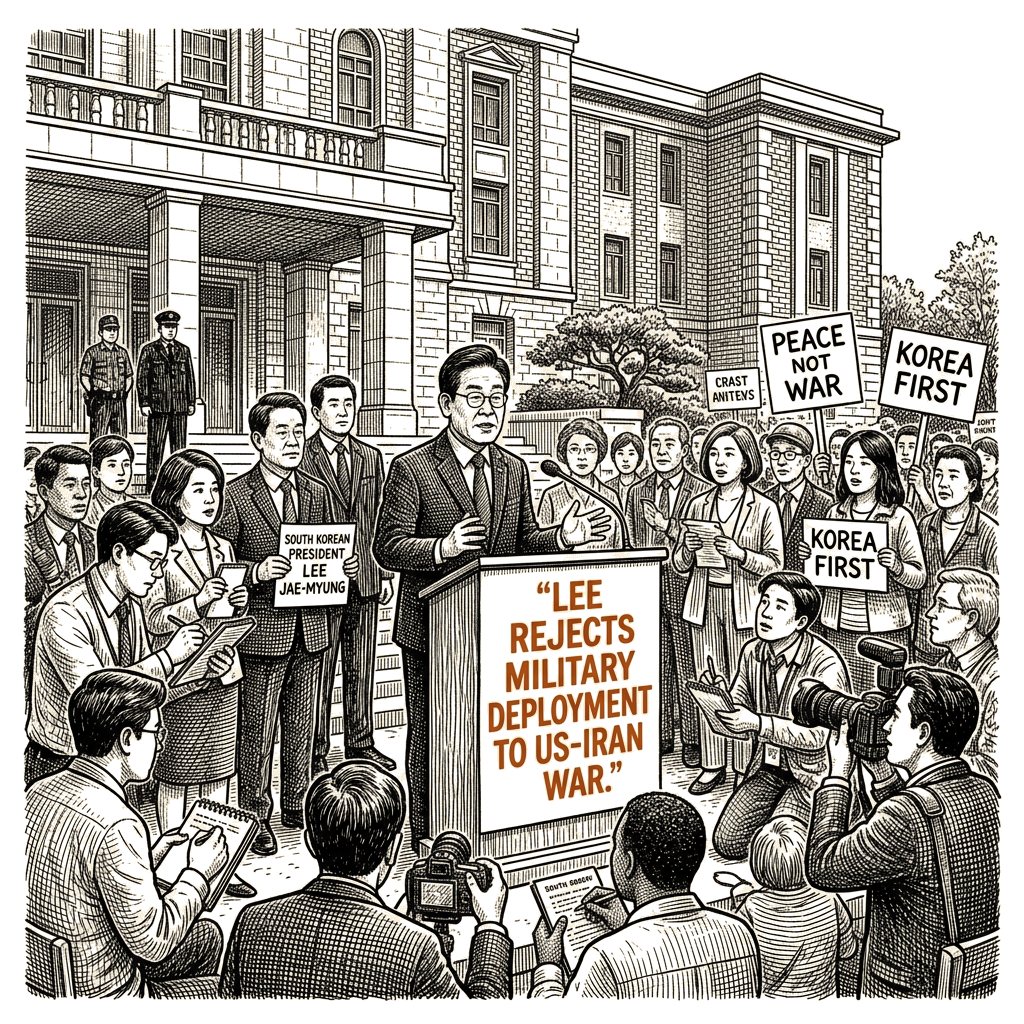
South Korean President Lee Jae Myung said Friday that his country would not deploy military assets that could draw it into the United States’ war in Iran, resisting calls from President Donald Trump to back the conflict. “There won’t be deployment that would involve or enter war. I can tell you that very clearly,” Lee told a news conference. “We won’t deploy military assets in any form to that end.” Lee distinguished the war axis from a parallel shipping-protection track, saying Seoul would do “the minimum” other countries do to safeguard Korean commercial shipping and people in the region. The Guardian reported the statement resolves recent speculation over whether Seoul would contribute forces to the Strait of Hormuz; the proposal had been proving unpopular domestically, with protesters rallying in Seoul against the potential deployment. The substrate documents the announcement as a structured multi-criteria outcome rather than as a binary refusal.
The decision architecture: a separable multi-criteria outcome
Lee’s Friday statement resolves into a structured decision architecture in which the war axis and the shipping-protection axis are scored independently rather than collapsed into a single alliance-burden criterion. The arrangement is consistent with multi-criteria weighting of the form where each criterion receives its own weight and the option set is evaluated criterion by criterion: a configuration that permits Seoul to retain credit on the lower-stakes navigation-protection axis while declining the higher-stakes war-deployment axis. The middle path Lee has chosen — no war deployment, paired with “the minimum” navigation-protection role other countries play — is the option that satisfies Lee’s stated no-war constraint while serving the outcome-quality criterion Lee has named as operative.
Six criteria are visible across Lee’s remarks and the surrounding reporting, arrayed in three categories. Outcome-quality criteria include alliance solidarity with the United States, characterized in the substrate as an “ally” relationship; protection of Korean nationals and commercial shipping and crude transit through the Strait of Hormuz; and success of the parallel North Korea track, with Lee quoted as saying, “What’s clear is that President Trump wants talks, and I want him to as well, and we’re continuing coordination to make dialogue between the North and the US possible.” Cost criteria include trade-deal leverage, with Lee identifying “the commercial viability” of the $350 billion U.S. investment package as “the main sticking point” in trade talks, and domestic political cost, with the substrate reporting that protesters rallied in Seoul against the potential deployment. Constraint criteria are signaled by Lee’s formulation — “There won’t be deployment that would involve or enter war. I can tell you that very clearly” alongside “We won’t deploy military assets in any form to that end” — a baseline he treats as not negotiable; the substrate does not specify whether the constraint is constitutional, statutory, or political. The substrate does not establish whether the cost criteria are inputs to the decision or consequences the decision accepts, nor does it name the load-bearing criterion for the choice.
The option set Lee’s framing centers and obscures
The fuller option set the substrate does not enumerate sorts against the criteria space as follows. Full deployment serves alliance-solidarity directly but violates the no-war constraint, accepts the documented domestic political cost, and accepts casualty-risk; the option is dominated on Lee’s stated rationale. Symbolic support preserves the constraint marginally and reduces domestic political cost but addresses none of the outcome-quality criteria the substrate identifies, leaving trade-deal leverage and shipping protection unaddressed. Shipping-protection deployment only — Lee’s stated middle path — preserves the constraint, addresses the shipping-protection outcome-quality criterion directly, and accepts reduced alliance-solidarity. Full non-entanglement preserves the constraint and serves domestic political cost, but fails the shipping-protection criterion the substrate reports Lee treating as operative. Expansion of the existing Somali anti-piracy mission only preserves the constraint but does not engage the geography of the strait. Within the criteria the substrate documents, the middle path is the option that satisfies Lee’s stated constraint while serving the outcome-quality criterion Lee has named as operative. The binary framing the substrate constructs — war deployment versus no war deployment, with a peripheral shipping question — centers this option and obscures the alternatives it dominates.
Place-conditioning: how the Strait of Hormuz shapes the option set
The structural features of the Strait of Hormuz shape the decision independent of the political debate. Read across the place-reading tradition-clusters, the strait offers extreme prospect and minimal refuge in the Appleton (1975) sense: any vessel in the passage is visible to shore-based observation and to surface assets on both sides, and cover is unavailable. For tanker operators, the geometry is pure prospect-and-hazard, with the hazard dominant. For naval commanders operating from platforms at the strait’s mouths, the geometry inverts — refuge at distance, prospect over the chokepoint. In Alexander’s (A Pattern Language, 1977) Pattern 30 vocabulary, the strait operates as an activity node where paths converge and community functions concentrate; Lee’s reference to “other countries” doing “the minimum” indicates Seoul treats the strait as a shared node requiring shared maintenance. Norberg-Schulz’s genius loci framework characterizes the strait as a contested chokepoint — narrow, valuable, dangerous, structurally cooperative at the same time it is structurally contested — whose character cannot be reduced to either “international waterway” or “war zone.” Kaplan’s attention-restoration framework, which conventionally treats restoration as requiring the “being-away” precondition of extended voluntary attention, scores the strait low on being-away (deployed personnel remain in a high-alert operational environment), low on compatibility (the strait’s character resists adaptation to non-operational use), and high on hazard. The strait is not legible in Lynch’s cognitive-mapping sense at the scale relevant to tanker operations, and Bachelard’s intimate-space vocabulary does not extend to this scale; the tradition-cluster gap is itself diagnostic: the strait is functional before it is representational.
Inhabitant variation across the same geography produces incompatible priorities. Tanker operators prioritize safe passage; naval commanders prioritize control; the Korean government weighs energy security and alliance friction; the United States prioritizes the war effort; Iran prioritizes sovereignty; UAE and Oman prioritize transit-state interests. The inhabitant-variation predicts a multi-criteria weighting for the Korean government specifically: energy security and alliance friction push toward shipping-protection, domestic political cost pushes away from war-deployment, and the constraint criterion anchors the position. The prospect-refuge geometry means shipping-protection deployment by an outside power operates from the mouths of the passage rather than from cover inside it, which limits the protective value of any “minimum” contribution and makes escalation the only way to expand the protective footprint. The chokepoint character predicts that both war-fighting and passage-protection strain the same narrow geometry, so options that escalate presence inside the passage increase hazard for the shipping they would protect. The place-reading does not predict Lee’s choice — the political reading does — but it constrains which of the options the multi-criteria frame identifies as politically feasible are also physically coherent.
The U.S. announcement architecture: weight-raising without treaty trigger
The U.S. announcement architecture operates in the same criterion space as Lee’s. The reported characterization of Seoul’s posture as “insufficient support” for the Iran war functions as a weight-raising act on the alliance criterion from outside the formal trigger structures. The reported U.S. scaling-back of major joint military drills this summer — described in the substrate as a move that unsettled Seoul — functions as a parallel weight-raising act, a curtailment that is itself framed as responsive to Seoul’s posture but that raises the marginal cost of further refusal without invoking any treaty-based escalation path. The bilateral security framework the substrate reports is described by both governments as an “ally” relationship. The substrate does not name a formal mechanism through which the United States has invoked allied obligations to compel expeditionary support; the U.S. framing has been conducted through the rhetoric of “insufficient support,” which presupposes the obligation it then complains is unmet. This gap between alliance expectation and formal trigger in the substrate’s reporting is itself a structural feature of the decision: it permits Lee to characterize deployment as a presidential choice rather than as an obligation discharge, and it gives the U.S. characterization the character of a political appeal rather than a treaty-grounded demand. The reported U.S. scaling-back of major joint military drills this summer compounds the gap — curtailment of the principal bilateral military instrument reduces the alliance-burden weight from the U.S. side even as the political-expectation rhetoric raises it from the other.
The shipping-protection dominance move
The shipping-protection move operates as a dominance move in the option set, geographically anchored to the Strait of Hormuz — the chokepoint named in the substrate as the proposed deployment zone. Lee’s appeal to a defined comparator — South Korea’s existing naval presence off Somalia as part of an anti-piracy mission — allows a Hormuz convoy-escort option to dominate “no contribution” on the alliance criterion while not sacrificing the political-tolerance criterion. Lee was reported to be reviewing whether to play a greater role in safeguarding navigation in the region. The phrasing “the minimum as other countries do” anchors the contribution to a multinational baseline rather than to U.S.-specified requirements, which is itself a weight-setting act that re-frames the contribution as navigation-protection-with-allies rather than as participation-in-the-Iran-war.
Sensitivity and robustness: where the decision can flip
Lee’s explicit separation — “There won’t be deployment that would involve or enter war. I can tell you that very clearly” alongside “We won’t deploy military assets in any form to that end” — is the rhetorical correlate of a decision-maker hedging against a weight perturbation that would otherwise flip the top choice. If domestic protests intensify, political tolerance alone could flip the outcome; if U.S. negotiators link trade-deal progress to deployment, the alliance and trade criteria could compress political tolerance from the other direction. Lee’s structuring preserves the trade-deal track as a separate criterion, evident in his identification of “the commercial viability” of the $350 billion investment package as “the main sticking point,” and in Seoul’s postponement of a parliamentary briefing on the investment plans to the following week. South Korea committed last year to invest $350 billion in U.S. manufacturing in exchange for Washington lowering tariffs on Korean imports to 15 percent.
Lee’s statement that a Trump–Kim meeting remained possible “in the coming months” but that “many factors needed to align” introduces the U.S.–DPRK criterion with a positive sign for Seoul regardless of the deployment outcome. Any dialogue that reduces peninsula tension reduces the strategic cost of refusing deployment by lowering the risk that a U.S.–Iran entanglement complicates Korean Peninsula security. The Wall Street Journal has reported that Trump has been pushing aides for a meeting with Kim as soon as autumn; against the backdrop of North Korean state media’s reported silence, this describes a track whose near-term probability is low enough that Lee can preserve it without paying for it in troops. The directional inference assumes the Trump–Kim track is at least partially substitutable for the alliance-deployment track; the magnitude and the assumption itself are uncertain.
The weighted ranking the announcement produces: shipping protection, high — the Hormuz escort option dominates “no contribution” on the alliance criterion while not sacrificing political tolerance; trade-deal preservation, high — separate track, with “commercial viability” identified as the main sticking point and a parliamentary briefing postponed; Trump–Kim facilitation, medium-positive — conditional on DPRK response and autumn meeting timing; political tolerance, binding constraint — caps the war axis and would flip the outcome with protest intensification or trade-deal linkage; war deployment, zero — declined explicitly. The decision is robust to small perturbations in any single weight except political tolerance, and Lee’s chosen announcement architecture — explicit separation, named comparator, appeal to a multinational “minimum” baseline, preservation of a parallel trade track — is the rhetorical signature of that robustness check. The U.S. side’s announcement architecture, by contrast, raises the alliance-criterion weight through rhetorical characterization and visible drill curtailment rather than through formal trigger mechanisms, leaving the formal-obligation dimension quiet while the political-expectation dimension grows. The residual analytical question is whether the trade-deal leverage Trump retains is sufficient to move Seoul from the middle path toward full deployment, or whether the domestic political room Lee has bought will hold against renewed pressure — and whether the path is robust to perturbations the substrate does not name: legal challenges to the deployment ceiling, regional escalation beyond the strait, North Korean movement on the diplomatic track.
Frame-audit: how the substrate positions the reader
The Guardian’s September 18 piece, classified in the source materials as a Tier 2 national-daily originating article, sits within UK national-daily conventions for allied-relations coverage. The headline framing (“defying Trump pressure”) and the structural choice to open with Lee’s direct quote and close with North Korean silence place the reader in a position to evaluate Trump’s posture through the lens of allied resistance rather than through the lens of U.S. strategic framing. Direct quotation from named principals carries primary weight; characterization of allied protest is reported as observed fact rather than framed through editorial attribution. The substrate supports Lee’s framing — presented as clear, principled, validated by a named protest constituency — and frames Trump’s posture as pressuring; the headline “defying Trump pressure” and the verb “resisting calls” establish the directional frame. Both sides receive direct quotation, but the structural choice — opening with Lee’s “There won’t be deployment that would involve or enter war” and closing with North Korean silence — centers Lee’s position.
On lexical and presupposition choices: “war in Iran” is accepted as established without independent characterization; “insufficient support” is presented as Trump’s framing rather than as independently assessed; “the minimum” establishes a floor and implicitly characterizes anything beyond as more than necessary; and “defying pressure” presupposes that pressure existed and that resistance was the response. Each choice is neutral in isolation; together they construct Lee as the autonomous decision-maker and Trump as the pressuring party. On source-dependence, the substrate draws on three sources: Lee’s news conference (primary), Trump’s public statements (secondary), and Wall Street Journal reporting on Trump–Kim coordination (tertiary). Lee’s news conference is the source for the no-deployment commitment, the shipping-protection framing, the trade-deal characterization, and the characterization of the drill scale-back as unsettling to Seoul; Trump’s public statements are the source for the “insufficient support” characterization; the Wall Street Journal is the source for the Trump–Kim autumn-meeting push. The substrate’s assertion that North Korean state media has “remained largely silent” on Trump’s outreach is the substrate’s own observation without independent corroboration. The domestic protest in Seoul is reported without named organizers, attendance figures, or sponsorship. No independent verification of the war situation, the scaled-back drills, or the trade-deal mechanics is presented. The conclusion most exposed to source-dependence is the trade-deal leverage assessment, which rests entirely on Lee’s characterization of “commercial viability” as the sticking point; if that characterization were independently contradicted, the multi-criteria weighting would shift toward alliance-solidarity as a relatively unconstrained cost criterion.
Substrate omissions
The substrate does not characterize the U.S. war in Iran beyond the locator “Strait of Hormuz.” It does not name the legal or constitutional framework Lee invokes. It does not detail Trump’s specific demands or the specific trade-deal elements beyond “commercial viability.” It does not explain why North Korean state media is “largely silent” on Trump’s outreach — only that the silence is notable. It does not establish whether the Seoul protests are the deciding political force or one input among several. It does not specify what “the minimum” means in terms of assets or personnel. Each omission is consistent with the originating substrate’s structural scope but leaves the analytical picture under-specified at points the public record would require.
Convergence: where the readings meet
The readings converge on a common structural observation. Lee’s middle path is a multi-criteria outcome — the option that satisfies Lee’s stated no-war constraint while serving the outcome-quality criterion Lee has named as operative, against alliance-solidarity and trade-leverage. It is a place-conditioned outcome: the strait’s affordances support passage-protection from outside the passage more naturally than war-fighting from inside it. It is reported through a frame that already centers Lee’s position while naming its source-dependence. The substrate closes on the North Korea track, where Lee reports Trump “wants talks” and that “many factors” must align; the silence of North Korean state media is described as a notable absence rather than as a fact about Kim Jong-un’s position — a silence the substrate cannot characterize and a silence the multi-criteria frame cannot score.
Analytical techniques used in this piece
This analysis applies the methods below. Each links to a short, plain-English explainer you can read and reuse.
- Multi-Criteria Decision Analysis
- Scores competing options against several weighted criteria at once.
- Genius Loci — Sense of Place
- Reads the character and felt quality of a place.
- Propaganda Audit
- Reads a message for propaganda technique — loaded framing, manufactured consensus, and demonization.