Summary
- Russia’s wartime parliamentary vote in the four Ukrainian regions it annexed in September 2022 documents a ballot administered through armed escort and house-to-house canvassing, with participation enforced through conditional access to wages, pensions, and humanitarian assistance.
- According to The Associated Press, the ballot is intended to secure Kremlin political dominance and showcase public support for the war, with Russian President Vladimir Putin framing the territories as having been “reunified” with Russia.
- The European Union, Ukrainian authorities, and a coalition of nine Ukrainian human rights groups uniformly characterize the vote as illegal, with European Commission spokesperson Christian Wigand describing it as “another blatant violation of international law.”
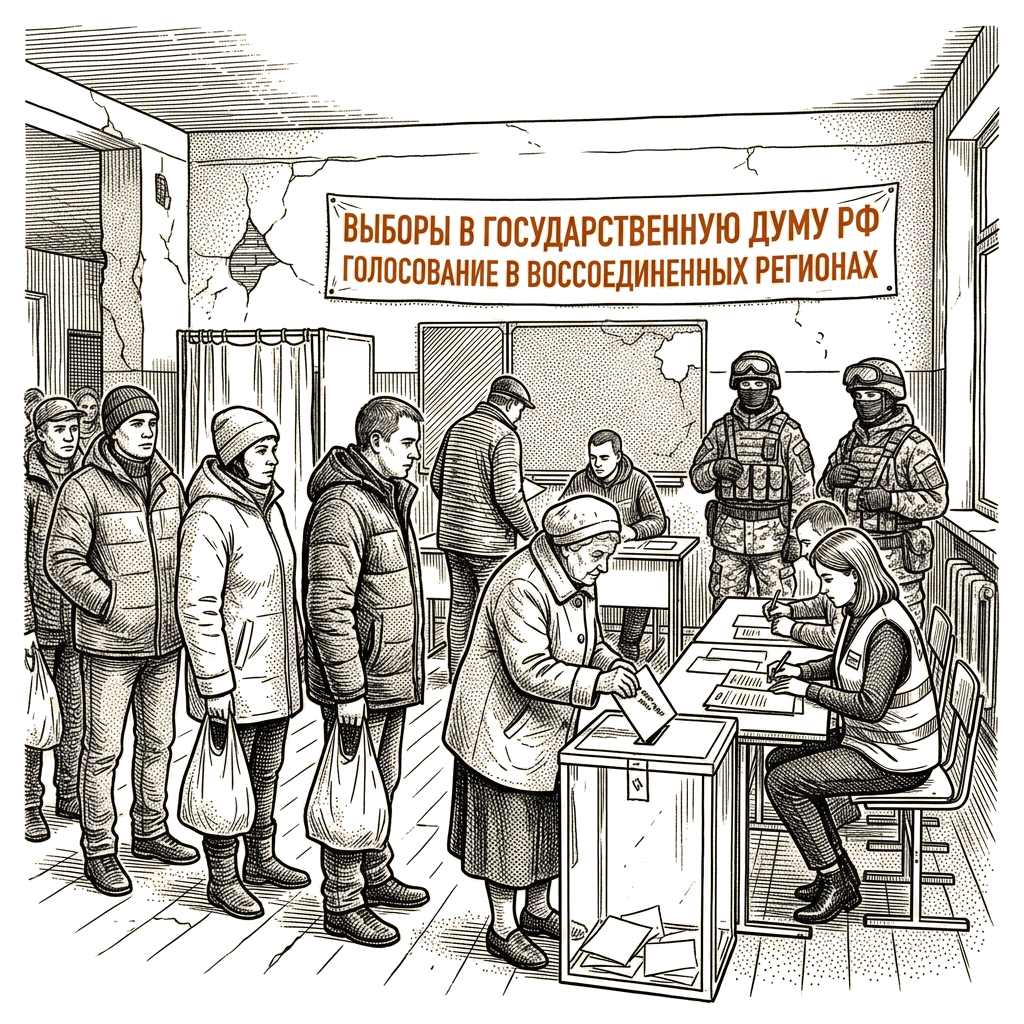
- Read against spatial conventions that ordinarily support democratic voting, the polling-station scene — armed guard, open ballot box, door-to-door canvassing of domestic dwellings — registers the inverse of the civic geography on which the act of voting depends.
Russia opened a three-day nationwide parliamentary vote on Friday, the first held since the start of its full-scale invasion of Ukraine more than four and a half years ago, with voting for the first time extended to residents of the four Ukrainian regions Moscow annexed in September 2022: Donetsk, Luhansk, Kherson, and Zaporizhzhia. Russian authorities describe these territories — collectively referred to by Moscow officials as “the new regions” — as having over 3.5 million voters. Voting in the annexed regions and in some Russian border areas began at the end of August, with Russian officials citing “security reasons” for the extended period. At one polling station in the Russian-held part of the Donetsk region, voters dropped their ballots in a box as an armed Russian soldier stood nearby and watched.
How participation is being secured
According to Violeta Artemchuk, coordinator of the Donbas SOS human rights group and a signatory to a coalition statement by nine Ukrainian human rights groups, members of local election commissions are moving through the occupied territories escorted by Russian troops and security agents, conducting house-to-house canvassing. Moscow-appointed officials exert pressure on residents in documented ways: public-sector employees are threatened with dismissal if they fail to vote; pensioners and persons with disabilities are told their pensions, social payments, and humanitarian assistance are conditional on participating.
“For instance, if a person with a disability or a pensioner relies on social assistance and does not take part in the ‘voting,’ they could be added to a list of individuals deemed ‘disloyal’ to the so-called authorities and subsequently deprived of their benefits or humanitarian assistance,” Artemchuk said.
The conditionality mechanism operates as a parallel civic infrastructure alongside the vote itself, converting voting from a discrete ritual into a continuing condition of subsistence. The voter is continuously indexed; the election persists past the polling period. The extended voting window — three days nationwide, with voting in the annexed regions and some Russian border areas beginning at the end of August — operationalizes the door-to-door escorting, with the temporal structure functioning as the enforcement technology. The “security” rationale Russian officials cite and the effects Artemchuk describes are aligned.
Who the vote serves
The vote serves the Russian state’s domestic-legitimation calculus. In a Wednesday speech, Putin framed the ballot as a demonstration of national unity behind the war effort. Residents of the four regions, Putin said, are voting “for the first time since their reunification with Russia.” His framing extended further: “Your choice and resolve will once again demonstrate that millions of people stand behind our fighters, that we are a united people, bound by shared values, historical memory, and love for the Motherland and that nobody can divide or intimidate us, undermine our statehood and political system.”
According to The Associated Press, the ballot’s intended effect is to secure the Kremlin’s political dominance and showcase public support for the war. The unanimity of international rejection documented in advance of the vote is the backdrop against which Putin’s in-group framing is delivered. Voting is also taking place in Crimea, the Black Sea peninsula the reporting records as illegally annexed by Moscow in 2014 — establishing the institutional template now applied to the four regions, though the reporting notes Moscow does not fully control all of the annexed territory in 2026.
Civic geography inverts at the polling station
Jay Appleton’s prospect-refuge theory characterizes environments by their balance of visibility, shelter, and hazard. Applied to the polling-station scene documented at one Donetsk-region location, the polling station offers neither refuge nor balanced prospect: visibility is forced (a soldier watches; the ballot box is open), concealment is foreclosed (a list of “disloyal” persons can be compiled from non-participation), and hazard is staged from inside the safety the room was supposed to provide — the maladaptive variant Appleton’s framework identifies as producing background anxiety rather than dramatic intensity.
Christopher Alexander’s pattern language identifies Pattern 61, the small public square, as the civic pattern that makes public gathering possible by being small enough to feel populated. Under that frame, the polling station has been re-engineered to inhibit the gathering it formally enables; the room reads as a polling station but functions as a checkpoint.
Gaston Bachelard’s topoanalytic vocabulary treats the house as a topology of corners, thresholds, and folds. The most consequential spatial detail in the reporting — the door-to-door escorting of election workers by Russian troops and security agents — collapses the distinction between civic and domestic space; the house is reclassified as an extension of the public sphere; the “corner” as topological fold is precisely where the election worker now arrives.
Kevin Lynch’s five-element vocabulary — paths, edges, districts, nodes, and landmarks that organize an inhabitant’s mental map — describes the spatial grammar the ballot is rewriting. The ballot is one instrument of that rewriting: Moscow, not Kyiv, becomes the orientation center, and the polling station functions as Lynch’s node within the mental map being rewritten, with the State Duma as its institutional referent.
Christian Norberg-Schulz’s genius-loci framework holds that the qualitative-total character of a place is the sum of natural place (landform, light, climate) and man-made place (built form, settlement pattern, symbolic content of architecture). The genius loci of Donetsk, Luhansk, Kherson, and Zaporizhzhia has been in legal-political dispute since the September 2022 annexation declarations, which the reporting records as not internationally recognized; the genius loci has been administratively overwritten since then, with Russian officials now referring to the territories as “the new regions.”
Rachel and Stephen Kaplan’s attention-restoration framework evaluates settings by four properties: being-away, extent, fascination, and compatibility. A place scoring low on being-away, low on compatibility, and high on intrusive demand is cognitively depleting rather than restorative. Under that frame, the occupied territories register at the cognitively-depleting end of the scale.
International rejection as a frame
Three clusters of named entities organize the response documented in the reporting. Russian state actors — Putin, the State Duma, Russian authorities — frame the ballot as reunification and national unity. The occupied-territory population is addressed through Moscow-appointed officials, election workers, Russian troops, and security agents. International rejection is voiced by the European Commission (Wigand), Ukrainian authorities, and the coalition of nine Ukrainian human rights groups.
Wigand said the voting in Russian-held regions represented “another blatant violation of international law. The European Union does not, and will never recognize either the holding of these, so-called elections, sham elections, in the temporarily occupied territories of Ukraine or their results.”
Ukrainian authorities called the vote illegal and urged foreign governments and international organizations not to recognize the election; they warned Ukrainians that taking part in organizing the vote could carry criminal liability.
The coalition of nine Ukrainian human rights groups issued a statement: “We urge residents of the temporarily occupied territories, above all, to protect their lives and health and to look after their own safety. Holding Russian elections in the temporarily occupied territories is an attempt to use the electoral process to legitimize the Russian occupation and the attempted annexation of Ukrainian territories.”
Volodymyr Fesenko, political analyst with the Kyiv-based Penta Center, said: “elections held at gunpoint are a farce. The very fact that voting takes place amid endless shelling and bombing reflects the Kremlin’s attitude toward the people and the electoral process in the occupied territories. It’s nothing short of a mockery. Any electoral procedures conducted by the Russian occupation authorities have nothing to do with democracy.”
The international rejection documented connects the European Union, Ukraine, and Ukrainian human rights groups to a non-recognition position stable since the 2022 annexation declarations.
What precedent and probability suggest
The closest reference class is elections staged by an occupying or controlling power in foreign-held territory: the 2014 Crimea referendum and subsequent Russian elections in Crimea; elections in Abkhazia and South Ossetia under Russian influence; Iraqi elections under occupation in 2005; elections in Bosnia under Office of the High Representative supervision; elections Russia has held in Transnistria. A near-uniform pattern is documented: votes staged by an occupying or controlling power receive recognition only from that power and a small set of aligned states.
Calibrated probabilities drawn from the substrate:
- Probability the vote shifts the international posture in any of the non-recognizing states: low single digits.
- Probability the vote consolidates the domestic Russian political effect described in The Associated Press’s reporting: 70–85 percent.
- Probability the vote changes the on-the-ground calculus for residents of the occupied territories: equivocal, depending on whether the conditionality mechanism becomes durable administrative infrastructure or is withdrawn after the voting period closes.
Discriminating observables within the 70–85 percent domestic-consolidation band: whether announced turnout figures in the annexed regions fall within or below the Russian-reported ranges from comparable previous votes (Crimea 2014–2021, South Ossetia, Transnistria); whether post-vote Russian state-media coverage emphasizes the “reunification” framing versus turnout numbers. Inverse readings on both observables would push the band into the 30–55 percent range. Pre-committed update triggers include announced turnout figures when released, any post-vote statements by residents or election workers that surface through international reporting, and whether the conditionality mechanism persists past the voting period.
Russia’s Central Election Commission will report a turnout figure and a result consistent with the political dominance the reporting identifies as the vote’s intended effect. International recognition will remain at its current baseline, limited to Russia and a small set of aligned states, with no movement from the European Union, Ukraine, or the broader international community. The primary measurable effect is internal: the institutional fact of State Duma representation for the four regions becomes a documented element of Russian domestic political geography, whatever its standing in international law. The historical record on votes staged under occupation suggests that institutional facts created through the mechanisms documented in the reporting are typically durable only as long as the security environment that produced them holds.
Rejection as the ritual’s other half
The three analytical registers converge on a shared finding. Read through spatial analysis, the vote registers as an attempt to install a man-made civic layer on a lived environment whose prior character has not been erased by the act of voting and whose inhabitant population is being administered through an enforcement infrastructure that extends voting from a discrete act into a continuing condition. Read through probabilistic forecasting, the international legitimation yield is forecast to be very low and the domestic consolidation yield substantial. Read through the relationships documented in the response, the unanimity of rejection is itself a resource the vote consumes — a finding neither the spatial nor the probabilistic readings reach alone.
The ballot box under armed guard, read as a place, supplies the first reading; read as an election, supplies the second; read as a ritual with a built-in rejection, supplies the third. Fesenko’s framing registers the spatial inversion from inside the occupied-territory context; Wigand’s framing registers it from the European institutional context; the unanimity of those two readings, neither of which the vote can absorb without the other, is the joint finding. The vote and its rejection are two ends of the same ritual, each presupposing the other.
Analytical techniques used in this piece
This analysis applies the methods below. Each links to a short, plain-English explainer you can read and reuse.
- Genius Loci — Sense of Place
- Reads the character and felt quality of a place.
- Probabilistic Forecasting
- Puts calibrated probabilities on what happens next.
- Relationship Mapping
- Extracts the network of ties among people, institutions, and entities.
- Bayesian Reasoning
- Starting from base rates and updating beliefs proportionally as evidence arrives.
- Principal–Agent Problem
- An agent acting for a principal has its own interests, which can quietly diverge.