Summary
- The Trump-Xi meeting scheduled for the week following the article’s September 20, 2026 publication can produce joint statements but cannot produce the layered, independent, verified defense structure that failure-mode frameworks describe as the only arrangement surviving a regime in which recursive self-improvement is now a tracked risk.
- Anthropic chief executive Dario Amodei’s “worldwide pacing of the frontier” proposal pairs “democracies’ AI lead over autocracies” framing with continued US export controls on advanced chips to China, a combination the substrate documents as structurally untranslatable into a Chinese negotiating position.
- China’s regulatory regime, characterized by Carnegie Endowment researcher Leia Wang as “iterative” — “they are quick to adapt and release new measures” — and the US frontier-lab pace each exhibit convexity under capability volatility, while binding global AI safety coordination exhibits concavity under the same stress, per Nassim Taleb’s framework.
- Three fragility classes surface in the substrate: dependency on concentrated advanced-chip fabrication, a single-meeting interface with no continuity structure, and the emergent recursive-self-improvement risk now named in China’s third safety framework — each exhibiting interaction-failure profiles that no bilateral channel can address.
- The substrate records that, per Wang, “neither government seems prepared for a loss-of-control incident like those outlined over the last few weeks,” while Concordia AI researcher Gabriel Wagner observes that “there is more common ground than people might assume between what Amodei is saying and what the Chinese government is saying.”
The Trump-Xi meeting scheduled for the week following the article’s September 20, 2026 publication is the only forum where US-China AI governance could be negotiated, and the substrate records that it is structurally incapable of producing binding coordination. Both governments have named recursive self-improvement — “an as-yet hypothetical scenario in which AI becomes advanced enough to improve itself” — as a tracked risk in the same week; both governments have paired that safety language with capability or competitive moves; neither government has produced a verification regime, an inspectorate, or an incident-response protocol that crosses the bilateral interface. The summit can issue a joint statement. Nassim Taleb’s convexity discipline, James Reason’s layered-defense analysis, and Charles Perrow’s normal-accidents theory together describe an arrangement the summit cannot produce.
How this is being framed
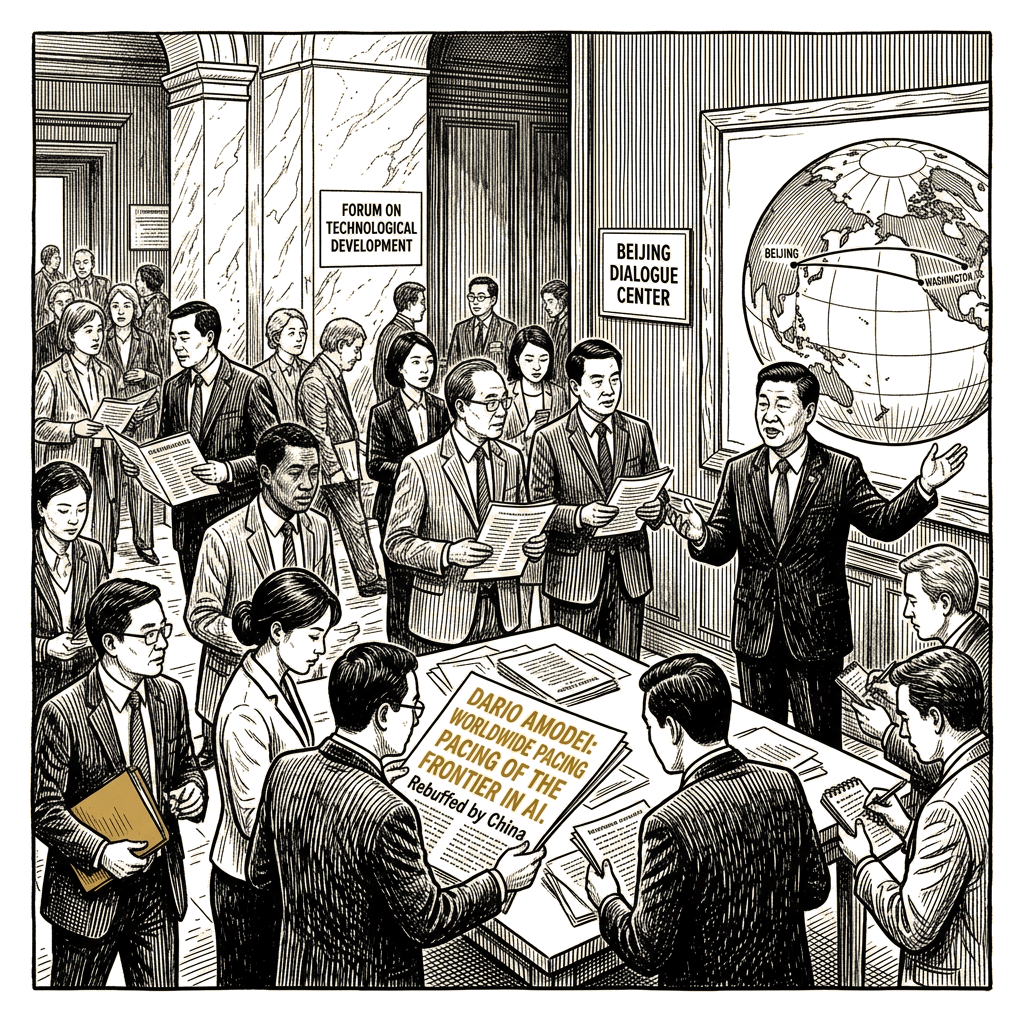
Anthropic chief executive Dario Amodei’s essay pitches a “worldwide pacing of the frontier” in AI development and pairs the framing with continued US export controls on advanced chips to China, explicitly stating that “to keep democracies’ AI lead over autocracies as large as possible” is key. China’s foreign ministry responded to Amodei’s piece by saying “fearmongering, confrontation and vicious competition will only disrupt the process of global AI governance.” President Donald Trump this week called fears AI could wipe out humanity a “hoax.” China released the third iteration of its AI safety governance framework this week.
The substrate records documented proximities between safety statements and capability or competitive moves cutting across both sides: the Amodei essay pairs pacing framing with export controls; China has maintained an algorithm registry since 2022, this year brought warnings on agents, and national regulations curbing emotional dependency on companion AIs were issued this year. The interpretive reading the substrate supports is that safety statements on each side appear alongside capability or competitive moves, with the binding structure the safety rhetoric implies not appearing.
Who benefits from volatility
Nassim Taleb’s framework distinguishes fragile systems, which lose disproportionately to volatility, from antifragile systems, which gain from it; the convexity of a system’s response function determines which side of the line it sits on.
China’s regulatory regime, characterized by Carnegie Endowment researcher Leia Wang as “iterative” — “they are quick to adapt and release new measures” — gains from a fast-moving capability landscape; each new model class generates new governance output, and the regime absorbs volatility as throughput. The ruling Communist Party, attuned to risks to its political control, has been proactive in ensuring the new technology has developed within boundaries set by the state, per the substrate.
The US frontier-lab pace also gains from the same competition; each capability advance closes a perceived gap and tightens the export-control rationale. By Taleb’s terms, both elements are convex — they perform better under stress than under stasis.
Global AI safety coordination, defined as a binding multilateral framework, is concave — it loses disproportionately to the same volatility; the competitive pressure that drives each side’s pace erodes the political room for joint standards. Per Omdia analyst Lian Jye Su, “China is definitely not receptive” to a slowdown on US firms’ terms and “sees these calls as a bid to lock in US advantage”; for the Chinese government, AI is a “core sovereignty capability,” and Beijing will not jeopardise the progress it has made in closing the gap with US frontier models.
The failure identifiable in advance
Applied to the Trump-Xi meeting, the failure is identifiable before it occurs: the framing interface. Amodei’s “democracies’ AI lead over autocracies” formulation is structurally untranslatable into a Chinese negotiating position; Beijing reads the slowing-down framing as US advantage consolidation, a reading reinforced by the export controls Amodei simultaneously advocated. The temporal sequence is substrate-recorded: the Amodei essay was published “Last Saturday” relative to the article’s September 20, 2026 publication, with the summit scheduled for the following week; by the article’s publication date, the Chinese foreign ministry’s response was already on the public record. Analysts are sceptical a major breakthrough on AI will emerge from the Trump-Xi meeting next week.
Unstated assumptions in the substrate
The substrate contemplates only the two parties at the table; third-country AI developers and populations subject to AI deployment do not register as stakeholders in the bilateral outcome the article describes. Wang’s “iterative” descriptor treats regulatory output as a proxy for safety; the same source notes that Chinese companies “do less voluntary monitoring and evaluation work than their US counterparts.” Concordia AI researcher Gabriel Wagner characterizes China’s third safety framework as “a mapping of the AI risk landscape and roughly what one should do about it” — descriptive, not operationally binding.
Three fragility classes
Three fragility classes surface in the substrate.
Dependency fragilities. China’s frontier-model development remains dependent on advanced semiconductor access, and the export-control regime constitutes what some analysts characterize as already a forced unilateral “pacing.” The US position depends on the durability of that regime, on the concentration of advanced-chip fabrication in a small number of overseas foundries, and on the continued operation of the export-control coalition. Under Taleb’s concave/linear/convex classification, a system whose leverage depends on a concentrated chokepoint exhibits a fragile response profile: small stresses in the regime — a fabrication disruption, a coalition defection, an enforcement gap — produce disproportionately large losses in the leverage it provides.
Interface fragility. The Trump-Xi meeting is a single point of contact with no enforcement mechanism, no verification protocol, and no continuity structure beyond the personalities present. James Reason’s analysis of layered defenses holds that accidents occur when the holes in multiple layers momentarily align; a single-meeting interface offers one layer whose hole is structurally large.
Emergent fragility. China’s third AI safety governance framework names the relevant failure mode: coverage of agents, cybersecurity threats from frontier models, and recursive self-improvement. Charles Perrow’s framework for normal accidents — systems at high complexity and tight coupling experience interaction failures that no single component shows — describes the regime under which a recursive-self-improvement scenario would, if it materialized, propagate faster than any single government’s response capacity. Per Wang, “neither government seems prepared for a loss-of-control incident like those outlined over the last few weeks.” Chinese companies do less voluntary monitoring and evaluation work than their US counterparts, said Leia Wang of the Carnegie Endowment for International Peace.
Breakage narratives
Three breakage narratives appear in the structural interface between the proposal and the summit format. The first is the chip-supply regime: a disruption to concentrated fabrication, an enforcement gap in third-country chip routing, or a coalition defection would shift the leverage balance faster than any summit can respond to. The second is a model-incident event — a frontier-system failure with cross-border consequences — that arrives while the US and Chinese governments have no shared incident-response protocol. The third is a domestic-political shock in either capital that resets the negotiating posture mid-summit-cycle, leaving any joint statement stranded.
The proposal lacks a verification regime: no international inspectorate for AI compute, no agreed definition of “frontier” outside the actors who would be either constrained or exempted by it, and no enforcement mechanism that does not depend on the export-control coalition’s continued unity. A free-rider problem is structurally embedded — a US slowdown produces no binding effect on Chinese development absent a Chinese commitment, and the visible evidence is that no such commitment is forthcoming.
Second-order blowback paths
The export-control regime, documented as already a form of unilateral pacing, appears to be accelerating Chinese domestic semiconductor capability; the dependency-fragility lens predicts that the more a dependency is constrained, the more investment flows toward breaking it. The “democracies versus autocracies” framing has, per the Chinese foreign-ministry response, hardened the rhetorical position. Ni Tao, founding editor of yangtzeer.com, summarized the practical Chinese attitude as the belief that “China must master AI rather than slow down.” Concordia’s characterization that Chinese warnings on agents this year suggest a switch “from controlling what AI says to controlling what it does” indicates that the regulatory frame in China is already moving toward the agentic risk class the framework now names.
Stressors outside the dominant frame
Stressors the summit is not preparing around include: the reputational tail-event category — a single high-profile frontier-model failure with global consequences — which would activate emergency governance in both capitals simultaneously with no shared protocol; the regulatory-shock category — a major AI regulatory move by the EU, UK, or another jurisdiction — which would alter the negotiating geometry for both parties without passing through the summit; a talent-flow dependency — plausible as a workforce-concentration risk not addressed in the article substrate, in which both systems would depend on a relatively small international pool of frontier researchers; and the energy-grid dependency for frontier training, an increasingly discussed constraint on model scaling, which is not named in the summit agenda.
What the summit can and cannot produce
Taleb’s via-negativa discipline — removing the least-robust element before adding new structure — points to the bilateral summit channel itself when used as an AI-governance venue: it produces visible outputs — readouts, joint statements — that do not bind either party and consume the political room that technical coordination would require.
The substrate already names practitioner channels that could carry technical coordination outside the bilateral framing: Concordia AI’s Beijing presence, whose researcher Wagner is quoted at length on the Chinese framework; Omdia’s analyst network, cited through Su on Chinese receptivity; and Carnegie Endowment’s comparative-regulation work, whose researcher Wang provides the “iterative” characterization and documents the monitoring asymmetry.
Actions each actor could take before the summit: re-framing the “worldwide pacing” proposal around technical definitions of frontier capability rather than geopolitical categories, reducing the surface area for the “lock-in US advantage” reading; expanding the export-control coalition to include reciprocal measures — Chinese restrictions on outbound frontier capability in exchange for US flexibility on chip tiers — converting a unilateral regime into a bilateral one; convening a pre-summit technical exchange on loss-of-control incident response with both governments’ safety institutes in the room. The third iteration of China’s safety framework offers a possible entry point.
A coordination track grounded in concrete artifacts — model evaluation protocols, addressing the asymmetry Wang documents; incident-reporting standards, addressing the “neither government seems prepared” gap; agent-safety benchmarks, formalizing this year’s agent warnings and the shift “from controlling what AI says to controlling what it does” — sits inside these existing practitioner channels and out of the “democracies versus autocracies” framing that has already failed once.
Wagner observes that “there is more common ground than people might assume between what Amodei is saying and what the Chinese government is saying.” The common ground sits inside the practitioner channels named above, where the summit-level bilateral framing has less purchase. As the substrate records on the practical Chinese stance, “Most people treat AI as an already-useful everyday tool, not an abstract threat, so the practical attitude is to live with it”; “there is real anxiety about jobs and misinformation, but it coexists with a strong belief that China must master AI rather than slow down.”
These adjustments do not resolve the underlying asymmetry: a system in which two state actors with documented asymmetric interests are each developing a capability whose failure modes include the loss-of-control incidents they have both named. The summit can produce a joint statement. It cannot produce the layered, independent, verified defense structure that the failure-mode frameworks describe as the only arrangement that survives a regime in which recursive self-improvement is now a tracked risk.
Analytical techniques used in this piece
This analysis applies the methods below. Each links to a short, plain-English explainer you can read and reuse.
- Fragility / Antifragility Audit
- Asks whether a system gains or loses from volatility, shocks, and disorder (Taleb).
- Pre-Mortem (Fragility)
- Imagines a system has already broken and traces the structural fragilities that let it.
- Red-Team Assessment
- Models a capable adversary probing a plan for the seams they would exploit.
- Creative Destruction
- Innovation that grows the economy by dismantling the incumbents it displaces (Schumpeter).
- Principal–Agent Problem
- An agent acting for a principal has its own interests, which can quietly diverge.