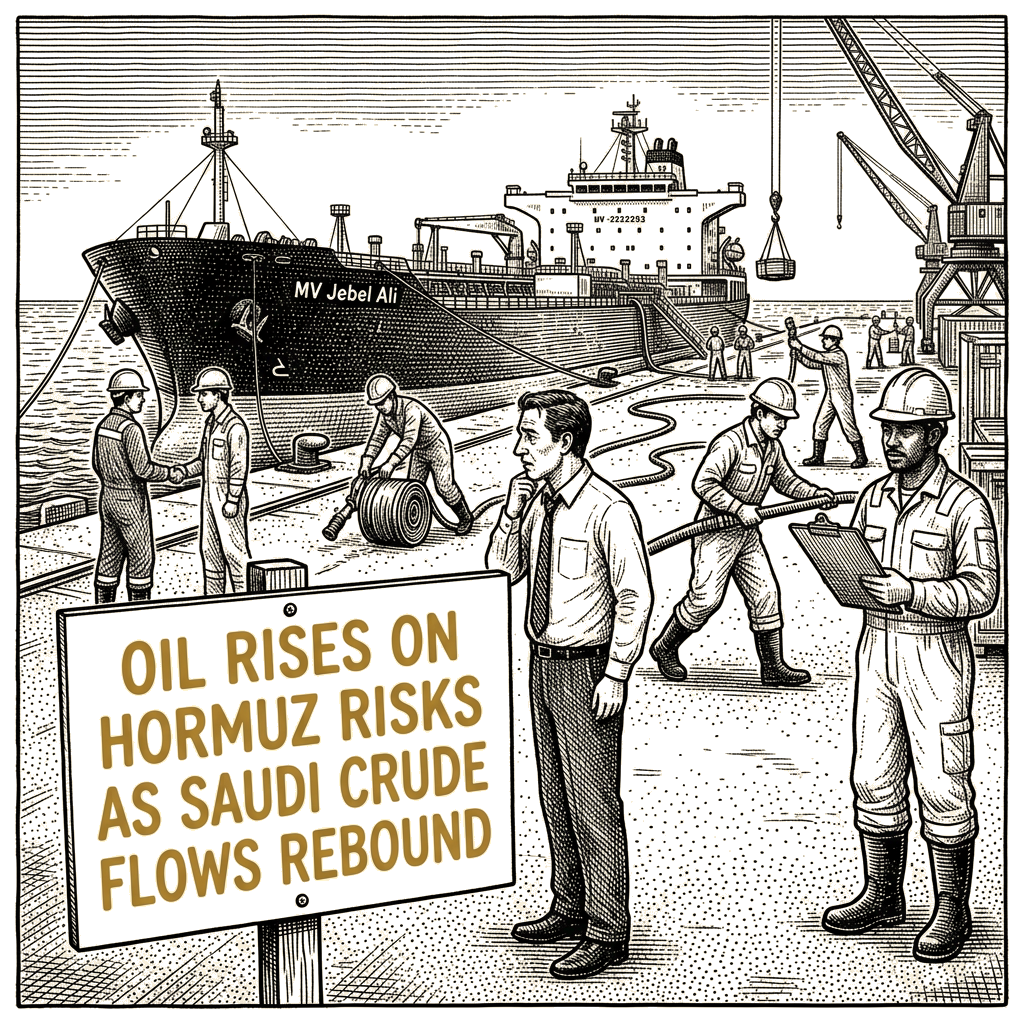
The Saudi export system has shifted, in roughly six weeks, from a two-path design to a one-path design: the East-West Pipeline, which had carried crude from Saudi Arabia’s eastern oil fields to the Red Sea port of Yanbu, was shut “earlier this month as a precaution after attacks in the Riyadh and Medina regions,” according to the Saudi Press Agency. Since then, roughly 2.4 million barrels a day of Saudi crude and condensate have flowed through the Strait of Hormuz, Kpler data show, with the four-week average of Saudi loadings from inside the Persian Gulf rising above 2 million barrels a day — up from “virtually zero for most of June and less than 1 million barrels a day in July,” Vortexa figures indicate. That concentration of throughput defines the structure under analysis.
Two market positions on the resulting volatility sit in sharp contrast. Operators of very large crude carriers stand to absorb a disproportionate share of the rents. Michael Haigh, head of commodities research at Societe Generale, reported that the cost of moving a cargo from Saudi Arabia’s Ras Tanura terminal to Ningbo, China has risen to “nearly $63 million per voyage from around $4.5 million before the conflict” — a freight-rate multiple whose inverse accrues to whoever controls the hulls capturing that incremental voyage value. On the other side sit Saudi Arabia itself, Asian refiners, and any counterparty tied to Hormuz-transit routes that cannot be substituted. The Wall Street Journal, citing people familiar with the matter, reported Saudi Aramco has asked several Asian customers to take deliveries off Oman instead of at Persian Gulf terminals — a contractual pass-through that distributes the cost downstream without resolving the structural imbalance. On the freight market’s other side sits an exposure the elevated voyage costs mask rather than resolve — the rents appear to flow to vessel owners without necessarily building alternative routing capacity.
Three load-bearing elements of the current structure carry the highest strain and would yield first if stress intensified. The first is the Gulf of Oman ship-to-ship transfer zone, where Kpler reports activity “has surged to record levels” as Saudi Aramco moves crude from Persian Gulf terminals to delivery tankers. Concentration at a single offshore hub means a successful attack, regulatory closure, or sustained capacity exhaustion would not merely throttle throughput — it would eliminate the workaround currently masking the pipeline outage. The second is the very large crude carrier fleet: Kpler estimates that redirecting 3 million barrels a day of Saudi crude would require an additional 36 to 40 VLCCs in its base case, “and as many as 58 VLCCs” if transfers were pushed as far as Malaysia, against the approximately 25 needed if transfers stayed in the Gulf of Oman. The third is Bab el-Mandeb: Saudi-flagged vessels have stopped transiting that strait following attacks by Yemen’s Iran-backed Houthi rebels, and “more than a dozen Saudi vessels have rerouted around South Africa’s Cape of Good Hope,” according to maritime-intelligence firm Windward. A second shipping chokepoint closure would, on the substrate’s evidence, compound rather than relieve the Hormuz exposure — the Cape rerouting already underway documents the dynamic.
The leading indicators visible in the present data describe a system approaching rather than breaching its break threshold. They include the voyage-cost multiple (Haigh’s figure is the most quantitatively specific proxy), the record Gulf of Oman transfer volume (a capacity-saturation signal), the Monday projectile strike on a tanker entering the strait — which U.K. Maritime Trade Operations said injured two crew members — and the rerouting of more than a dozen Saudi-flagged vessels around the Cape. Each appears independently in the substrate; their simultaneous presence describes a structure under compounding stress, with the East-West Pipeline sitting offline for as long as the Riyadh and Medina attack environment persists.
The distinction any fix must respect runs through several layers. The proximate trigger for higher prices and longer voyages is the shipboard threat to Hormuz traffic, illustrated by the Monday strike. One sub-layer beneath that is the Saudi pipeline shutdown, itself a defensive response to attacks in the Riyadh and Medina regions per the Saudi Press Agency. A further sub-layer is the threat environment in which both maritime and inland Saudi infrastructure face targeting by distinct but overlapping actors — the Houthis in the maritime domain, with the Riyadh and Medina actors unnamed in the substrate but operating in the same general threat surface. A response that secures Hormuz traffic but does not address the land-attack vector leaves the original vulnerability intact, because the East-West Pipeline’s reopening is the specific sub-cause whose removal most directly restores path redundancy. Conversely, a diplomatic track that lowered the threat environment on both vectors would feed back into pipeline reopening and voyage-cost normalization; that is the channel U.N. Secretary-General Antonio Guterres referenced when he said dialogue between the U.S. and Iran “would probably take place elsewhere” than New York, a development that Lukman Otunuga at FXTM said could weigh on prices by “raising expectations for increased regional supply.”
The recurring property is captured by one observation in the article itself: U.S. Central Command reported that the volume of oil, natural gas, and cargo passing through the strait over the past two weeks reached “its highest level in six months,” even as the Monday strike and a second tanker-hit-by-debris incident occurred. Traffic holds because the actors involved absorb the cost, not because the system has absorbed the risk. The decisive subtraction would be reopening the East-West Pipeline; the principal addition would be expanding VLCC supply and dispersing ship-to-ship transfers into Sri Lankan or western Indian waters, where capacity has not yet been tested at scale. The substrate does not name a release valve independent of political settlement, and the most recent data do not indicate that one is being built under existing market pressure.
Analytical techniques used in this piece
This analysis applies the methods below. Each links to a short, plain-English explainer you can read and reuse.
- Fragility / Antifragility Audit
- Asks whether a system gains or loses from volatility, shocks, and disorder (Taleb).
- Pre-Mortem (Fragility)
- Imagines a system has already broken and traces the structural fragilities that let it.
- Root-Cause Analysis
- Traces a symptom back along its causal chain to the conditions that actually generated it.