Summary
- Brent crude’s sixth consecutive session of decline to $98.32 per barrel on Wednesday priced three independent channels — Saudi Arabia’s reported east-west pipeline restart, Trump’s simultaneous “progress” claim and “annihilate” threat on Iran, and Xi Jinping’s expected Washington visit with AI-cooperation speculation — as a coherent package rather than as isolated signals.
- Saudi Arabia’s resumed east-west pipeline operations and exports from Yanbu, which Reuters reported citing sources “may have already” restarted, added observable supply into a market already weighing the probability of an Iran deal, reinforcing downward pressure implied by both supply and diplomatic channels.
- Joseph Farrell and Matthew Rabin, in their 1996 survey of the game-theoretic literature on cheap talk, characterize Trump’s conditional threat to “annihilate” Iran absent a deal — issued alongside a claim of “progress” — as “cheap talk” lacking a binding commitment device, with Brent’s sustained decline indicating traders priced the diplomatic track above the conflict scenario.
- Asian equities separated into AI-linked gains outside China — South Korea’s Kospi up nearly 0.7%, Taiwan up 0.75% — and a 0.5% decline in China’s CSI 300, indicating investors treated Chinese equities as a distinct allocation from the broader AI-driven Asia trade in a separating equilibrium that holds only while US-China truce expectations remain intact.
- The dollar climbed to a two-month high on interest-rate-hike expectations while sterling fell 0.2% to $1.3316 and the euro eased 0.2% to $1.1423, its weakest level since July, with the dollar-commodity co-movement on the date consistent with the rate channel dominating the commodity channel under one reading of the substrate.
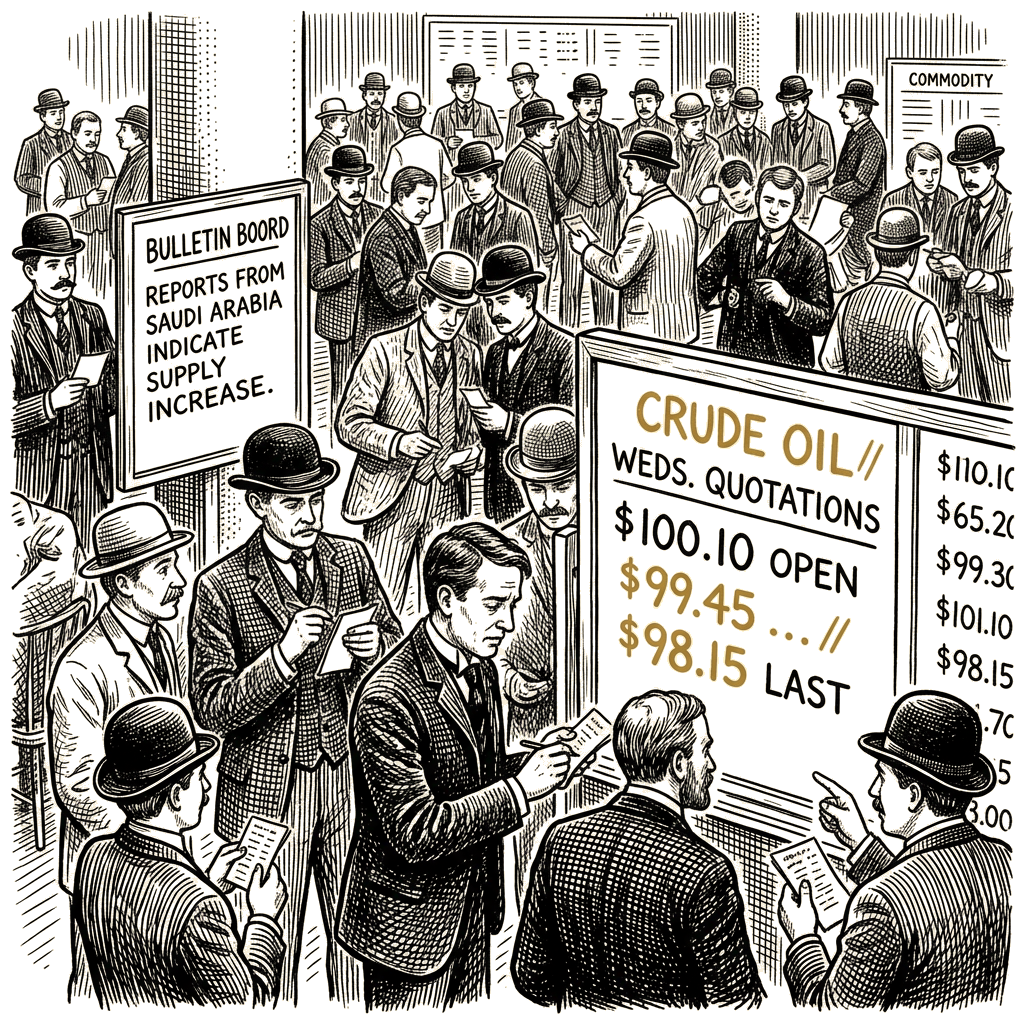
On Wednesday, Brent crude fell about $1 to $98.32 per barrel, extending declines to a sixth session after closing below $100 a barrel the prior day for the first time in more than two weeks. Per Bloomberg, if the six-day decline extends through the session it would mark oil’s longest losing run since August 2025. Three independent channels priced into the move within the same session: Saudi Arabia’s reported restart of east-west pipeline operations at the Red Sea port of Yanbu, President Donald Trump’s simultaneous claim of “progress” in US-Iran talks and threat to “annihilate” Iran absent a deal, and Chinese President Xi Jinping’s expected Washington visit with speculation of a US-China AI cooperation agreement alongside a trade-truce extension. The day’s news — pegged to Trump’s New York presence for the UN General Assembly week — moved the markets in parallel rather than in sequence, and the six-day decline stands as the market-priced probability of three correlated games moving in compatible directions.
Supply channel: Saudi pipeline restart
Reuters, citing sources, reported that Saudi Arabia has restarted operations at its east-west pipeline and that exports from the Red Sea port of Yanbu “may have already” resumed. The pipeline carries crude from Saudi Arabia’s eastern oil fields to the Red Sea coast, providing a structural alternative to Strait of Hormuz transit. The hedged register of the sourcing — “sources” rather than named officials, and “may have already” rather than a confirmed date — is itself analytically relevant: market participants priced a probability distribution over actual supply rather than a verified state.
The exception path the report does not detail is a partial restart in which the pipeline resumes technical operations without full export throughput. The gap between documented and actual is the difference between Reuters’ sourcing and any official Saudi confirmation, which the report does not record. The reported restart is an observable step whose market effect operates through demonstrated, not promised, supply.
Diplomatic channel: US-Iran
President Donald Trump, in New York, said there had been “progress” in US-Iran talks and simultaneously threatened to “annihilate” Iran if no deal was reached. Iranian President Masoud Pezeshkian was scheduled to address the UN General Assembly the same day and, according to reports, may meet Trump on the assembly’s margins. The market’s response — sustained decline rather than a spike in oil — indicates traders are assigning higher probability to the diplomatic track than to the conflict scenario; a reduced probability-weighted conflict premium translates into downward pressure on Brent.
The two signals Trump articulated — “progress” and “annihilate” — are not strictly compatible within a single communication, and the article records no clarification of how the threat conditions on a deal’s absence versus a broader breakdown in talks. The Iranian response recorded is Pezeshkian’s scheduled UN address; the report does not record a reciprocal escalation step, which would be required for the configuration to function as mutual brinkmanship rather than as coercive bargaining with an open exit. The information asymmetry between Trump’s publicly claimed “progress” and the verifiable diplomatic substance is the principal bottleneck in pricing this channel.
Joseph Farrell and Matthew Rabin, in their 1996 survey of the game-theoretic literature on cheap talk, characterize conditional positional claims of this kind as “cheap talk” — statements whose credibility is not backed by a binding commitment device or announced sunk-cost expenditure. Trump’s conditional statement to “annihilate” Iran operates within the bargaining range of the diplomatic track rather than as a binding commitment to action, given the simultaneous assertion of progress, the scheduled UNGA appearance of the Iranian president, and the prospect of direct presidential contact. In the Schelling framing of brinkmanship, a credible move requires the threatener to take a partly irreversible step that raises the probability of catastrophe while leaving the opponent a face-saving off-ramp. Trump’s verbal threat to “annihilate” Iran, on the substrate supplied, is reversible — the same speaker characterized talks as making “progress” — and the off-ramp (diplomacy) is openly available. The credible-commitment deficit is not resolved by rhetorical intensity; simultaneous progress signaling reduces, rather than raises, the perceived probability of the threatened action. The two frameworks — Farrell and Rabin’s cheap-talk analysis and the Schelling brinkmanship analysis — overlap in treating verbal threats without commitment devices as not self-executing; they emphasize different structural requirements at different levels of analytical granularity and are not contradictory.
Diplomatic channel: US-China and AI policy
Xi Jinping was expected in Washington later Wednesday for talks with Trump, with speculation focused on extension of a US-China trade truce and a possible cooperation agreement on artificial intelligence. Trump, in his UN speech, called AI “super intelligence” and rejected any attempts to control it. The AI posture articulated in the speech — rejection of multilateral regulatory control combined with the reported pursuit of bilateral cooperation with China — fits a framework in which AI governance proceeds through bilateral deal-making rather than multilateral constraint.
Xi was expected in Washington later in the same Wednesday that Trump was in New York — a calendar collision the report’s diplomatic framing does not develop. The convergence of Xi’s visit and Trump’s AI rhetoric puts the US-China trade-truce expectation to a near-term test, and the outcome of that test is one of the structural risk factors against which the six-day decline stands or falls.
Equities and the AI consumer signal
Outside China, Asian markets rose for a sixth session — South Korea’s Kospi up nearly 0.7% and Taiwan’s market up 0.75% — on AI-linked gains. Japan’s markets were closed for the silver holiday. China’s CSI 300 fell 0.5%. There has been strong uptake of Meta’s new personal Muse agent, which has sat at the top of US app download charts since its launch a fortnight ago. The agent sits on the consumer-side AI adoption track that the policy discussion is simultaneously addressing, and Trump’s AI remarks and the prospect of bilateral US-China AI cooperation feed into Asian tech equities outside China, with the Meta download data providing independent confirmation of consumer AI uptake.
Within Asian markets, the structure separates rather than pools. Kospi and Taiwan gains on AI-linked names, set against a 0.5% fall in China’s CSI 300, indicate investors treating Chinese equities as a distinct allocation from the broader AI-driven Asia trade. A Chinese-specific risk premium — trade-truce uncertainty, despite Xi’s expected Washington visit — is not being absorbed into a regional AI-beta exposure. The implied equilibrium is separating rather than pooling: it holds only as long as the truce expectation does not collapse.
Currency channel
The dollar climbed to a two-month high on expectations of interest-rate hikes. Sterling dipped 0.2% to $1.3316 and the euro eased 0.2% to $1.1423, its weakest level since July. Two readings of the dollar-oil relationship coexist on the substrate. Under a first mechanism, a stronger dollar compounds downward pressure on dollar-denominated commodities, reinforcing the supply-channel effect on Brent. Under a second mechanism, the dollar’s climb on rate-hike expectations and oil’s decline on supply-and-diplomacy news move together rather than inversely; the usual commodity-currency relationship would predict the dollar softening as oil weakens. The divergence reported is consistent with the rate channel dominating the commodity channel on this date. The two readings are alternative weightings of channel mechanics rather than competing claims — the first treats the dollar-commodity relationship as additive, the second treats the co-movement as a rate-channel-dominance finding.
Cui bono: positioning in the configuration
Saudi Arabia’s reported pipeline restart operates as a signaling move by a third party rather than a bilateral maneuver. Releasing supply into a market already weighing the probability of an Iran deal has the observable effect of reinforcing the downward price pressure that a US-Iran agreement would itself produce. The signal is publicly readable through Reuters’ sourcing and is reinforced by the structural property of the Yanbu route as a Red Sea alternative to Hormuz transit. Brent closing below $100 the prior day for the first time in more than two weeks, and extending the decline to a sixth session, is consistent with the price path implied by both supply addition and a higher probability of diplomatic resolution. Both an operational reading of the Saudi restart (observable supply addition) and a third-party-signaling reading (Saudi reinforcing the price path an Iran deal would itself produce) sit on the substrate and are not mutually exclusive.
Frame, sequel, and verification
The organising structure across the day’s reported events is hub-and-spoke, with the US presidential calendar in New York as the hub: oil-market signaling (Trump on Iran), diplomatic signaling (Pezeshkian at the UN, Xi Jinping’s expected Washington visit), and policy signaling on AI (Trump’s UN speech) all radiate from a single node and a single news day. The six-day oil decline is the market-priced probability of three correlated games moving in compatible directions: a supply-addition game in which Saudi Arabia has visibly increased optional capacity; a coercive-bargaining game in which the US has raised and lowered the temperature of confrontation with Iran in the same communication; and a parallel US-China game in which trade-truce stability and AI policy are jointly negotiated. The UN General Assembly week functions, on this reading, as the Schelling focal point that schedules these games to overlap; Reuters’ source-based reporting supplies the price-discovery channel through which the supply move became observable before any official Saudi confirmation.
Wednesday’s economic calendar adds flash manufacturing PMI releases from the eurozone at 9am BST, the UK at 9:30am BST, and the US at 2:45pm BST — data windows that sit alongside the diplomatic and supply events and that can reset the rate-hike expectation underpinning dollar strength. The exception path that would unwind the configuration — a failed US-Iran negotiation, a Saudi pipeline reversal, or a US-China truce breakdown — is not priced in the data the report supplies, but is the structural risk against which the six-day decline stands or falls.
Brent is exposed to a confirmed Iran-deal outcome as a downward catalyst; a failed Pezeshkian-Trump meeting would lift the conflict premium and reverse part of the six-session decline. Asian tech equities outside China are exposed to the substance of any US-China AI cooperation announcement; a rhetorical-only outcome leaves the AI-linked gains intact, while a substantive restriction would compress them. Saudi supply action is observable. The US-Iran and US-China tracks are both pending direct leader-level contact within the day’s calendar, and market directional exposure remains conditional on the outcomes of the Pezeshkian-Trump and Xi-Trump meetings.
All numerical figures and verbatim quotations in this analysis are substrate-fidelity confirmed on the Tier-2 originating source (The Guardian, 2026-09-23). Independent open-web verification returned no results at the publication date, which falls outside indexed coverage at verification time; substrate fidelity and originating-source tier carry the load-bearing facts.
Analytical techniques used in this piece
This analysis applies the methods below. Each links to a short, plain-English explainer you can read and reuse.
- Process Mapping
- Lays out a process end to end — steps, hand-offs, and bottlenecks.
- Relationship Mapping
- Extracts the network of ties among people, institutions, and entities.
- Strategic Interaction (Game Theory)
- Models a situation as a game — players, moves, payoffs, and likely equilibria.
- BATNA
- Your best alternative to a negotiated deal — the walk-away that sets your leverage (Fisher & Ury).
- Bayesian Reasoning
- Starting from base rates and updating beliefs proportionally as evidence arrives.