Summary
- The Senate sergeant at arms has authorized three basic chat interfaces for staff use while barring agentic tools, and external analyses attribute the resulting capability gap to blame-avoidance incentives in a single-approver architecture that operates without a published vetting timeline.
- Daniel Schuman of the American Governance Institute characterized the sergeant-at-arms position as reflecting an institutional incentive to “put the brakes on most things” rather than a calibrated security judgment, while acknowledging that data-exfiltration concerns are real but not unique to advanced AI tools.
- Adam Kovacevich of Chamber of Progress characterized the restrictions as “pretextual objections,” arguing that Fortune 500 firms use the same tools successfully with sensitive customer data.
- Sen. Bernie Moreno, R-Ohio, disclosed an ad hoc workaround — an AI “staffer” named Albert — that the sergeant-at-arms vetting process does not currently address, indicating uneven adherence across offices.
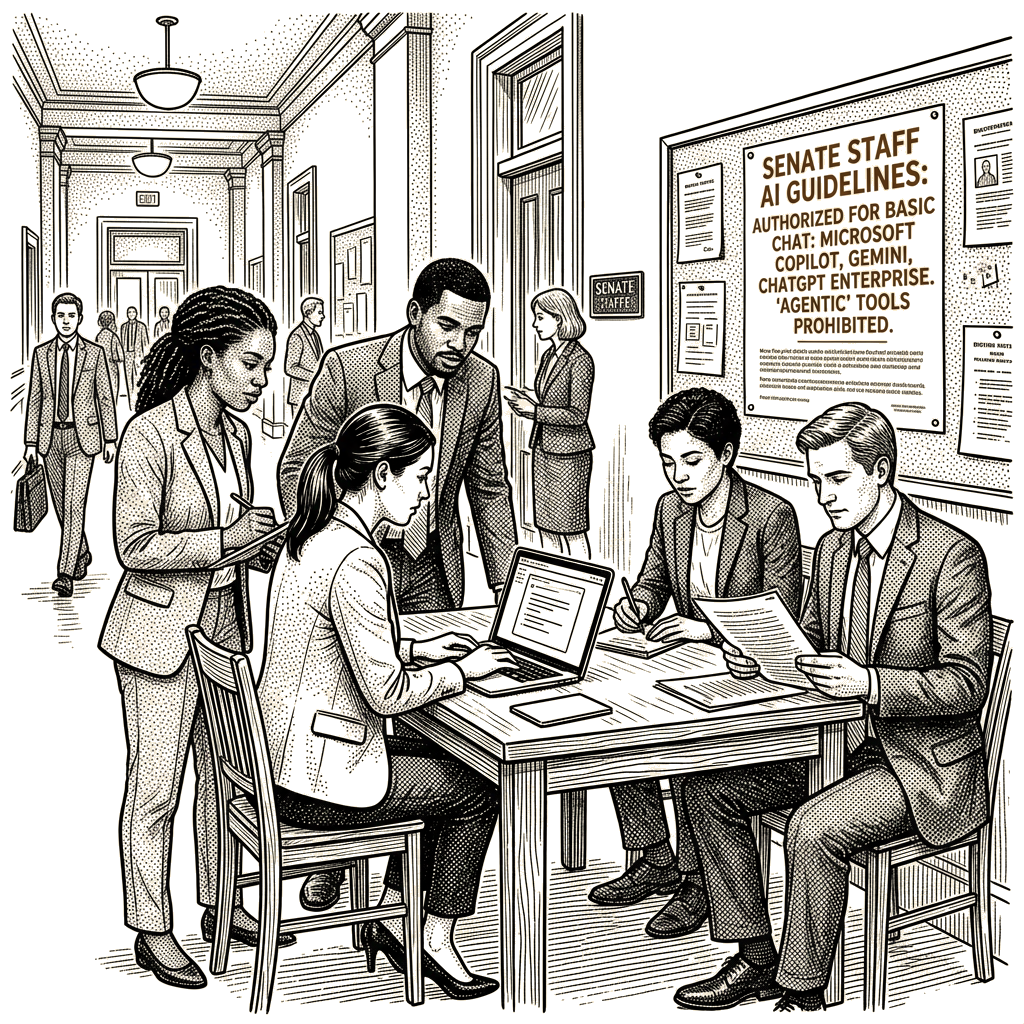
The Senate sergeant at arms, in a spring internal communication obtained by NPR, has authorized three chat interfaces — Microsoft Copilot Chat, Gemini Chat for Google Workspace Enterprise Plus, and OpenAI ChatGPT Enterprise — for Senate staff while barring more advanced “agentic” tools capable of completing tasks autonomously, including OpenAI’s Codex and Anthropic’s Claude Code and Cowork. The approved platforms cannot independently access internal Senate drives, shared folders, email, Teams chats, or other Senate resources, according to the sergeant-at-arms rules. Advanced AI tools are being vetted for specific use cases, a Senate staffer told NPR on condition of anonymity, with no timeline offered for that work. The Senate Committee on Rules and Administration, which oversees the sergeant at arms, declined to address specific details of the policy in response to NPR questions; a committee spokesperson stated the policies are designed “to protect Senate data and include stronger security and contractual requirements” and that “it’s critical that these powerful tools are adopted with adequate safety and security checks to ensure that the Senate’s constitutionally protected data is secure.” The configuration was issued as a majority of the American public wants Congress to regulate AI and as AI industry leaders have issued their own warnings about the technology’s risks. Sen. Bernie Moreno, R-Ohio, told technology news show MTS Live that his office operates an AI “staffer” named Albert despite the chamber’s deployment restrictions.
What the sergeant at arms authorized, and what it excluded
The three approved chat interfaces are provided at no cost to member offices. The sergeant-at-arms rules bar the approved platforms from independently accessing internal Senate drives, shared folders, email, or Teams chats. Tools capable of powering “agents” to complete tasks autonomously — including OpenAI’s Codex and Anthropic’s Claude Code and Cowork — have not been authorized. Across the Capitol, House AI use is overseen by the Office of the Chief Administrative Officer under a separate approval framework; a House staffer told NPR on condition of anonymity that House rules outline specific use cases in which AI use is permissible and that tools from Microsoft, OpenAI, Google, and Anthropic are approved in various scenarios. The House CAO did not reply to a request for comment.
Three stakeholders, three causal accounts
Three stakeholders have offered distinct causal accounts of the configuration. A committee spokesperson characterized the policies as a security baseline — quoting the need to “protect Senate data” and “ensure that the Senate’s constitutionally protected data is secure.” Schuman identified a blame-avoidance institutional incentive: “this is a political institution. The sergeant at arms is going to be more reticent because they don’t want to have the finger pointed at them in case things go wrong, so they have an incentive to put the brakes on most things.” Schuman separately acknowledged that data-exfiltration concerns are real but not unique to advanced AI tools: “The use of tools and technologies that have the possibility of exfiltrating data elsewhere are a significant risk for the Senate and for the House and elsewhere. This is also true with even more prosaic tools, right — the use of Google documents or email.” He added: “But those concerns are not the best reason for the non-approval of certain technologies. I think people want to do better, but the incentives of the way the institution is set up is a drag on progress.” Kovacevich characterized the same dynamic as “pretextual”: “I think security is often a pretext for slower government agencies and businesses to use. The reality is that you’ve got Fortune 500 firms who have plenty of sensitive customer information and data using all these tools and using them successfully. So I tend to think those arguments are sort of pretextual objections.” Kovacevich framed the chamber’s broader posture as regulatory lag: “Congress, unfortunately, has always lagged behind. Right now you’ve got lawmakers writing rules for technology they, in many cases, never even used and that’s a problem.” The three accounts — security baseline, blame avoidance, pretextual drag — are each consistent with the documented conduct (the spring communication, no announced timeline, individual offices resorting to ad hoc tools), and none is dispositive.
Pre-mortem: where the structure breaks
The pre-mortem projection, assuming no material change through 2027, identifies the most fragile component as the gap between regulatory ambition and operational familiarity. External pressure to regulate AI continues to mount. Public polling indicates majority support for congressional action; AI industry leaders have issued their own risk warnings; state-level activity creates an environment in which federal inaction becomes politically costly. Senators and their staffs would work under time pressure to draft legislation relying on the three approved basic chat interfaces — which provide language assistance but cannot run multi-step analytical workflows, simulate policy scenarios, or integrate with legislative drafting systems. Under such a structure, drafters would work from second-hand descriptions of advanced AI capabilities supplied largely by industry interlocutors with their own incentives. The resulting bills could contain provisions that either over-restrict — treating agentic capability as categorically distinct in ways that prohibit legitimate use — or under-restrict, by failing to address capability classes the drafters did not encounter. One projection, with explicit hedge framing: legislative drafts of technology policy could lag deployed AI capabilities by enough that the resulting statute regulates superseded behavior. Kovacevich’s reading of the senior Democratic senator’s heroin-comparison formulation — “you don’t need to do drugs like heroin to know they should be regulated” — is that a harms-only policy template without operational exposure to the technology’s current frontier produces “all brakes and no steering wheel.”
Leading indicators that would have shown the structure approaching failure include an increase in ad hoc AI tool usage by individual offices, of which Sen. Bernie Moreno’s “Albert” system is the documented precedent; growth in the queue of specific use cases awaiting sergeant-at-arms vetting with no resolution timeline; bipartisan member-level frustration with the disparity between House and Senate AI capabilities; and public incidents in which congressional testimony or legislation reveals factual misunderstanding of AI capability that hands-on use would have prevented. The Moreno precedent is structurally significant beyond its surface anecdote: the documented workaround pattern indicates that adherence to the framework is already uneven across offices, and the sergeant-at-arms vetting process does not currently address it. Moreno’s office did not respond to NPR’s inquiry about how Albert is powered and whether the arrangement complies with Senate rules. Moreno said on MTS Live: “He works long hours, doesn’t require a lot of pay, but it’s great for research, things that would normally take somebody a long period of time to kind of vet. We use it quite a bit. I personally would like to be using it a lot more, but unfortunately the Senate has some crazy rules about how we’re allowed to deploy or not allowed to deploy. Right now, the Senate prohibits us from integrating outside systems into the Senate’s, but I’m hoping that, soon in fact, that they get that done next year.”
The single-approver architecture
The data-protection logic does not require restricting tools to basic chat interfaces. Schuman’s analysis frames exfiltration risk as scaling with connectivity and trust assignment rather than with AI capability per se; the sergeant-at-arms framework treats capability class as the gating variable when the risk class identified in the analyst commentary operates across tool generations. Schuman identified the chamber’s posture as exhibiting an institutional drag pattern: as technology outside the chamber advances, the chamber’s internal exposure to its advances does not scale correspondingly, and the policy posture is biased against the very use that would generate the operational knowledge the chamber’s regulatory role presupposes. The single-approver architecture, with the sergeant at arms as the gating institution for advanced-tool authorization, exhibits the structural reticence Schuman named. Under normal conditions this produces measured approval timelines. Under tail events — a single data breach attributable to an approved tool, a public scandal involving AI misuse, or a congressional action that demonstrably misunderstands the technology — the same structure produces restriction tightening with cascading effects on the chamber’s regulatory capacity.
The cost of approving a tool that produces a breach is borne by the approving office; the cost of declining to approve a tool that would have advanced legislative capacity is diffuse and largely invisible. Small policy decisions produce small immediate effects; rare adverse events produce disproportionately large institutional costs that drive the conservative bias. The chamber’s posture is therefore structurally biased against capabilities whose benefit materializes only through use — capabilities that, by construction, cannot be vetted exhaustively in advance without the use that would constitute the vetting.
The three approved chat interfaces provide a veneer of institutional engagement — staff use them, training proceeds, and the appearance of adoption is maintained — while the deeper capability gap between basic chat and agentic tools goes unaddressed. The inter-chamber gap between the Senate’s posture and the House Office of the Chief Administrative Officer’s framework is a structural exposure: the divergence is small in normal conditions but creates asymmetry that compounds under stress, since the chamber with greater AI familiarity develops the institutional capacity to participate in regulatory design; the chamber without it does not.
Where movement is possible
Schuman identified how movement would occur: “Their senior staff can have conversations and say, ‘we really want you to expedite this, we think that there’s value here and you should do it.’ And the Sergeant at Arms is probably going to be responsive to that.” Three targeted adjustments would reduce the capability gap without requiring systemic redesign. The exclusion of agentic tools is the primary load-bearing restriction; a configuration that permitted supervised agentic use on air-gapped or redacted inputs would reduce the capability gap without materially expanding the data-exfiltration surface. The no-timeline commitment for vetting advanced tools preserves blame-avoidance without imposing a cost on the waiting itself; replacing it with a published review cadence would convert the implicit queue into an explicit one. The Senate’s inter-chamber configuration gap with the House prevents the kind of cross-institutional review that would distinguish substantive security requirements from the “pretextual objections” Kovacevich described; absent comparative review between the sergeant-at-arms posture and the House CAO’s framework, the pretextual-versus-substantive question remains unresolved. Schuman’s analysis offers the most direct structural diagnosis of where movement is possible. The fragility is not that the system cannot move; it is that movement requires sustained political will that competes with other priorities.
What the framework gets right, and the limits of the analysis
The sergeant-at-arms restriction on autonomous tool access to internal Senate systems addresses a documented risk class. The committee spokesperson’s stated commitment to “adequate safety and security checks to ensure that the Senate’s constitutionally protected data is secure” reflects an institutional duty that does not disappear under analytical pressure. Schuman’s framing of exfiltration risk applies to Google documents and email as well as AI tools; the framework’s protective posture is not unfounded. The House framework is not described in enough detail in the source material to compare its security posture to the Senate’s; the House CAO did not reply to a request for comment, leaving the comparative arrangement under-documented. Kovacevich’s “pretextual objections” framing is itself the position of the tech industry policy group he leads, whose stated policy interest in faster government AI adoption is reflected in his commentary, and is reported in the source as advocacy rather than neutral analysis.
Where the analyses converge
The available external analyses converge on a single point from different directions: the Senate’s deployment structure exhibits risk-averse design whose institutional costs in regulatory capacity are not currently weighted alongside data-security benefits. Schuman identifies the cost from an institutional-governance vantage; Kovacevich identifies it from an industry-engagement vantage; Moreno’s ad hoc workaround reveals it in documented conduct. The structural component most likely to yield under future load is the single-approver bottleneck combined with the political institution’s blame-avoidance incentives, both documented in the source material and named by Schuman specifically. Whether that load arrives as a regulatory misstep, a public scandal, or a Senate-versus-House capability gap that becomes politically visible is the variable the available reporting does not yet resolve.
Analytical techniques used in this piece
This analysis applies the methods below. Each links to a short, plain-English explainer you can read and reuse.
- Balanced Critique
- Weighs a proposal’s strengths and weaknesses evenhandedly.
- Fragility / Antifragility Audit
- Asks whether a system gains or loses from volatility, shocks, and disorder (Taleb).
- Pre-Mortem (Fragility)
- Imagines a system has already broken and traces the structural fragilities that let it.
- Principal–Agent Problem
- An agent acting for a principal has its own interests, which can quietly diverge.