Summary
- Saul Kavonic of MST Financial projects Australian diesel prices above A$4 a litre with rationing within weeks of a US export ban, while Dr Lurion De Mello of Macquarie University’s Transforming Energy Markets Research Centre projects prices surpassing A$3.10 but unlikely to reach A$3.50 — a divergence of nearly A$1 a litre under identical trigger conditions, The Guardian reports.
- The Trump administration is actively considering banning US diesel exports to suppress local service-station prices ahead of the November midterm elections, The Guardian reports, citing ANZ analysts who described export limits as “especially disruptive.”
- Direct US supply accounted for 510.9 million litres out of more than 18,400 million litres of Australian diesel imports from January to July 2026, with most US shipments arriving in April, per government data The Guardian cites.
- Gulf diesel exports have fallen to about a quarter of prewar levels as conflict prevents transit through the Strait of Hormuz and the smaller Bab al-Mandab chokepoint, while Ukrainian attacks have curtailed Russian supply, and Brent crude has held above US$100 a barrel for most of the past two weeks, The Guardian reports.
- Australian diesel stockpiles have fallen to 31 days’ worth of supply — the March level — down from 39 days in July, and Energy Minister Chris Bowen said government-backed fuel purchases had slowed because storage facilities were full, The Guardian reports.
- The Reserve Bank is expected to raise interest rates to 4.6% on Tuesday, a 14-year high, in part due to upward pressure from fuel costs, The Guardian reports.
The Guardian reports that Australian diesel prices could push past A$3 a litre nationally under a Trump administration restriction on US diesel exports, with two cited analysts placing the ceiling as high as A$4 a litre and as low as A$3.50 — a forecast split of nearly A$1 that hinges on which transmission channel dominates the global diesel market once American barrels are withdrawn. The dispute is not over whether the price floor rises; both projections agree it does. It is over whether Asian refining throughput can absorb the redirected demand without crowding Australian importers out of South Korean and other regional cargoes. With Australian stockpiles down to 31 days, government fuel purchases halted for storage reasons, and the Reserve Bank already expected to lift rates to a 14-year high on Tuesday, the cited evidence leaves a thinner domestic buffer than at any point since March.
Why direct US imports are not the channel
The Guardian’s reporting makes clear that the risk to Australian consumers runs through global diesel-market price formation, not through any direct bilateral supply line. Government data cited by the paper shows Australia imported more than 18,400 million litres of diesel from January to July 2026. Just 510.9 million litres of that total came from the US — roughly 2.8% — and most of the American volume arrived in April. The exposure is global, not transactional: a US export ban would not remove a meaningful share of Australian physical supply directly, but would reshape the price of every cargo Australia competes for on the Asian marine-fuel market.
That distinction is what separates the two forecasts. ANZ bank analysts, as reported by The Guardian, noted that the US has stepped up its global diesel supply since the Middle East conflict began and now exports more than 1.5 million barrels a day — a flow that, if curtailed, would force European buyers who depend on American diesel to compete with Australian importers for shipments from South Korea and other Asian refiners. ANZ characterised the limits as “especially disruptive.” The transmission, in other words, runs through European demand chasing the same marginal Asian barrel, lifting the Asian benchmark and forcing Australian importers to absorb both the elevated Asian price and a freight differential that European buyers had previously carried.
The Kavonic versus De Mello split
Saul Kavonic of MST Financial told the ABC that Australia would have to ration diesel and face prices above A$4 a litre within weeks of a US export ban. Dr Lurion De Mello of Macquarie University’s Transforming Energy Markets Research Centre told The Guardian that supply remained “healthy” but a ban would lift prices as Europe began competing with Australia for Asian shipments, projecting Australian diesel prices could surpass A$3.10 a litre but were unlikely to reach A$3.50 as long as Asian refiners continued to access oil. “If you take any supplier out, globally, it puts pressure on prices to go up,” De Mello said, per The Guardian.
Both projections share the same first-order claim — that the price floor rises. They disagree on the slope. Per The Guardian, Kavonic’s framing assumes a rapid substitution contest in which Europe and Australia bid against each other for the same Asian barrels, tightening the Asian market’s marginal supply and forcing Australian importers to absorb freight differentials European buyers had previously absorbed. De Mello’s framing assumes Asian refining capacity can absorb the redirected demand without crowding Australia out. De Mello’s A$3.10–A$3.50 ceiling conditions explicitly on continued Asian access to crude, a conditional that The Guardian’s own supply-side reporting complicates: Gulf transit is impaired, Russian supply is curtailed, and Brent has held above US$100 a barrel for most of the past two weeks, reaching its highest point since May. The substrate does not record a corresponding conditional in Kavonic’s projection.
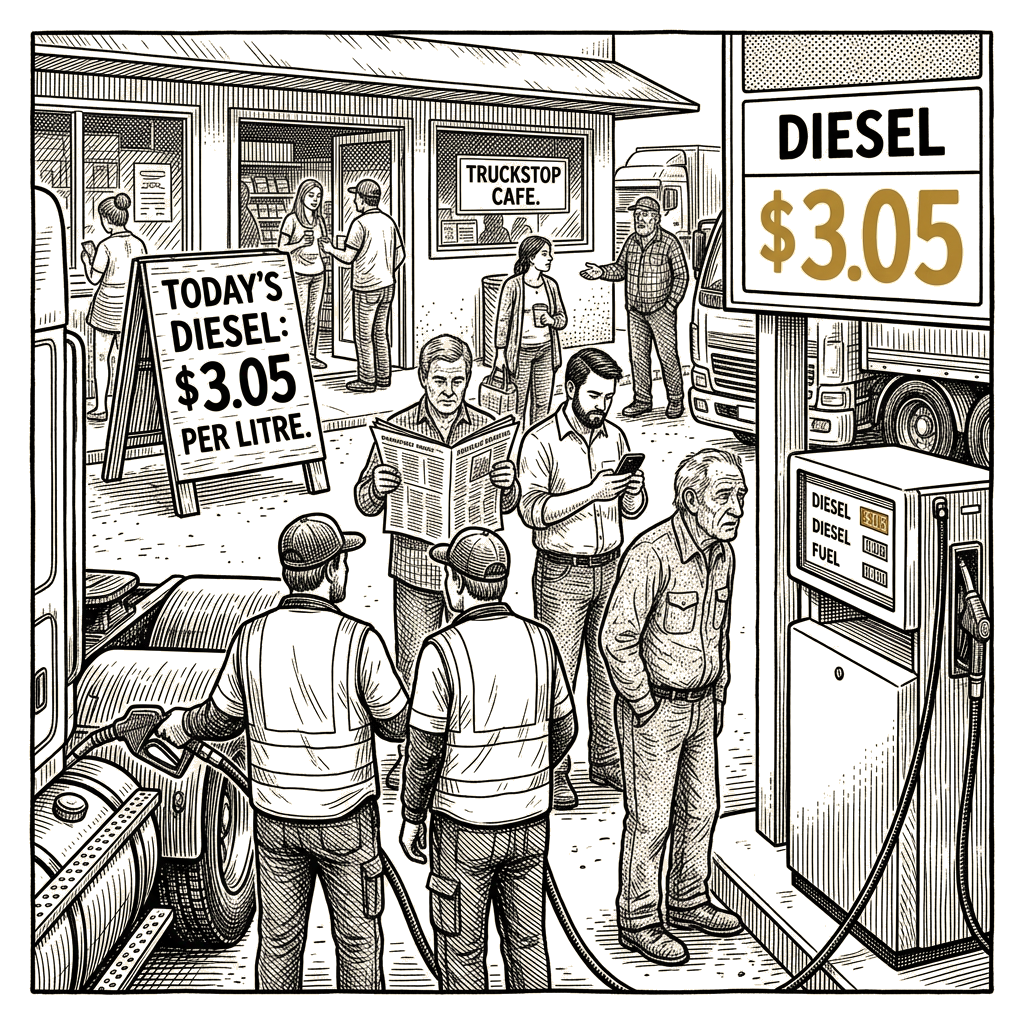
Anchoring against The Guardian’s own reported figure — Canberra diesel at 298.7 cents a litre on Thursday, the highest among capital cities — De Mello’s “surpass $3.10” describes a near-term move of roughly 11 cents from already-elevated levels rather than from a low baseline. Diesel prices across Australia’s capital cities have risen nearly 40 cents a litre since the start of September, adding about A$22 to the cost of filling a 55-litre tank. The Kavonic projection, by contrast, would require an additional roughly A$55 on a 55-litre tank fill from current levels within weeks — a 55-litre tank rising from A$2.987 to A$4.00 alone adds about A$1.01 a litre, or approximately A$56 per fill, and because the projection is open-ended above A$4 the realised move is a floor rather than a ceiling. Framed comparatively, that A$55-plus per-fill increase is more than double the cumulative A$22 increase Australians have already absorbed since the start of September.
The upstream chokepoints
The supply picture The Guardian assembles has three compressed nodes. Gulf diesel exports have fallen to about a quarter of prewar levels, with conflict preventing transit through the Strait of Hormuz and the smaller Bab al-Mandab chokepoint. Ukrainian attacks have cut off Russian supply. The US, as noted above, has stepped up its global diesel supply since the war began and now exports more than 1.5 million barrels a day, a flow ANZ characterises as the marginal swing supplier.
A coordinated OPEC+ production response, or alternatively an Iran-negotiation outcome that lifts sanctions and adds barrels, could break the supply picture in either direction. The Guardian flagged “floundering Iran negotiations” as part of the policy backdrop but provided no timeline or probability for a resolution. Either outcome would compress prices faster than the conflict-only scenarios assume.
The thinning Australian buffer
Per The Guardian’s reporting, Australia’s domestic cushion has thinned on every measurable axis. Diesel stockpiles have fallen to 31 days’ worth of supply — the level recorded in March — down from 39 days in July. Energy Minister Chris Bowen said government-backed fuel purchases had slowed because existing storage facilities were full. The Guardian records De Mello describing Australia’s supply as “healthy”; the same reporting shows stockpiles at 31 days and the government-purchase halt — a posture The Guardian does not reconcile in a single sentence, leaving the “healthy” characterisation in tension with the 31-day figure.
The Albanese government temporarily lowered the fuel excise in March when diesel prices surpassed A$3.10 a litre but has not announced a second cut. The Guardian’s reporting does not state whether the March excise cut remains in force, has been extended, or has lapsed — a coverage gap that bears on which contingency lever remains available. Mining and agricultural producers facing simultaneous fuel and finance cost pressure would likely pass costs downstream, lifting food and manufactured-goods prices — a path the source identifies but does not quantify.
Demand exposure and the rate path
Demand-side exposure, as The Guardian frames it, is broad and rate-sensitive. High fuel costs would threaten industries that rely heavily on imported diesel — including farming and mining — and push up prices in food, manufacturing and transport. Service stations have passed through sustained increases from international refineries.
The Reserve Bank is expected to raise interest rates to 4.6% on Tuesday, a 14-year high, in part due to upward pressure from fuel costs. The Guardian attributes the expected 4.6% move partly to fuel costs without separating the September price move’s contribution from a hypothetical ban scenario’s incremental effect — a decomposition that would change which intervention is most efficient, and which The Guardian does not provide.
Trajectories and leading indicators
Observable trajectories divide along two documented axes: US export policy and the trajectory of the Middle East conflict. Under a ban with continued conflict, the cited evidence aligns with Kavonic’s projection of rationing and prices above A$4 a litre, with the RBA’s 14-year-high signal showing fuel-driven inflation already incorporated into the Tuesday decision — the worst case on the cited evidence. A ban with conflict easing would partially relieve Gulf crude constraints; the outcome would sit closer to De Mello’s A$3.10–A$3.50 ceiling, contingent on Asian refining throughput recovering, with a short-term spike followed by partial mean-reversion as Gulf flows resume and US export policy normalises around the November midterm cycle. No ban with continued or expanding conflict preserves the September trajectory, with capital-city diesel gradually approaching A$3.10 a litre — the March price level at which the Albanese government previously lowered the fuel excise — while 31-day stockpiles continue drawing down. No ban with conflict easing would loosen Gulf supply enough that Brent could retreat toward prewar ranges, putting downward revision pressure on the Tuesday rate decision; Brent eases from above US$100, Asian refining margins compress, Australian diesel drifts lower from 298.7 cents a litre.
Leading indicators distinguishable in current data streams: any decline in Australian stockpile coverage below the 31-day mark, combined with capital-city diesel movement toward A$3.10, would signal the no-ban/continued-conflict trajectory’s risk materialising. Recovery or further deterioration in Hormuz and Bab al-Mandab transit volumes would distinguish conflict continuation from resolution. The 510.9-million-litre US import figure, with most arriving in April, establishes a baseline; a sustained drop in total monthly Australian imports below the January-to-July monthly average — approximately 2,629 million litres per month, derived from The Guardian’s reported totals — would indicate the substitution De Mello’s ceiling assumes is failing. Sustained Asian import flows at or above that rate would compress the Kavonic forecast toward De Mello’s; price moves consistent with Kavonic’s ceiling would suggest the marginal-supplier mechanism is binding faster than De Mello’s conditional implies. The Reserve Bank’s Tuesday decision itself functions as a partially observable signal: a 4.6% move partially attributed to fuel costs confirms the no-ban/continued-conflict or ban/continued-conflict trajectories’ path; a smaller-than-expected increase would weaken the conflict-continuation narrative underlying both price-ceiling estimates.
Contingency levers and what the substrate leaves open
A fuel-excise cut is a robust lever that cushions the consumer in any scenario where prices rise; the March precedent lowers the political cost of repeating the action, though The Guardian does not specify the current excise status. Stockpiling beyond current 31-day levels is robust but constrained by the storage-capacity ceiling Bowen named; The Guardian does not quantify that ceiling or address whether private-sector storage is approaching the same constraint. The RBA rate path is scenario-dependent — a hike is more defensible if the price move proves persistent than if it reverses with the conflict. Mining-sector hedging of fuel costs, where available, is robust; cost pass-through to consumers is the residual lever when other buffers fail.
The Guardian’s reporting leaves several decompositions unresolved. The article does not separate how much of the recent 40 cents-a-litre rise is attributable to the Brent move, to Gulf export contraction, to refining margins, or to currency effects — a decomposition that would change which intervention is most efficient. The article does not state whether the March excise cut remains in force, has been extended, or has simply lapsed. The article does not quantify the storage-facility capacity constraint Bowen named; the headline finding is that the buffer exists at 31 days, not whether it can be enlarged quickly. The Guardian flags “floundering Iran negotiations” as backdrop but provides no timeline or probability for a resolution.
Across the substrate, ANZ’s analyst commentary comes closest to a synthesis: the US has stepped up global diesel supply since the war began, limits on US exports would be “especially disruptive,” and the disruption would propagate through European demand chasing the same Asian barrels that Australia depends on. The Kavonic and De Mello forecasts bracket that propagation — rationing and A$4-plus if Asian supply crowds Australia out, A$3.10 to A$3.50 if it does not — and the cited evidence leaves the call closer to the middle of that range than to either pole.
Sourcing posture
The Guardian is the primary substrate for every load-bearing claim; pre-flight web verification returned no independent corroboration for the eleven core figures (the 510.9-million-litre US import volume, the 18,400-million-litre total Australian diesel imports, the 298.7c/L Canberra diesel price, the 40c/L capital-city rise since September, the 31-day and 39-day stockpile coverage, Brent above US$100, Gulf export contraction to about a quarter of prewar levels, US exports above 1.5 million barrels a day, the March Albanese excise cut, the RBA 4.6% Tuesday expectation, the Trump export-ban consideration, and the Bowen storage statement).
The attribution chain is preserved intact: the Kavonic projection is sourced to an ABC interview carried by The Guardian; De Mello’s projection, ANZ commentary, Bowen statements, the Trump-administration framing, and the stockpile figures are sourced to The Guardian.
The March excise-cut status, the storage-capacity ceiling, the 40c decomposition, and the Iran-negotiation timeline remain unresolved in the substrate.
Analytical techniques used in this piece
This analysis applies the methods below. Each links to a short, plain-English explainer you can read and reuse.
- Red-Team Assessment
- Models a capable adversary probing a plan for the seams they would exploit.
- Root-Cause Analysis
- Traces a symptom back along its causal chain to the conditions that actually generated it.
- Scenario Planning
- Builds a small set of distinct, plausible futures to plan against.