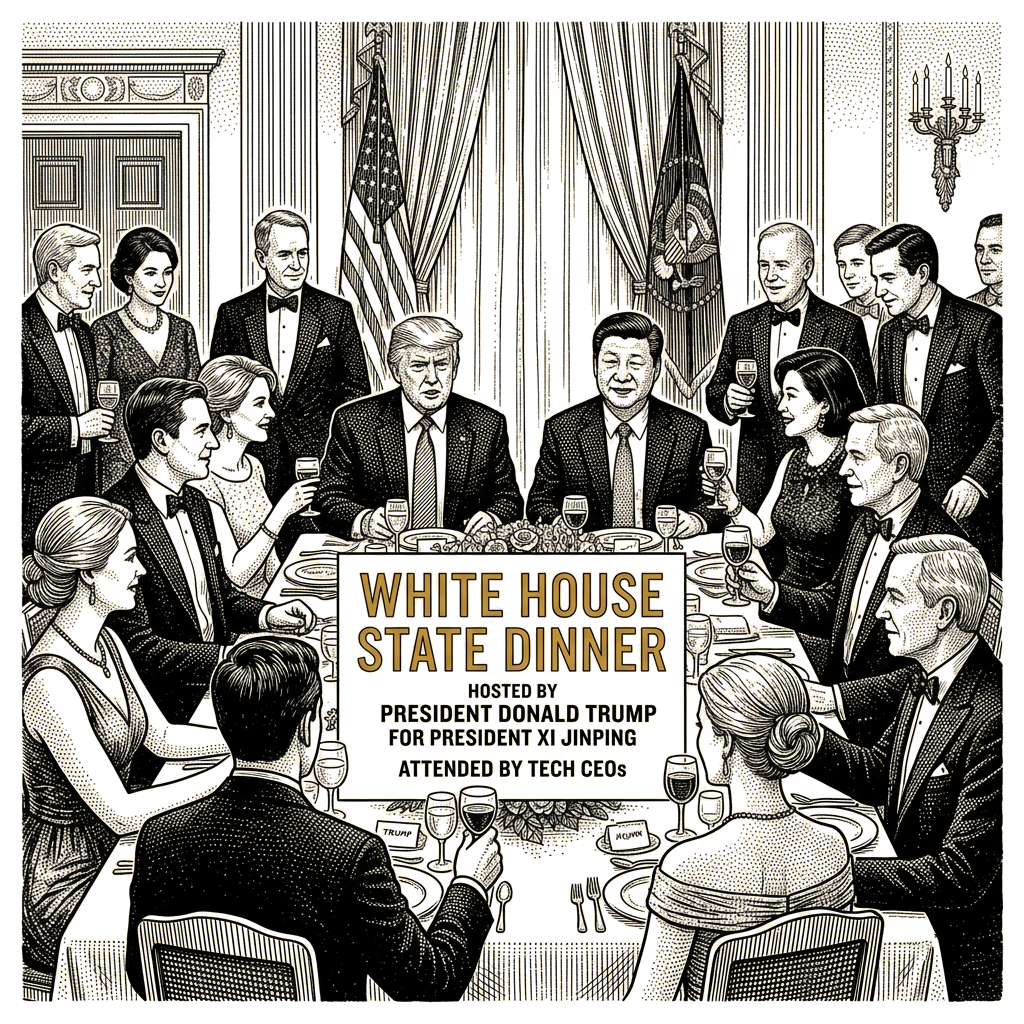
A White House state dinner operates simultaneously as diplomatic instrument, domestic political stage, and industry coalition signal. The September 25 dinner President Donald Trump hosted for Chinese President Xi Jinping, as reported by the Associated Press, performs all three registers at once, while the day’s substantive agenda — Taiwan, trade, and artificial intelligence — is held in the closed-door sessions the public record does not detail.
The tech-CEO guest list and the off-stage agenda. The technology executives who dominated the guest list — Sam Altman of OpenAI, Jensen Huang of Nvidia, Jeff Bezos of Amazon, Elon Musk of Tesla and SpaceX, Sundar Pichai of Google and Alphabet, OpenAI President Greg Brockman, Michael Dell of Dell Technologies, and LVMH’s Bernard Arnault — head firms whose products and supply chains sit at the intersection of the two policy areas discussed out of public view. AP documented the arrival register in granular terms: Altman “signed autographs as he arrived,” Huang “opted for a tuxedo over his trademark black leather jacket,” and Arnault “walked through black security fencing to enter the event.” The public record AP describes does not establish that the closed-door sessions engaged specific commercial matters; the guest list’s sector prominence coincides with the agenda sectors AP names (Taiwan, trade, artificial intelligence), but a direct linkage between individual firms and individual agenda items is not sourced in the article. Inferred interests on the CEO side — flagged as hypothesis rather than confirmation — include access to the negotiating principals and positioning for whatever AI and trade framework emerges; the only interest confirmed by the public record is the symbolic inclusion itself.
The toasts as position-vs.-interest theater. Both leaders used the toasts to perform the relationship in language that allows each side to claim it on return to their respective audiences. Trump, per AP: “President Xi and I both understand we represent different systems, but the ties between our people endure, and we’ve never gotten along better.” Xi responded in the register of national ambition: “President Trump has pledged to make America great again… China is committed to achieving great national rejuvenation. These two goals are both ambitious and can surely be mutually reinforcing.” Roger Fisher and William Ury, in Getting to Yes (1981), distinguish positions from interests and integrative (mutual-gain) from distributive (zero-sum) bargaining; the public record AP describes does not disclose which mode the closed-door talks pursued, naming Taiwan, trade, and artificial intelligence as the agenda items without detailing the bargaining posture within them. For the Trump side, the toast language is consistent with a domestic-facing narrative of personal deal-making and restored great-power rapport; for the Chinese side, Xi’s chosen phrasing is consistent with situating the relationship inside his own stated frame of parallel national projects rather than systemic competition.
The asymmetric gift exchange. AP recorded a one-direction ceremonial asymmetry: Trump presented Xi with “an eagle statue he said was designed ‘in personal collaboration with Melania and myself,’” while Xi “did not present a public gift in return during the dinner.” The documented asymmetry can be read as deference, confidence, or stage-management; the article does not resolve which. The conduct on the US side is consistent with treating the gift as a personal-imagery artifact; the conduct on the Chinese side is consistent with reserving reciprocity for a closed channel.
The ballroom pivot. Trump, per AP, used his toast to draw attention to the South Lawn ballroom he is building, departing briefly from his prepared remarks to invite attendees to “visit through that beautiful curtain in the back” and “be ‘the first people to step foot’” on the worksite, adding, “Anybody wants to walk into a construction site that’s nice and sparkling, it’s our honor to have you do so.” AP reported Trump has called the project the “Great Hall of the United States” and “suggested it could rival the Great Hall of the People, where he was hosted by Xi on his own state visit to Beijing in May.” The Chinese side’s documented response at the May Beijing visit (hosting Trump beneath grand chandeliers in the Great Hall of the People, per AP) and the US side’s documented framing of the project as the “Great Hall of the United States” (per AP) are each consistent with a parity-recognition register; whether the underlying motive matches the documented conduct is not resolvable from the public record AP describes. Credibility assessment: the construction itself is documented as “a year from completion,” per Trump’s remarks as recorded by AP, which limits the symbolic parity to a forward-looking claim rather than a completed one.
The Andrews greeting and the protocol register. AP noted that Trump personally greeted Xi and his wife on Wednesday at Joint Base Andrews — “presidents typically wait for their state-visit guests to arrive at the White House itself before offering a formal welcome.” The documented deviation raises the personal-hospitality register ahead of the substantive talks. The first lady’s authorship of the menu on Reagan-era red china, and the documented fashion particulars — Melania Trump in a white Saint Laurent cotton poplin blouse, a black silk cummerbund and black brocade pants from Dolce & Gabbana, “both pieces carrying a peony motif”; Peng Liyuan in red — constitute the documented aesthetic register of state-visit protocol that the public performance requires.
Equilibrium and credibility. Each leader’s documented conduct positions a domestic-audience payoff that depends on a visible working relationship with the other, and minimizes a domestic-audience cost from visible tension; the binding constraint is therefore the closed-door agenda, not the public register. Both sides have cheap-talk incentives to overstate convergence in the toasts; the credibility test is whether the closed-door deliverables match the public language, which the public record does not yet show. Roger Fisher and William Ury’s framework treats the parties’ alternatives to a negotiated agreement as drivers of the equilibrium position; the public record AP describes does not enumerate those alternatives, but the closed-door agenda Taiwan, trade, and artificial intelligence frames the substantive terrain on which the alternatives are tested. The public performance should be read as the audience-targeted signal it is, while the binding decisions sit in the closed-door record the article does not disclose.
Symmetric application. The May Beijing visit — “Xi hosted Trump beneath grand chandeliers in the Great Hall of the People alongside tech luminaries including former Apple CEO Tim Cook and Musk” — establishes the reciprocal precedent the Washington dinner mirrors. AP also recorded Trump’s 2015 position on a similar Obama-era state visit plan: “Just take them to McDonald’s and go back to the negotiating table,” followed by a Fox News Channel concession that Xi might at least deserve “probably a double-size Big Mac.” The substrate records Trump’s 2015 statement on protocol but does not document a comparable Chinese-side 2015-era position on fast-food protocol alternatives; the contrast the AP record permits is one-sided in the public materials AP cites. The state visit, AP noted, “unfolded against the backdrop of an ongoing First Amendment fight over press access at the White House,” a contextual frame that belongs to the domestic environment the dinner was staged against.
Analytical techniques used in this piece
This analysis applies the methods below. Each links to a short, plain-English explainer you can read and reuse.
- Interest Mapping
- Separates parties’ stated positions from their underlying interests (Fisher & Ury).
- Principled Negotiation
- Works a negotiation from interests, options, and objective criteria rather than positions.
- Strategic Interaction (Game Theory)
- Models a situation as a game — players, moves, payoffs, and likely equilibria.