Summary
- NSW Premier Chris Minns committed $47.1 million to recommission the 515-bed Dawn de Loas correctional centre and fast-track more than 360 beds at Parklea, totalling nearly 1,000 additional beds, while the Public Service Association’s parallel call for 15 state-run domestic violence centres, diversionary programs, and dedicated courts remains documented as a position without a matching dollar commitment.
- Corrections Minister Anoulack Chanthivong ruled out closing Long Bay’s Metropolitan Special Programs Centre against an independent watchdog finding that the unit “simply cannot provide a safe environment,” following the May suicide of a 19-year-old remand prisoner there, leaving the in-custody risk pathway outside the announced response.
- The 6,398-person September remand population — 46 per cent of the state’s adult prison population — is documented as flowing from post-2024 bail reforms requiring serious alleged offenders to “show cause” as to why they should be released, paired with Minns’s stated inability to extend compulsory rehabilitation to that cohort.
- Four documented framings — operational capacity, domestic violence prevention, corrections land use, and unit-level safety — describe the same input chain but name different intervention points, and the source material does not reconcile them.
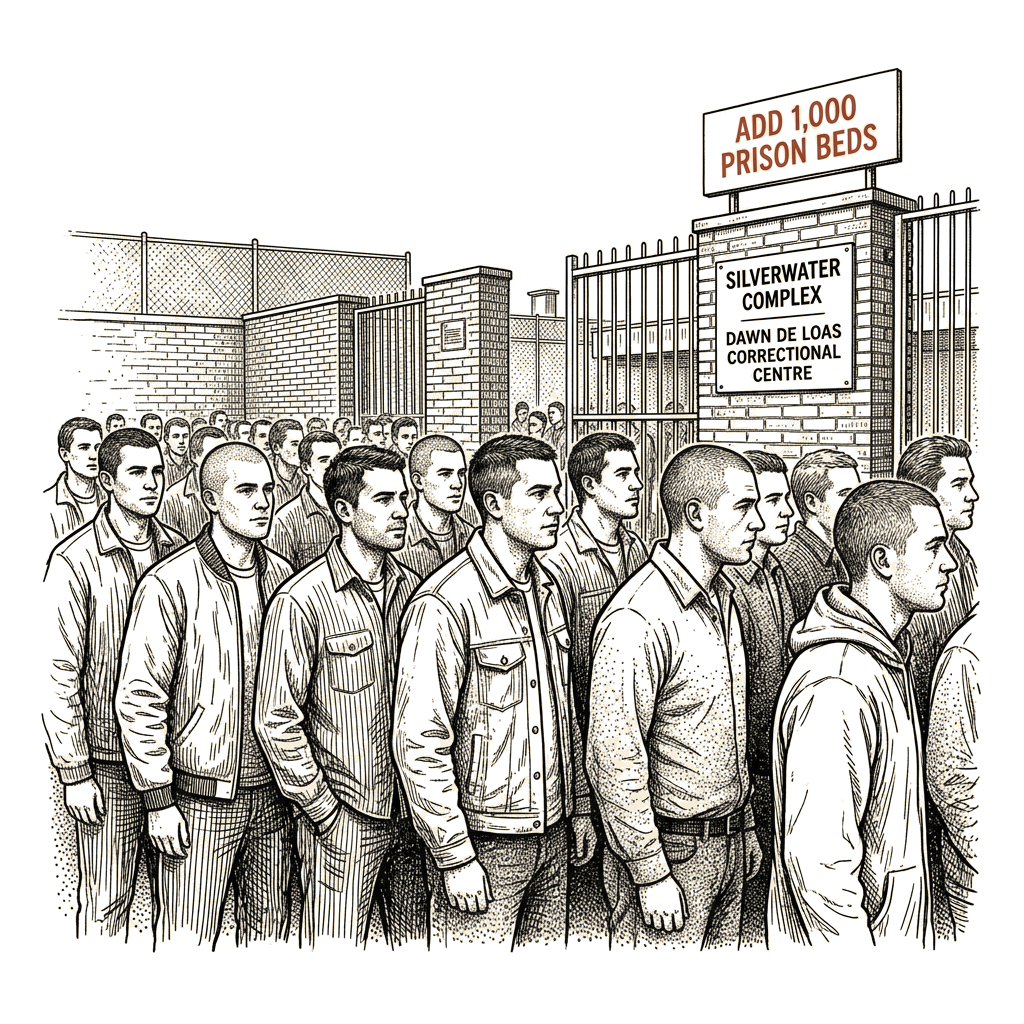
The NSW government’s $47.1 million recommissioning of the 515-bed Dawn de Loas correctional centre at Silverwater, paired with the fast-tracking of more than 360 beds at Parklea correctional centre as it returns to public management in October, will add nearly 1,000 beds to the state’s prison capacity by early 2027. Premier Chris Minns announced the measure at Dawn de Loas on Monday, framing it as “a necessary decision for NSW, [which] we believe in the long run will keep the public safe.” The expansion responds to a September remand population of 6,398 — 46 per cent of the state’s adult prison population — a figure documented as following bail-law changes introduced after the 2024 killing of Forbes woman Molly Ticehurst by her ex-boyfriend, who had been freed on bail a fortnight before the murder. Daniel Billings was sentenced on 11 September 2026 to 28 years in jail for Ticehurst’s murder. The reforms require serious alleged offenders to “show cause” as to why they should be released, and bar registrars from making bail decisions.
The distributive question
The Public Service Association of NSW characterised the announced measure as “a response to a DV crisis that demands far more than extra prison capacity.” General secretary Stewart Little said: “We can’t just arrest our way out of domestic violence. Prison can contain someone who poses a serious risk. It cannot, by itself, protect a person before violence occurs or stop an offender returning to violent behaviour after release.” The PSA has called for the government to run domestic violence services in-house through 15 centres across the state, alongside compulsory diversionary programs for alleged offenders on remand, dedicated domestic violence courts to address a backlog of cases, and “properly resourced” domestic violence programs for people leaving custody on parole. Two parties in the source agree on the existence of a domestic violence crisis requiring state action and diverge on what constitutes a sufficient response. A single fiscal envelope cannot fund both the $47.1 million recommissioning and the PSA’s proposed network of 15 state-run centres with dedicated courts at the scale each would require; the integrative candidate — paired investment in capacity and prevention infrastructure — is documented as a possibility in the parties’ shared recognition of the crisis but not as a funded combination. The capacity-only trajectory is supported in the source by the announced line item and by Minns’s stated inability to extend compulsory rehabilitation to remand prisoners; the paired-investment trajectory is documented as a position only, with no matching dollar commitment recorded in the source material.
What the source material leaves in the in-custody risk pathway
Corrections Minister Anoulack Chanthivong on Monday ruled out closing the Metropolitan Special Programs Centre (MSPC) at Long Bay correctional centre, where a 19-year-old remand prisoner took his own life in May. An independent watchdog had previously recommended the unit be closed, finding it “simply cannot provide a safe environment.” Four documented claims — the PSA’s analytical claim that prison can contain risk but cannot prevent initial violence or post-release reoffending; the watchdog’s MSPC finding; the post-2024 bail reforms documented as contributors to the September remand population; and Minns’s stated inability to make rehabilitation programs compulsory for prisoners on remand — together support an integrated claim no single component contains: an expanded remand intake, unaccompanied by compulsory in-custody rehabilitation, expanded post-release supervision, or expanded prevention infrastructure, produces an elevated — though not formally priced in the source material — probability of further in-custody incidents and continued re-entry into the remand system. The PSA’s analytical claim about prevention and the watchdog’s documented MSPC finding together imply that the announced bed expansion does not address the in-custody risk pathway the watchdog documented.
How four framings diverge on the same input chain
Four framings appear in the source material. The government frames the situation as one of operational capacity in the corrections system, exacerbated by an increased remand population following bail reform. The PSA frames it as a domestic violence crisis requiring prevention and case-management infrastructure. The NSW opposition, which has proposed closing all of Long Bay to build 10,000 homes and upgrading Goulburn correctional centre in its place, frames the corrections footprint as a housing-affordability and land-use question. The independent corrections watchdog frames the MSPC as an in-custody safety failure. The four framings describe the same input chain — Ticehurst killing (2024), bail tightening, increased remand intake, capacity pressure, $47.1 million announcement — and diverge in their intervention points: the government’s intervention is at the symptom (capacity), the PSA’s is upstream (prevention), the opposition’s is at land use, and the watchdog’s is at the unit level. The source material does not invoke a primary-prevention framing such as that associated with Our Watch, the Australian primary-prevention agency, or the WHO’s violence-prevention work, and the absence of that framing from the government’s announcement is itself documented. The four framings are not formally reconciled in the source material.
The Minns-Little exchange on compulsion and prevention
Minns told reporters the government “had increased funding for domestic and family violence services” without specifying scale. Of his critics Minns said: “People pitch these arguments as: ‘Look, it’s a waste of money to have the criminal justice system in place or to have long sentences for violent domestic violence offenders’. I don’t agree with that.” Minns stated a constraint on the in-custody rehabilitation pathway: he “could not make rehabilitation programs compulsory for prisoners on remand.” Little offered a containment-versus-prevention distinction as the PSA’s on-record diagnostic frame: prison as containment, prevention as something the source material records as the PSA’s claim rather than as a funded program. Minns also added: “Not arresting people for violent domestic violence offences will not solve them either.”
The cyclical pattern in the same facility
Dawn de Loas temporarily closed in November 2022 amid a declining prison population and staff shortages during the pandemic. About 150 staff will be recruited to support the reopening in early 2027, according to the government. The recommissioning in early 2027 under the present announcement documents a cyclical pattern in which the same facility is treated as dispensable under capacity contraction and indispensable under capacity expansion.
Infrastructure decisions beyond the line item
The 1,000 additional beds are designated for minimum-security remand and sentenced prisoners and are intended to relieve pressure on Silverwater’s 24-hour Metropolitan Remand and Reception Centre. Parklea correctional centre, one of two privately managed correctional centres in NSW, will return to public management in October. The source documents the capacity rationale — more than 360 additional beds — but does not document the rationale for the public-management shift. Corrections Minister Anoulack Chanthivong confirmed the government had closed four Victorian-era wings at Goulburn correctional centre that he said were “no longer fit for purpose,” documenting that some infrastructure decisions are being taken on fitness grounds. The expansion comes amid reporting that three women and two children were the subject of “alleged murders” earlier in the month of the announcement, a high-profile cluster whose political consequences the source material does not project.
Unresolved questions surfaced by the source
Whether the $47.1 million commitment and the PSA’s calls for 15 state-run centres, diversionary programs, and dedicated courts are treated as substitutes or as layers is the question the source material surfaces without resolving. The article does not record any on-record statement from remand prisoners or their representatives. The article does not record the operational or other considerations that informed Chanthivong’s ruling against closing the MSPC at Long Bay. The article does not record the rationale for the Parklea re-nationalisation beyond capacity, nor the rationale for retaining Long Bay’s MSPC open against the watchdog recommendation. The article does not report domestic violence incidence trends that would allow the 6,398 remand figure to be read against upstream demand for the system. The article does not document any proposal to soften bail laws in a way that would expose the 1,000-bed expansion as overcapacity; the gap between the announced infrastructure and a prevention-oriented end-state remains unbridged in the source material. Survivor voices are not directly quoted in the source; the PSA’s proposals include a court-backlog remedy and “properly resourced” post-release parole programs, both of which the source documents as institutional rather than survivor-stated positions. Whether the government’s announced DV-services funding represents a parallel commitment at a different scale, or whether the integrative move — paired investment in capacity and prevention — is being pursued, is not established in the source material; each commitment is documented as a stated position, and their relative scale or sequencing is not.
Additional considerations
The cluster context in the source material lists “Geographic location: United States” while the article concerns New South Wales, Australia. The analytical reading treats the article as Australian throughout; the metadata entry does not affect the substrate or this analysis.
Analytical techniques used in this piece
This analysis applies the methods below. Each links to a short, plain-English explainer you can read and reuse.
- Interest Mapping
- Separates parties’ stated positions from their underlying interests (Fisher & Ury).
- Wicked Futures
- Explores a long-horizon, deeply entangled future with no clean resolution.
- Wicked Problems
- Treats a problem as wicked — no stopping rule, no clean test of success, every attempt consequential.