Summary
- Andy Burnham’s first Labour conference address as party leader in Liverpool packages a new government-backed grid-investment body, an NHS-style social care pledge, and a signal of willingness to review the pension triple lock as an interlocking set whose fiscal coherence the speech must reconcile.
- The Guardian’s overnight reporting documents Downing Street’s silence on speculation linking the social-care funding to triple-lock reform, establishing the funding question as the analytic pivot the address surfaces without resolving.
- Unite general secretary Sharon Graham’s contemporaneous intervention, characterising any triple-lock reform as “electoral suicide” and “morally” wrong, places an organised-labour floor below which the triple-lock position cannot move without political cost.
- The Guardian’s reading, drawing on Ed Miliband’s prior “Go Big” assessment, positions the address against the Corbyn-era benchmark and against the “politics-as-usual” diagnosis Burnham’s reported remarks repeat without specifying what makes the present instrument different from the prior one.
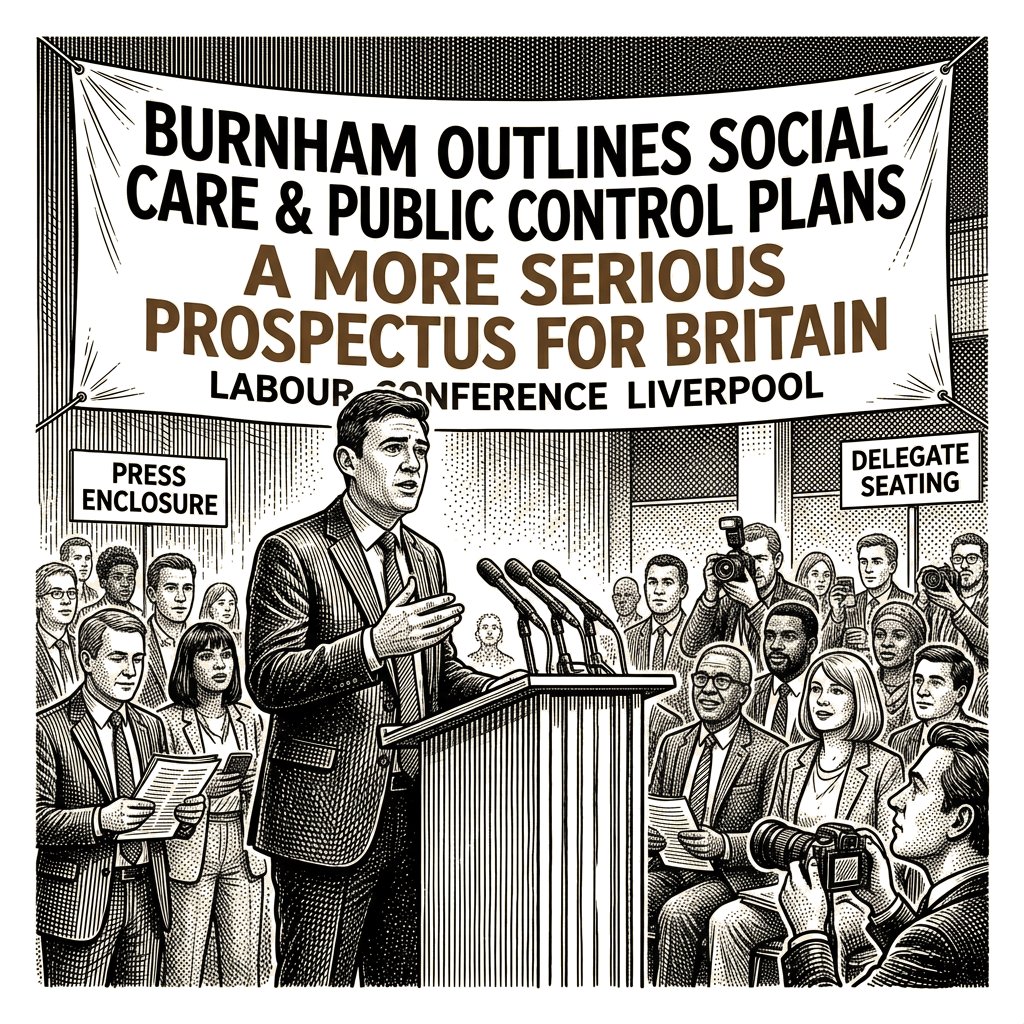
Andy Burnham will use his first Labour conference address as party leader on Tuesday at 2pm in Liverpool to set out what the party’s overnight briefing describes as “a more serious prospectus for Britain than people have been offered in a generation.” The Guardian’s overnight splash, bylined to Kiran Stacey, Jessica Elgot and Pippa Crerar, reports three substantive moves. First, a new government-backed body to invest in the electricity grid, described by The Guardian as “his first major step towards putting Britain’s utility companies into public control, and the opening move in a broader direction covering energy, water and housing.” Second, an NHS-style social care service “free at the point of delivery” that Burnham articulated on Sunday. Third, a signal — sourced by The Guardian to government officials — that Burnham will mark his willingness to review the pension triple lock without pledging to scrap it. Downing Street has done nothing to quash speculation that the social-care proposal will be partly funded by reforming the triple lock; The Guardian reports that Burnham made the care pledge without naming a funding mechanism. Unite general secretary Sharon Graham told the Times that any such reform would be “almost electoral suicide” and “morally” the wrong course. The analytical pivot The Guardian’s overnight coverage surfaces is the fiscal relationship between the three commitments: whether the grid body’s investment model, the social-care pledge, and the triple-lock review form a coherent package, or three separate moves whose funding paths the address does not reconcile.
The three commitments as The Guardian reports them
The Guardian’s overnight reporting identifies three substantive moves in Burnham’s reported address. The first is a new government-backed body to invest in the electricity grid, which The Guardian describes as the opening move in a broader direction covering energy, water and housing. The architectural form of the new body — whether it sits alongside existing grid regulators, displaces them, or operates as a state-equity holding company over private operators — is not specified in the reported excerpts. The Guardian does not document the body’s relationship to the existing regulatory architecture, and the transition cost is unquantified in the reporting.
The second is the NHS-style social care pledge. The Guardian reports Burnham said on Sunday that he wants to fight the next election on a pledge to set up an NHS-style care service “with care free at the point of delivery.” The Guardian reports that Burnham “did not say how the proposal would be funded.” The Guardian does not specify which funding architecture — general taxation, a hypothecated levy, National Insurance reallocation, asset means-testing, or partial funding through pensioner-benefit reform — Burnham intends. The Guardian’s overnight reporting carries Downing Street’s silence on the speculation linking the social-care funding to triple-lock reform as a documented posture rather than a denial.
The third is the triple-lock signal. The Guardian reports government sources indicated Burnham would signal willingness to review the policy but stop short of pledging to scrap it. The Guardian reports that Labour’s manifesto committed to keeping the triple lock for this parliament, and that Burnham is “sticking to that.” The Guardian describes the triple lock as one of the sacred cows of British politics, conventionally viewed as untouchable, and attributes to “almost all reputable economists” the view that in the long run its costs are unsustainable, adding that “many politicians from all parties” agree with this assessment in private. The Guardian’s framing thus positions the lock as a fiscal exposure whose political convention diverges from its fiscal reality.
How the address is being framed
The Guardian attributes to Burnham’s overnight briefing language a “serious-politics” register The Guardian reads as inheriting Ed Miliband’s prior “Go Big” assessment of Donald Trump’s approach. The Guardian reports Burnham will tell the conference: “We can’t carry on as we are. Politics-as-usual has taken Britain backwards. More of the same isn’t good enough and isn’t going to get us where we need to be.” He will add, according to The Guardian’s reporting, that “hope comes from honesty and from saying the things politicians usually avoid,” and that the moment requires “honest conversation” with the public on difficult issues that Westminster has ignored — including social care, youth unemployment, and the need for greater public control of energy, water and housing.
The Guardian’s overnight live blog drew an explicit “Corbyn mark 2” comparison, noting that “a more mainstream Labour leader is also going to embrace ‘Go Big’” and that Jeremy Corbyn’s Labour “certainly offered voters a ‘Go Big’ vision but for various reasons could not persuade the electorate.” The Guardian’s framing requires two claims to track together: that the diagnosis of politics-as-usual’s failure is separable from the prior instrument, and that the prior instrument failed for reasons that do not apply to the present leadership. The Guardian’s overnight reporting supplies the diagnostic register repeatedly but does not, in the reported excerpts, specify what makes the present instrument different from the prior one. The Guardian’s characterisation of the grid body as the opening move in a broader direction covering energy, water and housing gives the announcement analytical weight as a sequencing move that exceeds what the reported announcement alone establishes.
The Guardian’s reported schedule places cabinet colleagues in supporting roles rather than as speakers on the headline announcements: Angela Rayner (housing secretary) is scheduled to address the conference at 11:40am; Lucy Powell (deputy leader) speaks at a 10am fringe alongside energy secretary Miatta Fahnbulleh and AI minister Kanishka Narayan; Bridget Phillipson (Labour chair) joins former cabinet minister Alan Milburn at a 5pm Tony Blair Institute fringe. The Guardian does not document cabinet posture on the headline announcements; the schedule documents the staging.
Documented interests of named parties
The Guardian reports Burnham’s documented interest in an election-winning platform, the establishment of a “serious-leadership” brand distinct from prior iterations, and positioning for government. The Guardian reports his stated intention to fight the next election on the NHS-style care pledge.
Sharon Graham, general secretary of Unite, articulates the union’s documented interest in her Times remarks. Her intervention is reported by The Guardian as positioning the union’s stance in fairness-perception terms: “We’re the lowest in the G7 in terms of how much we spend on pensions. I think that’s an embarrassment, quite frankly, because we’re one of the six richest economies in the world. I think it would be an absolute disaster, it would send completely the wrong message. I cannot understand why we keep going back to pensioners.” Her characterisation of any triple-lock reform as “almost electoral suicide” and “morally” wrong sets an organised-labour floor below which the policy cannot move without cost.
The Guardian’s overnight reporting carries an intergenerational framing whose stakeholders are not equally represented in the conference positioning as reported. The Guardian attributes to “almost all reputable economists” and to “in private” agreement among “many politicians from all parties” the view that the triple lock is fiscally unsustainable; The Guardian does not document the position of younger workers paying for the lock via taxation as a named constituency. Unite’s public stance treats the triple lock as a settled political preference; The Guardian’s description of the lock as a “sacred cow” implies the political convention and the fiscal reality diverge. The Unite intervention does not engage with the long-run sustainability point The Guardian attributes to economists. Whether Burnham’s speech bridges that gap, or sharpens it, is the unresolved question the conference will answer.
Downing Street’s documented posture, as The Guardian reports it, is consistent with not pre-empting the leader’s speech. Private utility companies — named by The Guardian in reference to “Britain’s utility companies” being moved toward “public control” — have substantive economic interests in continued operation; The Guardian does not document those interests further in the reported excerpts.
What the speech must reconcile
The Guardian’s overnight reporting surfaces one cross-cutting constraint. The social-care pledge, the grid-investment announcement, and the triple-lock signal are framed by The Guardian as a connected set, with speculation linking the second to the third as a partial offset for the first. The Guardian’s overnight splash, Downing Street’s silence on the triple-lock-funding linkage, and Graham’s contemporary intervention together establish this triangulation as the central analytical question. Whether Burnham’s review framing permits an integrative move — a pension package that protects current pensioner living standards while creating fiscal headroom for the social-care commitment — or forecloses it by signalling abolition, is what the speech text will determine.
The Guardian reports Burnham acknowledged the political risk during an LBC phone-in the day before the conference, accepting that voters might reject the proposal. The Guardian does not document a fallback position.
The substrate leaves several items unspecified that bear on the reconciliation. The cost of NHS-style social care is unquantified. The transition cost of moving grid investment into a new government-backed body is unquantified, and the body’s relationship to existing grid regulatory architecture is not described in the reported excerpts. The “Go Big” frame leaves unspecified which stakeholders absorb adjustment. Utility shareholders, energy consumers, taxpayers funding the body, care workers delivering the new service, and younger workers paying for the triple lock all appear as affected parties without any of their interests being represented in the conference positioning as reported.
The Unite position rests on defensible empirical and political premises but does not engage with the long-run sustainability point The Guardian attributes to economists and to cross-party private agreement. The Guardian’s framing of the lock as a fiscal exposure rather than a settled preference marks a gap the Unite intervention does not address. The Guardian’s overnight reporting thus leaves the analytical question — whether the three commitments form a coherent package or three separate moves the address leaves unreconciled — open. The speech text is what the substrate does not contain.
Analytical techniques used in this piece
This analysis applies the methods below. Each links to a short, plain-English explainer you can read and reuse.
- Argument Audit
- A full structural audit of an argument’s premises, inferences, and load-bearing assumptions.
- Interest Mapping
- Separates parties’ stated positions from their underlying interests (Fisher & Ury).
- Red-Team Assessment
- Models a capable adversary probing a plan for the seams they would exploit.