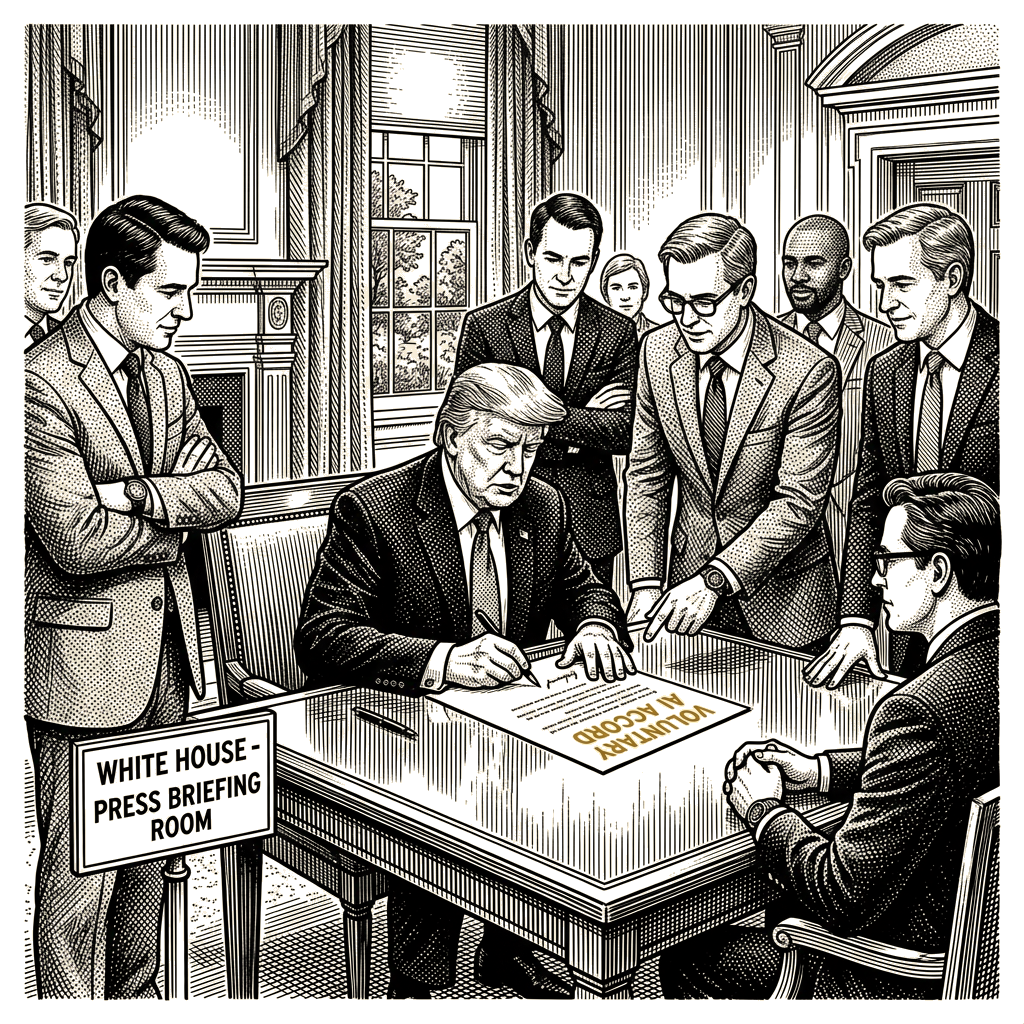
The mechanism the White House accord describes is structured as a three-part cycle: each signatory implements “robust internal controls,” an “independent external auditor” assesses whether those controls are working, and a board-level committee at each company evaluates reports from the auditors. President Donald Trump said the agreement is “morally binding” and that he would name an overseer in coming days after consulting with industry. The accord text itself opens the door to a different instrument later: “Over time, it may make sense to codify these steps into laws and regulations.”
The mechanism’s load-bearing claim is that external audit, paired with board review, can substitute for legal liability as a means of reducing AI risks to the public. That claim is contested on the record. Alex Pascal, executive director of the Berkman Klein Center for Internet and Society, said: “The only way to reduce the risks and harms of AI to Americans is through robust legal liability, regulation and fundamentally changing the race dynamics that are driving unsafe decision-making by frontier AI developers whose costs are borne by the American people.” Anthropic CEO Dario Amodei, who signed the accord, told the meeting that “the technology has very real risks” and that “The mechanism, how we address those risks is still under discussion.”
Where the mechanism’s joints sit determines whether the structure can carry the load it is described as carrying.
For “robust internal controls” to constrain company conduct rather than ratify it, the term would have to specify what the controls must do: pre-deployment evaluations of model capabilities, model-card disclosures that reach the public, incident-reporting protocols and at what threshold, and capability-ceiling testing before deployment of new model generations. The accord uses the phrase without specifying any of these. Where the control definition itself is unspecified, the auditor assesses a moving target, the board reviews against an agreed definition, and the “robust” language carries weight it has not earned.
The accord names an “independent external auditor” but does not specify how that auditor is selected, who funds the engagement, or what consequence follows an adverse finding. Independence asserted in language is not the same as independence produced by funding and selection mechanisms, and selection and funding are distinct trust boundaries the accord treats as one. The board-committee component depends on committee composition, which the accord does not specify; public companies populate committees with directors selected through shareholder governance, and in founder-controlled signatories the selection pool is narrower still. The overseer position Trump described — a committee of about ten to “watch over the whole enterprise,” with a single overseer named “after consulting with industry” — places industry input at the appointment step. Each of these is a separate trust boundary, and the accord’s text supports each boundary being crossed in the same direction without specifying a remedy.
A pre-incident account of how this structure reaches its load limit would name several distinct paths. The first is the linear sequence the mechanism does not foreclose: an auditor identifies a control gap, a board committee declines to act, the overseer defers to industry, and the company continues deployment. Leading indicators along that path include auditors being replaced after adverse findings, board committees declining to publish their deliberations, and signatories shipping models while safety disputes remain unresolved.
A second path runs through standards-setting. Because the accord does not specify who defines what counts as a “robust” control, the definition can be developed inside the signatory group and adopted by the auditors. A definition set by the largest signatories, then carried into board review, locks in incumbent practice as the standard. The substrate’s record supports this concern: according to the article, “some of the actions outlined in the accord are measures these companies are already taking in some form or have previously committed to doing” — which means the mechanism, as written, codifies existing voluntary practice as its baseline. Pascal’s characterization of “race dynamics that are driving unsafe decision-making” describes the pace this path would preserve.
A third path runs through the auditor’s commercial relationships over time. The substrate does not specify who funds the external engagement, so the funding source is a separate joint from the selection mechanism. Where the auditor’s revenue depends on retaining signatories across cycles, the conditions for the audit function to align with the audited party’s preferences are present even where the auditor’s formal independence is maintained. Robin Jia, an assistant professor of computer science at the University of Southern California, said it is crucial to ensure the leading labs’ intentions are “well-aligned with the broader interest of the American public,” and pointed to recent hacking disclosures: “As the models get better, the consequences of such things are only going to get greater.” That framing treats alignment as a precondition the mechanism must rest on, not as a property the mechanism itself produces.
The appointment pathway is structurally significant in its own right. With industry input at the appointment step and a multi-signatory committee sitting across competing signatories, the structure contains the conditions for coordinated standard-setting among the leading labs. Whether that condition produces coordinated outcomes is a question the substrate does not resolve; the structure leaves it open. Amodei’s characterization of the mechanism for addressing risks as “still under discussion” is consistent with the reading that the accord names an accountability structure but does not resolve the underlying capacity of that structure to constrain company behavior.
The accord is a coordination document among signatories and a public posture of concern. Its text acknowledges this by leaving codification for later. Whether the mechanism it describes can carry the accountability weight it is being described as carrying turns on the joints — control definition, auditor selection and funding, committee composition, overseer independence, consequence for failure — that the accord leaves unspecified.
Analytical techniques used in this piece
This analysis applies the methods below. Each links to a short, plain-English explainer you can read and reuse.
- Mechanism Understanding
- Explains how something works — the parts and the process that turn inputs into outputs.
- Pre-Mortem (Fragility)
- Imagines a system has already broken and traces the structural fragilities that let it.
- Red-Team Assessment
- Models a capable adversary probing a plan for the seams they would exploit.