Summary
- Three documented demands have converged on a single 15-second White House advertisement, and the convergence forces a choice between copyright-track and appropriations-track exposure that the administration has not yet addressed on the audio question it controls.
- JMSN’s cease-and-desist alleges the song was used “without a synchronization license, a master-use license or any other authorization” and adds that “you neither requested nor received such permission” and that “no permission would have been granted if the administration had requested it” — a documented commitment device that forecloses the negotiated-settlement path on the copyright holder’s terms.
- The White House Friday statement rejected the Democratic lawmakers’ “propaganda one might expect from North Korea” framing without addressing the licensing question, asserting that “President Trump is not on the ballot and there is no call to action” — and the statement did not address Trump’s recent public comments in which he has “repeatedly told Republicans to vote as if he were on the November ballot.”
- Each side’s preferred framing concedes legitimacy to the opposing framing, leaving the characterization contest durable beyond any deadline-day resolution of the audio question and converting the dispute into a precedent-setting one for future licensing.
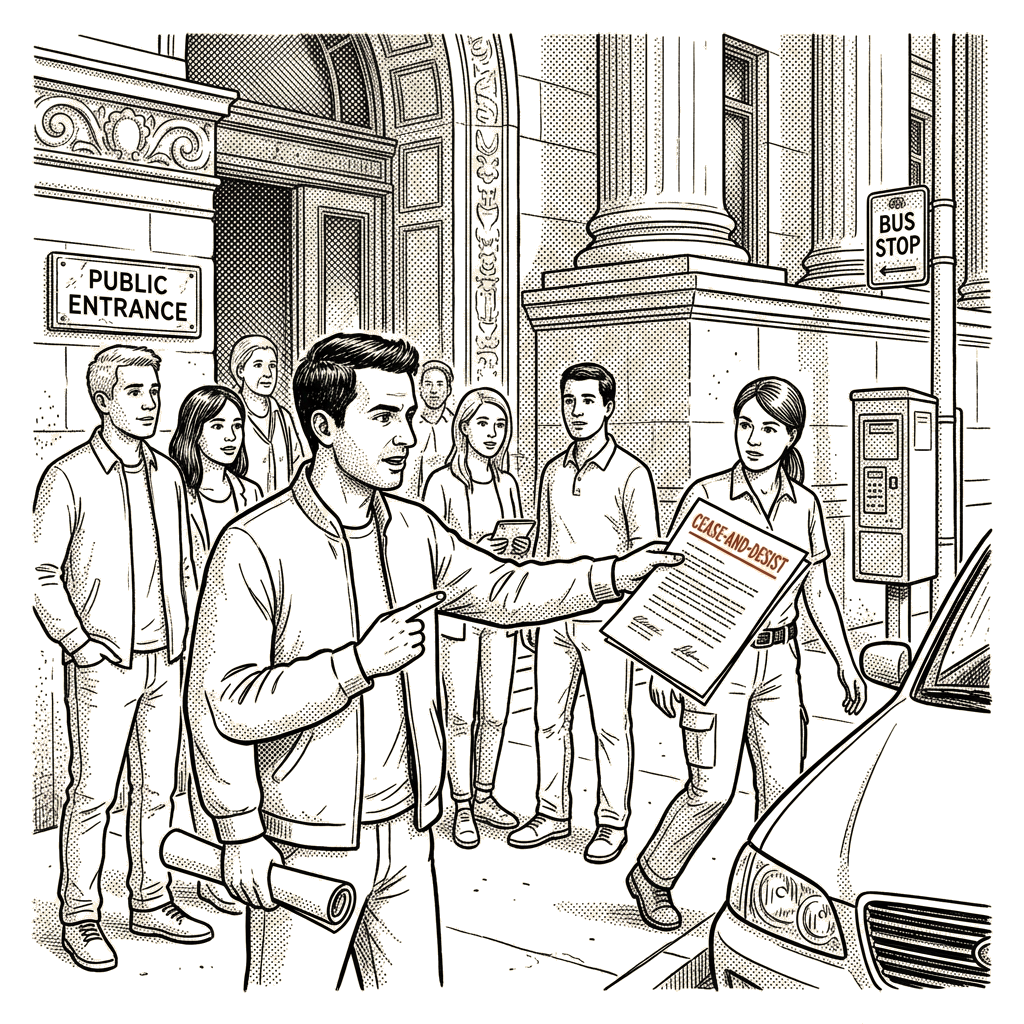
On Monday night, musician Christian Berishaj, recording as JMSN, sent a cease-and-desist to White House Chief of Staff Susan Wiles demanding the Trump administration stop using his song “Love Me” in the 15-second advertisement “The Country He Loves,” which the article reports remained posted on the White House’s YouTube account as of early Wednesday. JMSN’s counsel, Democracy Defenders Action and Ballard Spahr LLP, alleges the song was used “without a synchronization license, a master-use license or any other authorization” and that “no permission would have been granted if the administration had requested it” — a statement that forecloses the negotiated-settlement path on the copyright holder’s terms and gives the administration until 5 p.m. EDT Thursday to confirm cessation of “its infringing activities.” The JMSN filing arrived on top of a separate letter from Sens. Patty Murray (D-Wash.), Jack Reed (D-R.I.), Reps. Rosa DeLauro (D-Conn.) and Steny Hoyer (D-Md.), who called the spot “an egregious and illegal misuse of Americans’ hard-earned tax dollars” and “propaganda one might expect from North Korea.” The White House, in a Friday statement issued before JMSN’s letter, rejected that criticism, describing the spots as “public service announcements” and asserting that “President Trump is not on the ballot and there is no call to action.” The Friday statement did not address Trump’s recent public comments in which he has “repeatedly told Republicans to vote as if he were on the November ballot” — a non-response that converts a copyright dispute into a precedent-setting challenge the administration’s standing characterization does not address.
Two legal tracks running in parallel
The artifact at issue sits at the intersection of two distinct enforcement chains, and the move by JMSN’s counsel has placed copyright doctrine on the table alongside an appropriations-law objection already in motion.
JMSN’s filing operates in copyright vocabulary. The cease-and-desist states he “owns the copyright in both the musical composition of ‘Love Me’ and its sound recording” and that the works “may not be used for any purpose without his prior consent.” The letter asserts the excerpted portion was “the heart of the copyrighted works” and warns the government’s use “will have a negative effect on JMSN’s ability to license the song, and others, in the future” — a statement that extends the dispute beyond the single artifact. Under the Copyright Act, a synchronization license covers use of a musical composition in timed relation with visual images, and a master-use license covers use of a specific recording; the cease-and-desist asserts the administration obtained neither, and asserts no authority for the use. The doctrinal path a court can resolve includes statutory damages and an injunction; the article does not record whether JMSN’s counsel has filed suit, only that they have set a Thursday deadline.
The four Democratic lawmakers operate in appropriations vocabulary. Their letter demands the ad be taken off the air, calls it “an egregious and illegal misuse of Americans’ hard-earned tax dollars,” and states: “The law is not complicated. You cannot use taxpayer dollars for political advertisements.” That letter invokes an appropriations-law argument — that government funds cannot be deployed for campaign-style messaging — but attaches no immediate enforcement mechanism visible in the article. The weight of that argument depends on whether committee jurisdiction can be translated into a hearing, a Government Accountability Office inquiry, or a withholding; the article does not record such a procedural step, which leaves the threat conditional on subsequent congressional action.
The two tracks carry distinct exposure profiles. The copyright track rests on a documented chain of elements the White House has not, on the article’s record, contested in writing: the asserted absence of licenses, the identification of the excerpt as the work’s “heart,” and a public deadline. The appropriations track depends on a disputed characterization of the artifact as “partisan” within the meaning of the relevant statutes, and on an enforcement chain that runs through Congress rather than the courts.
How the artifact is being framed
The characterization contest sits between two competing framings of the same artifact: the White House’s “public service announcement” framing and the lawmakers’ “propaganda one might expect from North Korea” framing. Both sides have reported in this contest in their own lexical register, and the rhetorical choices in the official statement do substantial work.
The White House Friday statement operates on four rhetorical levels: it defines the operative issue as whether the government’s communication is appropriate civic messaging; it locates any concern in audience reception rather than in the content itself; it invokes patriotism as the relevant moral category; and it anticipates no remedy, on the premise that the framing forecloses the question of violation. Specific linguistic mechanisms in the statement carry that load: “public service announcements” is a category normally reserved for health, safety, and civic-information campaigns distributed through public-service advertising slots; “no call to action” is a technical phrase from campaign-finance and advertising law that, taken literally, would exclude a wide range of recognized campaign messaging; “still believes” presupposes a contrast with a prior administration that did not; “at home, at the border and abroad” enumerates threat domains without naming them; and the spot’s title, “The Country He Loves,” centers the President as the patriotic subject. The White House’s statement continued: “The announcements are a reminder for Americans to love their country and know why it’s worth defending — at home, at the border and abroad. That’s not partisanship — that’s a government that still believes in the country it serves.”
The counter-characterization makes the operative frame visible as a frame. If the relevant category is government-produced political messaging, funded by general taxation, distributed through an official White House channel during an active midterm cycle, and featuring the voice of a President who has publicly urged supporters to vote for his party, then the operative question becomes whether existing appropriations law and advertising law permit that activity. Under that reading, “no call to action” does not load logically — because calls to action can be implicit — and “reminder” selects out the speaker’s identity and the funding source.
For the “PSA” frame to remain plausible to its intended audience, three premises have to hold without being asserted: that a sitting President airing government-funded video during a midterm cycle can produce a “reminder” rather than campaign-style communication; that “no call to action” exhausts the criteria by which campaign-style communication is identified; and that the absence of the President’s name from a state ballot equates to non-partisanship. Three pieces of undermining evidence visible in the article select against each premise: the spot’s substantive content is described as Trump’s voiceover declaring “that the United States will never be a communist country” — a partisan-coded message rather than a generic civic reminder; the distribution channel is the White House’s official YouTube account, not a public-service clearinghouse; and the Friday statement’s reassertion that “President Trump is not on the ballot” does not address the President’s own public statements asking Republicans to vote as if he were on the November ballot. As of early Wednesday, “a 15-second version of the ad remained posted on the White House’s YouTube account.”
Three distinct legal-political registers therefore converge on the same artifact: copyright vocabulary in JMSN’s cease-and-desist, appropriations vocabulary in the lawmakers’ letter, and presidential-messaging vocabulary in the White House’s defense. Each register treats the same artifact as a different kind of object — a work of authorship, an appropriated resource, and a presidential communication. The advertisement’s persuasive structure combines imagery, music, and voiceover to associate the president with patriotic affect, a category JMSN’s counsel has explicitly declined to authorize, writing that “JMSN does not want to be viewed as directly or indirectly affiliated with the president or his administration.”
Differential exposure across the two fronts
The two demands run on different information and different commitment structures, and the asymmetric exposure predicts which side moves first.
JMSN’s counsel has full information about the licensing non-request and has stated that “no permission would have been granted if the administration had requested it,” a commitment device that forecloses the negotiated-settlement path on the copyright holder’s terms. The White House, for its part, has full information about its own internal decision-making and about Trump’s public “vote as if he were on the November ballot” statements, which its Friday defense did not address. That information asymmetry is durable on the audio question — JMSN’s counsel knows what was or was not requested — and more contestable on the appropriations question, where the relevant facts sit inside the executive branch.
The lawmakers’ threat is reputational and procedural rather than coercive. Their letter invokes an appropriations-law argument but attaches no immediate enforcement mechanism visible in the article; the weight of that threat depends on whether committee jurisdiction can be translated into a hearing, a GAO inquiry, or a withholding. JMSN’s stakes, by contrast, are explicitly extended beyond the single artifact: the cease-and-desist states the government’s use of the song “will have a negative effect on JMSN’s ability to license the song, and others, in the future,” which converts a single dispute into a precedent-setting one.
The framing contest itself is closer to zero-sum than positive-sum, since each side’s preferred framing concedes legitimacy to the opposing framing. The White House’s “public service announcement” framing presupposes that the artifact belongs in a category for which appropriations law poses no question; the lawmakers’ “propaganda” framing presupposes that it does. Both premises cannot hold simultaneously, and the proximate resolution is the audio question — whether the song continues to be heard in the spot. The characterization contest is the durable one.
What the documented commitments predict
Three commitment devices run on parallel boards: JMSN’s cease-and-desist with a public Thursday deadline, the lawmakers’ appropriations objection, and the White House’s denial of the framing. Each operates on a different register of law or classification, and each leaves a sequence of documented moves available to the other side.
JMSN’s move is a documented commitment device supported by the attorneys’ statement that “no permission would have been granted if the administration had requested it,” signaling that the licensing option is closed from the copyright holder’s side. The White House’s move has been to deny the framing entirely rather than to address the licensing question; the article reports that “a 15-second version of the ad remained posted on the White House’s YouTube account” as of early Wednesday. The lawmakers’ move invokes a parallel legal-political front using appropriations language rather than copyright language.
The available moves for the White House are: compliance — pull the audio; negotiated settlement — license the song retroactively; or refusal — continue using the excerpt and litigate the posture. The game structure also admits alternative framings: the administration could have requested a license preemptively at low cost, a path now closed per JMSN counsel; the White House could separate the copyright question from the appropriations question, conceding one while defending the other; or concede both — pull the ad and absorb the framing loss.
The duration framing matters: this particular dispute is one-shot — a specific ad, a specific deadline — but JMSN’s counsel has explicitly extended the stakes beyond the single artifact, writing that the use “will have a negative effect on JMSN’s ability to license the song, and others, in the future.” That converts the dispute into a precedent-setting one. If the Thursday deadline passes without confirmation, the documented commitment device opens three analytical pathways outside the substrate’s report: copyright infringement damages, an appropriations complaint, or a DMCA takedown to the hosting platform. Each outside option alters the cost-benefit calculation of the current strategic interaction.
The current resting points visible in the article describe a non-equilibrium state: the White House maintaining the ad while contesting its character, JMSN’s counsel holding its position pending the Thursday deadline, and the lawmakers maintaining a public letter. The deadline has not yet arrived and the flak has not yet been absorbed or escalated.
Persuasive architecture under established frameworks
Several established scholarly traditions describe the persuasive architecture of the artifact and the responses to it.
George Lakoff’s lexical analysis applies to the ad’s pairing of JMSN’s song titled “Love Me” with the spot’s title “The Country He Loves” and Trump’s voiceover declaring that the United States will never be a communist country. The repetition of love-and-devotion vocabulary across musical, titular, and spoken components — “Love Me” / “Country He Loves” / “love their country” — forms a triad of lexical reinforcement that identifies a deployed pattern of emotional alignment between artist, leader, and polity.
Norman Fairclough’s critical discourse analysis observes the nominalization in the White House’s “public service announcements” formulation — the phrase removes any actor and any recipient — and the presupposition embedded in “President Trump is not on the ballot and there is no call to action,” a position that presupposes ballot-status and the presence or absence of a call to action as the dispositive criteria. JMSN’s letter operates in a different register, deploying copyright vocabulary — “synchronization license,” “master-use license,” “infringing activities” — whose presuppositions are about authorization rather than political character. The lawmakers’ letter operates in a third register, deploying appropriations vocabulary and a hostile-comparator frame.
Robert Entman’s selection-and-salience framework applies to the newsroom’s choice of which facts to surface. The article foregrounds the licensing question and the deadline, gives the White House’s defense in full, surfaces the lawmakers’ “North Korea” comparison, and reports the administration’s silence on Trump’s “vote as if he were on the November ballot” statements.
Todd Gitlin’s routinization observation applies to the consistent pattern in which the executive’s framing of its own messaging is reported in the executive’s own lexical register (“announcements,” “reminder,” “still believes in the country it serves”) while opponents are reported in registers the executive rejects (“propaganda,” “illegal misuse”).
David Snow and Robert Benford’s diagnostic-prognostic-motivational triad is visible: the diagnostic frames diverge (Democrats: illegal appropriation of taxpayer funds; JMSN: unauthorized use of intellectual property), the prognostic frames diverge (JMSN: cease use; lawmakers: pull the ad), and the motivational apparatus differs (a legal deadline versus a public letter invoking appropriations law).
Shanto Iyengar’s episodic-versus-thematic distinction applies asymmetrically: the White House’s “no call to action” formulation is episodic — focused on the ad’s content as a discrete artifact — the Democratic objection is more thematic — focused on the use of taxpayer funds for presidential messaging as a category — and JMSN’s objection operates in copyright’s third register.
Applying Jason Stanley’s supporting/undermining distinction to propaganda, the advertisement functions as supporting propaganda — its persuasive combination targets existing patriotic sentiment rather than mobilizing discrete action. The Democratic lawmakers’ letter attempts to undermine that construction by invoking a hostile authoritarian comparator.
Edward Bernays’s engineering-of-consent framework identifies the use of presidential voice, popular music, and patriotic imagery as a coordinated symbolic environment — a publicly funded message whose persuasive structure tracks commercial-advertising conventions.
Jacques Ellul’s distinction between integration and agitation propaganda is visible in the ad’s cumulative, ambient character: the spot is closer to integration propaganda, reinforcing existing identity rather than mobilizing for a discrete action, even as the “no call to action” defense rests on denying the mobilizing function.
Edward Herman and Noam Chomsky’s flak mechanism is visible in the organized external responses. JMSN’s cease-and-desist and the Democratic letter constitute the two documented flak events, and the pattern predicts whether the institution absorbs the criticism, negotiates, or doubles down on the framing.
Analytical techniques used in this piece
This analysis applies the methods below. Each links to a short, plain-English explainer you can read and reuse.
- Frame Audit
- Surfaces the frame an argument adopts and what that framing quietly includes or excludes.
- Propaganda Audit
- Reads a message for propaganda technique — loaded framing, manufactured consensus, and demonization.
- Strategic Interaction (Game Theory)
- Models a situation as a game — players, moves, payoffs, and likely equilibria.
- Stanley on Propaganda
- How anti-democratic propaganda cloaks itself in the language of democratic ideals.