Summary
- Federal Communications Commission Chairman Brendan Carr endorsed the Trump White House’s “normal course PSA” characterization of taxpayer-funded advertisements featuring President Donald Trump on Wednesday, a frame that, on the published record, selects into a bipartisan precedent the administration invokes and selects out three documented elements: the 2024-campaign provenance of one of the three spots, the appropriated-funds pathway for the three purchases, and a Monday cease-and-desist letter from attorneys for musician JMSN.
- The Carr and White House defense uses lexical substitution to move the unit of analysis from the ad content (“communism,” “the deep state,” Trump’s voiceover) to the institutional category the ad is filed under (“PSAs that the government naturally and normally runs”), and pre-labels future license-renewal objections as “weaponization,” placing the burden of distinguishing on the complainant.
- Three constituencies are explicitly served by the framing — the administration (defended from complaint-driven regulatory exposure), broadcasters (defended from license-renewal liability), and the bipartisan-precedent category (the “Republicans and Democrats” comparison neutralizes partisan signal); three constituencies bearing documented costs — the appropriated-funds pool, the copyright-holder (Christian Berishaj, who records as JMSN), and future complainants — are positioned outside the regulator’s frame.
- Three federal bodies now bear the procedural cost of adjudicating the complaint — the FCC, the U.S. Office of Special Counsel, and the U.S. Government Accountability Office — with the latter two sitting outside the FCC license-renewal process Carr’s press conference described; whether the “normal course PSA” characterization survives is a question those bodies will adjudicate on a record that includes the 2024-campaign provenance of “The Final Battle,” the “vote as if on the ballot” record on ballot status, and the JMSN cease-and-desist.
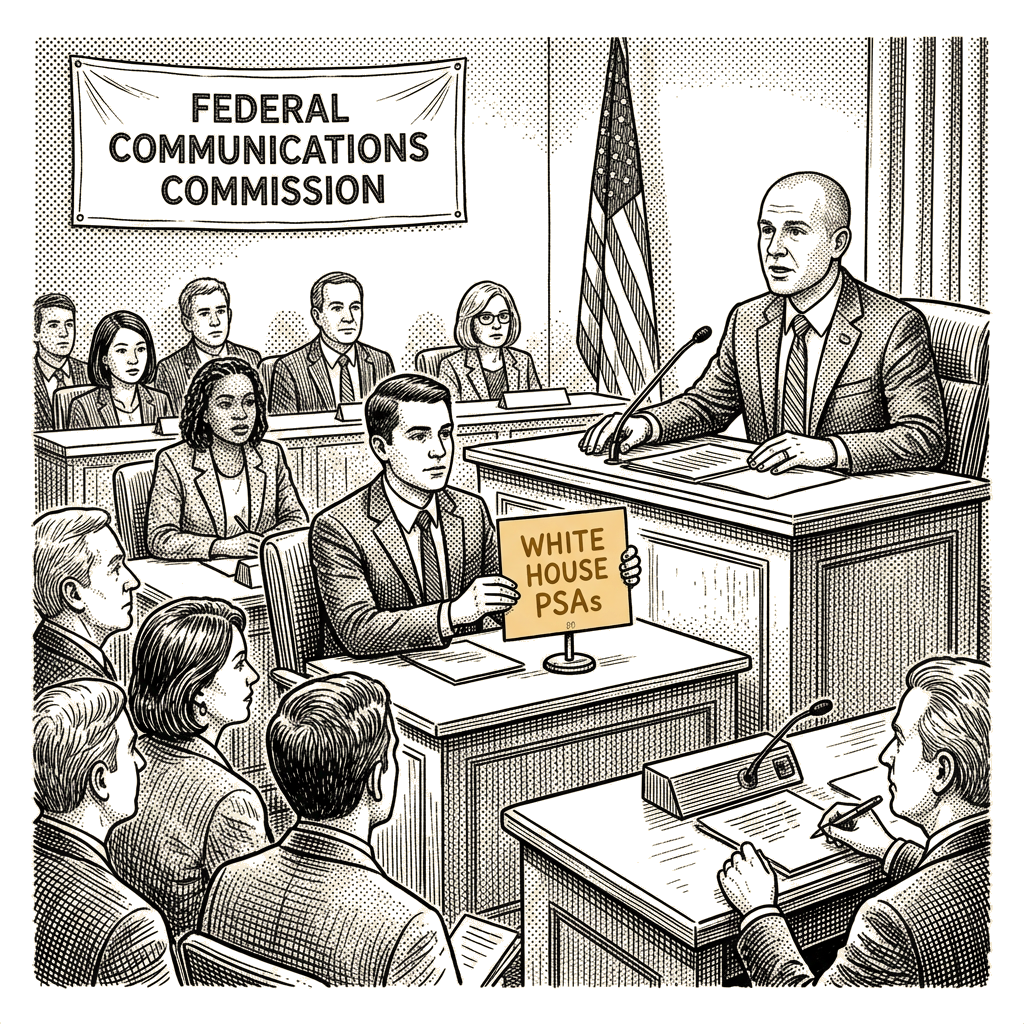
Federal Communications Commission Chairman Brendan Carr on Wednesday endorsed the Trump White House’s characterization of taxpayer-funded advertisements featuring President Donald Trump as “normal course PSAs,” telling reporters there is “nothing there that strikes me that merit any sort of FCC review or any liability on any broadcaster for running a regular, normal PSA.” The three spots, which began airing September 23 at a cost Public Citizen has put at more than $1 million, are the subject of complaints filed with the FCC, the U.S. Office of Special Counsel, and the U.S. Government Accountability Office alleging violations of statutes prohibiting the use of government resources for propaganda and partisan political activity. The “normal course PSA” characterization, on the published record, selects into a bipartisan precedent the administration invokes and selects out the 2024-campaign provenance of one spot, the appropriated-funds pathway for the three purchases, and a Monday cease-and-desist letter sent by attorneys for musician JMSN (Christian Berishaj) over the use of his song “Love Me” in the first ad, with a Thursday compliance deadline. The two-track adjudication — at the FCC and at the two bodies outside Carr’s licensing process — will determine whether the framing the regulator adopted Wednesday survives the complaints already on file.
What the “normal course” framing serves
Three constituencies are explicitly served by the Carr and White House characterizations on the published record. The first is the administration itself, which the framing insulates from complaint-driven regulatory exposure on three spots that began airing September 23. Carr’s verbatim statement that the ads “do not merit any sort of FCC review” addresses the FCC track of the Public Citizen complaint directly, and the parallel statement that the ads carry “no liability on any broadcaster” addresses a secondary exposure pathway Carr’s own language frames as a possible pressure point.
The second constituency is broadcasters, who receive revenue from the three purchases — at a cost Public Citizen has put at “more than $1 million,” with the nonprofit stating the cost is “believed to be in excess of $1 million” — and are simultaneously defended from the licensee-liability exposure Carr’s press conference named. Carr’s verbatim characterization of license-renewal objections as part of a pattern in which “groups on the left that have long worked and pushed to weaponize the FCC’s license renewal process” operates on broadcasters as audience: the press conference tells licensees that the regulator views objections of this type as falling inside a pre-existing frame.
The third constituency is the bipartisan-precedent category itself, which the “Republicans and Democrats” comparison invokes to neutralize the partisan signal of the ad content. Carr’s verbatim: “These are normal course PSAs that the government runs, Republicans and Democrats, routinely and it doesn’t strike me as anything at all out of the ordinary.” The category does work that no individual constituency can do alone: it absorbs the visual and voiceover prominence of the sitting president into a routine, and the routine into a non-partisan one.
Three constituencies bearing documented costs on the published record are not named in the Carr press conference as beneficiaries of the framing. The appropriated-funds pool — the source of the three purchases — is treated as administrative background rather than as a constituency whose interests the “PSA” label secures; Public Citizen’s complaint to the U.S. Government Accountability Office rests on the appropriations question, which is whether congressionally authorized funds may be spent on content the complaint characterizes as campaign material. Christian Berishaj (who records as JMSN), the copyright holder whose attorneys sent a cease-and-desist letter Monday demanding the White House stop using his song “Love Me” by Thursday, is positioned as a private litigant rather than as a participant in the regulatory frame the Carr press conference addressed. The future-complainant constituency is told, in the same press conference in which the ads are defended, that objections to the ads will be treated inside a pre-existing frame — Carr’s verbatim “I’m sure they will do it again in the future” makes the pre-labeling explicit on the record.
How the “normal course PSA” frame is constructed
The “normal course PSA” frame performs a specific set of selections on the documented record, and the selections are visible in what the frame admits into the comparison and what it backgrounds.
The frame selects into the comparison the historical practice of agency-issued public service announcements, a category the White House has invoked in a statement late last week and whose typical production and distribution conventions — agency-produced creative, broadcaster-donated time arrangements, no visual or narrative resemblance to campaign-style material — the source materials do not establish. Whether the comparison holds against that historical record is a question the pending federal complaints will adjudicate.
The frame selects out the 2024-campaign provenance of “The Final Battle,” the second spot. The article reports that “The Final Battle” is “nearly identical to one his campaign aired ahead of the 2024 presidential election.” The ad shows Trump walking down a hallway staring at the camera as he speaks in voiceover about demolishing “the deep state.” The provenance is documented; the Carr press conference did not address it.
The frame selects out the appropriated-funds purchase of commercial time. The funding mechanism — taxpayer money for the commercial slots, at a cost Public Citizen has put at more than $1 million for the three spots that have run since September 23 — is the documented basis for the Public Citizen complaint to the U.S. Government Accountability Office; it is not addressed in the Carr statement.
The frame selects out the cease-and-desist letter attorneys for JMSN sent Monday demanding the White House stop using “Love Me” in the first ad, with a Thursday compliance deadline. The copyright dispute is reported as pending; the Carr press conference did not address it.
The frame naturalizes — treats as not requiring justification — the use of taxpayer money for advertising built around the image, voice, and prior campaign template of the head of the executive branch. The unstated premise is that “normal course” government PSAs and campaign-style advertising are not the same category, and that no further inquiry is required to distinguish them.
Two lexical operations support the frame. The first is lexical substitution: the ad surface vocabulary — “The Country He Loves,” “The Final Battle,” “deep state,” “communism” — activates identity and conflict schemas, while the administration’s defense substitutes a different lexical register (“public service announcement,” “normal course,” “Republicans and Democrats,” “not partisanship”). The lexical substitution moves the unit of analysis from the content of the ad to the institutional category it is filed under.
The second operation is the management of two attribution registers. The ads frame attribution episodically — Trump as central agent, the country as his object of love, “the deep state” as his antagonist. The administration’s defense frames attribution institutionally — “the government,” “Republicans and Democrats,” “PSAs that the government naturally and normally runs.” The two frames locate responsibility at different levels, one at the individual, one at the office, and are kept simultaneously and separately available on the published record.
A separate tension is visible in the White House’s parallel characterization. In a statement late last week, the White House said: “President Trump is not on the ballot and there is no call to action.” The same statement describes the announcements as “a reminder for Americans to love their country and know why it’s worth defending — at home, at the border and aboard. That’s not partisanship — that’s a government that still believes in the country it serves.” The “not on the ballot” assertion sits alongside the sitting president’s reported repeated instruction telling Republicans to “vote on Nov. 3 as if he were on the ballot.” The two statements are not formally contradictory — “not on the ballot” can be read literally as a description of ballot access, distinct from a campaign instruction to treat an off-ballot vote as a referendum — but they distribute their emphases in opposite directions, and the White House framing is the one the regulator has now adopted.
The Carr press conference was structured so that the burden of distinguishing fell on the complainant. Asked specifically about Public Citizen’s contention that “The Final Battle” is a Trump campaign ad, Carr laughed before delivering the formulation. Carr’s verbatim: “There are groups on the left that have long worked and pushed to weaponize the FCC’s license renewal process and I’m sure they will do it again in the future, but again with respect to these particular ads, these are PSAs that do not raise any red flags that are normal course that Republicans and Democrats always do.”
The propaganda-research reading
The pattern visible on the published record has been characterized in the propaganda-research tradition that runs from Edward Bernays through the propaganda-model framework associated with Edward Herman and Noam Chomsky. Attributed to Bernays, the engineering-of-consent model describes content designed to associate an officeholder or institution with desired schemas, funded by the office or institution itself. The three spots operate as engineering-of-consent artifacts on that reading: content designed to associate the officeholder with patriotism, anti-communism, and the country he loves, funded by the office the officeholder occupies. The “normal course PSA” frame is the engineering-of-consent counterpart on the defense side: it associates the ads with a precedent — “Republicans and Democrats” — meant to neutralize the partisan signal of the content. The PSA defense is integration-coded — the ad is meant to look like the routine operation of government — and the administration’s frame attempts to rekey an agitation artifact as an integration artifact.
The Herman-Chomsky five-filter model provides a separate lens. The official-source filter is operative, with the chairman of the relevant regulator endorsing the producer’s framing on the published record. The flak filter is operative preemptively, since Carr’s verbatim reference to groups that “have long worked and pushed to weaponize the FCC’s license renewal process” is a documented instance of preemptive framing of anticipated complaints. The common-enemy filter is operative through the ads’ own language — “communism” and “the deep state” as shared antagonists that authorize the featured speaker as the responder. The reliance on official sources and the absence of any independent documentary inventory of prior comparable presidential PSAs in the article further mark the structural pattern.
A not-at-issue layer is visible on the published record. The visual and voiceover presence of the sitting president — his image, his voice, his gaze down a hallway in “The Final Battle” — is not-at-issue content under the PSA frame: the frame treats the presence of the president as incidental to a public-service message, while the surface treatment centers him as the protagonist. The pattern — surface messaging claims one thing, the artifact’s presence communicates something else, and the “PSA” frame protects both layers by making only the surface messaging the unit of analysis — is the structural signature the propaganda-research tradition was developed to detect.
The diagnostic-prognostic-motivational sequence articulated by David Snow and Robert Benford in the framing-process literature is present in the ad copy. The diagnostic register identifies the antagonist — “communism” and “the deep state.” The prognostic register identifies the responder — Trump, walking down a hallway, staring at the camera. The motivational register is picked up verbatim in the White House’s “a reminder for Americans to love their country and know why it’s worth defending — at home, at the border and aboard.” The administration’s defense uses nominalization — “PSAs that the government naturally and normally runs” — that deletes the specific individuals who conceived, paid for, and approved the spots; the agent of the advertising disappears into the institution of “the government.” The defense also deploys presupposition — “Republicans and Democrats” do this routinely — that takes the comparability of the precedent as established rather than demonstrated.
Parameters and pending adjudication
Three parameter choices on the documented record would, if altered, shift the distribution of the “normal course PSA” framing. If the creative were produced for the federal government as original PSA material — rather than, as the UPI report states, drawing on a template “nearly identical to” the 2024 campaign spot — the “normal course” comparison would not require the 2024-campaign provenance to be backgrounded. If the funding mechanism routed through a campaign account or a political-party committee, the appropriated-funds pathway would not be in play. If the ad creative used licensed music on terms the rights-holder accepted, the cease-and-desist pathway would not exist. Each of these parameter choices is documented in the source materials, and none is addressed in the Carr or White House characterizations on the published record.
The complaint has been lodged with three separate federal bodies. Two of the three — the U.S. Office of Special Counsel and the U.S. Government Accountability Office — sit outside the FCC license-renewal process Carr’s press conference described. Whether the “normal course PSA” characterization survives the three pending federal complaints is a question those bodies will now adjudicate, on a record that includes — as the Carr press conference did not — the 2024-campaign provenance of “The Final Battle,” the “vote as if on the ballot” record on ballot status, and the JMSN cease-and-desist.
Limits of the analysis
The historical-comparability claim is asserted by the administration and by Carr; it is not documented in the article. No documented inventory of comparable prior government-funded ads featuring a sitting president in voiceover with imagery and language previously used in his campaign is reported. The appropriations question — whether the spending violates the restriction on use of government resources for propaganda and partisan political activity — is reported as the subject of the three complaints; the article does not report the text of the relevant statute or any enforcement determination. The intent question — Carr’s “normal course” assertion, the White House’s “no call to action” assertion, and the reported fact of the president’s repeated get-out-the-vote appeals — sits on the published record as a factual matter of competing characterizations; no finding of bad faith can be drawn from the article alone. The cease-and-desist dispute is reported as pending; the article does not report whether the White House has complied.
Analytical techniques used in this piece
This analysis applies the methods below. Each links to a short, plain-English explainer you can read and reuse.
- Cui Bono — Who Benefits
- Asks who gains and who pays from a state of affairs, decision, or claim.
- Frame Audit
- Surfaces the frame an argument adopts and what that framing quietly includes or excludes.
- Propaganda Audit
- Reads a message for propaganda technique — loaded framing, manufactured consensus, and demonization.
- Stanley on Propaganda
- How anti-democratic propaganda cloaks itself in the language of democratic ideals.