Summary
- Lt. Gen. Benjamin T. Watson’s 48-hour operational pause on Okinawa advances U.S. military command’s procedural and recognition interests while leaving the structural demand for a fundamental revision of the U.S.-Japan Status of Forces Agreement outside the addressed frame.
- The pause, in effect from 12 a.m. Wednesday to 12 a.m. Friday, imposes mandatory training on liberty policy, alcohol awareness, Okinawan culture, and alliance responsibilities, with a complete alcohol prohibition across the force.
- Marine Devin Jacob Ballard, 20, stationed at MCAS Futenma, was arrested Sunday on accusations of strangling 39-year-old Anna Yagi at a Naha hotel between 2 a.m. and 4 a.m. Saturday and taking her wallet and other belongings, a case now moving through the criminal-justice track under SOFA’s jurisdictional allocation.
- Japan Foreign and Defense ministries lodged protests with their U.S. counterparts through diplomatic and military-to-military channels respectively, and Okinawa Gov. Genta Koja met Defense Minister Shinjiro Koizumi in Tokyo on Wednesday calling for a stronger response than warnings and training.
- The cumulative pattern — procedural protest escalating to high-level engagement, structural demands aired alongside tactical ones, public anger reported as having grown since the arrest — corresponds to escalation markers identified in third-side scholarship, with the conduct-level response leaving the framework-level engagement Koja names as necessary outside the 48-hour window.
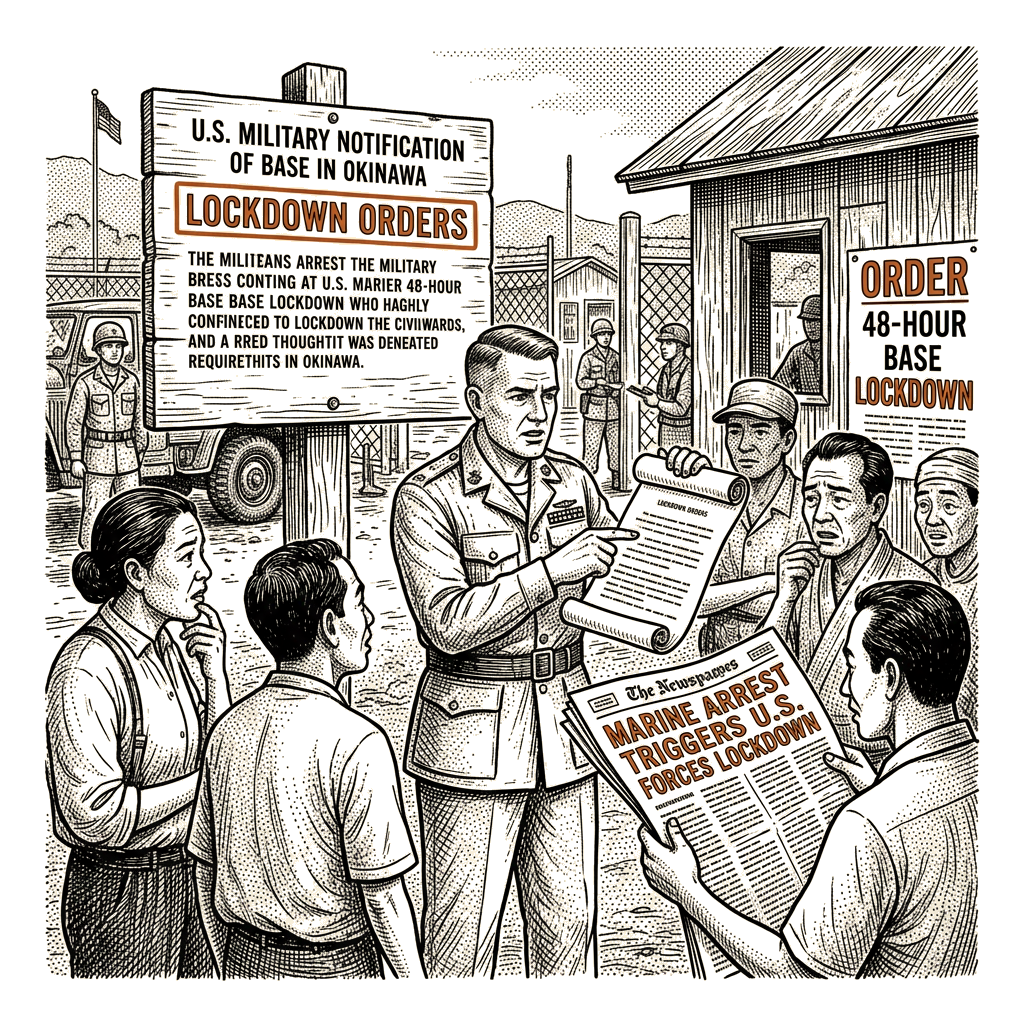
U.S. forces on Okinawa began a 48-hour operational pause Wednesday, with Lt. Gen. Benjamin T. Watson ordering roughly 30,000 service members on the island to remain at their bases for mandatory training on “standards, discipline and our responsibilities as members of the Okinawa community,” alongside a complete alcohol prohibition, following the Sunday arrest of Marine Devin Jacob Ballard on accusations of strangling 39-year-old Anna Yagi at a Naha hotel. The pause addresses a conduct-level and chain-of-command interest set within the U.S. military’s internal response framework, but the Okinawan prefectural government’s parallel demand — articulated Wednesday by Gov. Genta Koja in a meeting with Defense Minister Shinjiro Koizumi in Tokyo — sits at the framework level, calling for a “fundamental revision of the U.S.-Japan Status of Forces Agreement” that has governed the U.S. presence since World War II. Three institutional responses now run in parallel: Watson’s measures, the criminal-justice track under SOFA, and Koja’s framework-level demand, and the source material does not establish how the three integrate.
Three interest sets, three addresses
The 48-hour window defined by Watson’s letter serves three institutional interest sets to different degrees, with two further interest sets present in the reporting without a seat at any of the three tables.
Watson’s letter advances several interest categories simultaneously for U.S. military command. The training and lock-down signal substantive control over personnel during a crisis. The announcement demonstrates procedurally that the chain of command is responding. The explicit reference to “responsibilities as members of the Okinawa community” addresses recognition interests the command has reportedly struggled to satisfy after prior incidents. Watson’s statement that “Serving on Okinawa comes with responsibility. We live, work and socialize alongside the people of Okinawa; their home is our home” and that “Every interaction with our neighbors builds or undermines the trust that is essential to our team” ties the threads together. Identity and security interests, both for the force and for the bilateral alliance, are served by visible contained action. Watson’s framing — “Every member of this force must understand that individual conduct has consequences” — states the conduct-level object the pause is designed to serve: preserving force readiness while signaling to the host population that conduct standards are being enforced.
The Japanese central government’s interest set, addressed by the same announcement, runs on a different object. Japan’s Foreign and Defense ministries lodged protests with their “respective U.S. counterparts” — the “respective” framing indicating that the Foreign Ministry’s protest moved through the diplomatic channel and the Defense Ministry’s protest through the military-to-military channel. Both protests are procedural steps that register the offense without escalating it. Koizumi’s response after meeting Koja — “We would like to move forward with discussions between Japan and the United States” — leaves the diplomatic path open while signaling that the relationship will be managed through established channels. The pause, from Tokyo’s vantage, allows alliance management to proceed without forcing a renegotiation of the U.S.-Japan Status of Forces Agreement that could carry costs across adjacent areas of the bilateral relationship.
The Okinawan prefectural government’s interest set, by contrast, is touched by the pause at the level of conduct but not at the level of structure. Koja’s reported call for “a stronger response than warnings to U.S. troops and additional training” indicates that the interest categories at stake are not principally about the individual incident. The prefectural interest set includes a procedural interest in revisions to the framework governing U.S. military presence, a substantive interest in reducing the incident rate itself, a fairness-perception interest in the appearance that Okinawans bear disproportionate burden, and an identity-and-recognition interest in having Okinawan voices shape the conditions under which the bases operate. The pause, by its design, touches none of these structurally.
Two interest sets appear in the reporting without an institutional seat at any of the three tables. Anna Yagi’s family, while not named as a party in the public statements reported, carries a separate set of interests the source material does not address, including substantive interests in the criminal process, recognition interests in how the victim’s status is treated in U.S. and Japanese proceedings, and a future-relationship interest in whether the case produces institutional change. The source also reports that “public anger against the U.S. military and demands for accountability have grown since the arrest.” This public sentiment does not have a seat at any of the three institutional tables, but it shapes what each hub can credibly do: for the U.S. military command, public anger raises the cost of any response that appears purely procedural; for the Japanese central government, public anger raises the cost of any response that appears to manage the dispute away from the Okinawan public; for the Okinawan prefectural government, public anger is both a resource and a constraint. The pause, as a tactical response, addresses the procedural interest of managing public anger but does not engage the structural interest the public anger reflects.
A sixth constituency — Okinawan civilians employed by U.S. bases — is not named in the source. Their structural position, economically dependent on the U.S. presence while sharing the safety and recognition concerns of other Okinawans, places their interests outside the pro-base and anti-base framing that public discourse tends to enforce, and the pause, by addressing service-member conduct, leaves the question of base-area civilian experience unresolved on the available reporting.
The parallel tracks and what the 48-hour window does not cover
The pause sits inside a relationship structure organized around three primary hubs — the U.S. military on Okinawa, the Japanese central government, and the Okinawan prefectural government — with the SOFA framework as the institutional spine.
Three categories of action are in parallel, not in sequence. The Watson measures (conduct-level), the criminal-justice process following Japanese police’s Sunday arrest of Ballard on accusations of strangling Yagi at a Naha hotel between 2 a.m. and 4 a.m. Saturday and of taking her wallet and other belongings (individual-accountability), and the Koja demand (framework-level) address three different objects. The criminal-justice track operates under the SOFA framework for jurisdictional allocation, with its own pace, evidentiary discipline, and standing for the Yagi family as the alleged-victim party. The custody and cooperation arrangements implementing SOFA in this case constitute an additional layer of the relationship map. Whether the relationship among these three responses is generative, with one feeding into another, or parallel, with each addressing its own object without integration, is unresolved in the source. None of the three, as reported, references the others.
Five relationship types are visible in the reporting. The Watson-to-unit link is a chain-of-command relationship, direction downward. The Japanese Foreign and Defense ministries’ protests with their U.S. counterparts are a diplomatic-protest relationship, channeling host-nation dissatisfaction through formal bilateral instruments across the diplomatic and military-to-military channels respectively. The Koja-to-Koizumi link is a hierarchical-advocacy relationship, with a prefectural governor escalating to the central government to press for a national-level response. The U.S. military-to-Okinawan-civilian connection is a structural-presence relationship; the source reports roughly 30,000 U.S. service members on the island, an absolute concentration that host-community advocates have characterized as a documented power asymmetry, though the demographic ratio against the Okinawan host population is not established in the source. The U.S. military has maintained a presence on Okinawa since World War II. The criminal-justice track, involving Japanese police, prosecutors, the Yagi family, U.S. military authorities, and the courts operating under SOFA’s jurisdictional-allocation terms, is a fifth relationship type whose dynamics — custody arrangements, evidentiary procedure, victim-family standing, prosecutorial reach — run on their own clock.
Each of these relationships carries a specific falsification condition: the chain-of-command link by a service member ignoring the training mandate; the diplomatic-protest link by a host-nation prosecutor being denied access to a suspect under existing SOFA terms; the hierarchical-advocacy link by the central government declining to elevate the request to a formal bilateral channel; the criminal-justice link by procedural terms producing a custody or jurisdictional outcome diverging from either side’s stated position.
The repeated prefectural calls documented in the article for a “fundamental revision of the U.S.-Japan Status of Forces Agreement” frame the underlying interest as structural rather than conduct-level. The two categories of response — Watson’s training and Koja’s SOFA-revision demand — are not opposed in content; they address different objects. The Koja demand descends to a different need from the one Watson’s measures serve: not the management of this incident but the prevention of the next, at the level of the framework within which incidents are adjudicated and within which the roughly 30,000 U.S. service members on the island are stationed.
Whether the dispute moves toward a structural engagement — the SOFA revision Okinawan officials have called for — or toward a chronic pattern in which tactical responses recur without addressing underlying conditions depends on choices made outside the 48-hour window the lockdown defines. The pause, on the available evidence, addresses one interest set and leaves the others in play.
The frame: who fills which third-side role
The community surrounding the incident — Okinawan civil society, the prefectural government, the central Japanese government, the bilateral diplomatic channel, and the U.S. and Japanese legal systems — constitutes a third side as a social fact. In the framework associated with William Ury’s The Third Side, the ten third-side roles are commonly grouped into prevention (provider, teacher, bridge-builder), resolution (mediator, arbiter, equalizer, healer), and containment (witness, referee, peacekeeper).
The provider role, addressing frustrated needs that drive conflict, is partially active in the Watson announcement, which names the underlying frustrations of the Okinawan community; the measures announced, however, operate on conduct-level frustrations rather than on the structural frustrations Koja identifies. The teacher role is active in the Watson training program, with named topics covering liberty policy, enforcement mechanisms, alcohol awareness, Okinawan culture, and alliance responsibilities. The bridge-builder role, developing relationships that pre-empt conflict, corresponds to the bilateral status-of-forces negotiation track; Koizumi’s statement that “We would like to move forward with discussions between Japan and the United States” indicates that this role is being claimed but not yet actively filled by an institutional bearer. The mediator role is not visibly filled in the article’s reporting. The arbiter role is being filled by the Japanese and U.S. legal systems with respect to the criminal matter, and by the SOFA framework as the standing arbitral instrument for jurisdictional allocation. The equalizer role, addressing power asymmetry, is not visibly active; the prefectural SOFA-revision demand is, in substance, a request that this role be performed by the institutional framework. The healer role, addressing injured emotions and broken relationships, is not visibly active; Watson’s statement that “Every interaction with our neighbors builds or undermines the trust that is essential to our team” acknowledges the relational dimension, while no specific healing intervention is named. The healer role is the most visibly empty of the ten on the present reporting, and the substrate does not establish what specific institutional actor or intervention would fill it. The witness role is being filled by the Japanese ministries’ lodging of formal protests, by Koja’s meeting with Koizumi, and by the prefectural government’s ongoing public documentation of incidents. The referee role, establishing rules for fair engagement, is being filled by the SOFA and related bilateral instruments; the prefectural demand is that the rules be revised. The peacekeeper role is not visibly relevant to the current incident, which post-dates the alleged offense.
A complementary mapping organizes the same actors into three concentric rings. The intimate ring contains the Yagi family, named in the source material, alongside the accused Marine’s family and the immediate U.S. unit to which Ballard is assigned, neither of which is named in the source but both of which are structurally inferable as intimate-ring actors. The mid ring contains U.S. military command on Okinawa, the Okinawan prefectural government, Okinawan civil society organizations identifiable as part of the mid-ring institutional field though not named in the source, and local U.S. military justice actors. The outer ring contains the Japanese central government, the U.S. executive branch, the U.S. Congress, the broader U.S.-Japan alliance apparatus, and the international press. The arbiter function sits partly in the U.S. military justice system for the accused Marine, partly in the SOFA framework for jurisdictional questions, and partly in the bilateral diplomatic process for structural questions.
Three patterns that third-side scholarship identifies as escalation markers are visible in the public record. First, the movement from procedural protest — the lodging of formal protests through the diplomatic and military-to-military channels by the Foreign and Defense ministries — to direct high-level engagement (Koja’s in-person meeting with Koizumi in Tokyo) is the kind of move third-side analysis describes as shifting a dispute from routine channels into the senior-leadership tier. Second, the simultaneous airing of structural rather than tactical demands — Koja’s reported call for a stronger response than warnings and training, alongside the public resurfacing of calls for fundamental SOFA revision — is the kind of move third-side scholarship identifies as shifting a dispute’s level from the individual incident to the institutional frame. Third, third-side scholarship identifies the public accumulation of unaddressed grievances across incidents as an escalation marker; the source’s reference to public anger that has grown since the arrest is consistent with this pattern. None of these is itself destabilizing, but the accumulation, if unaddressed at the structural level, is consistent with the trajectory third-side analysis describes as moving a dispute from tactical toward chronic.
The limits of the third-side framework apply directly. Power asymmetry between the U.S. military presence and the Okinawan host community makes mediation a venue in which the structurally weaker party may be pressed into accepting a corrective that does not address the underlying grievance. Parties’ agency means that third-side intervention can become intrusive when what is required is confrontation rather than facilitation. The conduct alleged in the criminal matter requires the legal-justice response rather than the mediation response. The institutional weight of the U.S.-Japan alliance, the legal architecture of SOFA, and the geographic distribution of bases mean that the third side is not a single community but a layered set of communities whose interests diverge. A purely local third-side approach is structurally constrained from addressing SOFA itself, which sits in the outer ring. A purely central-government third-side approach risks reproducing the pattern that has produced the dispute: decisions about Okinawa made without Okinawan weight in the decision.
The Watson announcement corresponds to what scholars writing on host-nation relations in the U.S.-Japan context, in a body of work associated with Robert D. Eldridge and others, have characterized as recurring remedial responses on incidents: an internal corrective cycle intended to demonstrate institutional capacity to self-govern the conduct of service members.
The prevention cluster and parts of the containment cluster are being filled by the U.S. military’s internal response and by the Japanese ministries’ record. The resolution cluster is partially filled by the criminal-justice system and partially empty. The equalizer and referee roles are the ones Koja’s call names explicitly. The healer role is the most visibly empty on the available reporting, and the substrate does not establish an institutional mechanism that would fill it from outside the affected community. The gap the conduct-level and individual-accountability responses leave open on the available reporting: what institutional mechanism, if any, will translate these parallel responses into a framework-level engagement that the prefectural government has named as necessary.
Additional considerations
The source material does not establish several points that the analysis above references. The demographic ratio of U.S. service members to the Okinawan host population is not provided; only the absolute figure of roughly 30,000 U.S. service members is reported. The specific current terms of SOFA’s jurisdictional allocation as they apply to this case are not detailed in the source, leaving the custody and cooperation arrangements implementing SOFA as a structural layer whose specific content on this case is not in evidence. Whether Ballard is in U.S. military or Japanese custody is not specified in the source. The canonical prevention/resolution/containment clustering as Ury’s exact wording versus a gloss on his framework is not verified in the source; the analysis above applies the framework as it is commonly summarized in third-side scholarship rather than as direct quotation from Ury’s text.
Analytical techniques used in this piece
This analysis applies the methods below. Each links to a short, plain-English explainer you can read and reuse.
- Interest Mapping
- Separates parties’ stated positions from their underlying interests (Fisher & Ury).
- Relationship Mapping
- Extracts the network of ties among people, institutions, and entities.
- The Third Side
- Takes the vantage of the surrounding community that has a stake in resolving a conflict (Ury).