Summary
- Adidas has filed a Federal Court action against White Fox Boutique setting the dispute for a 2027 hearing and testing whether the sportswear company’s fifty-year Australian three-stripe registration extends to enjoin four-stripe apparel from a fast-fashion rival.
- White Fox’s barrister Ed Heerey KC has framed the four stripes as decorative, citing comparable items from Princess Polly, Glassons, and Shein and invoking an apparel-versus-shoes category boundary the source attributes to the 2013 judgment.
- Adidas’s barrister Patrick Flynn SC presented an influencer photograph pairing White Fox’s four-stripe shorts with genuine Adidas shoes as evidence of association intent, characterising the matter as “a pretty simple matter” and “not uncharted territory.”
- The proceedings will turn on whether the Australian court treats four-stripe apparel as a derivative of the three-stripe mark or as decorative practice within a documented fast-fashion convention, against a backdrop of Adidas’s 2013 Australian shoes win and recent Thom Browne losses in the United States, United Kingdom, and Germany.
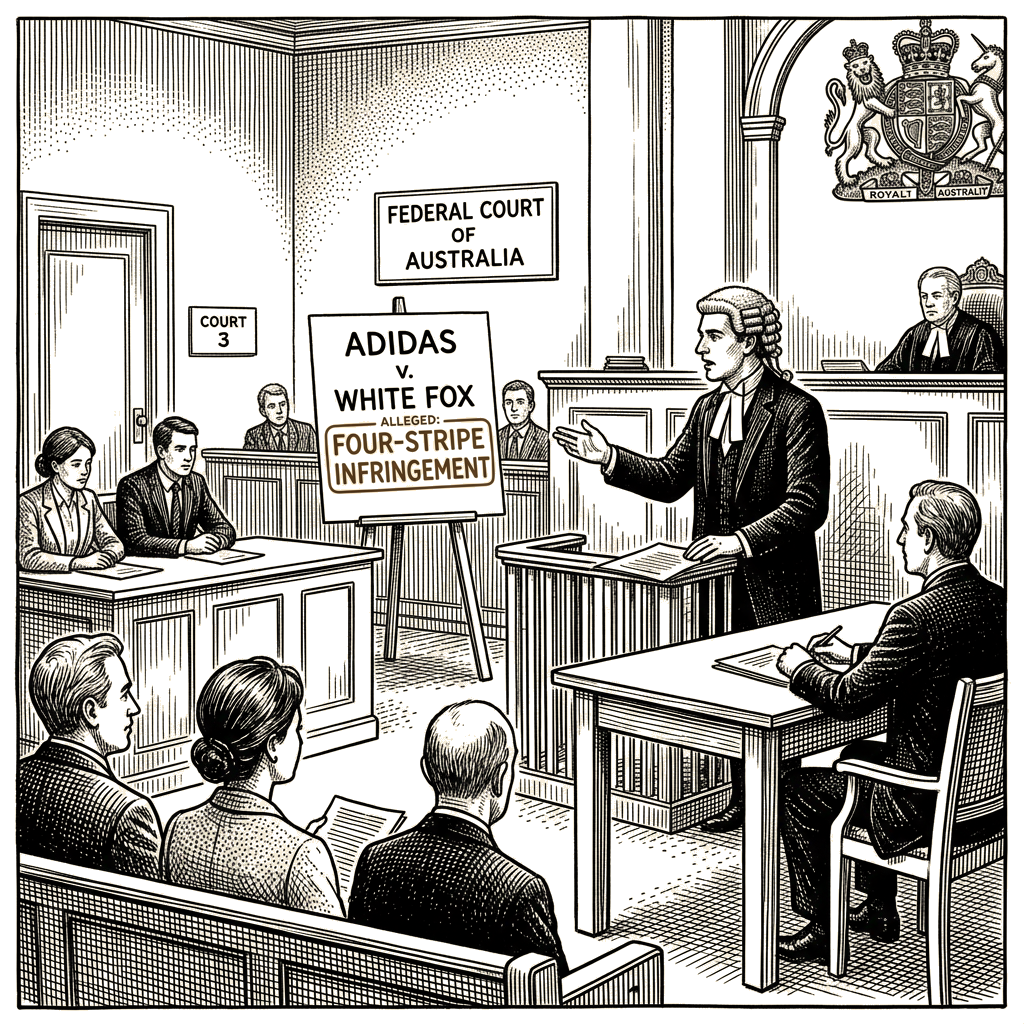
Adidas has sued Sydney-based online retailer White Fox Boutique in the Federal Court of Australia, setting the matter down for a hearing in early 2027 before Justice Ian Jackman. The action targets White Fox’s use of four parallel stripes on items including track pants and shorts, which Adidas alleges trade off its reputation. White Fox has elected to defend rather than redesign, with the boutique’s counsel signalling that comparable four-stripe items from Princess Polly, Glassons, and Shein and an apparel-versus-shoes distinction drawn from the 2013 judgment will anchor the defence. The case lands at a moment when Adidas’s global enforcement record has split between an in-jurisdiction win on shoes and three-jurisdiction losses to luxury label Thom Browne, and the Australian court’s treatment of comparable-products evidence will determine whether the four-stripe mark travels beyond the three-stripe mark into apparel.
The parties and the documented stakes
The procedural posture is established: the matter had its first mention on Friday before Justice Ian Jackman, with Adidas seeking orders preventing White Fox from making four-stripe clothing and requiring the retailer to hand over profits earned on the disputed products. The public record on the merits remains limited: no design-intent documents, no consumer-perception evidence, and no prior Adidas communications to Princess Polly, Glassons, Shein, or other fast-fashion retailers are on the public record.
The documented stakes divide sharply by revenue. Adidas generated a record $39.9bn in 2025 and has held the three-stripe mark in Australia for more than fifty years, and The Guardian reports the company “has vigilantly defended its three-stripe trademark across the globe, with varying success.” White Fox, founded in Sydney in 2013 by Georgia and Daniel Contos with Daniel’s mother Melina Maceri, generated $542m in revenue in the year to June 2025 and has expanded to the United States and United Kingdom. The revenue gap implies a structural per-month cost asymmetry in contested litigation, with White Fox bearing the heavier relative burden on the documented figures. The boutique is family-held, and the article reports the lawsuit as the first high-profile litigation of its kind against White Fox Boutique. Justice Ian Jackman set the matter down on Friday without a substantive ruling; the article identifies him as the brother of Hugh Jackman.
The defensive theory: decorative use and the apparel boundary
White Fox’s barrister Ed Heerey KC has set the defence on two legs. The first is that the four stripes are decorative rather than a trademark, a position supported by Heerey’s identification of comparable items bearing four stripes from Princess Polly, Glassons, and Shein. The second is an apparel-versus-shoes category boundary that the source attributes to the 2013 judgment in Adidas’s favour against another Australian retailer. Heerey noted in submissions that the 2013 ruling found side-stripe branding common on shoes, with no equivalent common practice found for clothing, and stated the boutique will interrogate whether the four-stripe use was deceptively similar to Adidas’s trademark and whether any consumers would actually be misled.
Heerey’s submissions on Adidas’s reputation, in the source’s reported voice, framed the dispute around the three-stripe slogan: “Obviously Adidas has a reputation,” Heerey said. “Their own slogan is that it’s the brand with three stripes. Emphasis on the three.” The decorative-use theory and the apparel-vs-shoes boundary together constitute the documented defence, and the comparable-products record at Princess Polly, Glassons, and Shein functions as the principal evidentiary anchor.
Adidas’s stated theory and the influencer-paired photograph
Adidas’s barrister Patrick Flynn SC advanced a different account. Flynn argued that White Fox had used the four-stripe design as a trademark and rejected repeated requests to stop, characterising the matter as “a pretty simple matter” and “not uncharted territory” on the strength of the 2013 Australian ruling. Flynn’s specific evidentiary anchor was a photograph of a White Fox-endorsed influencer wearing the company’s four-stripe shorts paired with genuine Adidas shoes, which Flynn presented as evidence of association intent. “There’s an intention to trade off our reputation,” Flynn said.
The article also reports Flynn as citing the 2013 judgment over four-stripe shoes as the operative Australian precedent. The pairing of the influencer image with the request-and-rejection narrative functions as the documented evidentiary core of Adidas’s case on the public record, with the apparel-vs-shoes boundary the source attributes to that same 2013 ruling positioned by the defence as a limit on how far the precedent extends.
How this is being framed: a “pretty simple matter” against an uneven record
The frame tension the proceedings will test runs through Flynn’s “a pretty simple matter” characterisation. The Guardian’s article frames the case against an enforcement backdrop in which Adidas’s record has split: a 2013 Australian win against another retailer over four-stripe shoes, set against recent losses against Thom Browne in the United States, United Kingdom, and Germany. The parties’ submissions will turn on whether the Australian court treats the present dispute as an instance of an established local practice of stripe enforcement or as an extension of that practice into apparel, where the source reports the 2013 court drew a category boundary.
How the comparable-products record at Princess Polly, Glassons, and Shein is treated — as descriptive common practice or as competitive imitation of the kind the source reports Adidas has previously contested — is the substantive question the frame tension masks. Flynn’s “simple matter” framing presupposes the former is treated as a narrow exception; Heerey’s decorative-use framing presupposes the latter is treated as the rule.
Candidate explanations and the evidence ledger
The substrate presented surfaces four candidate explanations consistent with the documented record. The first, which the source attributes to Adidas’s stated theory, is intentional free-riding: White Fox adopted the four-stripe design to capture brand equity in the three-stripe mark, with disconfirming evidence including White Fox design records predating any Adidas enforcement, market-research evidence showing no consumer confusion, and an absence of internal references to Adidas in design files. The second, which the source attributes to White Fox’s stated theory, is decorative convention: the four-stripe pattern is industry-common and serves a decorative rather than source-identifying purpose, with disconfirming evidence including the influencer-paired photograph Flynn cited.
Two further explanations are not directly aligned with either party’s stated position. The third is deliberate differentiation by stripe count, under which White Fox may have chosen four stripes to remain within the sportswear aesthetic without copying three; disconfirming evidence would include trademark counsel records showing the company considered three stripes and chose four, or a documented marketing strategy of pairing four-stripe items with Adidas products. The fourth is path-dependent category imitation, under which four stripes represent a broader fast-fashion convention not originating in Adidas’s three-stripe mark, with Princess Polly, Glassons, and Shein operating in similar territory without Adidas enforcement against them; disconfirming evidence would include those brands having previously altered similar designs after Adidas enforcement actions, suggesting the industry treats the pattern as risky rather than common. The substrate presented does not resolve whether the third and fourth explanations are non-trivial competing accounts grounded in the record, or scope-creep beyond the two theories the parties have put forward.
The evidence ledger distinguishes substrate-supported evidence in each direction. The fifty-year Australian registration, the 2013 Australian judgment over four-stripe shoes, and the influencer-paired promotional photograph are identified as favouring Adidas. Comparable four-stripe apparel from Princess Polly, Glassons, and Shein; the one-stripe difference between the marks; and the apparel-vs-shoes distinction Heerey attributes to the 2013 ruling are identified as favouring White Fox. The most consequential evidence the substrate does not establish has been obtained is consumer-survey data on whether apparel shoppers associate four-stripe sportswear-adjacent items with Adidas; such data would either support the common-practice argument or cut against it as evidence of actual confusion. Whether such survey evidence has been commissioned is not established on the substrate.
Reference classes and the forecast range
The forecast turns on three reference classes of unequal weight. The first is Adidas’s Australian enforcement record, where the closest prior Australian proceeding documented in the substrate is the 2013 shoes case Adidas won — a single in-jurisdiction data point, narrow but directly on point. Flynn cited this in court as evidence the matter was “not uncharted territory.” The second is Adidas’s global record in fashion-adjacent disputes, where Adidas recently lost trademark infringement cases against Thom Browne in the United States, United Kingdom, and Germany — a class size of three pointedly adverse decisions, jurisdictionally heterogeneous but consistently unfavourable. The third is the rate at which decorative-use defences prevail in apparel trademark disputes generally, a base rate the source does not quantify; Heerey’s three-stripe-slogan emphasis invokes the principle that decorative elements are not protectable as trademarks, with the prevailing rate varying by jurisdiction and by strength of the underlying mark.
The narrow Australian reference class is the most directly informative but underpowered; the broader apparel trademark base rate is more statistically robust but jurisdictionally heterogeneous. The inside-view adjustment turns on the strength of the Adidas mark in Australia (held for more than fifty years) and on the influencer-paired promotional photograph. The most defensible range on the substrate presented: an Adidas win in some form on the apparel question is plausible; an outcome confining the mark to specific product categories or narrowing the scope of Adidas’s apparel claim is at least as consistent with the documented record.
What would point toward a finding of infringement: consumer-survey evidence specifically on four-stripe apparel; the influencer-paired promotional photograph; and the apparel-vs-shoes boundary being read narrowly by the court. What would point toward a category-bound narrowing: consumer-survey evidence supporting the common-practice defence; and the comparable-products record at Princess Polly, Glassons, and Shein being treated as descriptive rather than imitative. Settlement pattern before trial and any rulings on whether the four stripes on the specific products at issue are source-identifying or decorative are leading indicators the substrate does not resolve.
What happens next: sequencing, cross-jurisdiction, downstream consequences
The 2027 hearing functions as a documented focal point. The likely sequencing on the substrate presented is an extended discovery phase followed either by a narrowing of the disputed product range in a settlement or by a contested hearing testing the four-versus-three distinction, the apparel-vs-shoes category boundary, and the prevalence of comparable four-stripe items at other fast-fashion labels. Each side has alternatives not depending on the ruling: White Fox can redesign or relabel products before the substantive hearing, narrowing the dispute; Adidas can broaden enforcement against additional fast-fashion retailers, raising the cost of the four-stripe convention across the industry. Adidas filed first; White Fox has now answered through counsel and has chosen to defend rather than redesign the four-stripe design at issue.
White Fox’s documented expansion to the United States and United Kingdom, and the recent Thom Browne losses for Adidas in those same jurisdictions, indicate that any Australian ruling will be read alongside — though not bound by — comparable foreign proceedings. The article frames the matter as a potential turning point in how the sportswear company’s signature mark is defended in the age of rapid imitation.
The downstream consequences split by outcome. A win for Adidas would extend the deterrent signal across Australian fast fashion and potentially globally and re-establish Adidas’s deterrent posture. A loss would weaken Adidas’s broader enforcement position and could embolden similar defences in pending and future disputes; the Thom Browne losses in three jurisdictions, combined with a loss here, would cumulatively shift the strategic balance toward defendants.
Additional considerations: gaps in the public record
Three coverage gaps in the substrate bear on the forecast and on the framing of both parties’ positions. First, whether consumer-survey evidence has been commissioned by either party is not established. Second, whether design-intent documents exist on White Fox’s side is not established. Third, whether Adidas has sent prior demands to Princess Polly, Glassons, Shein, or other fast-fashion retailers is not established. Each gap corresponds to a class of evidence that would either support or undercut the documented theories the parties have put forward, and each is a leading indicator the substrate does not resolve.
Analytical techniques used in this piece
This analysis applies the methods below. Each links to a short, plain-English explainer you can read and reuse.
- Analysis of Competing Hypotheses
- Scores rival explanations by how well each fits the evidence, weighting the diagnostic items (Heuer).
- Probabilistic Forecasting
- Puts calibrated probabilities on what happens next.
- Strategic Interaction (Game Theory)
- Models a situation as a game — players, moves, payoffs, and likely equilibria.