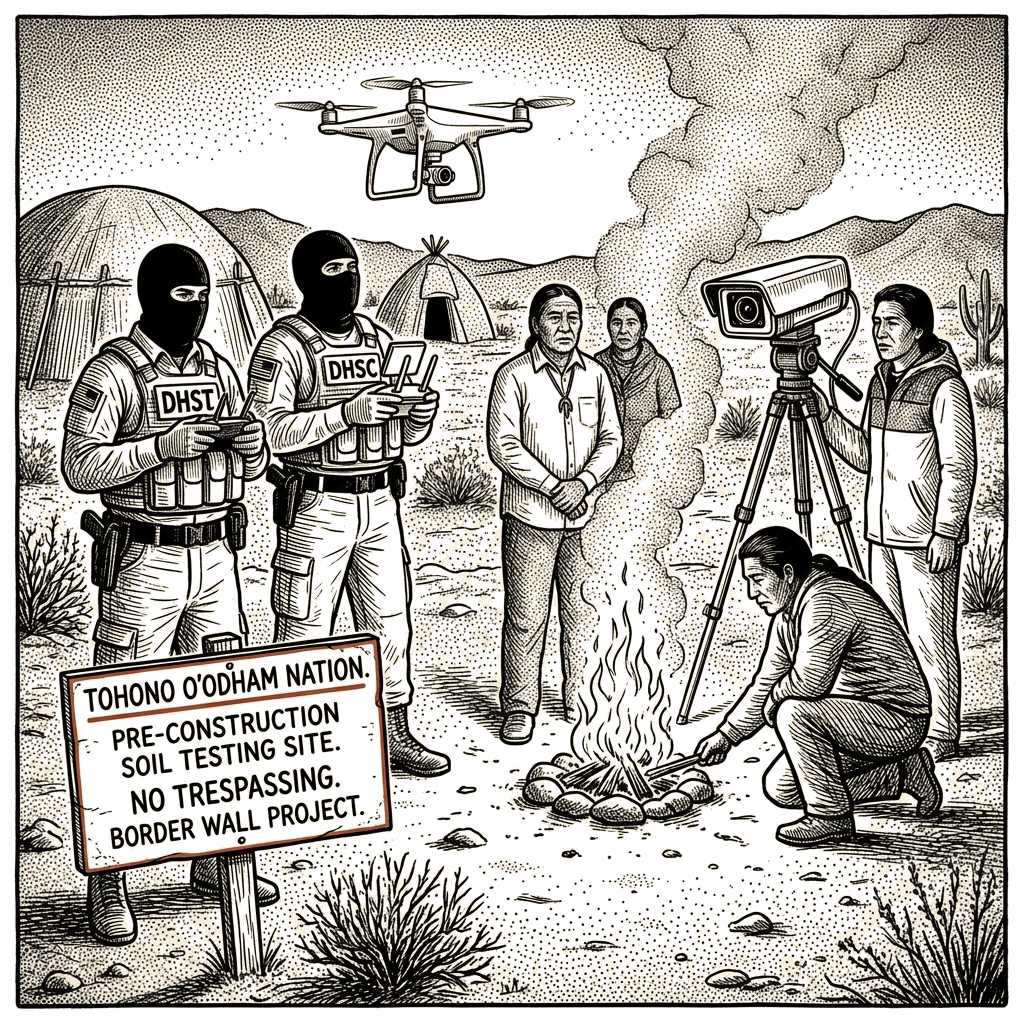
At 4:59 a.m. on Aug. 25, Tohono O’odham Nation Chairman Verlon Jose opened an email from Henry N. Laxdal, the acting chief patrol agent of the Border Patrol’s Tucson Sector: government contractors were en route to conduct soil tests for a 62-mile wall along the nation’s southern boundary. The work would begin in exactly one minute. If the tribe wished to have cultural monitors observe the work, they were welcome to, Laxdal wrote, but they could not interfere with the government’s operations. The agency’s willingness to accommodate cultural monitors underscored its “commitment to ongoing coordination” with the Nation. By sunrise, ProPublica reported, the contractors were guarded by federal agents in masks and tactical gear drawn from BORTAC, the agency’s special operations wing — the same unit that had taken part in Minneapolis and Chicago enforcement operations the previous year that left three people dead, including two U.S. citizens.
Eleven days earlier, on Aug. 14, U.S. District Court Judge Richard J. Leon had denied the tribe’s request for a preliminary injunction. He had done so on an express condition. “I fully expect the government in the months ahead to follow through on its guarantees of consultation and cooperation with the Nation,” he wrote, “to address the Nation’s concerns regarding border wall construction!” That expectation has become the analytical pivot of what followed.
The operational record documented by ProPublica — court filings, interviews with tribal leadership, firsthand observations, and more than 1,000 contemporaneously written observations compiled by tribal members — describes a documented mismatch between the assurances the court credited and the conduct within days of the denial. Adam R.F. Gustafson, the Justice Department attorney who represented the administration, told the court the tribe had previously approved a barrier on its land, that the question of what kind of barrier was for DHS to decide, and that the department “take[s] very seriously the tribe’s views on this.” The court relied on those representations in declining to issue an injunction, observing, “I don’t think the government is trying to go outside of that 60-foot strip.” ProPublica reported that, within hours of the denial, DHS General Counsel James Percival posted a celebratory meme depicting the cybernetic Star Trek antagonists known as the Borg, captioned “RESISTANCE IS FUTILE,” with the written gloss: “We respect tribal sovereignty but not to the detriment of border security. This wall is getting built. Our authority is beyond dispute.”
On Aug. 25, ProPublica reported, contractors’ heavy vehicles were documented beyond the 60-foot zone government attorneys had assured the judge would contain the work. The tribe’s chief of police was stopped at a Border Patrol roadblock when he attempted to reach the worksite; the SWAT-style agents he encountered were BORTAC operatives. The chief was permitted to record only after promising not to interfere. The chief also encountered a trio of Bureau of Indian Affairs agents who said they had been sent from Washington, D.C., to “preserve the peace and monitor activities.” Chairman Jose issued a statement on the nation’s website declaring the incursion illegal and disclosing that DHS had deployed a surveillance blimp and enlisted Mexican security forces to help protect the work crews.
The Aug. 25 events fell within a broader operational sequence. Two days after DHS Secretary Markwayne Mullin, an enrolled citizen of the Cherokee Nation and the first Native American to head the department, met with tribal leaders on April 21, a border wall contractor “inadvertently disturbed a cultural site” west of the reservation, bulldozing a 70-foot swath through the Las Playas Intaglio, a 200-foot-long earthen etching in the shape of a fish that was at least 6,500 years old. The site was well marked and well known to area archaeologists. In a meeting that month, according to council member Vivian Juan-Saunders, Mullin told the delegation, “Don’t mess with me.” Mullin’s office did not respond to questions from ProPublica about the exchange. Chairman Jose, corroborated by Juan-Saunders and council member Jesse Navarro, said CBP Commissioner Rodney Scott told the delegation that if they filed a lawsuit opposing the wall, the nation could lose access to three border gates members use to travel to and from Mexico. CBP declined to comment on the alleged threat.
Federal-tribal relations law has long rested on a structural premise: that the sovereignty of recognized nations predates the Constitution and that only Congress, acting within its Article I authority, can diminish reservation boundaries. The Tohono O’odham Nation’s June 16 federal lawsuit invoked that premise directly, arguing that the proposed wall would “reduce” its reservation — an act the tribe said only Congress could perform. In court filings, the government acknowledged its long history of working “cooperatively” with the tribal government while also arguing that the nation “does not hold veto power over the United States’ sovereign duty to secure its borders.”
The administration also points to its stated enforcement rationale. Benjamin S. Hollinder, a senior Border Patrol official, argued in a sworn declaration opposing the tribe’s lawsuit that the absence of a wall on the nation has produced a funneling effect, channeling smugglers onto the reservation. “Not having a border barrier system in this particular area makes it a vulnerable and a desirable area for [transnational criminal organizations] to operate,” he wrote. Customs and Border Protection has reported border apprehensions 94% lower than during the Biden presidency, with Border Patrol “encounters” hitting their lowest levels in more than 50 years. Commissioner Scott described the reservation’s southern boundary as “one of the most dangerous smuggling and trafficking corridors on the Southwest border” and “a remote desert that has facilitated decades of drug loads, migrant deaths, and cartel activity.” The nation’s interim chief of police, James Cook, claimed in a sworn declaration that there had been a 90% drop in reports of illegal entry on the reservation over the preceding year, and that smuggling and other border-related crimes had “almost disappeared.”
On July 22, DHS filed a notice affirming that, to accelerate the project, it was waiving, in whole or in part, more than 30 laws, including several that mandate tribal consultation. ProPublica reported that the Trump administration has used those waiver authorities to circumvent environmental and cultural preservation statutes on 60 occasions across its two terms. In court, Riyaz Kanji, the tribe’s lead attorney, argued the Roosevelt Reservation doesn’t extend onto tribal land, and that even if it did the rugged landscape would force construction to diverge far from the 60-foot boundary. Sweeping as its powers were, Kanji contended, DHS could not override a sovereign government. The administration’s plans, he argued, constituted a “blatant and unprecedented disregard for the tribe’s rights.” After the Aug. 25 events, the tribe’s attorneys told the court that DHS was “making ‘a mockery’” of the consultation expectation the court had anchored to its Aug. 14 denial.
Several elements of the substrate document the operational escalation around the prayer fire at Ko:li Ki:jig, the symbolic border gate, lit on Aug. 9 as contractors prepared to enter the reservation. Someone was always awake to watch the flame. The first drone sighting in the area was recorded the following night, at 11:43 p.m., documented in the first of two activity logs. Kept in spiral notebooks, the logs offered a minute-by-minute account of what participants in the ceremony saw and heard. The handwritten observations span 13 days and chart a steady escalation by DHS. During the camp’s first seven days, the activity log filled with nearly 665 observations, mostly federal agents circling the location. Over the next five days, ProPublica reported, the book filled with 379 observations — nearly two-thirds of which involved Border Patrol units near the fire. The arrival of Mexican authorities was documented six times; an additional 39 entries referenced unmarked vehicles and suspected “undercovers.” The logbook cataloged a dozen instances of aircraft flying over the camp, including four helicopters, three planes and five drones. “Nobody has any idea what’s actually happening out here,” 28-year-old tribal member Liz Quiroga told ProPublica. “This is true dystopia.”
A comparison the article draws: one week before the convoy rolled onto the Tohono O’odham reservation, Republican Gov. Greg Abbott announced that, after speaking with the secretary of DHS, he had secured a pause on the Big Bend wall project. “There are technology tools that don’t include barriers,” Abbott said. “Think of drones, think of fiber optics.” A federal judge subsequently granted a preliminary injunction halting construction in the Big Bend area while a lawsuit proceeds. To Amy Juan, the comparison was darkly ironic: for two and a half decades, the Nation had been a laboratory for the technology Abbott described, yet when tribal leaders raised that case, they were told to stand down. “What makes Texas the exception to us is very clear,” Juan said. “It’s good old boy conversations that are happening between the politicians and the CBP commissioners and Markwayne Mullin.”
The substrate does not enumerate every element relevant to a full audit. The article references but does not itemize the more than 30 laws DHS waived at the July 22 hearing, so readers seeking a full accounting of the statutory protections suspended would need the underlying filing. ProPublica submitted nearly 30 questions to DHS, CBP and the Border Patrol about the surveillance and interactions with tribal members and leaders, and the agencies answered none; the absence of on-record government explanation for the operational choices documented means that DHS’s stated rationale must be drawn from filings like the Hollinder declaration and Scott’s corridor statement, rather than from a direct response to the conduct at issue. The exact date of any Supreme Court decision narrowing tribal standing in analogous contexts is referenced in some background discussion but not provided in the substrate.
While the legal challenge continues, the nation has ceased attempting to remove border wall contractors from its lands. The camp and the surveillance that has come with it remain.
Analytical techniques used in this piece
This analysis applies the methods below. Each links to a short, plain-English explainer you can read and reuse.
- Domain Induction
- Builds a working mental model of a domain from the ground up.
- Quick Orientation
- A fast lay-of-the-land read of an unfamiliar domain.
- Red-Team Assessment
- Models a capable adversary probing a plan for the seams they would exploit.
- Principal–Agent Problem
- An agent acting for a principal has its own interests, which can quietly diverge.