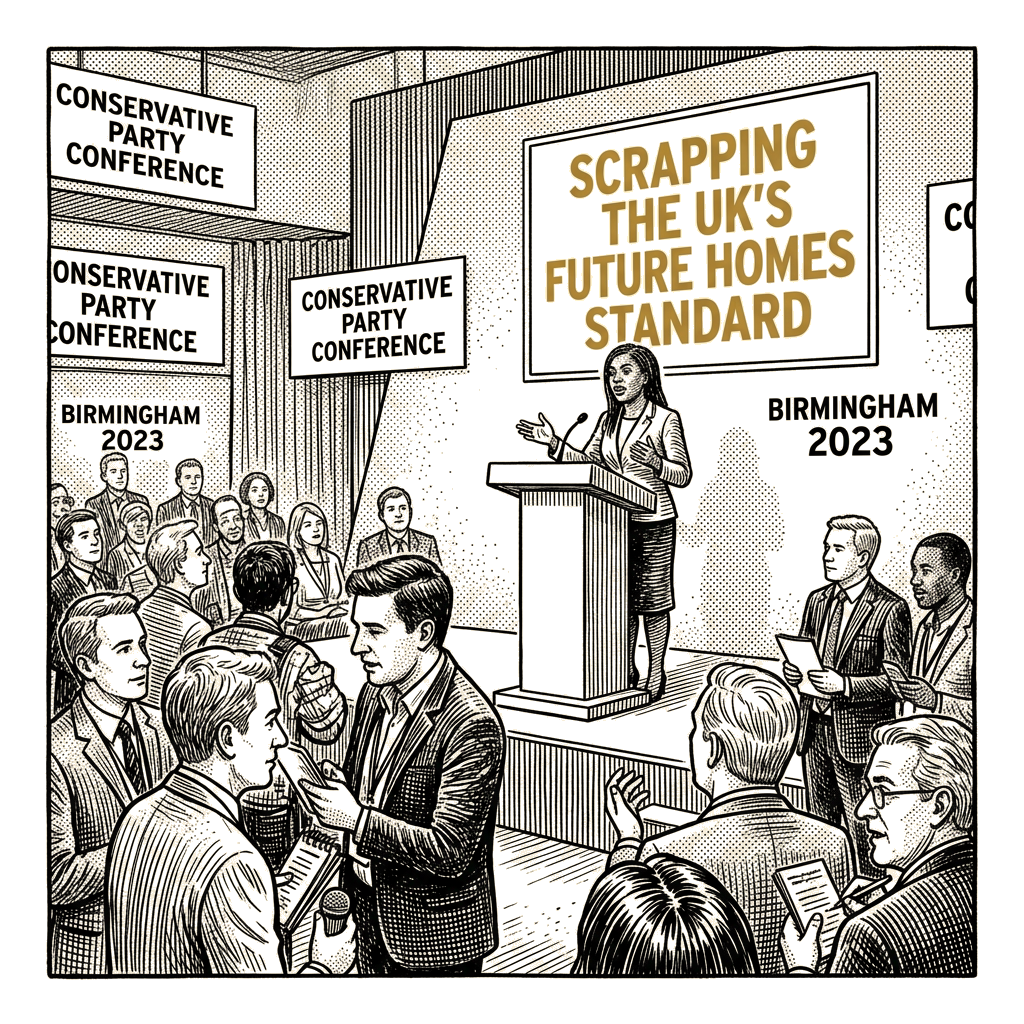
At this autumn’s party conferences, the future homes standard became an unusually clear example of how a long-lived regulatory commitment can be repriced by a short electoral timetable. The Conservative proposal would permit new homes to be built without solar panels, heat pumps and high-grade insulation, according to The Guardian’s review of the conference season. The review describes the homes policy as part of “a broader rollback of the party’s environmental positions,” which would also abolish the Environment Agency and Natural England. The same review puts the UK in need of approximately 6 million new homes. Because those homes would be occupied for decades, the cost of scrapping the standard does not disappear; it is relocated to later bills and later retrofits.
The timing is more concrete than the conference debate suggests. The UK Green Building Council said the construction industry is well prepared for the standard and will have to implement the policy before the next general election, so scrapping it is of little benefit. Simon McWhirter, the council’s chief executive, said: “The housebuilding industry has spent years preparing for the introduction of the FHS, investing in skills, supply chains and new products.” If the implementation date arrives before any new government can act, the first plausible outcome is not a post-election repeal but a pledge that becomes largely symbolic. What remains is the uncertainty the pledge itself creates in the meantime.
The cost comparison in the source material clarifies who pays, and when. The Conservatives quoted estimates of £30,000 for low-carbon new builds. The Guardian’s review cites an estimated installation cost of about £5,000 to £8,000 at the point of building, calculated in 2024 when energy prices were much lower, and annual bill savings of more than £1,300 — a saving likely to be substantially higher now. Retrofitting homes after construction would cost more than £20,000. The distributional structure is direct: the annual saving is a household benefit, while the upfront cost is a construction-stage item. The review also notes that housebuilders have been among the Conservative party’s biggest donors, though donations have fallen off in recent years.
The strongest counter-reading is temporal. A leadership conference pledge is not legislation, and the report does not cite a repeal bill. If the standard comes into force first, the practical effect of the Conservative proposal would be limited to homes built after any subsequent repeal, while the skills, supply chains and products McWhirter describes would already have been committed. The same counter-reading applies to the cost dispute: the two figures are not identically specified, and the article dates the lower estimate to 2024. The gap between £30,000 and £5,000–£8,000 is therefore not only a factual disagreement; it is also a disagreement about scope, timing and which costs count.
Two uncertainties would structure any forward view. The first is electoral: which party forms the next government. The second is administrative: whether the standard’s implementation date arrives before any repeal. The predetermined elements are the 6-million-home need, the industry’s existing preparation, and the El Niño conditions that campaigners say are building regardless of conference decisions. Crossing the two uncertainties yields three material futures. In the first — implementation proceeds on schedule, whichever party governs next — the pledge is confined to party positioning. In the second — a future government repeals the standard before its implementation date — homes are built under pre-standard rules, leaving occupants with higher bills and the option of a retrofit costing more than £20,000. In the third — the standard is neither clearly delivered nor clearly repealed — the signal alone disrupts investment. Jan Rosenow, a professor of climate and energy policy at the University of Oxford, described the mechanism: “Every home constructed today that runs on fossil fuels is a liability for the occupants. It also results in investor uncertainty and disrupts the supply chain that has been gearing up for this.”
Observable markers would distinguish these paths before the next election: whether repeal legislation appears in any parliamentary timetable; whether the implementation that the UK Green Building Council says the industry must deliver before the next general election proceeds on schedule; whether the Rosebank and Jackdaw decisions are taken or postponed again; what new-build cost data show once homes built to the standard enter the market; and the Green Party’s vote share in further urban contests. Each of these is public, periodic and visible before voters decide.
Labour’s conference contribution carried the same temporal structure in reverse. Andy Burnham made only passing references to the climate, pollution crises and nature, and announced a publicly owned body to invest in the energy grid alongside the privatised National Grid, which has been criticised for slow progress on upgrades, plus a community fund for planting 500,000 trees across England. The decision on the Rosebank and Jackdaw drilling sites was reportedly postponed for the byelection. A decision deferred is not a decision resolved. Ami McCarthy, head of politics at Greenpeace UK, said that decision would “truly define this government’s legacy on climate”.
The Green Party’s nuclear reversal introduces a tension that neither an electoral forecast nor a policy critique can resolve alone. Delegates at the party’s Bournemouth conference resolved to abandon the party’s long-held opposition to nuclear power, while still prioritising renewables; Green MPs could now support new reactors. In electoral terms, the shift follows a byelection in which the party increased its vote share in a Labour-held seat and could be the main challenger in urban Labour strongholds. In political-economy terms, Paul Dorfman, a Bennett scholar at the University of Sussex and the chair of the Nuclear Consulting Group thinktank, said the move “will lose them significant grassroot support and votes”, citing “20-plus-year construction times, repeated delays and huge cost overruns”. Both effects can operate at once: a party can widen its appeal in urban Labour seats while eroding the activist base that supplies campaign capacity. The source material does not say which force dominates, and the two mechanisms point in opposite directions.
External stress enters through the El Niño forecast. Campaigners warned that a record El Niño weather system, super-charged by global heating, is likely to bring heatwaves, droughts and floods to key agricultural areas and raise global food prices. Rosie Downes, the head of campaigns at Friends of the Earth, said: “The government must translate its words into action that delivers for people and the planet.” The connection to housing policy is indirect but material: a policy that lowers the efficiency of new homes increases occupants’ exposure to energy price movements during a period of climate-driven disruption — the “liability for the occupants” that Rosenow describes.
The conference season therefore left the UK with a set of choices whose real consequences are measured in decades but whose political rewards are measured in weeks. The future homes standard, the Rosebank and Jackdaw decisions, and the Greens’ nuclear shift all share that structure: each converts a long-lived infrastructure commitment into a near-term political signal. The least speculative near-term outcome is that the standard is implemented before the election, making the promise to scrap it a statement about future intent rather than a change in current regulation. What follows depends on whether the next government treats building regulations as a commitment with a decades-long tail or as a signal renewable at each election.
Analytical techniques used in this piece
This analysis applies the methods below. Each links to a short, plain-English explainer you can read and reuse.
- Red-Team Advocate
- Argues the adversary’s case in full to expose what a plan underrates.
- Scenario Planning
- Builds a small set of distinct, plausible futures to plan against.
- Wicked Futures
- Explores a long-horizon, deeply entangled future with no clean resolution.
- Mutually Assured Destruction
- Deterrence by guaranteeing that any attack is suicidal for the attacker.