Summary
- President Donald Trump’s Sunday “energy ceasefire” declaration was issued without reciprocal Russian confirmation on the record, and within hours Ukrainian officials documented Russian strikes on Kyiv and Kharkiv power plants that the Guardian reported as causing outages and civilian casualties.
- The Guardian reported the declaration arrived two days after Trump announced a Russian diesel purchase agreement that “temporarily lifted US sanctions,” and the Financial Times, cited by the Guardian, quoted European officials reporting the Trump administration is threatening to halt the weapons-procurement system providing Ukraine with arms to press Kyiv to end strikes on Russian energy infrastructure.
- EU foreign policy chief Kaja Kallas said the bloc would welcome a truce only “when it holds,” Canadian Prime Minister Mark Carney called the diesel deal “in direct opposition” to allied peace efforts, and German Foreign Minister Johann Wadephul and EU Commission President Ursula von der Leyen reaffirmed backing for Zelenskyy on the Guardian’s record.
- Oil markets registered the announcement through expectations of expanded Russian supply; the Guardian did not document a market interpretation framing the announcement as contracting the underlying energy relationship the announcement’s namesake was supposed to constrain.
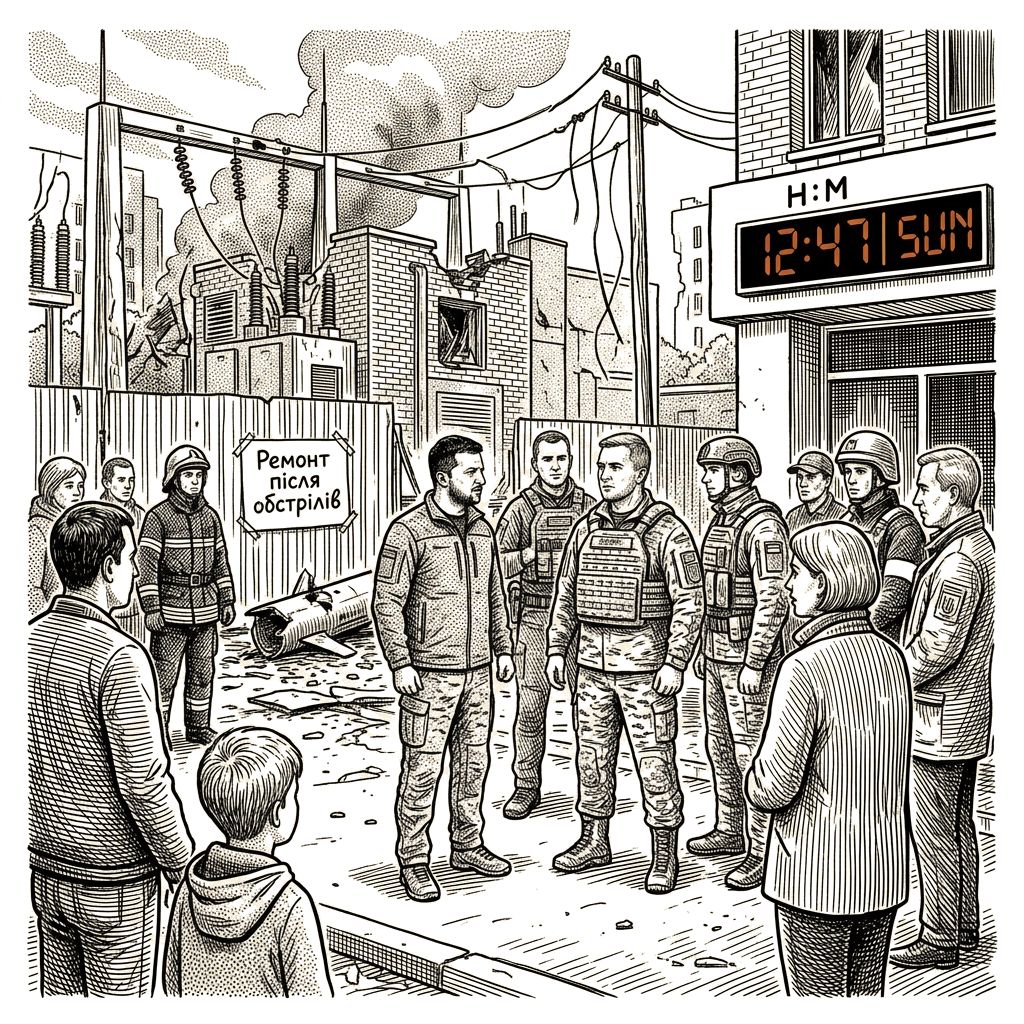
President Donald Trump announced Sunday on Truth Social what he termed an “energy ceasefire” between Russia and Ukraine, writing that “effective immediately, there is an ENERGY CEASEFIRE in the War between Russia and Ukraine” and that “Both parties have agreed. Do not break it!” The Guardian reported the post “offered no further details” and that “Russia has not yet confirmed its agreement.” Within hours, Ukrainian President Volodymyr Zelenskyy reported via X that a drone struck a Kyiv power plant, causing power outages, and reported a separate strike on a Kharkiv power plant; Russian attacks killed six people in two Ukrainian cities on Sunday per Ukrainian officials, including three killed and twenty injured, among them two children, at a grocery store in Kharkiv per the regional governor, and three killed in western Ukraine per officials. The Guardian reported the ceasefire announcement came two days after Trump announced an agreement to buy Russian diesel fuel that the paper said “temporarily lifted US sanctions” and was “prompting outrage from Ukraine and European allies.” The Financial Times, cited by the Guardian, quoted European officials reporting the Trump administration is “threatening to stop the procurement system that provides Ukraine with weapons” and is “lobbying European capitals and Kyiv in an attempt to end the attacks on Russian oil refineries.”
The documented sequence: an announcement, reported strikes, and the absence of reciprocal confirmation
The Guardian’s Sunday reporting documents a sequence in which an “energy ceasefire” was announced by one party, not reciprocally confirmed by the second on the record, and coincided with reported strikes on the energy infrastructure the announcement’s text purported to halt.
The Guardian reported Trump’s Truth Social post as stating “effective immediately, there is an ENERGY CEASEFIRE in the War between Russia and Ukraine” and “Both parties have agreed. Do not break it!” The Guardian reported the post “offered no further details” and that “Russia has not yet confirmed its agreement.” Zelenskyy, the Guardian reported, said the deal was “news to me.” On Telegram, Zelenskyy wrote that “Ukraine is ready to refrain from striking Russian energy infrastructure – and we count on the same readiness from Russia.” On X, Zelenskyy wrote that “Ukrainian skies have been infested with Russian ‘shaheds’ all day,” a term the Guardian identified as “a type of Iranian-made drone commonly used in the conflict.”
The Guardian reported Russian attacks killed six people in two Ukrainian cities on Sunday: three killed and twenty injured, including two children, at a grocery store in Kharkiv per the regional governor; and three killed in western Ukraine per officials. Iranian-made drones, described in the Guardian’s reporting as commonly used in the conflict, are not named in the announcement’s text. The reported civilian exposure in Kharkiv and western Ukraine — six killed and twenty injured in Sunday’s strikes per the regional governor — constitutes the direct documented human exposure from the strikes the announcement covered; the Guardian does not name those civilians as participants in the negotiations producing the declared terms.
Documented distributions of relief and pressure
The Guardian reported the announcement “came two days after” Trump’s separate agreement to buy Russian diesel fuel that, in the paper’s words, “temporarily lifted US sanctions” and was “prompting outrage from Ukraine and European allies.” Sanction relief to Russia, weapons-procurement pressure on Ukraine, and a public “energy ceasefire” declaration the Ukrainian side said it had not been informed of distribute in opposite directions across the negotiating parties in the framing of European officials quoted via the Financial Times.
The Financial Times quoted European officials as reporting the Trump administration is “threatening to stop the procurement system that provides Ukraine with weapons in order to press Kyiv to halt its deep strikes on Russian energy infrastructure,” and is “lobbying European capitals and Kyiv in an attempt to end the attacks on Russian oil refineries.” The Guardian does not document a parallel lobbying track or pressure instrument applied to Russian strikes against Ukrainian infrastructure. US domestic diesel market participants, identified as the counterparty in the Russian purchase agreement the Guardian reported was announced two days prior, are implicated in the diesel purchase agreement per the Guardian’s framing. Operators of Kyiv and Kharkiv power infrastructure face the operational impact of the strikes Zelenskyy reported.
The verification test on the record
The announcement’s own text frames the cessation as bilateral — “Both parties have agreed.” The Guardian’s reporting does not document a Russian reciprocal confirmation, Russian-side statement, or reciprocal pledge matching that text. On the Ukraine side, Zelenskyy’s Telegram post states a reciprocal readiness to refrain from striking Russian energy infrastructure and counts on the same from Russia; Ukrainian officials documented the day’s reported strikes as incoming from Russia. On the Russia side, the Guardian does not document any matching Russian statement, confirmation, or reciprocal pledge at the time of the announcement.
EU foreign policy chief Kaja Kallas, at a meeting of EU foreign ministers, said the bloc would welcome a truce only “when it holds” and added, “We haven’t yet seen that also Russia will stick to it.” Her framing names the verification test the Guardian’s record does not show as met at the time of the announcement. The Kallas framing and the European officials quoted via the Financial Times describe the verification structure the Guardian documents: verification is sought from one party through subsequent observation and presumed from the other through announcement alone.
Both parties face documented tests on the record. Russia’s: the strikes Zelenskyy reported within hours of the announcement, paired with the Guardian’s reported absence of Russian confirmation. Ukraine’s: the on-record commitment Zelenskyy posted on Telegram, paired with the absence, in the Guardian’s reporting, of reported Ukrainian strikes on Russian energy infrastructure on Sunday.
Lithuanian Foreign Minister Kestutis Budrys said at the same meeting of EU foreign ministers that the bloc should designate Russia’s GRU military intelligence agency as a terrorist organization. NATO Supreme Allied Commander Europe Alexus Grynkewich is due to deliver a warning to Russia at a security conference in Warsaw over the alliance’s ability to counter any attack from Moscow.
How each party and its allies are framing the announcement
The reported sequence is consistent with one of two readings. If the announcement functions as the opening of a verified ceasefire process, the relevant scenario involves bilateral reciprocation under observation, with terms publicly pegged to be ratified by both parties. If the announcement functions as a pressure event timed to the diesel purchase — a public marker at which one party’s compliance is presupposed — the scenario involves Ukrainian unilateral restraint under the threat of weapons-procurement cutoff and residual Russian operational freedom, with verification satisfied through the announcement itself. Russian strikes documented by Ukraine within hours are consistent with the second reading; the first reading requires Russian confirmation, which the Guardian’s reporting indicates had not been documented.
Trump told reporters it was “time for Ukraine to get a new president” who would settle the war — introducing the framing of conflict resolution as entangled with Ukrainian leadership succession. Zelenskyy responded on ABC News: “First of all, with all respect to President Trump, it’s up to our society, up to our people to choose one or another leader.”
Canadian Prime Minister Mark Carney, after a call with Zelenskyy, said the diesel deal “is in direct opposition to the efforts of Ukraine, Canada and our allies to create peace and stability in Europe.” German Foreign Minister Johann Wadephul said Berlin continued to “fully support” Zelenskyy. EU Commission President Ursula von der Leyen backed him “as he leads the fight for his people’s freedom.” The Carney, Wadephul, and von der Leyen framings consistently position the question as one entailing domestic Ukrainian agency. NATO’s eastern members and EU foreign policy leadership have aligned, per the Guardian, around verification rather than acceptance of the announced terms.
The countervailing reading — that public pegging of terms constitutes a starting point for subsequent bilateral refinement — is, in Kallas’s framing and the European officials quoted via the Financial Times, evaluated as remaining incomplete until Russian confirmation and operational pause materialize. The further argument that the announcement exerts pressure on Russia to reciprocate in order to retain diplomatic standing cannot be evaluated without Russian confirmation, which the Guardian reported had not been communicated at the time of the announcement.
Audience-specific weight of the documented signals
For European allies aligned with Ukraine, the diesel-deal proximity and the weapons-procurement pressure bear on the mediator’s posture, since the announcements originated from the US side, the documented pressures are applied to Ukraine, and the documented sanction relief went to Russia. For observers of US-Russia policy across the political spectrum, the absence of Russian confirmation combined with documented Russian strikes within hours of the announcement bears on the announcement’s basic credibility. For Ukraine’s supporters, the verification arrangement described above repeats a pattern earlier negotiation rounds had, in their reported view, produced.
Market response and documented takeaways
Global oil markets registered the announcement through “expectations of more Russian supplies.” Brent crude futures fell 1.47% to $103.18 a barrel by 0154 GMT Monday; US West Texas Intermediate crude fell 1.68% to $90.31. The Guardian does not document a market interpretation framing the announcement as a credible contraction of the energy relationship the announcement’s namesake was supposed to constrain.
The analytical significance of the announcement, on the Guardian’s documented record, lies in how the reporting characterizes the verification arrangement — terms pegged without confirmation from one party and with strikes reported by the other within hours — and in how the documented sequence distributes sanction relief to Russia and weapons-procurement pressure on Ukraine around the announcement itself.
Analytical techniques used in this piece
This analysis applies the methods below. Each links to a short, plain-English explainer you can read and reuse.
- Red-Team Advocate
- Argues the adversary’s case in full to expose what a plan underrates.
- Stakeholder Mapping
- Charts the parties to a situation — their interests, power, and alignments.
- Strategic Interaction (Game Theory)
- Models a situation as a game — players, moves, payoffs, and likely equilibria.