Summary
- Paul Clement, the former U.S. solicitor general, is set to make his 129th Supreme Court oral argument on Wednesday on the 1988 Video Privacy Protection Act, returning the most prolific advocate of his generation to routine appellate function after a sequence of executive-power matters that have defined his recent practice.
- The career’s analytical feature, on the substrate, is Clement’s stated commitment to the unitary executive theory — “I’m a big believer in the unitary executive — but that doesn’t mean that the president gets to do anything he wants,” as he told the National Review — coupled with repeated challenges to executive-branch actions taken by an administration of his own party.
- Clement’s self-stated operating principle — “somebody who’s trying to get to five for their client,” per the National Review — treats the fractured court as a coalition-assembly problem, with the D.C. Circuit’s pending decision on the law-firm executive-orders challenge serving as the next test of whether his cross-administration record operates as a portable asset.
- The closed path to Supreme Court appointment, following Clement’s representation of Trump targets, functions as a costly signal in the Michael Spence signaling-equilibrium sense that aligns his incentives with portable credibility across party control of the White House.
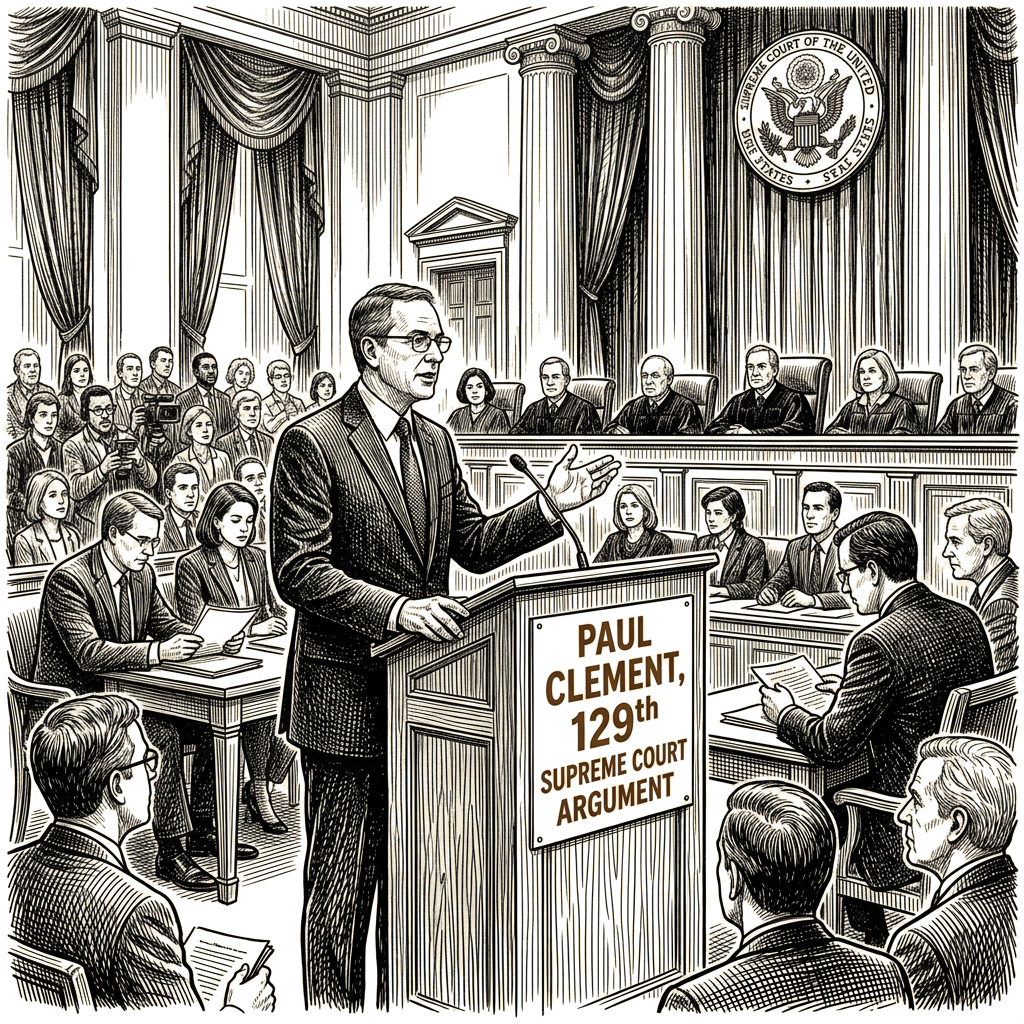
Paul Clement, the former U.S. solicitor general who served in the George W. Bush administration, is scheduled to argue his 129th case before the Supreme Court on Wednesday on a 1988 video-rental privacy law, returning the most prolific Supreme Court advocate of his generation to routine appellate work after a sequence of executive-power cases that have made him a recurring presence in the chamber. The career arc captured in the NPR account — wins on partisan gerrymandering, agency deference, and Second Amendment grounds; a loss on the Affordable Care Act challenge under President Obama; and recent challenges to Trump administration actions, including a 2026 Supreme Court refusal to allow the firing of Federal Reserve Governor Lisa Cook and the defense of the federal district court in Maryland against a Trump Justice Department suit — frames the analytical question of how a repeat-player advocate sustains portable credibility across party control of the White House. Clement’s self-stated operating principle, “somebody who’s trying to get to five for their client,” treats the fractured court as a coalition-assembly problem, while the conceptual narrowing he applies to the unitary executive theory marks the contested term his litigation is helping revise. The D.C. Circuit’s pending decision on the law-firm executive-orders challenge, in which Clement represents firms targeted for hiring attorneys who once investigated the officeholder, will test whether his cross-administration record operates as a portable asset before a panel that includes Trump appointee Neomi Rao, who openly challenged his stated position in May oral argument.
The record and its operating logic
Clement, 60, served as U.S. solicitor general in the George W. Bush administration and has spent the years since working outside government, often challenging executive-branch actions. He told the National Review he never planned to pull back when he saw examples of executive-branch overreach, no matter who controlled the White House. Among the arguments Clement has won at the court: rulings that kept judges out of partisan gerrymandering disputes, told courts they do not have to defer to federal agency expertise, and struck down restrictions on guns. His challenge to the Affordable Care Act under President Obama was a loss.
Clement’s self-description of appellate work identifies the operative problem in a fractured court: “I always think a good working definition of a good Supreme Court advocate is somebody who’s trying to get to five for their client.” The framing treats the Supreme Court as a setting in which the advocate’s job is to assemble a majority from Justices whose votes are not predictable from the advocate’s identity alone. Each of his 129 Supreme Court appearances is one round in that iterated work, with reputation, client matching, and win probability updated sequentially. Whether he is the best Supreme Court advocate of his generation is arguable; that he is the most prolific is not.
Conceptual pressure on the unitary executive
Read under a conceptual-engineering lens — the approach Sally Haslanger develops in feminist philosophy and Herman Cappelen and David Plunkett adapt for general use, in which a concept is evaluated, criticized, and revised on the basis of how well it serves its purposes — Clement’s “unitary executive” statement operates as conceptual work. The ameliorative question applied to his framing: what work does the concept need to do for someone who defends executive-branch power as a structural matter and rejects particular executive-branch actions as a policy matter?
Two candidate revisions present themselves in the article. The first narrows the concept — a strong presidency with substantive limits, signaled by Clement’s “doesn’t mean that the president gets to do anything he wants” gloss. The second is what Clement argues against — an expansive version in which the concept absorbs First Amendment retaliation against law firms, removal of Federal Reserve governors, and similar actions. The reverse-engineering move — inferring the expansive version from what Clement files against — surfaces where conceptual stress shows up in litigation.
Adjacent concepts are also under revision pressure in this record: “rule of law,” “zealous representation,” and “First Amendment retaliation.” Clement told the D.C. Circuit panel that the executive orders “strike at the heart of the rule of law and the zealous representation on which the judiciary and the adversary process depend.” Applied symmetrically, the same lens would read the orders’ framing — security-clearance and federal-buildings-access authority raised against firms that hired attorneys who once investigated the officeholder — as a contested concept undergoing stress from the other side. The article does not supply the administration’s stated rationale; the substrate available is Clement’s characterization of the orders’ effects. On that one-sided substrate, the conceptual work the orders do, as Clement describes them, tracks the expansive version of unitary executive that Clement’s narrowed version rejects. The article’s structure — Clement as protagonist — leaves the administration’s framing unsurveyed; on the substrate available, the conceptual-engineering reading of the orders must run on Clement’s characterization.
Portable credibility and the assembly of five-justice majorities
The strategic-interaction reading traces a pattern in which a repeat-player advocate faces an audience that updates on the advocate’s reliability based on observed behavior across cases. An advocate who declines ideologically inconvenient representation loses portability with the swing-justice coalition. An advocate who accepts such representation buys credibility that compounds across arguments. Clement’s cross-administration record is the sunk-cost component of that credibility: a loss on the Affordable Care Act challenge under President Obama, and wins against the current administration, including this year’s Supreme Court refusal to allow the President to fire Federal Reserve Governor Lisa Cook, and the defense of the federal district court in Maryland, where the Trump Justice Department sued every judge over an order on immigration detention. That record is the asset that allows him to credibly address Justices who would discount a purely oppositional advocate.
The reputation loop resembles Michael Spence’s job-market signaling model, in which costly actions — years of craft, contested issues, public losses — credibly signal a quality (“can assemble a five-justice coalition for a client”) that is otherwise hard to verify. Low-quality advocates cannot easily fake the signal; high-quality ones bear lower cost, in the asymmetry Spence’s framework requires. Lower search costs for clients needing elite appellate counsel raise demand; higher demand permits selectivity; selectivity sharpens the win rate on contested issues and feeds back into the next round. The loop saturates when the market absorbs his availability.
Clement’s closed Supreme Court nomination path is the personal-cost signal that makes the representation credible. The article reports he appeared on a shortlist during the President’s 2020 campaign and that, given his representation of Trump targets, his nomination now appears out of the question. For trust in this kind of commitment game, the cost of signaling must be observable; Clement’s burned bridge is observable. The strategic cost is consistent with the portable-credibility account: an advocate whose portable credibility is the primary asset cannot credibly seek appointment from an administration he has opposed in court without forfeiting the asset. The cost is borne by the most portable advocate.
The May D.C. Circuit exchange has the structure Thomas Schelling describes in “The Strategy of Conflict” (1960), chapter 2, on commitments and credibility. Clement told the three-judge panel “I’m kind of a unitary executive guy myself”; Judge Neomi Rao, a Trump appointee, interjected “Not any more,” prompting murmurs from the audience; Clement replied, “No, I really I am, I really am, trust me on that.” The article reports the utterances without characterizing either party’s intent. Schelling’s framework treats such exchanges as commitments whose credibility the audience assesses against subsequent conduct; here the subsequent conduct is the briefs Clement has filed against the officeholder, and the panel’s pending ruling is the institutional response. The exchange operates on the substrate Clement has made observable: his stated position and his filed position are both public. Whether the prior cross-administration record carries weight before a Trump-appointed panel is an open question the substrate does not resolve, since the D.C. Circuit has not yet ruled.
Clement’s D.C. Circuit submission reads on the substrate as a direct articulation of the pattern he is trying to preserve. “Lawyers cannot zealously represent their clients while walking on eggshells for fear of reprisals,” he told the panel; the executive orders, he contended, “strike at the heart of the rule of law and the zealous representation on which the judiciary and the adversary process depend.” The framing treats advocacy supply as a load-bearing component of the adversary system and the orders as an intervention on that supply.
The executive-orders challenge as retaliation and resistance
The retaliation game is a second structure. Trump’s punitive executive orders against firms that hired attorneys who once investigated him — withdrawing security clearances and barring the firms from federal buildings — are designed, by Clement’s submission, to raise the cost of hiring those attorneys. The firms’ individually optimal response would be to comply and recover normal federal practice. The deviate-from-deterrence equilibrium requires coordination: a credible legal challenge path that lowers the expected cost of resistance. Clement’s representation, alongside the willingness of firms to retain him despite personal and institutional risk, supplies that coordination. The orders issued against firms that did not retain comparable counsel illustrate the asymmetric cost distribution while the loop is still spinning up.
The feedback structure visible in the substrate runs: executive orders withdraw security clearances and bar targeted firms from federal buildings; the targeted firms face institutional pressure to disengage from representation that triggers such orders; the residual pool of advocates willing to test executive action shrinks; executives face weaker adversarial testing and face weaker costs from further punitive orders. Each step amplifies the next, producing a self-reinforcing cycle of punitive pressure on the bar.
Clement and Murphy’s entry on the firms’ side is a partial offset to that sequence: by supplying representation despite the pressure, the firm provides adversarial testing where other firms have withdrawn. The pattern the substrate records would suggest that the supply of representation is most robust where a residual advocate’s cross-administration credibility is greatest, and most fragile where such portable credibility is absent — though the substrate documents Clement and Murphy’s entry and the prior firm’s withdrawal while leaving undocumented which other advocates declined, were dissuaded, or chose not to enter.
The Second Amendment episode fits the same pattern from the supply side. Erin Murphy, Clement’s current law partner, recounted on a Federalist Society webinar that the prior firm told Clement he could remain “only if you drop your existing clients and discontinue the Second Amendment work you had done. We said, ‘No thank you’ and started our firm, Clement and Murphy.” Murphy’s account describes the prior firm requiring Clement to drop existing Second Amendment clients; Clement and Murphy’s response was to leave and start a new firm. Under a reputation-signaling reading, the firm-founding episode reads as institutional pressure converted into a sharper professional signal — though the article documents the founding without characterizing its reputational effect. The episode is the supply-side analogue of the executive-order pressure: institutional withdrawal from unpopular representation, with the residual advocates spinning off into a new firm.
In Peter Senge’s systems-archetype vocabulary developed in “The Fifth Discipline” (1990), two named archetypes fit this record. The retaliation pattern fits Escalation: each punitive order invites a legal challenge, which invites a counter-order or procedural defense, escalating the dispute without resolving it. The firm-founding episode fits Limits to Growth: the prior firm’s institutional ceiling limited the kind of work that could be done; founding a new firm removed the ceiling by changing the boundary at which the constraint operated. The Lisa Cook case — in which, per the article, the Supreme Court refused to allow Trump to fire the Federal Reserve governor — and the defense of the Maryland federal district court against a Trump Justice Department suit illustrate the latter archetype playing out across institutional surfaces.
The reinforcing loops that the iterated game conceals come into view as reputation-and-demand (wins reduce search costs; reduced search costs raise demand; higher demand permits selectivity; selectivity raises the win rate on contested issues; contested wins accumulate reputation; the loop saturates when the market absorbs his availability) and retaliation-and-resistance (each punitive order produces a potential client; each serious challenge raises the cost of the next order; orders against firms that did not retain comparable counsel exhibit the loop’s downside before litigation matures). The balancing loop is institutional filtering: the legal market exerts a counter-pull on any advocate’s career.
In Donella Meadows’s “Leverage Points: Places to Intervene in a System” (1997) hierarchy — parameters, feedbacks, information flows, rules, self-organization, goals, paradigms — the operative moves in this record span at least three depths. Representing firms in defiance of punitive orders is a rules-level intervention (changing who counts as a legitimate challenger to executive action). Firm-founding in response to institutional pressure is a self-organization move (the firm boundary is the unit that changes). The conceptual narrowing of the unitary executive theory, when courts credit it, is a paradigm-level move: the underlying understanding of what executive power is, in legal practice, shifts.
Delays are present and consequential. The D.C. Circuit has not yet ruled on the law-firm executive-orders challenge. The interim period during which orders carry full legal weight is the window in which any deterrence effect operates; the delay is the operational reason punitive orders produce compliance pressure in the short term even when they may be invalidated in the longer term. The schedule around the 129th appearance, with Wednesday’s video-privacy case sitting apart from the executive-power matters, illustrates how procedural posture controls the equilibrium.
Wednesday’s argument and the routine iteration
Wednesday’s argument opens a different analytical register. The 1988 statute is the Video Privacy Protection Act, which Congress passed to protect consumer privacy in video rentals; Clement’s filings argue that plaintiff lawyers have stretched the law in recent years “to cover situations far beyond a trip to the old Blockbuster video store.” The substrate on Wednesday’s argument is thin: the statutory text, the circuit split, the plaintiff-side counsel, and the standing question are not reproduced in the article. The conceptual-engineering lens reads the VPPA question as a contested statutory concept whose working scope is being negotiated in litigation; plaintiff-lawyer extension and defense-side pushback are both moves in the same conceptual-stretching game. The strategic-interaction reading is simpler here — there is no officeholder-driven retaliation game, no deviate-from-deterrence coalition; there is one advocate, one statute, and the routine “getting to five” iteration. The systems-dynamics loops that define the executive-power record do not run on this docket; what runs is the reputation-and-demand loop in its default mode. Clement’s 129th appearance, in other words, returns to the function the rest of his career has served: the iteration that builds and maintains the signaling equilibrium, applied to an ordinary appellate matter rather than a politically contested one. Whether that method produces a fifth vote on a textual question that does not implicate the executive-power arguments that have defined his recent practice is what the substrate does not establish.
Open questions the substrate does not resolve
- The D.C. Circuit has not yet ruled on the executive-orders challenge; the credibility of Clement’s stated unitary-executive-with-limits framing before a Trump-appointed panel is an open question the substrate does not resolve.
- The year of the May D.C. Circuit hearing is not supplied by the substrate (only “May” is recorded); the article’s October 2026 publication date and “this year” references are consistent with May 2026 but do not establish it.
- The administration’s stated rationale for the executive orders’ framing is not in the substrate; the conceptual-engineering reading of the orders must run on Clement’s characterization.
- The substrate on Wednesday’s VPPA argument is thin: statutory text, circuit split, plaintiff-side counsel, and standing question are not reproduced.
- The supply-side claim documents Clement and Murphy’s entry and the prior firm’s withdrawal while leaving undocumented which other advocates declined, were dissuaded, or chose not to enter.
- Two variables lie beyond the article’s scope: judicial-selection politics at the circuit level, where Clement’s record may influence which advocates qualify for the bench on contested issues, and the broader market for elite appellate counsel, in which case-mix shifts may follow his retirement timeline.
Analytical techniques used in this piece
This analysis applies the methods below. Each links to a short, plain-English explainer you can read and reuse.
- Conceptual Engineering
- Asks not just what a concept means but what it should mean, and re-engineers it.
- Strategic Interaction (Game Theory)
- Models a situation as a game — players, moves, payoffs, and likely equilibria.
- Systems Dynamics (Causal)
- Models the feedback loops and delays that drive a behavior over time.