Summary
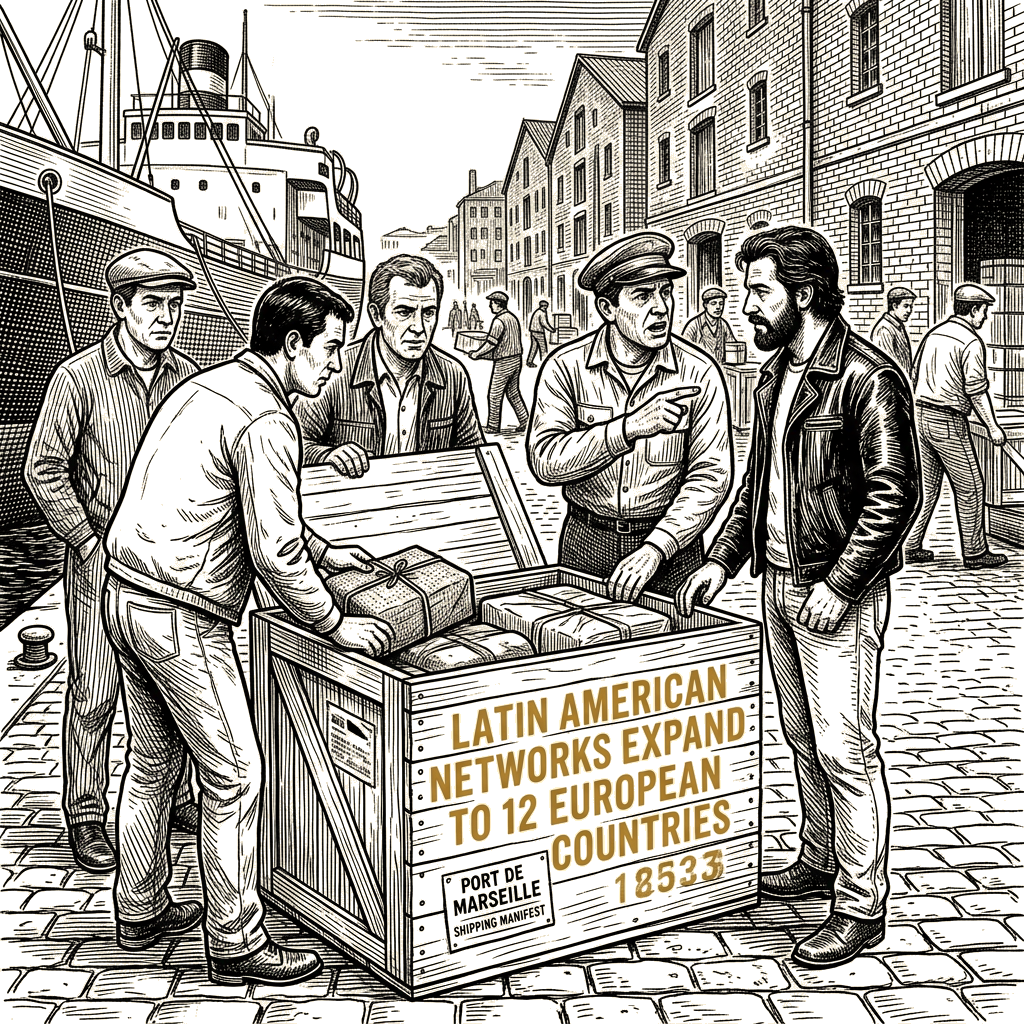
- The Guardian’s four-month investigation drawing on police and intelligence-agency databases and interviews with judges, prosecutors, and experts from eight countries documents Latin American criminal organizations with identified activity in at least twelve European countries, while an unpublished São Paulo public prosecutor’s office report identifies PCC operations in sixteen countries.
- Cocaine seizures in Europe rose 471% between 2014 and 2024, and drug production in Latin America reached a record approximately 4,100 tonnes in 2024 — roughly four times the 2014 figure — as production growth, processing relocation, and partner-network integration reinforced one another.
- The relationship structure documented in the reporting is bipartite and emissarial: named Latin American organizations on one side, collectively described European criminal partners on the other, with operational contact running through cells, business emissaries, and joint ventures identified by transnational cases.
- Daniel Brombacher of the Global Initiative Against Transnational Organized Crime has characterized the geographic pattern as “something new happening with a presence of Latin American groups in geographies where there’s no pre-existing infrastructure,” supported by documentary evidence of meth-lab sites in southern France, north-eastern Poland, and Brandenburg.
A four-month Guardian investigation drawing on police and intelligence-agency databases and interviews with judges, prosecutors, and experts from eight countries has identified Latin American criminal organizations with documented activity in at least twelve European countries. Cocaine seizures in Europe rose 471% between 2014 and 2024, drug production in the region increased roughly fourfold over the past decade to a record approximately 4,100 tonnes in 2024, and derivative processing has relocated into southern France, north-eastern Poland, and Brandenburg — a chain in which production growth, processing relocation, and partner-network integration with European criminal groups appear to be mutually reinforcing rather than independent. The investigation’s framing of the current scale — “on another level from the historical pattern” — captures the divergence from Colombian foothold-era activity in Spanish Galicia documented since the 1980s to a multi-country presence that, by the São Paulo prosecutor’s accounting, reaches Iceland, Sweden, and Turkey through PCC operations documented in sixteen countries.
Network shape: catalogued Latin American side, uncatalogued European side
The 12-country floor is constructed from organizations identified through police operations, transnational investigations, and ongoing court cases involving brokers, active members, cells, or operational networks. The figure excludes organizations working in “joint ventures” with European criminal groups without a physical European presence; the actual count, per the investigation, runs higher. An unpublished São Paulo public prosecutor’s office report, partly based on data from Brazil’s intelligence agency Abin and reviewed by the Guardian, identifies Brazil’s Primeiro Comando da Capital (PCC) — described as Brazil’s biggest criminal organization — as operating in sixteen European countries, including the United Kingdom, Ireland, Iceland, Serbia, Sweden, Switzerland, and Turkey. The 12-versus-16 gap is methodological, not contradictory: the Guardian figure is conservative and excludes joint-venture arrangements, while the São Paulo prosecutor’s count reflects PCC’s documented reach more inclusively.
Europol, by contrast, operates at the network level: of 731 “most-threatening criminal networks” (MTCNs) identified across Europe, 149 are connected to Latin American organizations; of these, 67 have Latin American members, and 22 mainly consist of Latin Americans. The distribution — 149 connected, 22 mainly consisting — indicates that the majority of Latin-American-connected networks are not predominantly Latin American in composition, supporting a reading in which European counterpart organizations do the structural work on the European side rather than Latin American communities operating within the EU. A Europol report this year is quoted as stating: “Latin American MTCNs [most threatening criminal networks] have also settled in the EU, from where they direct operations that affect the EU. This is particularly the case for mobile criminal networks involved in organised property crime.” The “mobile criminal networks” framing supports a reading in which the operative unit is mobile and cross-border rather than fixed and territorial.
The named organizations on the Latin American side, per the Guardian investigation, include Mexico’s Sinaloa cartel and Jalisco New Generation cartel (CJNG); Colombia’s Clan del Golfo, the ELN, and dissident Farc factions; Brazil’s PCC and Comando Vermelho; Venezuela’s Tren de Aragua; Ecuador’s Lobos and Choneros; and the U.S.-originated Barrio 18 and MS-13 gangs, also prevalent in El Salvador, Honduras, Guatemala, and, to a lesser degree, in Mexico. Víctor Manuel Sánchez Valdés, an academic at the Autonomous University of Coahuila who studies organized crime, identified the principal organizations to the Guardian: “The main ones are the Sinaloa cartel and the Jalisco cartel [CJNG] in Mexico; the Comando Vermelho and the PCC of Brazil; the Gulf Clan and different factions of the Colombian Farc; the Lobos and the Choneros of Ecuador; and Tren de Aragua of Venezuela.” Sánchez Valdés characterized the European presence of Mexican organizations in particular as emissarial: “Sinaloa cartel and the CJNG have a presence in more than 20 European countries. Obviously, that does not mean they dominate or have large cells. Rather, they are business emissaries.”
The European counterpart organizations that the reporting describes as having “forged close ties” with Latin American counterparties are not individually named in the published investigation. The Latin American side is catalogued by organization; the European counterpart side is referred to collectively. The naming asymmetry is a documented feature of the substrate, not an analysis gap: any claim about specific European counterpart organizations requires material not present in the published reporting.
The relationship structure documented is bipartite and emissarial: named Latin American organizations on one side, collectively described European criminal groups on the other, with edges taking multiple forms — formal co-presence identified in twelve countries, joint-venture arrangements without Latin American physical footprint, and emissarial representation without fixed presences or large cells but with cross-border operational reach. Groups documented as having their most prominent presence in Spain, Portugal, the Netherlands, Belgium, and France include activities also documented in Germany, Romania, Croatia, and Slovakia. The Global Initiative Against Transnational Organized Crime (Gi-Toc) also includes Bulgaria.
The chain: production, transit, processing, retail
The historical evolution documented in the reporting divides into three stages. In the first, from at least the 1980s through the early 2010s, Colombian criminal organizations such as the Cali and Medellín cartels maintained footholds in Spanish regions such as Galicia; the relationship structure was territorial — a named organization maintaining regional presence in a single gateway country. In 2013, a Europol report warned of the rise of these organizations, marking a warning stage. The third stage, the 2024–2026 era documented in the present investigation, adds German, Romanian, Croatian, Slovak, and Bulgarian territory along the Balkan route, north-eastern Poland, southern France, and Brandenburg as documented meth-lab sites; the São Paulo prosecutor’s report adds the United Kingdom, Ireland, Iceland, Serbia, Sweden, and Switzerland to PCC’s footprint alongside Turkey.
The production-to-consumption chain documented has production, transit, derivative processing, wholesale, retail, and repatriation phases. Coca cultivation in Latin America covered a record 385,000 hectares over the past decade — three times the 2014 figure; the UN Office on Drugs and Crime’s 2026 World Drug Report on illicit crimes states global cocaine production in 2024 was between 3,800 and 4,700 tonnes; the Guardian investigation found more cocaine is now produced in Colombia than during the era of Pablo Escobar, and that nearly all the world’s cocaine originates from Latin America, particularly Colombia. The Balkan route serves Eastern European destinations; the Iberian gateway serves Spain and Portugal; derivative processing now occurs in destination markets rather than at source.
On the consumption side, Europe has emerged as a key market because it offers organizations higher profit margins than the United States; data indicates Europe represents about a quarter of global consumption; since the beginning of the decade, European police have confiscated more drugs than American forces. Cocaine seizures in Europe rose 471% between 2014 and 2024; more local laboratories processing cocaine derivatives were dismantled over the same period. Daniel Brombacher, director of the Europe Observatory at the Global Initiative Against Transnational Organized Crime (Gi-Toc), described the geographic expansion to the Guardian: “There is something new happening with a presence of Latin American groups in geographies where there’s no pre-existing infrastructure.” He added: “This phenomenon is no longer limited to the traditional gateway countries. Recent police operations have uncovered Mexican-run methamphetamine labs in southern France, north-eastern Poland and Brandenburg, south of Berlin. Latin American groups are also appearing in Romania and Bulgaria along the Balkan route.”
The 471% seizure rise is both an enforcement metric and a market signal: supply may have expanded enough that seizures grew in absolute terms while the market also grew, enforcement may have been retooled, or both. The investigation does not adjudicate which reading applies, and the reported figures do not allow the alternatives to be distinguished. The handoffs between production and enforcement are uneven, with source-country production rising faster than interdiction in proportional terms and derivative processing relocating closer to consumers. The traditional transit role of gateway states is being supplemented by destination-country derivative processing: meth labs in southern France, north-eastern Poland, and Brandenburg bring documentary evidence that the European side is no longer only a transit corridor but increasingly a derivative-processing market.
How the reporting frames the pattern
The Guardian investigation frames the expansion through three pattern-name characterizations — “something new” for geographic expansion beyond traditional gateways, attributed to Brombacher with quoted evidence of meth-lab sites and Balkan-route presence; “business emissaries” framing of European presence for Mexican organizations, attributed to Sánchez Valdés with quoted evidence of cross-border representation without fixed cells; and “mobile criminal networks involved in organised property crime,” attributed to Europol with quoted evidence of MTCN settlement in the EU. The register across sources is technical and police-academic; plain-language naming vocabulary does not appear in substrate attribution.
The frame is consistent in treating the Latin American organizations and their European counterparts as distinct criminal economies with documented working connections, rather than as one territorial entity extending into another. The frame is asymmetric in cataloguing: individual organizations are named on the Latin American side; the European counterpart organizations are referred to collectively without individual naming. The investigation’s joint-venture framing describes the relationship generically without enumerating European partners, so any further mapping of the European-side structure requires material not present in the published reporting.
Who benefits, by interest
For Latin American criminal organizations, the documented interest is profit per unit of risk, supported by Europe’s higher margin relative to the United States; operational security is sought through cells and business emissaries rather than fixed presences. Next-best alternatives include continuing in the U.S. market, expanding into African and Asian transit corridors, deepening the European footprint, or substituting product lines — synthetic drugs already documented in the European laboratories dismantled in France, Poland, and Brandenburg.
For European criminal partners, the documented interest is access to a product line where European demand is high and Latin American groups can supply at scale; procedurally, the European side retains the wholesale and retail layer, controlling the customer-facing part of the chain. The European counterpart organizations in the “joint ventures” are not individually named in the published reporting; partner-to-partner arrangements — revenue share, territorial non-overlap, conflict resolution — are not reported in detail because they are by definition undocumented.
For destination-country governments and law enforcement, the substantive interest is reducing supply, violence, and corruption risk; the procedural interest is interagency and cross-border coordination through Europol and bilateral arrangements. Next-best alternatives absent coordinated regional action include unilateral enforcement, which has produced seizures and laboratory dismantlements but not a reversal of the expansion trend. Objective criteria invoked in this setting are public-health and public-safety harms, the rule of law, and the integrity of the single market.
For source-country governments, the substantive interest is reducing cultivation — Colombia’s 385,000 hectares is itself a source-country metric — and the violence associated with it; the procedural interest is securing international assistance and extradition arrangements while managing the political cost of being labeled a failed state. Next-best alternatives absent external support include unilateral military or police action against domestic organizations, which the reporting implies has been tried without reversing production growth. Criteria recurring in source-country contexts include human-rights-compliant policing, crop-substitution programs, and judicial-process integrity.
Two of the four parties sit outside any cooperative-deal-making framing: Latin American criminal organizations and European criminal partners are both adversarial counterparties, and the engagement destination-country governments have with them is enforcement, not negotiation. The operative pressure point is to alter the legal economy and the European market so that the criminal organizations’ next-best alternatives become less attractive. The cleanest application of any interest-based framing is to the intergovernmental relationship — between source-country and destination-country governments, with Europol and the UN system as connective tissue — not to the relationships between governmental and criminal actors.
What happens next
Source-country production growth, processing relocation to destination markets, and network integration with European criminal partners are mutually reinforcing: production growth supplies a volume that processing relocation prepares closer to consumers, while partner-network integration absorbs the supply into European retail layers. The relationship map is bipartite and dense; the process map shows operational handoffs moving from transit (traditional gateway states) to derivative processing (French, Polish, Brandenburg laboratories) to retail (European criminal partners). The interest map is asymmetric: the parties whose behavior most directly concerns the investigation — the Latin American criminal organizations — are not parties in any cooperative sense, while the parties who could coordinate (governments, Europol, source-country authorities) face next-best alternatives whose limits are visible in the production and seizure numbers themselves.
The reported figures permit three observations on what happens next, none of which the investigation itself adjudicates. First, the geographic expansion adds documentation to a multi-country presence that already exceeds the historical territorial-foothold pattern; the 12-country floor is conservative and the São Paulo prosecutor’s count is more inclusive. Second, the relocation of derivative processing to destination markets compresses the supply chain and brings enforcement closer to consumers, where partner-network integration is the structural feature. Third, the reporting identifies a network shape in which the operative unit of the relationship is mobile and cross-border rather than fixed and territorial — a shape whose limits as a policy object remain to be tested.
Interpol, led by Brazilian federal police officer Valdecy Urquiza, was approached for comment by the Guardian and did not respond, leaving one of the connective-tissue institutions absent from the public record on this investigation.
Analytical techniques used in this piece
This analysis applies the methods below. Each links to a short, plain-English explainer you can read and reuse.
- Principled Negotiation
- Works a negotiation from interests, options, and objective criteria rather than positions.
- Process Mapping
- Lays out a process end to end — steps, hand-offs, and bottlenecks.
- Relationship Mapping
- Extracts the network of ties among people, institutions, and entities.
- Creative Destruction
- Innovation that grows the economy by dismantling the incumbents it displaces (Schumpeter).