Summary
- The Tennessee documentary record on the 30 September lethal-injection attempt on Christa Pike documents a compound authentication-and-confirmation breakdown in the post-execution emergency response, while leaving the cause of the lethal-injection survival as an unestablished hypothesis advanced only by Pike’s defense counsel.
- Emergency call recordings obtained by the AP and published in full by the Nashville Banner anchor the response-delay diagnosis on three documented timestamps (20:40, 21:07, 21:11) and a 21:34 acknowledgement of “so much other confusion”; no equivalent forensic account appears in the substrate for the lethal-injection mechanism.
- The four documented stakeholder positions — Governor Bill Lee’s pause and corrections chief resignation, Slemmer mother branding the episode a “mess,” Pike counsel’s commutation request, and some Tennessee Republicans’ call for a new method — define mutually exclusive resolutions on the available record.
- The most likely twelve-month outcome on the documentary record is a state-level decision on a re-attempted execution; litigation is the most probable second-order consequence of such a re-attempt; commutation sits at lower weight, and the BBC’s “uncharted territory” characterization maps onto five specific unresolved items the substrate does not establish.
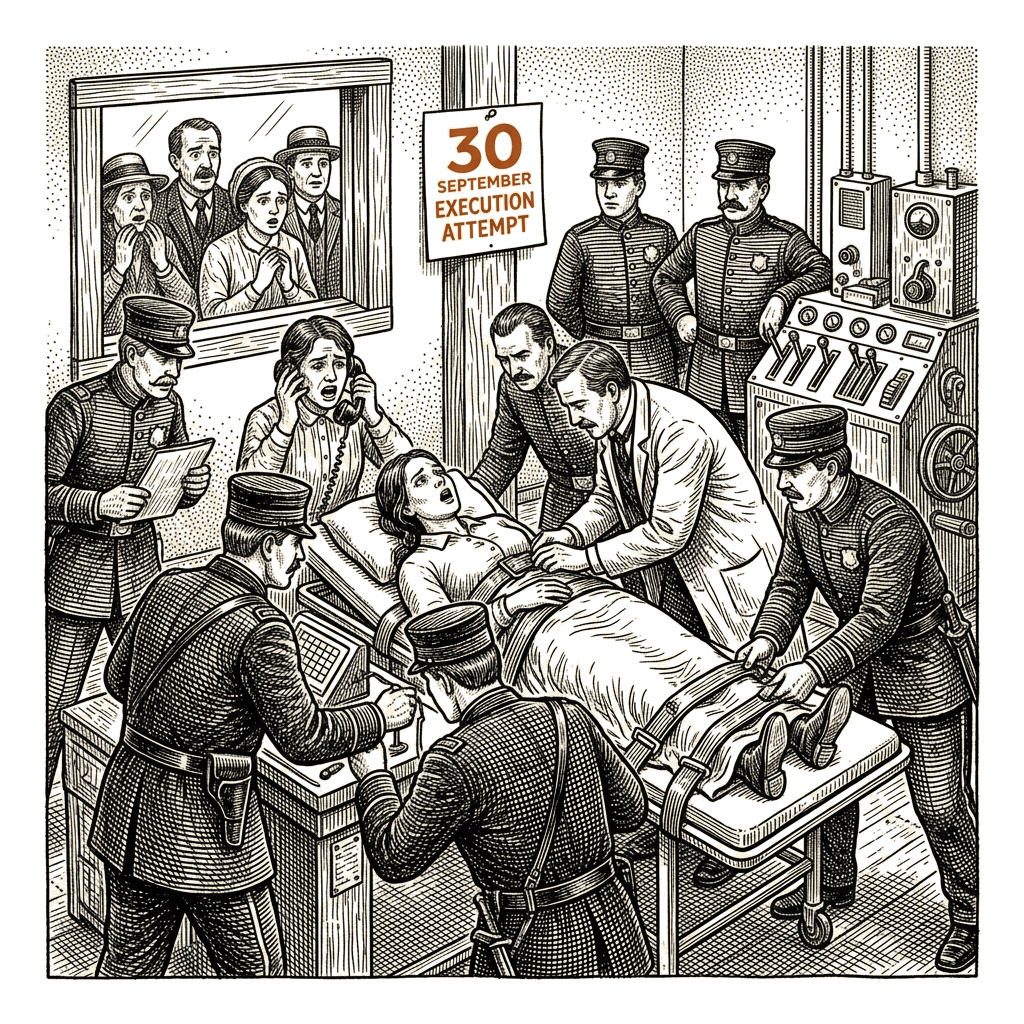
Christa Pike, 50, is thought to be the only person to have survived an execution attempt by lethal injection, per BBC News reporting in its 13 October 2026 article on emergency call records. Two strands of documentary evidence — emergency call recordings obtained by the AP and published in full by the Nashville Banner, alongside statements from Pike’s legal team, the family of Pike’s victim, and Tennessee state officials — place the case under three analytical operations: a differential diagnosis of what failed, an inventory of incompatible remedy paths each named stakeholder has advanced, and a probability-weighted set of possible futures. The record carries higher analytical confidence on the post-execution emergency response than on the lethal-injection mechanism itself, and that asymmetry is the condition under which the documented framings compete.
What failed in the lethal-injection procedure
The only candidate advanced by a named party for the 30 September lethal-injection survival is subcutaneous distribution. Pike’s legal team has offered the explanation that the pentobarbital “probably spread under skin rather than reaching her bloodstream in a sufficient quantity to kill her.” The hypothesis is consistent with the documented outcome — a 10-gram dose, no effect on vital function, subsequent recovery of the ability to walk and talk. The Tennessee Department of Correction “has not yet stated what it thinks went wrong,” per BBC reporting, and the article does not record an independent forensic account. The hypothesis therefore remains unconfirmed by any state or independent source.
Three alternative candidates appear in the substrate as unevidenced or weakened. Drug potency or underdosing. The 20:40 call describes administration of 10 grams, and Pike’s legal team does not allege a compromised dose; potency failure is consistent with survival but is not the only candidate that predicts it, and the substrate does not establish potency as a live hypothesis. The state has not alleged underdosing, and the doses described are the standard protocol. Equipment failure distributing two successive doses subcutaneously. The protocol calls for two doses, and complete subcutaneous distribution of both would require a coincident failure of two separate IVs that the substrate does not support. Protocol-compliant administration in a population in which the protocol does not reliably produce death. Consistent with the outcome but unevidenced in the article.
The diagnostic ranking between subcutaneous distribution and any unspecified operational failure is not established by the substrate; medical reasoning to settle the question is absent. The leading hypothesis is the only one a named party has offered; the differential between it and the alternative candidates is interpretive rather than sourced. The 20:40 call’s full opening — “We’ve been carrying out an execution tonight. We’ve administered 10 grams of pentobarbital. The person is not yet deceased. That started approximately one hour ago. And we’re calling for an ambulance” — is the prison’s contemporaneous characterization of the failure but a description of outcome, not an identification of cause.
What delayed the medical response
A separate differential applies to the post-execution emergency response, on which the record supports a more confident diagnosis. The 20:40 call from Riverbend Prison was initially treated as false because the caller could not verify themselves using a code, according to the emergency call records. At 21:07, staff from the institution’s central command said they “would have been the ones to call in” and that they “did not make that call.” The call was not confirmed as genuine until about 21:11, when emergency responders were allowed through the prison gates. At 21:34, as medics transported Pike, one asked a colleague to ensure the prison knew where Pike was being taken, “just ‘cause there’s been so much other confusion.”
The 31-minute gap between the 20:40 call and the 21:11 confirmation is documented through two distinct events: the 20:40 authentication failure and the 21:07 command-confirmation denial. Neither event alone accounts for the full timing; the inference that both contributed is the strongest reading the substrate supports. The 21:34 recording confirms, in source language, that the medical response itself was operating under degraded coordination.
A fourth candidate — deliberate delay or concealment — is rejected on the available record. The corrections chief’s resignation is described by BBC reporting as occurring “in the wake of the botched execution,” and the article does not record findings of intent. The differential on the response delay therefore narrows to a single dominant candidate — compound authentication and command-confirmation failure — with high confidence on the timing, grounded in the three documented timestamps (20:40, 21:07, 21:11), and medium confidence on the precise mechanism, reflecting that no independent forensic account appears in the article.
The denial of the 20:40 call is a downstream communication failure, not evidence of a procedural failure during drug administration. The two differentials — one on the injection mechanism, one on the response delay — should be read as independent variables, each measured against its own documentary support.
Documented stakeholder positions
Each named stakeholder holds a different stated position on how the case should resolve.
The state. Governor Bill Lee has paused the state’s executions for the remainder of the year; the head of the Tennessee state corrections department is resigning from his post. The two actions, on the documentary record, address the response failure but do not resolve whether to re-attempt. The BBC has asked the Tennessee Department of Correction for comment on the recordings; the department “has not yet stated what it thinks went wrong.”
The Slemmer family. Slemmer’s mother, who was among those pushing for Pike to be put to death, has branded the failed execution a “mess” — a position consistent with a re-attempt under a corrected protocol but not with commutation.
Pike’s legal team. Has asked Lee to commute the sentence to life in prison without parole — a position that bypasses both the diagnostic question and the method question. The same team cautioned in their most recent update that Pike faced a “long road to recovery,” and it is not clear what treatment she is receiving now that she is back in prison.
Some Tennessee Republicans. Have called for a new method to be attempted — a position that would require its own procedural and political pathway distinct from the diagnostic inquiry and from the commutation request.
Co-defendant Tadaryl Shipp was spared the death penalty because he was not yet an adult when the crime was committed and “remains in prison,” per BBC reporting. The comparative legal anchor for any future Pike resolution is that the death-eligibility threshold between the two co-defendants was age, not conduct.
Incompatible remedy paths
The four documented positions are not reconcilable within the available record. The state’s protocol-and-method focus, the Slemmer family’s “mess” characterisation, the commutation request from Pike’s lawyers, and the Republicans’ call for a new method each define “successful resolution” differently. The procedural framing and the commutation framing differ on whether re-attempt is appropriate; the “mess” framing and the commutation framing differ on whether accountability runs through the corrections department or through the sentence itself. Each apparent fix pathway — re-attempt under a corrected protocol, re-attempt by a new method, commutation — interacts with the others and leaves at least one stakeholder’s definition of success unmet.
If subcutaneous distribution is the failure mode, the most direct response would be a procedural review of IV establishment and chemical administration, since the same failure mode could repeat on a re-attempt under unchanged protocol. If the state cannot identify a specific procedural failure, the legal frame widens: a generalized diagnostic inability is consistent with a longer pause or with the commutation request from Pike’s lawyers. The diagnostic uncertainty on the lethal-injection mechanism is not a temporary obstacle to resolution; it is the condition under which the stakeholders’ incompatible outcomes compete.
A second failed attempt on similar grounds would compound the legal and political exposure the state already faces from the failed 30 September procedure. The diagnostic record would worsen, and the political frame would compress toward commutation or a method change rather than a re-attempt under the existing protocol.
Competing framings
Four framings are sourced in the article; a fifth is named as a candidate for a longer treatment.
The procedural framing. Offered by the corrections department’s resignation and the governor’s pause. The case is a failure of execution and response protocols; the substrate-attributable remediation is the resignation of the corrections chief and the pause through year-end.
The “mess” framing. Offered by the Slemmer family. The case is a failure of state competence; accountability runs through the corrections department.
The commutation framing. Offered by Pike’s legal team. The case is grounds for executive clemency; the appropriate remediation is reduction of her sentence to life without parole.
The constitutional framing. Invited by the BBC’s characterisation of Pike’s legal status as “uncharted territory” — wording the BBC itself supplied. The case is a question about the constitutional status of a survivor of an execution attempt. The article does not record a court, scholar, or party adopting a constitutional framing; the framing exists in the article as the BBC’s invitation of it.
A historical-genealogy framing. Would situate the case within the longer record of botched executions and litigation in the United States. Not recorded in the article; documented here as a candidate for a longer treatment.
The four sourced framings are not reconcilable within the available record. Each framing names a different locus of failure — protocol execution, state competence, the sentence itself, the survivor’s constitutional status — and each implies a different remediation path.
Probability-weighted scenarios
The substrate supports three scenarios at meaningful weight and two at lower weight.
Re-attempted execution by a different method. Most likely default on the record. Some Tennessee Republicans have called for a new method, per BBC reporting; Lee’s pause runs only through year-end and no court filing appears in the article. The scenario remains the policy default absent a contrary executive or judicial decision.
Commutation. At lower weight. Pike’s legal team has asked Lee to commute the sentence to life in prison without parole. The scenario’s probability is conditioned on factors the article does not resolve: the governor’s own position, the political composition of the clemency process, and the prospect of a legal challenge to any re-attempted execution.
Litigation. At meaningful weight. The BBC characterises Pike’s legal status as “uncharted territory” — meaning, in the article’s framing, that no comparable case exists to anchor the diagnosis. A survivor of an execution attempt would, on the article’s framing, have standing to challenge any re-attempted execution; the article does not record an active claim.
Federal review or a broader moratorium extending beyond Tennessee. Not recorded in the article; the pause and the resignation are state-level only.
Indefinite “uncharted territory.” Consistent with the article’s note that “it is not clear what treatment, if any, she is receiving now that she is back in prison”; documented as the lower-weight indefinite-resolution candidate.
The article does not record a stated end-state from any party other than the commutation framing, so no scenario beyond the three documented futures can be anchored on the source. The most likely outcome over the next twelve months on the documentary record is a state-level decision on re-attempted execution, with litigation the most likely second-order consequence of a re-attempt.
What the substrate leaves unresolved
Five specific items remain unestablished in the article.
The cause of the lethal-injection failure. The Tennessee Department of Correction has not yet stated what it thinks went wrong, and no independent forensic account is recorded. The divergence the substrate does not resolve is whether the department’s eventual statement will name a cause at all, or whether the case will resolve on the legal side with the underlying cause of the failed execution remaining officially unestablished.
The timing of any state decision on re-attempt. Lee’s pause runs only through year-end; no further state decision date is documented.
The content of any litigation. No court filing appears in the article; the litigation scenario’s probability is conditioned on a filing the article does not document.
The treatment Pike is receiving in custody. The article notes that it is not clear what treatment, if any, she is receiving now that she is back in prison.
Which framing the state, the courts, and the political process will adopt. The four sourced framings are mutually exclusive on the resolution outcome, and the substrate does not record which will prevail.
The BBC’s description of the case as “uncharted territory” applies to each of these five unresolved items. The asymmetry between the high-confidence response-delay diagnosis and the unestablished injection-mechanism diagnosis is the documentary record’s most consequential analytical feature: it permits the corrections department and the governor to act on what is documented, while leaving the commutation request and any constitutional framing to rest on a question no party has yet been able to answer.
Analytical techniques used in this piece
This analysis applies the methods below. Each links to a short, plain-English explainer you can read and reuse.
- Differential Diagnosis
- Lists the candidate explanations for a symptom and rules them out one by one.
- Wicked Futures
- Explores a long-horizon, deeply entangled future with no clean resolution.
- Wicked Problems
- Treats a problem as wicked — no stopping rule, no clean test of success, every attempt consequential.