Summary
- California utilities preemptively cut electricity to more than 150,000 customers on Thursday and Friday under a fire-weather policy whose causal logic The Guardian treats as settled — that power equipment has sparked past catastrophic fires — but whose chain from past equipment-attributed ignitions to present preventive action observational data, read as a causal graph, cannot independently verify.
- Judea Pearl and Dana Mackenzie, in The Book of Why (Basic Books, 2018), classify such an inference at the intervention rung of the ladder of causation rather than at the observational rung fire-cause attributions actually populate, and apply a back-door criterion whose minimal adjustment set requires an exclusion-style restriction the dispatch is consistent with but does not confirm.
- Three confounders the dispatch does not name — fire-cause attribution asymmetry, climate as a time-varying confounder, and documented regulatory and litigation pressure that concentrates investigative attention on utility liability — operate as alternative paths through which the dispatch’s surface pattern can hold without the underlying equipment-cause claim being independently verified.
- The dispatch’s preemptive cut, paired with Mayor Karen Bass’s directive to pre-deploy fire personnel and a request to the state Office of Emergency Services, frames a response Rose Schoenfeld of the National Weather Service describes as sized to a Santa Ana event “not expected to match” the 2025 Palisades and Altadena fires, an asymmetry that puts the shutoff at the catastrophic tail of an ignition distribution observational data cannot directly measure.
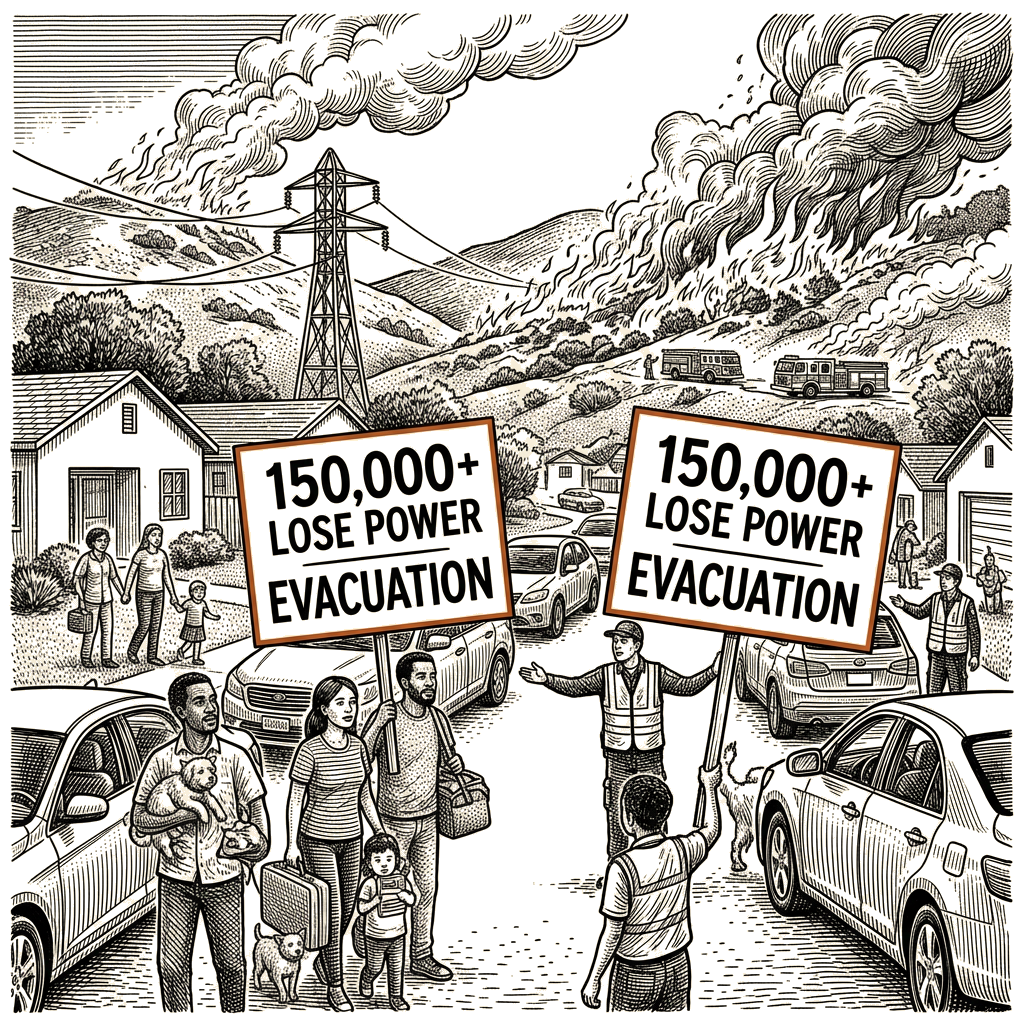
California utilities preemptively cut electricity to more than 150,000 customers on Thursday and Friday as multiple brush fires — including the Bryson fire at about 200 acres above Malibu, an Azusa blaze of more than 40 acres, and a fire at Camp Pendleton — forced evacuations across Southern California. The Guardian attributed the proactive de-energization to “the role of power equipment in sparking some of the state’s worst recent wildfires,” with the National Weather Service warning that Santa Ana winds gusting to 30 mph and dropping humidity “will favor a critical fire weather threat” through Friday afternoon. Read as a causal claim rather than as a sequence of bulletins, the dispatch rests on a less visible chain. The January 2025 Palisades and Altadena fires, which “killed more than 30 people and destroyed thousands of homes,” stand as the proximate referent. The chain between past equipment-incidents and the present-day de-energization is not displayed. To read it as causal, the dispatch requires a framework that goes beyond the observational fire-cause attributions it cites.
The central chain and what it requires
The dispatch situates the 150,000-customer figure within a utility risk-management framework that translates atmospheric inputs and historical memory into operational posture. Per the dispatch, utilities cut power “because some of California’s worst wildfires in recent years have been sparked by power equipment” — an if-then linkage treated as established rather than defended. Rose Schoenfeld of the National Weather Service described the present Santa Ana event as “a pretty widespread event of elevated fire weather,” with winds forecast to strengthen through Friday afternoon. Schoenfeld separately noted the event “is not expected to match the 2025 fires” when “winds were gusting 60 mph to 100 mph.” At observed wind levels, the underlying risk model produces what the dispatch reports: a policy intervention large enough to de-energize more than 150,000 customers while leaving ignition events — the Bryson fire at about 200 acres in the Santa Monica Mountains above Malibu with more than 285 firefighters deployed overnight, more than 40 acres in Azusa in the foothills of the San Gabriel Mountains, the Camp Pendleton Las Flores incident — realized across multiple jurisdictions. The dispatch treats this co-occurrence — intervention and ongoing ignition — as confirmation that the policy logic partitions risk into distinct channels.
The intervention rung
Under the framework Judea Pearl and Dana Mackenzie develop in The Book of Why (Basic Books, 2018), the question of whether turning power off prevents ignitions it would otherwise have caused sits at the intervention rung of causal inference — the rung of do-operator questions about counterfactual scenarios under matched conditions, distinct from the observational correlations on which fire-cause attribution actually rests. The dispatch’s central claim is, on that reading, an interventional claim about what would happen absent the shutoff. The graphical apparatus the framework supplies prescribes a minimal adjustment set for estimating the shutoff’s effect on outage magnitude: in the dispatch’s implicit graph, the relevant set is the latent variable that translates atmospheric and historical inputs into utility operational posture. The total effect of the shutoff intervention on outage magnitude is identifiable from observational data only conditional on an exclusion-style restriction — that past equipment-incidents affect the present-day grid state only through the policy channel, not through any persistent direct mechanism on today’s energization status. The dispatch is consistent with that restriction. It does not confirm it.
Three confounders the dispatch does not name
The dispatch does not address three variables that operate as plausible confounders on its central claim. First, fire-cause classifications record ignitions of indeterminate origin as “undetermined” rather than attributing them to a specific source. If utility equipment has more identifiable failure signatures than other candidate causes — campfires, vehicles, lightning, arson — it will appear over-represented in cause databases at identical true rates, producing an attribution asymmetry rather than a causation asymmetry. Second, climate and weather act as time-varying confounders: drought years raise ignition counts from any source and the probability of catastrophic outcomes, so a year with elevated attribution counts to utility equipment is independently a year in which all fire-cause tallies are higher. Third, regulatory and litigation pressure documented across cycles following the 2017–2018 fire seasons and again after the 2025 Palisades and Altadena fires concentrates the investigative lens on utility liability without necessarily changing the underlying rate of equipment-caused ignitions. Each of these can produce the surface pattern the dispatch reads as causal through pathways that do not run through equipment failure.
What observational data cannot adjudicate
The dispatch’s data cannot distinguish the chain it implies from at least two alternative structures consistent with the same surface observations. Under one alternative, past utility-linked fire damages drive lawsuits and regulatory attention, which raises the rate at which investigators classify ignitions as equipment-related; under that structure, a rising count of equipment-attributed fires is real as a count of attributions but not necessarily as a count of equipment-caused events. Under a second alternative, public memory of the 2025 fires intensifies scrutiny of utilities, again concentrating the lens without changing underlying ignition rates. The natural experiment capable of discriminating among the structures would compare investor-owned, public, and cooperative utilities with structurally different shutdown policies in matched weather and fuel conditions, with ignition causes classified by an independent panel blind to utility identity. No such panel appears in the public record the dispatch references. A further inference concern applies at the unit level. Tim Maudlin, in a Boston Review exchange with Judea Pearl, has argued that claims of the form “this past fire would not have occurred absent this specific equipment” either reduce to interventional claims about populations or require commitments about closest possible worlds the dispatch does not address. A reader holding that position would read the dispatch’s “sparked by power equipment” attribution as a statistical generalization about populations of ignitions, not as a definitive statement about a specific wire on a specific afternoon.
The policy asymmetry
The dispatch’s preemptive response — 150,000 customers without power, multiple evacuation orders, Karen Bass’s directive to the fire department to “deploy personnel and equipment ahead of the winds,” and a parallel request to the state Office of Emergency Services — is sized to a hazard the dispatch frames as bounded by recent memory. Schoenfeld’s framing that the present Santa Ana event “is not expected to match” the 2025 fires places the current forecast at roughly one-third to one-half the wind speed of the historical reference, a derived estimate anchored in her forecast ranges rather than in a National Weather Service event-comparison product. The asymmetry between response magnitude and current weather magnitude illustrates the policy logic: the shutoff functions as a hedge against the catastrophic tail of the ignition distribution, with the evidentiary basis necessarily inferential rather than directly measurable. Evacuation orders issued on Thursday afternoon for the Camp Pendleton Las Flores area were lifted by evening per military officials’ statement, leaving the Bryson fire above Malibu at about 200 acres with more than 285 firefighters deployed overnight as the operationally unresolved case at the dispatch’s closing. The dispatch’s central causal claim — that the 150,000-customer outage corresponds to a real prevented-ignitions asset rather than to an attribution lens applied to the same underlying ignition rate — is the empirical question the reporting does not address.
Analytical techniques used in this piece
This analysis applies the methods below. Each links to a short, plain-English explainer you can read and reuse.
- Causal DAG
- Maps cause and effect as an explicit directed graph, exposing confounders and mediators (Pearl).