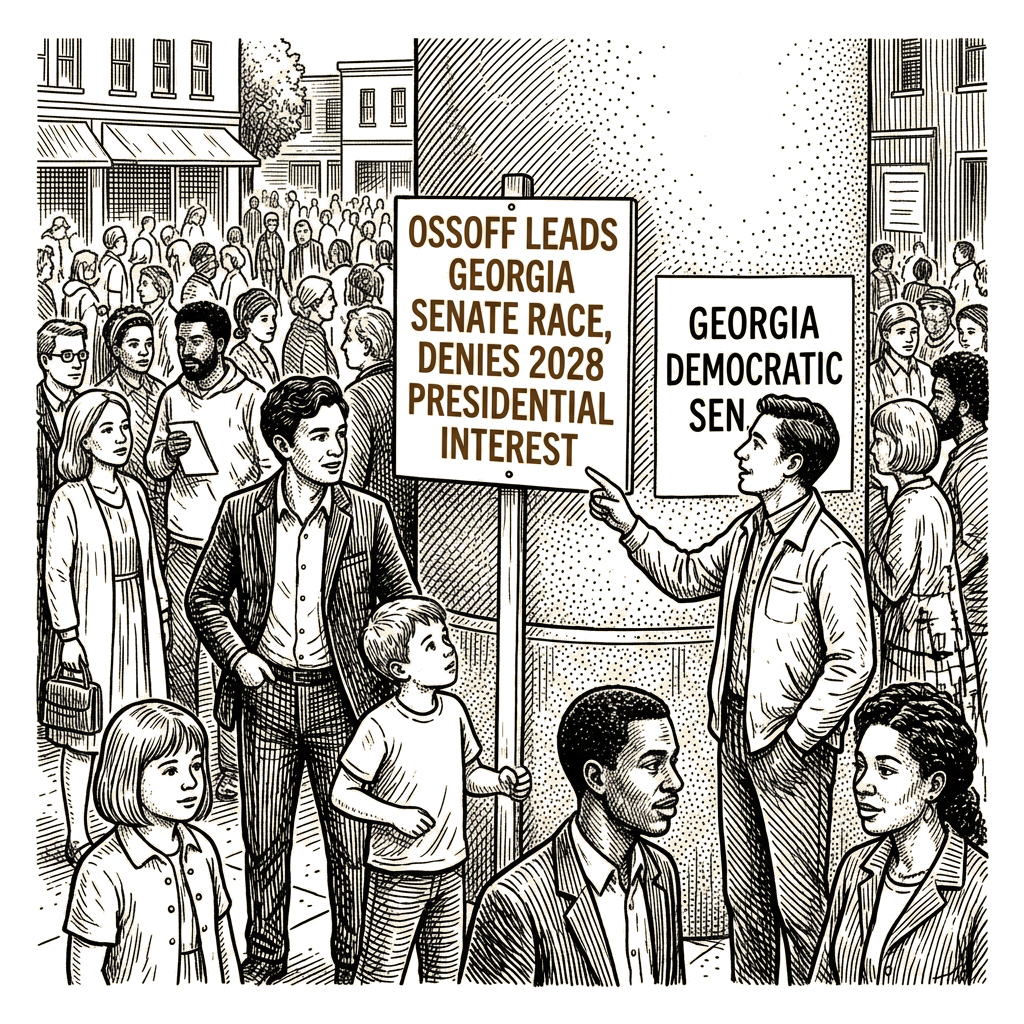
The Guardian’s October 16 profile of Sen. Jon Ossoff documents a structural puzzle the article does not resolve. The same operation that produced the largest Senate war chest of the 2026 cycle — about $43 million in cash on hand at the end of July, raised from contributors who gave more than $98 million overall with about 90 percent in donations under $100 — is described in language that is simultaneously individual and systemic. The polling lead, between four and eight points over Republican Rep. Mike Collins, is a margin The Guardian reports no Georgia Democrat has posted in the state since the late 1990s; it accompanies an individual portrayal (“when Ossoff, 39, lands on a message, he sticks to it like gum under a desk”) and a systemic one (a donor database The Guardian calls the largest Democratic donor database in the United States, a network of women who “had all knocked on doors for Ossoff” and then ran for local office themselves). The profile leaves the question open: “Democrats in the state fear his successes would be hard to replicate — in part because he has a gift for being the right person, in the right place, at the right time.” The piece is, in effect, an account of a process whose replicability it cannot determine.
Step one is a high-visibility federal race that produces a national donor list: the 2017 special election in Georgia’s sixth congressional district, in which Ossoff raised $23 million in small donations and lost the runoff to Karen Handel 52–48, but walked away with the donor database. Step two is sustained local investment between federal races. Ossoff declined a 2018 rematch with Handel; Dunwoody Mayor Lynn Deutsch told The Guardian that between the loss and his November 2019 Senate announcement, women who “had all helped on the Jon campaign” ran for and won local office in Atlanta’s northern suburbs. Step three is scaling the model to a statewide race: the 2020 Senate contest against David Perdue, in which Ossoff raised more than $150 million to Perdue’s roughly $100 million and won by about 56,000 votes after characterizing his opponent, in the profile’s language, as a caricature of Gilded Age wealth. Step four is incumbency and accumulation, in which the small-donor base continues to fund operations; Rep. Hank Johnson, a Democrat for whom Ossoff once worked, told The Guardian that Ossoff’s “cultivation of support from small-dollar donors from across the country strengthens his ability to pursue policy goals that favor the common good, as opposed to policies that favor the wealthy and the well connected.” Step five is re-election, the 2026 cycle the profile centers, in which the model is being tested against Collins, whose cash on hand is roughly one-twentieth of Ossoff’s.
The decision-point criteria at each transition are visible in the profile. The 2017 loss became a database rather than a defeat because the runoff against what the profile calls “a notably moderate Republican” generated enough small-donor attention to convert the loss itself into a fundraising asset. The 2018 decision to invest locally is presented as deliberate sequencing; as John Ernst, the former Brookhaven mayor, put it, “He wasn’t a known entity outside of a few congressional offices in Washington DC.” The 2020 Senate run became viable because the local investment had produced a coalition of independents in highly educated suburbs who, in Deutsch’s account, said “I can’t vote for Republicans any more.” The bottleneck at each step is different: at step one, name recognition; at step two, sequencing — the local investment had to occur between federal races; at step three, message discipline against an opponent whose pandemic-era stock trades Ossoff described by saying “It’s not just that you’re a crook, senator. It’s that you’re attacking the health of the people that you represent”; at steps four and five, the small-donor flywheel itself, which The Guardian suggests requires ongoing narrative production to keep small contributors writing checks.
A serious challenge to the model is documented in the same profile. Voter Rockwell McKay, asked at Atlanta’s Pride parade about what a senator can deliver, told The Guardian: “Even if his heart is in the right place and he’s trying to do these things, he can’t do it in two or four years. They churn up in the House with the Democrats and the Republicans. In the next three or four years, we’ll have somebody else in wanting to redirect their movement. I don’t see it.” Separately, McKay said: “I’m past the Obama shit, with the hope. Fuck all that.” A young Centers for Disease Control and Prevention worker, also at the Pride parade, told The Guardian: “We’re personally very, very burnt out, and very overstretched. We’re just nervous that we’re going to get fired every single day.” She said elsewhere: “I think I’m just burnt out. I’m going to vote and I’m going to encourage people to vote, but I’m not doing what I’ve done in the past because it’s just been too much.” The model the profile describes rests on a sustained small-donor energy and a canvassing infrastructure that the voters the profile quotes describe as depleted. The challenge is not that Ossoff has failed; it is that the substrate on which his model runs has thinned, and that the model’s apparent success may be drawing down a finite resource rather than compounding a renewable one.
The profile makes available a claim that the small-donor operation is neither purely individual nor purely systemic. The individual pole is anchored in the profile’s own language about Ossoff’s message discipline — “when Ossoff, 39, lands on a message, he sticks to it like gum under a desk” — and in Ernst’s verdict on his public image: “no one says he’s a raging liberal. No one says he’s conservative. No one says he’s moderate. He’s just Jon Ossoff.” The systemic pole is anchored in the 2017 donor database and the Dunwoody women’s pipeline that Deutsch describes — a donor list that funded local candidates, who renewed the party’s suburban bench. The synthesis, however, generates a new contradiction the profile names without resolving. The same piece that documents the model’s replicability documents the affective substrate the model presupposes. The 2017 race capitalized on what Deutsch called a “space of panic” — “What the heck just happened?” — and the canvassing energy of the 2020 cycle drew on a coalition of suburban independents newly unwilling to vote Republican. The McKay formulation and the CDC worker’s testimony suggest that the same kind of energy is not currently available. The model, in other words, requires a particular political-emotional state to operate, and that state is what the model’s success may have already exhausted.
Four positions surface in the profile, and the analytical interest of the piece lies in the fact that these positions are held by people in close proximity to one another. The first is the star-candidate paradigm, in which the party requires a figure capable of leading it nationally. The Guardian’s closing line — “Might he do it a third time? The chances are greater than zero” — embodies this view, as does Deutsch’s account of her “young adult children, who lives in Texas, wants him to run.” The second is the positional paradigm, in which a senator is valuable in the Senate and a presidential bid may be net-negative for the party. Deutsch articulates this directly: “Eventually, Jon Ossoff maybe should run for president, but not anytime soon,” and his departure “would be a terrible loss” for Georgia. The third is the infrastructure paradigm, in which what matters is the donor list, the local candidates, and the organizing relationships, and Ossoff is significant chiefly as the node through which the network currently runs. The fourth is the post-hope paradigm, voiced by McKay and the CDC worker, in which the entire electoral cycle the other three paradigms participate in is treated as exhausted.
Star-candidate politics and infrastructure politics are not opposed: the high-visibility race produces the donor list, the donor list funds the local pipeline, the pipeline produces the next cohort of candidates. The positional paradigm complicates but does not negate this synthesis: the network is real, but its current node is in the Senate, and the question of whether to move the node is a question about portfolio allocation rather than infrastructure destruction. The synthesis cannot accommodate the post-hope paradigm. The cross-paradigm claim that emerges from the profile is that the small-donor model requires star candidates to attract attention but produces infrastructure that outlasts them, and that the party accordingly benefits from a portfolio of such operations — each run by a disciplined candidate with a national profile, each leaving behind a donor list and a local organizing network when the candidate moves on or ages out. The cross-paradigm incommensurability is that this synthesis depends on a renewable affective substrate the post-hope paradigm identifies as depleted. Republican peanut farmer Donald Chase, who is backing Ossoff in part because “the tariffs on peanut products went up 295%,” represents a different cross-pressure — a voter coalition assembled from specific economic grievances rather than from the hope-frame. The current Ossoff model runs on a hope/anti-Trump/anti-MAGA affective substrate, anchored in the 2017 panic Deutsch describes and the 2020 suburban-independents-breaking-with-Republicans coalition. The Chase example is an economic-grievance substrate — tariffs, export markets, diesel prices — a different substrate that could either substitute for the depleting affective substrate or fail to. The profile opens this question. It does not answer it.
Analytical techniques used in this piece
This analysis applies the methods below. Each links to a short, plain-English explainer you can read and reuse.
- Dialectical Analysis
- Holds thesis against antithesis and works toward a higher synthesis.
- Process Mapping
- Lays out a process end to end — steps, hand-offs, and bottlenecks.
- Worldview Cartography
- Maps the clashing worldviews underlying a dispute.