Summary
- John Healey reportedly substitutes a bank tax for a capital-gains-tax rise, reduces fiscal headroom from £23bn to around £15bn, and confronts Kemi Badenoch’s call for £70bn in annual spending cuts that the reporting does not itemize by department.
- Senior allies of Andy Burnham pressed for a capital-gains-tax increase on second homes, shares and other assets; John Healey rejected the increase after warnings that wealthy individuals could leave the UK or defer sales and reduce revenue.
- HM Treasury uses unofficial background signals to limit market surprise, according to The Guardian, exposing the Treasury to a market or political signal if the announced budget diverges from the controlled preview.
- John Healey’s cost-of-living package is described as “targeted and temporary,” creating a cliff-edge question for recipients while leaving the exit mechanism, taper and contingency extension unspecified.
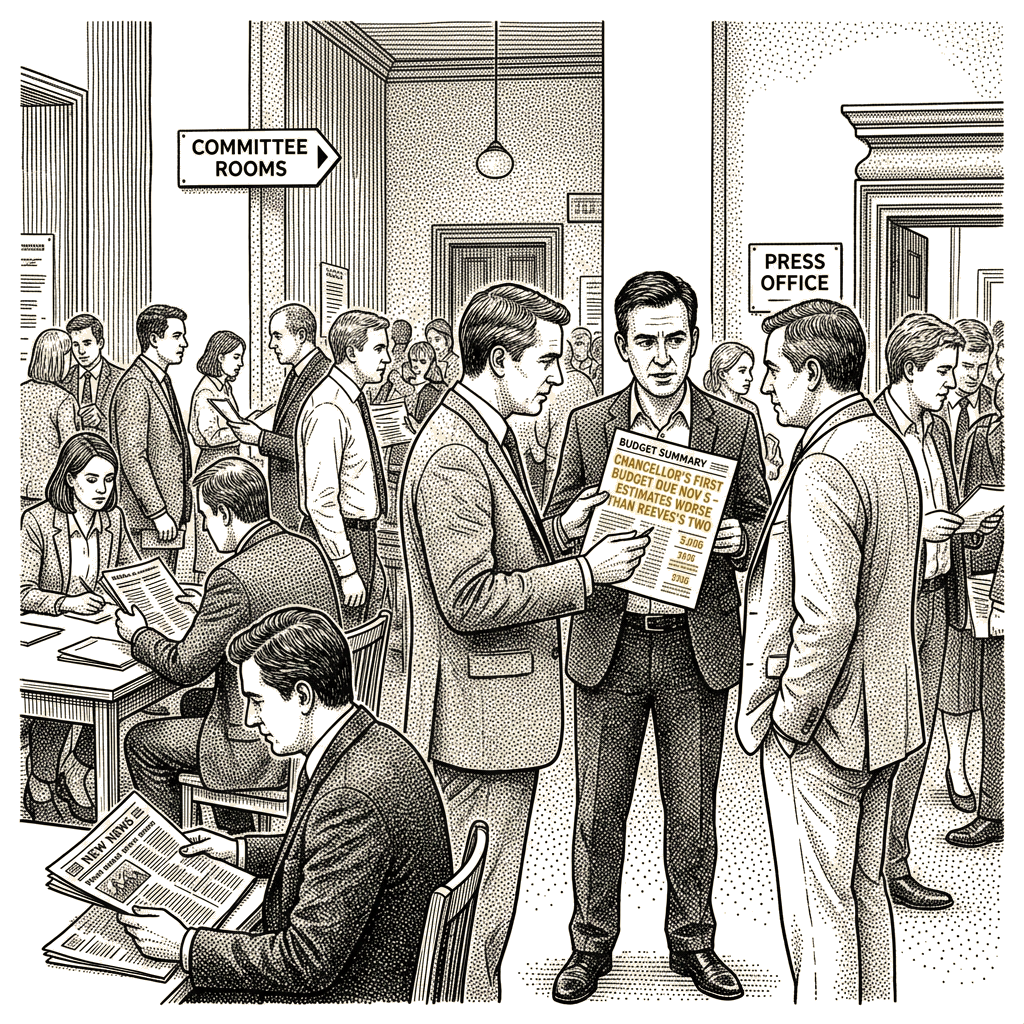
John Healey’s first budget, due the following week in advance reporting, will use a bank tax as its largest reported “revenue raiser” to help finance a “targeted and temporary” cost-of-living package, rule out a capital-gains-tax increase and reduce fiscal headroom from £23bn to around £15bn, according to The Times as reported by The Guardian. Kemi Badenoch’s scheduled Monday speech instead frames the budget through Rachel Reeves’s two tax rises and calls for £70bn in annual government spending cuts. The documented positions have not met on a concrete spending alternative: advance reporting provides no departmental allocation or costing for Badenoch’s proposal, while the reported Healey package supplies no matching explanation of how core spending will change. On the available record, the budget fight is therefore between a sector-specific revenue package with reduced fiscal space and an unitemized structural-spending alternative.
The reported budget choices
The Times’ advance account places four policy points on the table. A tax on banks will be the budget’s largest revenue-raising measure and will help finance cost-of-living support; John Healey has ruled out a capital-gains-tax increase; fiscal headroom will fall from £23bn to around £15bn; and several cabinet figures had pressed for the capital-gains-tax route before the chancellor rejected it.
The proposed capital-gains-tax increase had previously attracted support inside government. The Guardian’s live blog says a rise “was for a while seen as the government’s preferred money-raising ploy” and separately records that “several senior figures in the cabinet were lobbying for one earlier in the year.” The Times gives the political location of that pressure more specifically: “Senior allies of Andy Burnham, including several cabinet ministers, have been pressing for a rise in capital gains tax on the sale of second homes, shares and other assets to help repair the public finances.”
John Healey’s reported reason for rejecting the proposal was the possibility that higher capital-gains-tax rates would produce less revenue than expected. The Times reports that the chancellor ruled it out “after warnings that it could ultimately cost the government money if wealthy individuals left the UK or deferred selling assets.” The affected economic interest identified in that account is therefore the Treasury’s revenue exposure to changes in location and the timing of asset sales.
The shift toward a bank levy changes which sector bears the largest reported revenue-raising role. For an audience predisposed to regard financial-sector levies as distortionary or politically symbolic, The Times’ characterization lands as a documented movement of the tax burden from taxation of assets toward credit provision.
The Times records no on-record position from the banking sector. The policy sequence is consistent with preserving capital and lending capacity by avoiding a broader-based levy, but the available reporting does not establish a bank-backed campaign or preference behind the decision.
Treasury signaling and market exposure
The Guardian describes pre-budget Treasury signaling as an established mechanism for controlling how markets encounter budget news. Its live blog rejects the notion that the Treasury never provides advance detail and reports that “on certain issues the Treasury regularly ensures that the media gets an accurate picture of what is coming in a budget to minimise the risk of the markets getting an unwelcome surprise.”
The Guardian says this information arrives “not through on-record statements, but via ‘murky background nods, winks and hints.’” Journalists were reportedly assured overnight that The Times’ account was accurate. The live blog presents this practice as standard Treasury behavior rather than a Labour innovation.
That distinction places the burden on the relationship between the controlled preview and the formal announcement. If the announced budget matches the information supplied in advance, Treasury signaling has performed the market-management function described by the Guardian. If the announcement diverges from the preview, the divergence could become a market or political signal without requiring a separate on-record explanation.
For political reporters familiar with the Treasury’s briefing apparatus, the Guardian’s description of unofficial advance signaling lands as evidence of a staged budget narrative. The relevant test remains the content of the formal announcement against the picture previously provided to journalists.
Badenoch’s competing budget frame
Kemi Badenoch was due to make the political case before the formal budget and before the policy detail had been published. Her advance position rests on continuity with the two budgets associated with Rachel Reeves and on a structural alternative based on spending reductions.
In the supplied extracts, Badenoch said: “John Healey is not Rachel Reeves. Many people see that as an improvement. How could it be worse than £70bn in new tax rises across just two budgets?” She separately stated that John Healey would deliver a budget that would “do more damage to our country than either of Rachel Reeves’ budgets did.”
The article reports that Rachel Reeves’s two budgets raised taxes by £40bn and £26bn respectively. Those figures total £66bn, compared with Badenoch’s £70bn formulation. The available reporting does not reconcile the £4bn difference. The same £70bn figure also appears in Badenoch’s call for annual government spending cuts, placing one number in two distinct contexts: a comparison with tax rises across Reeves’s two budgets and a proposed annual reduction in public spending.
Badenoch also criticized the expectation that the budget would be inconsequential. She said: “We are being told that next week’s budget is going to be ‘nothing to see here’. That is code in Whitehall for a budget that tries to do as little as possible … in the hope that no one notices.” That language frames restraint as insufficient action and places Badenoch’s spending-cut alternative against the reported absence of a detailed Healey spending programme.
For an audience primed by the £40bn and £26bn figures, Badenoch’s advance language functions as continuity framing: the new budget is presented as another step in the same tax-and-spending trajectory rather than as a break with the two preceding budgets.
For an audience focused on fiscal headroom, the movement from £23bn to around £15bn represents a narrower stated buffer against future events. The reporting does not identify the forecasting basis for that figure, explain how the buffer is calculated or specify which fiscal rule applies, and it does not characterize the reduction as a breach of any published rule.
Fiscal exposures and unresolved measures
The cost-of-living package’s “targeted and temporary” design creates a cliff-edge profile for the recipient population. The reporting does not identify the package’s distributional profile, exit mechanism, taper, contingency extension or other provision for a later adjustment.
The bank tax introduces a separate exposure by concentrating the largest reported revenue-raising role in one sector. The available article provides no bank-tax rate, projected yield, sensitivity range, behavioral-response assumption or mitigation detail.
The campaign for higher capital-gains tax leaves a deferred intra-Labour policy question. Andy Burnham’s allies sought a measure affecting second homes, shares and other assets, while John Healey rejected that route because departures or deferred sales could reduce expected revenue. The formal budget would test whether that disagreement remains unresolved.
The reduced headroom leaves less documented space for adverse events, but the article does not enumerate the events against which the government is protecting itself. It also provides no Treasury revenue forecast for John Healey’s package and no calculation showing whether the bank tax and cost-of-living support produce revenue comparable to or larger than the figures associated with Rachel Reeves’s budgets.
Badenoch’s £70bn annual spending-cut proposal remains a frame rather than a fully documented counter-bill. The article does not identify which departments or programmes would bear the reductions, how the figure was costed or what distributional consequences would follow. It also does not explain how the proposed cuts would interact with the cost-of-living support implicated by the Conservative “living within our means” position.
Monday’s political sequence
The budget debate was scheduled to unfold within a crowded political day. Prime Minister Andy Burnham was to chair cabinet in the morning, while Kemi Badenoch’s speech and press conference were scheduled for 10am.
Oral questions for Health Secretary Yvette Cooper were scheduled for 11.30am. At noon, the latest report from the UK Covid-19 Inquiry, chaired by Heather Hallett and covering care homes, was due for publication alongside a Downing Street lobby briefing.
After 12.30pm, a Commons debate on the Northern Ireland Troubles bill was scheduled to resume. Reform UK leader Nigel Farage was due to address a Plymouth rally at 2pm, and Business Secretary Jonathan Reynolds was due to give evidence to the Commons business committee at 2.30pm.
Analytical techniques used in this piece
This analysis applies the methods below. Each links to a short, plain-English explainer you can read and reuse.
- Interest Mapping
- Separates parties’ stated positions from their underlying interests (Fisher & Ury).
- Red-Team Advocate
- Argues the adversary’s case in full to expose what a plan underrates.
- Red-Team Assessment
- Models a capable adversary probing a plan for the seams they would exploit.