Summary
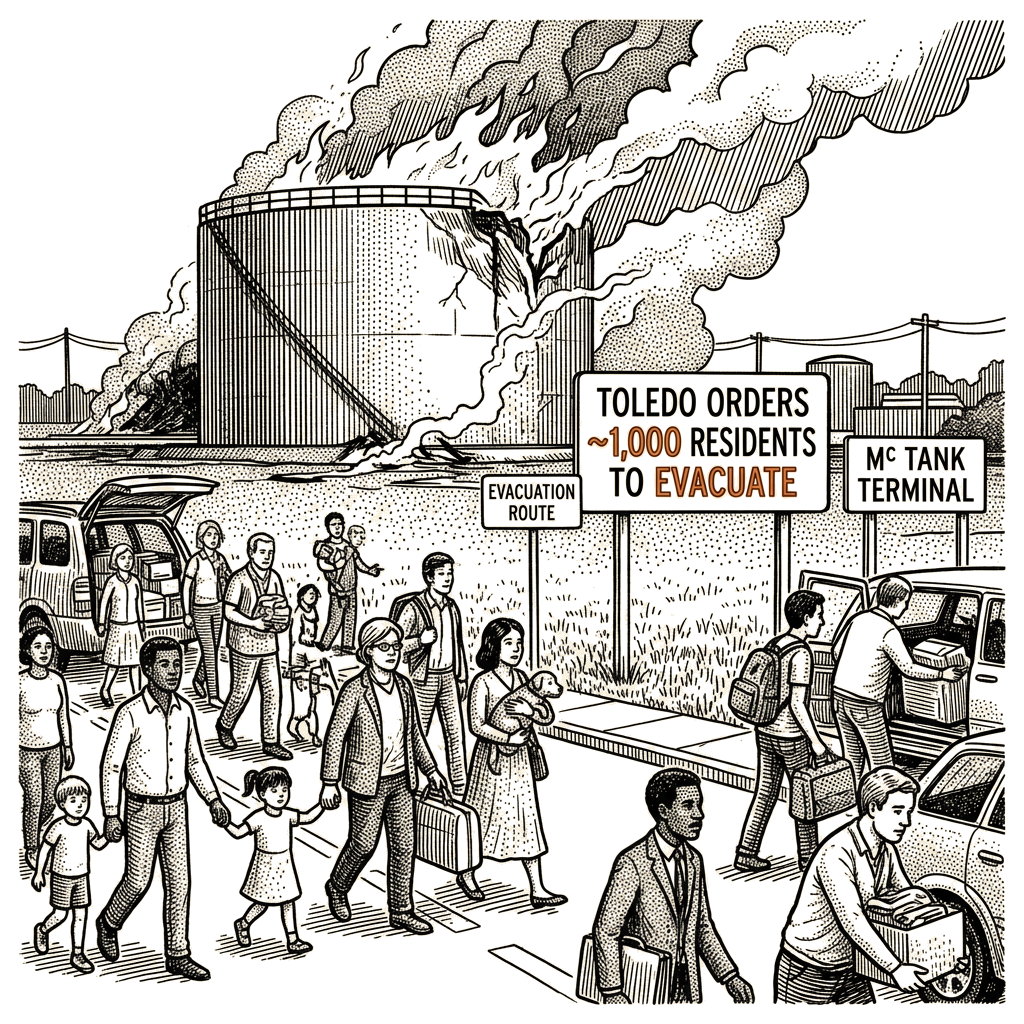
- Toledo officials doubled the evacuation zone from a half-mile radius covering about 300 residents to a full mile covering about 1,000 after MC Tank Terminal’s tank explosion, having drawn the initial perimeter before officials confirmed the released chemical or characterized its behavior in air.
- The record documents no dispersion, temperature or monitoring data behind the gas-to-liquid behavior Mayor Wade Kapszukiewicz described at Wednesday’s news conference.
- City officials said that, as far as they knew, all residents in the evacuation zone had been evacuated — a hedge tracking the zone as drawn, not the plume as it moved, with the count unverified at block level.
- One first responder was injured and hospitalized with injuries believed to be non-life-threatening, making responder exposure a load carried by the boundary decision itself.
- The zone expansion reads simultaneously as evidence that the first perimeter under-measured the hazard and as the one documented adjustment of the protective margin toward caution — two readings the next decisions will test.
A chemical tank explosion at MC Tank Terminal in Toledo, Ohio, released glycidyl methacrylate into the air. An employee called first responders late Tuesday night; the city issued an initial evacuation order covering about 300 residents within a half-mile, and by Wednesday’s news conference Mayor Wade Kapszukiewicz had expanded the order to a full mile covering about 1,000 residents, asked residents within 3 miles to shelter in place with their windows sealed, and said officials did not know how long the evacuation and shelter orders would last. The progression — an initial perimeter set hours after an unknown release, then widened the next day — is the point a post-incident review would examine first. The day after the explosion, the city’s response rests on a chain of decisions whose inputs are only partly verified: officials have said the explosion’s cause remains unknown, the released substance’s airborne behavior has been described by officials but not independently characterized in the reporting, and the evacuation and shelter orders have no stated end condition.
The boundary revision as the load-bearing decision
A post-incident accounting of this event would locate the breakage not in the tank alone but in the boundary-drawing step: the initial half-mile radius was set on incomplete information, before officials had confirmed the released material as glycidyl methacrylate or characterized its behavior in air. The load condition that exceeded the initial ring’s capacity was the combination of a chemical the mayor said “became a gas when released” and Toledo local news reports of a visible, dense fog over the city and a plastic-like odor — conditions consistent with an irritant spreading outside the footprint the first order assumed.
The expansion to a mile, and the shelter-in-place request with sealed windows extending to 3 miles, read as the structural admission that the first perimeter under-measured the hazard. The shelter-in-place extension is consistent with a hazard footprint that exceeded the initial evacuation radius, with residents further out asked to shelter in place rather than evacuate; the source offers no municipal rationale for the 3-mile boundary, and the inference is one of consistency rather than asserted cause.
Sociologist Charles Perrow’s study of system accidents described how failure concentrates where components join and where operators must reason about interactions they cannot fully observe; the Toledo incident is a bounded case of that condition. Perrow’s complexity-and-coupling analysis placed systems with many non-linear interactions and little slack in a regime where operators’ mental models are most likely to be defeated by unforeseen interaction. A response that must reason about such an interaction without published dispersion or temperature data — the reporting documents neither — and without a confirmed cause is operating in that regime.
In the fragility taxonomy attributed to Nassim Nicholas Taleb, which distinguishes load, dependency, interface, state and emergent fragilities, a load-fragile system performs normally until an unusual but specifiable demand exceeds its limits. The response has already absorbed two such demands: the zone expansion and the first-responder injury. The taxonomy’s attribution to Taleb could not be independently verified for this analysis and is flagged for confirmation against Normal Accidents and Antifragile.
What the record does and does not verify
The interface that yielded is the one between what the city could measure late Tuesday night and what it needed to decide. City officials said Wednesday that, as far as they knew, all residents in the evacuation zone had been evacuated — a formulation that tracks the zone as drawn, not the plume as it moved, and a hedge that concedes the count had not been verified as of the statement. The US Census Bureau puts Toledo’s population at roughly 265,000 people; that citywide figure does not resolve the question at block level, and its exact vintage is not externally corroborated.
The source report also carries an unresolved naming discrepancy: a photograph caption identified the company as MC Tank Transport Inc, while the report’s body called it MC Tank Terminal, and the record does not reconcile the two names; external verification of the company’s canonical name is unresolved.
One first responder was injured and taken to the hospital with injuries believed to be non-life-threatening. Responder exposure is a load the boundary decision also carries, since the zone being drawn is the zone first responders enter.
Open variables and load conditions
Three open variables sit on the near horizon of the response: the duration Kapszukiewicz said officials could not yet estimate, the cause officials said they remained unsure of, and the return-to-liquid transition the mayor described as the window for containment. Each is a point where the perimeter or shelter boundary could be redrawn on the same incomplete-information footing that produced the first revision. The containment and elimination plan was still prospective while the evacuation order was already in force: the mayor said he hoped the risk of explosion would have expired by the time the chemical reverted from gas to liquid and that containment efforts could then begin — a time-based expectation the reporting does not show resting on published monitoring data.
Health-system demand is the load not yet measured. Residents experiencing burning of the eyes, nose, mouth or skin, difficulty breathing, nausea, vomiting, dizziness or confusion were advised to go to the emergency room or call 911; the number who act depends on plume behavior the city has not published.
Dependency fragility sits in the response’s knowledge chain: the city’s chemical-specific knowledge is not yet in the room, with Kapszukiewicz saying MC Tank Terminal executives were en route to Toledo to assess the situation. The hazard-assessment inputs — residual liquid, vapor concentration, ignition source — are uncharacterized projections, and the reporting documents no monitoring data on any of them. State fragility centers on the tank itself, the uncharacterized state: officials said they remained unsure what caused the explosion, and the mayor’s gas-to-liquid account frames the central question as a state transition, with the risk-of-explosion expiry a time-based expectation. The gas-to-liquid description remains the mayor’s account; no independent physical-property confirmation exists in the reporting, and external verification is unresolved.
Sociologist Diane Vaughan’s study of the Challenger launch decision documented how tolerance for risk accumulates through successive successful deviations. The accumulation relevant in Toledo is physical rather than cultural — the residual liquid, vapor concentration and ignition source a hazard assessment would need to characterize, none documented as measured conditions.
Emergent fragility surfaces in what the public encountered directly: Toledo local news reports of a visible, dense fog and a plastic-like odor are observations of the released substance in the form residents are meeting it. The fog’s behavior is consistent with the plume’s interaction with wind, terrain and building stock rather than the tank alone, though the reporting does not characterize that dispersion process. Interface fragility concentrates at the operational joint between the one-mile evacuation zone and the three-mile shelter-in-place zone, where a household’s safety depends on a windows-sealed instruction with no identified end time. In Perrow’s account, surprises originate in the interaction between operator and system, and an instruction with no end condition leaves that interaction open indefinitely.
Three failure paths the record leaves open
Projected from a post-incident vantage, following the pre-mortem protocol described by psychologist Gary Klein — which directs a team to project a failure as already having occurred and trace it backward to present decisions — three failure paths warrant attention as stress tests of open decisions, not predictions. One leading indicator precedes them: the half-mile order was issued Tuesday night after an employee’s call to first responders, followed by the mile-wide order at Wednesday’s news conference — a sequence that reads as a drift pattern, with the safety margin corrected upward once rather than calibrated once.
Path one — the hazard-clearance decision. Projected failure: evacuation and shelter orders end, and containment proceeds, on the time-based expectation the mayor described, before the explosion’s cause is identified and the hazard-assessment inputs are characterized. Decision point: whether the orders’ end is conditioned on independent monitoring readings and a confirmed cause rather than elapsed time and the operator’s own assessment. Earlier signs: continued odor reports, persistence of the reported fog, readings crossing published action levels. Mitigation: publish the monitoring basis for repopulation before repopulation occurs.
Path two — the zone-boundary decision. Projected failure: exposure among residents outside the one-mile zone who followed shelter-in-place but whose homes could not seal effectively, or among residents inside the zone never counted. Decision point: the unverified evacuation count and the absence of a stated accommodation for unsealable units within the three-mile shelter zone. Warning signs: reports of people remaining in the zone, coordination gaps with local businesses and schools — the reporting shows residents were asked to manage those contacts themselves — and health complaints from beyond the one-mile boundary. Mitigation: block-level verification and a published distinction between units that can and cannot seal.
Path three — the health-system decision. Projected failure: emergency departments and 911, the two destinations named in the public guidance, are reached by a large simultaneous presentation of symptom reports, and triage delay produces the harm the guidance was designed to prevent. Decision point: whether regional hospitals and emergency medical services were placed on alert when the evacuation expanded; the source reporting does not document that either way. Warning signs: wait times, call volume, symptom presentations among roughly 1,000 evacuees and the three-mile shelter population. Mitigation: advance notification and symptom-triage protocols keyed to the released substance.
The adjustment capacity in place
The city’s stated posture — that it would “continue to monitor and communicate with the public throughout the day” — is the corrective control now in place. The pre-mortem question is whether monitoring inputs are read as leading indicators for the boundary decision or only as confirmation of the zone already drawn.
The record contains one adjustment capacity the fragility literature treats as load-bearing: the city expanded the evacuation zone rather than holding the initial half-mile boundary. The article does not state what drove the expansion, but the direction of the change is toward caution — the behavior that, in Taleb’s classification of fragile and robust systems, marks a response that adjusts rather than holds its protective margin fixed. Whether that capacity holds through the next decisions is the open question.
“We understand the seriousness of what has happened here,” Kapszukiewicz said. “That’s why we took the actions that we did. That’s why we’re going to continue to monitor and communicate with the public throughout the day.” The test of that commitment is whether the end of the orders, the verification of the zones and the alerting of the health system are driven by measurement or by elapsed time in advance of measurement.
One reading treats the boundary revision as evidence of a system under-measuring its hazard — a drift pattern corrected only under load. The other treats the same expansion as the adjustment capacity the fragility literature treats as load-bearing — a response that corrects toward caution rather than holding a protective margin fixed. Both readings survive: the expansion is simultaneously an admission that the first perimeter under-measured the hazard and the one documented instance of the response adjusting its protective margin in the direction of caution. The record does not resolve which characterization the next decision will confirm.
Analytical techniques used in this piece
This analysis applies the methods below. Each links to a short, plain-English explainer you can read and reuse.
- Pre-Mortem (Fragility)
- Imagines a system has already broken and traces the structural fragilities that let it.