Summary
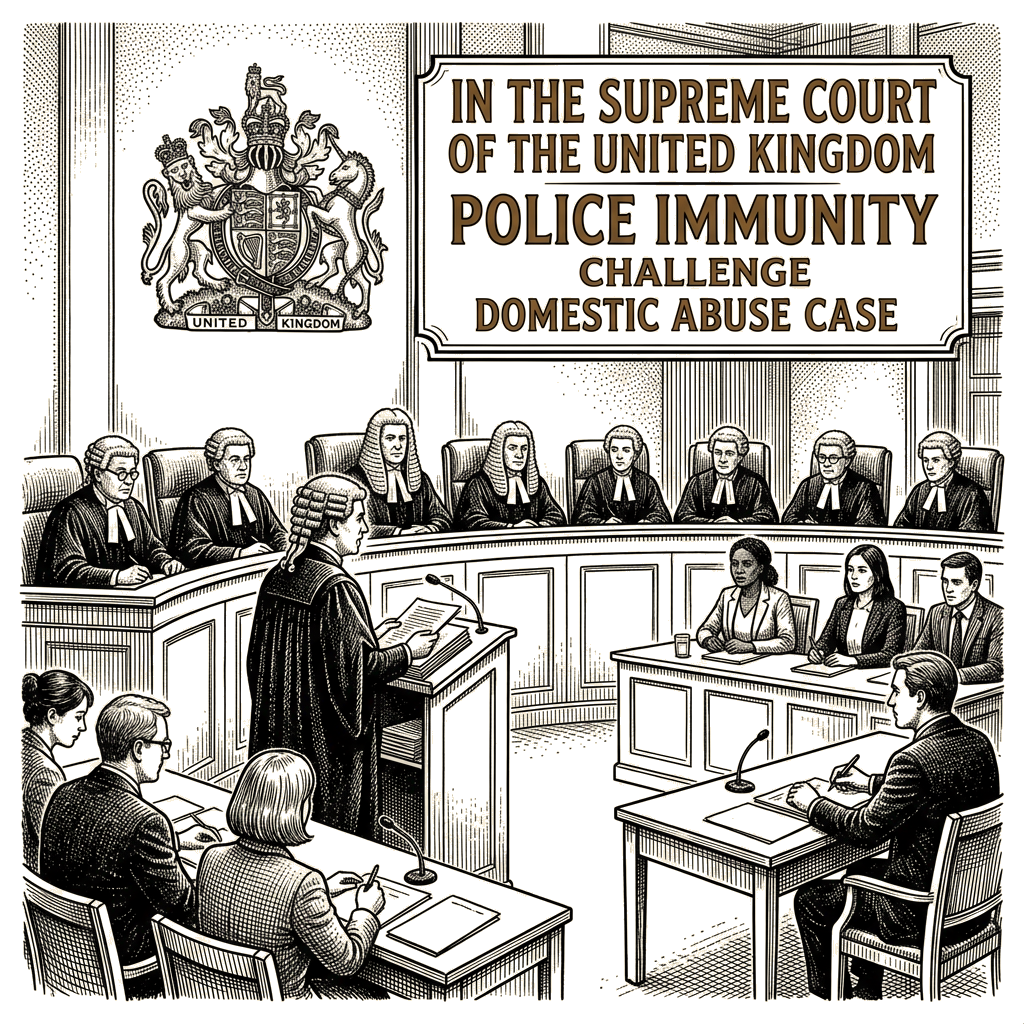
- XGY’s UK Supreme Court hearing, scheduled for Wednesday and Thursday, will decide whether “core immunity” bars her civil claim against Sussex Police and the CPS over an address disclosed at a magistrates’ hearing.
- The Court of Appeal extended core immunity beyond evidential matters to broad police activity, the scope Phillips argues would prevent police accountability for failures involving violence against women and girls.
- Sussex Police transferred XGY’s address to the CPS without a confidentiality marking, a CPS lawyer disclosed it during the hearing, and XGY relocated after the disclosure.
- Jess Phillips, David Davis and Andrew Mitchell have tabled a bill amendment as a contingent legislative response if the Supreme Court declines to overturn the Court of Appeal ruling.
- The Guardian report’s source distribution — Phillips on-record at length, XGY supplying two direct statements, Sussex Police and the CPS approached but offering no on-record response — produces a source asymmetry the article does not resolve.
The UK Supreme Court is set to hear, on Wednesday and Thursday, the case of XGY — an anonymised domestic abuse survivor whose address a Crown Prosecution Service lawyer disclosed during a magistrates’ hearing in proceedings seeking a condition intended to keep her former partner from the road where she lived. The court will consider whether the Court of Appeal was right last year to block XGY’s civil claim against Sussex Police and the CPS on the ground that witness-and-lawyer “core immunity” extends beyond evidential matters to broad police activity, including matters outside the courtroom. Labour MP Jess Phillips, a former minister for safeguarding and violence against women and girls, has urged the court to overturn the ruling, characterising an upheld outcome as “chilling” and tying it to “decades of failure” in criminal-law responses to such abuse. Phillips, David Davis and Andrew Mitchell have tabled a bill amendment designed to counteract the ruling if the Supreme Court declines to reverse it, and the article records no on-record response from either Sussex Police or the CPS.
The doctrinal scope at issue
The dispute turns on what lawyers and witnesses have traditionally called “core immunity.” The Court of Appeal ruled last year that XGY could not sue Sussex Police or the CPS, holding that the doctrine extends beyond evidential matters to a broad range of police activity, including matters outside the courtroom that relate to an investigation. That extension is what the civil claim contests. The supplied Guardian report does not develop the appellate court’s reasoning for that broad interpretation; the doctrine is described as traditional and the appellate conclusion as broad, with the underlying rationale compressed.
Phillips describes an upheld ruling in her own terms as “chilling” and argues that an upheld outcome would prevent police from being held accountable for failures involving violence against women and girls. The article supplies no record of independent judicial use of the term chilling effect; the formulation is Phillips’s own, recorded as advocacy. The phrase “core immunity” itself functions in the article as a technical label that directs attention to a body of law rather than to the discrete act of disclosure that triggered XGY’s move.
The information chain and where it broke
The factual sequence runs from police records to a courtroom disclosure. Sussex Police sent XGY’s address to the CPS without marking it confidential. At the magistrates’ hearing, where authorities sought a condition intended to keep her former partner from the road where she lived, a CPS lawyer disclosed the address. XGY moved home as a result. Her former partner was accused of raping her and of threatening to kill her and throw acid on her.
The Guardian report identifies the disclosing lawyer by institutional role, not by name, and records Sussex Police’s lack of a confidentiality marking on the transferred material. The article does not specify the procedural mechanism that connected the unmarked transfer to the courtroom disclosure, and it imputes no motive to either institution. The CPS and Sussex Police were approached for comment; the article records no on-record response from either. The unspecified mechanism between the unmarked transfer and the in-hearing disclosure is a documentation gap, not an accusation; the absence of on-record institutional replies is reported, not inferred.
Phillips’s intervention and the legislative fallback
Phillips builds her intervention on three linked propositions. First, that civil claims have a role beyond financial compensation — that suits involving failures can lead to longer-term system changes, including in grooming cases where women were charged with crimes rather than recognised as victims. Second, that criminal law has seen decades of failure in domestic abuse cases, leading her to support civil law as a lever for institutional improvement. Third, that “a broad exemption from civil action would not help the police or the CPS.”
Phillips cites two comparator incidents as evidence of existing trust deficits: the inquiry following Sarah Everard’s murder, and what the Guardian report describes as “racist and misogynistic comments filmed at the Charing Cross police station.” The article attributes both to Phillips as cited examples; it does not supply the inquiry’s full title, date or findings, nor the date or disciplinary outcome of the Charing Cross material. Their adjacency broadens the accountability frame from the civil claim to police legitimacy and institutional change — a move the comparator incidents support rhetorically but for which the article supplies no independent empirical test.
Alongside David Davis and Andrew Mitchell, Phillips has tabled an amendment to a bill intended to counteract the Court of Appeal ruling if the Supreme Court declines to overturn it. The Guardian places the judicial and legislative routes in the same frame, making the doctrinal question contingent on a future ruling while signalling a backup pathway.
How the dispute is being framed in the report
The article is presented as factual news, supported by an attributed account, a procedural recap and identification of the legal issue. Its frame selection, source distribution and adjacency cues nevertheless perform analytical work the reported facts alone would not establish.
Under Entman’s selection-and-salience distinction, the report foregrounds the address transfer, the courtroom disclosure, the relocation, the appellate ruling and the proposed legislative response. Technical legal vocabulary (“core immunity”) supplies the formal expression; XGY’s statements on confidentiality and Phillips’s statements on accountability and trust direct attention to institutional and moral stakes. Goffman’s distinction between a primary framework and keyings describes a shift from civil procedure to confidentiality and personal security, and then to police legitimacy and legislative policy — the address disclosure carries different meanings in each setting. Lakoff’s account of lexical activation helps explain how the technical label and the moral vocabulary interact within a single report.
Critical discourse analysis observes that the report preserves institutional agency on the disclosing side (institutional role, unspecified marking failure) while directing attention to institutional processes rather than individual motives. Iyengar’s episodic–thematic distinction maps onto the report’s pairing of XGY’s episodic case detail with Phillips’s broader systemic account. Chong and Druckman’s emphasis-versus-equivalence distinction notes that the report places greater emphasis on the ruling’s consequences for civil claims than on considerations supporting the existing doctrine; such source asymmetry does not by itself establish manipulation. Snow and Benford’s movement-framing categories describe Phillips’s intervention through diagnosis (criminal responses have failed some victims), prognosis (civil claims can prompt institutional change) and appeal (accountability and police confidence). XGY supplies a parallel structure from the affected party’s perspective — disclosure harmed security, confidentiality should govern information shared for protection, broken trust requires a remedy.
Under Gitlin’s account of the institutional-news routine, scheduled hearings, contested judgments and recognisable public actors are readily reportable. Tuchman’s distinction between a single news item and a wider news network limits that inference: a single article cannot establish how all outlets treat the dispute.
Sourcing observations
The named-source structure is asymmetric. Phillips receives the extended on-record platform, with her full reasoning and her two comparator citations on record. XGY supplies two direct statements: “I’ve continued with this case because I believe survivors should be able to trust that the information they share to protect themselves will be kept confidential” and “If that trust is broken, there should be accountability,” alongside the line “More than six years later, I’m still living with the impact of what happened and the loss of the security I thought I’d finally found.” David Davis and Andrew Mitchell are identified as co-tabling the proposed amendment; neither is quoted. Sussex Police and the CPS were approached for comment, and the article records no on-record response from either.
That asymmetry limits the available account of institutional reasoning without establishing either institution’s position on the events. Phillips’s propositions — that civil liability can improve institutional practice and that civil claims can prompt longer-term change — are presented as premises for judicial and legislative intervention rather than tested as empirical claims. Under Stanley’s distinction between supporting and undermining information, XGY’s account supports the significance of confidentiality and security, while Phillips’s examples support her broader policy case; countervailing material — the traditional status of core immunity and the Court of Appeal’s conclusion that its scope was broad — is reported briefly and without elaboration.
Under Herman and Chomsky’s five-filter model, the report exhibits one observable feature — uneven source distribution — but supplies no evidence on advertising ownership, organised criticism or a constructed common enemy. Bernays’s concept of engineering consent would require evidence of an organised effort to manage the symbolic environment, and no such apparatus appears in the record. Ellul’s distinction between agitation and integration describes the dispute as being carried into recognisable legal and legislative channels, where it is public and contestable rather than concealed. The supplied material does not establish a propaganda campaign.
What happens next
The UK Supreme Court is scheduled to hear the case on Wednesday and Thursday and must decide whether the Court of Appeal ruling remains. Two conditional routes are presented: the court could overturn the Court of Appeal, or it could decline to do so, in which case the bill amendment tabled by Phillips, Davis and Mitchell is positioned as the contingent response. XGY, in statements to the article, has continued with the case on survivor-trust and accountability grounds.
Because the decision is pending, neither stream of the supplied record supports a conclusion about the doctrine’s eventual scope. The Guardian article does not establish that overturning the ruling would produce the broader institutional changes Phillips anticipates, or that the proposed amendment would become law.
What the record does not establish
The supplied record supports a distinction among three analytical levels: the concrete transfer and disclosure, the disputed scope of immunity awaiting adjudication, and Phillips’s broader policy position. Broader anticipated outcomes remain attributed rather than treated as established. The operational sequence is supported at two reported edges — Sussex Police’s unmarked transfer and the CPS lawyer’s courtroom disclosure — but the causal or procedural mechanism between them is unspecified.
The report’s factual form does not eliminate framing choices, source asymmetry or untested policy propositions; those features support an evidence audit rather than a conclusion that a propaganda campaign exists. The Sarah Everard inquiry is attributed only as Phillips cited it; the article does not supply its full title, date or findings. The Charing Cross footage is article-described, with no date or disciplinary outcome supplied. The historical attribution of the selection-and-salience taxonomy to Entman’s 1993 framing paper is taken at face value as cited; independent verification of the citation is not performed in the supplied material. External corroboration of the Guardian article’s title and date is unresolved within the supplied material; the article itself remains authoritative for the facts it reports.
Source basis: The Guardian, “Jess Phillips hopes supreme court ‘sees sense’ and overturns domestic abuse ruling”, 21 October 2026.
Analytical techniques used in this piece
This analysis applies the methods below. Each links to a short, plain-English explainer you can read and reuse.
- Frame Audit
- Surfaces the frame an argument adopts and what that framing quietly includes or excludes.
- Propaganda Audit
- Reads a message for propaganda technique — loaded framing, manufactured consensus, and demonization.
- Relationship Mapping
- Extracts the network of ties among people, institutions, and entities.