Summary
- Israel’s Foreign Ministry and Brad Lander offer incompatible accounts of site authorization and prior notice, leaving the olive-harvest detention unresolved without contemporaneous location, rule and release records.
- Israeli authorities treated the olive harvest as unauthorized, but the official treatment does not independently establish the grove’s restricted status, applicable coordination rule, prior notice or lawfulness.
- Israel’s Foreign Ministry characterizes the trip as publicity-driven political provocation, while the report supports an olive-harvest activity but does not establish that the harvesting was staged.
- Brad Lander says his congressional candidacy affected his release, while the remaining detentions and the absence of an official explanation prevent a finding that comparable participants received equal treatment.
- The Foreign Ministry’s site records, the harvest group’s location evidence and individualized detention files could separate the competing explanations, but the report supplies none.
Israel’s Foreign Ministry and New York congressional candidate Brad Lander are in conflict over the authorization, notice and handling of a West Bank olive-harvest trip that resulted in Lander’s detention for about three hours and his release while other volunteers remained detained. The ministry says Lander deliberately entered a restricted security area and participated in an unauthorized activity without required coordination; Lander denies entering a restricted area, passing checkpoints or receiving notice of any coordination requirement. The dispute matters because the location rule, advance notice and release standard are separate factual questions, and the available report resolves none of them. Evidence that could distinguish the accounts—including an authoritative site map, dated designation orders, communications with the group, checkpoint logs and individualized release records—is not present in the report.
What the report establishes
Israel’s Foreign Ministry states that Lander traveled to Israel, deliberately entered a restricted security area and took part in an unauthorized olive-harvest activity without required coordination. The ministry characterized the participation as publicity-driven and a calculated political provocation. Its statement did not address Lander’s explanation that he was released because he was a congressional candidate.
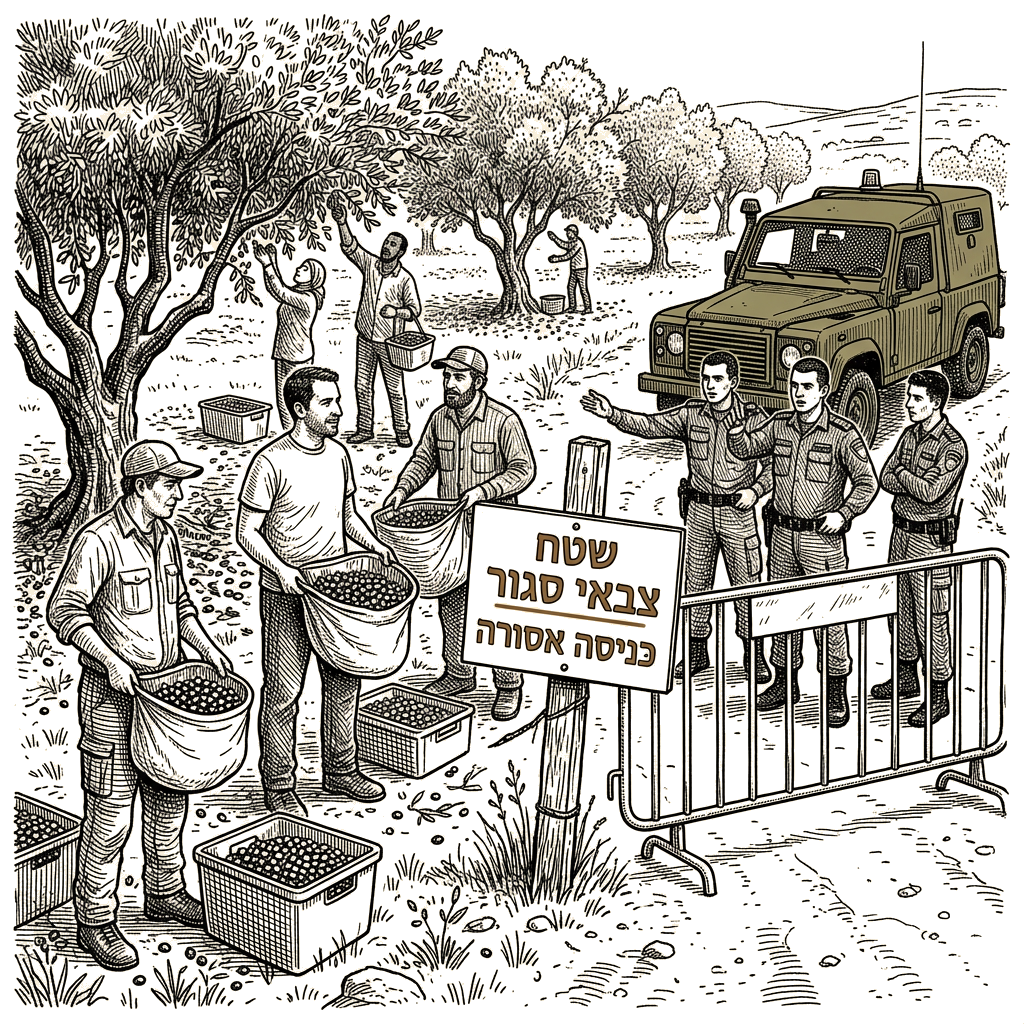
Lander said he and approximately 60 other volunteers were harvesting olives with Protect the Harvest. The group included about 40 foreign nationals, mostly Americans, and had also harvested in another part of the West Bank on Monday and Tuesday without incident. Lander said no checkpoint was crossed, no restricted area was entered and no one told the group that coordination was required.
Lander said Israeli military personnel detained him for about three hours. After his release, authorities told him that his actions were illegal and wrong, that the group had created a public disturbance and had gone where it was not supposed to go. He said he protested receiving special treatment because rabbis and other volunteers remained in detention. According to the Protect the Harvest steering committee, international volunteers were being held at the Etzion military base and Israeli detainees at Beitar Illit police station, both in the West Bank. Lander said the remaining volunteers faced possible deportation.
The report establishes the detention, Lander’s release and the continued detention of other participants. It does not establish the grove’s security classification, the applicable rule, whether notice was provided, whether the harvesting was lawful under the applicable rules, why Lander was released or whether other detainees received equal treatment.
Israeli authorities’ decision to detain the group is direct evidence of the official position that the activity was unauthorized. It does not independently establish the ministry’s factual premises or political explanation. Lander’s statements are direct evidence of his account but do not independently corroborate the site’s status, the notice provided or the criteria governing his release. His participation in the harvest likewise cannot establish the disputed facts.
The two accounts therefore require comparison against the same location, notice, authorization and release evidence. Lander’s participation, his detention, the continued detention of other volunteers and the earlier harvests without incident do not by themselves distinguish among the competing explanations. The report provides no independent corroboration for the attributed statements, detention locations or arrest figures.
Competing explanations
A pre-existing restriction and coordination requirement applied
The Foreign Ministry’s official account holds that a restricted-area rule was violated without required coordination. This explanation would gain support from authenticated records showing a pre-existing site restriction, an applicable coordination rule, documented notice before the visit and a group location within the designated area.
The explanation would weaken if authoritative records showed that the grove was not designated as restricted, that no coordination rule applied or that participants had no practical way to learn of one. Site maps, designation orders, dated access instructions, checkpoint logs and contemporaneous communications would be the principal evidence bearing on the question.
No restriction or notice requirement applied
Lander’s account is that the group harvested in an area that was neither restricted nor subject to a notice requirement. His direct-participation testimony, denials of checkpoint passage and restricted-area entry and account of uneventful earlier harvests support that explanation within the report.
Verified coordinates placing the group inside a designated restricted area, advance or contemporaneous notices requiring coordination, and authenticated video or witness accounts showing that the group crossed a marked boundary would weaken Lander’s account. Independent phone-location data, timestamped images, original video, harvest records and statements from volunteers without an organizational role would be leading evidence.
A classification or communication failure preceded the detention
A third explanation accepts that harvesting occurred while disputing both the site’s status and the communication of a coordination requirement. Lander acknowledges the harvesting while denying restricted-area entry and notice; the ministry asserts that a restriction existed and coordination was required. That combination supports a classification-and-notification explanation, but the inference remains unconfirmed and does not establish that either side’s account is true.
Records showing a gap between an applicable designation or rule and what volunteers actually were told would strengthen this explanation. Conclusive evidence that the location was plainly and consistently designated as restricted and that participants knowingly proceeded without approval would weaken it.
Security arrangements changed during the visit
The contrast between the earlier harvests Lander described and the ministry’s account of the disputed encounter makes a changed classification, a designation made during the visit or confusion about the relevant area possible explanations. The contrast suggests the possibility without establishing it.
Timestamped orders, communications and checkpoint activity during the harvest days would be decisive if the records exist and can be authenticated. A pre-existing restriction, unchanged rules and clear notice would weaken the changed-arrangements explanation.
Political or public status influenced Lander’s release
Lander says he was released because he was a congressional candidate and says he protested receiving special treatment while rabbis and other volunteers remained detained. If the steering committee’s accounts of differing detention locations are accurate, they support the existence of differential treatment. The report supplies no official explanation, release standard or comparable case record establishing that political status caused Lander’s release.
Standardized, conduct-based criteria and comparable cases would weaken the status-based explanation. Evidence that political or public status affected comparable releases would strengthen it. Even proof that political considerations affected the release would not determine where the group was or what coordination was required.
The present evidence cannot separate the explanations
The report does not establish deceptive conduct by either Israel’s Foreign Ministry or Brad Lander. The inability to distinguish the explanations is not a finding that Lander’s account is true; it reflects the absence of the records needed to test both accounts. The release dispute must remain separate from the location and coordination dispute because each turns on different records and decision criteria.
Limits of the available evidence
Lander’s reported warning lends some support to the official judgment that the group was in the wrong place. The warning does not establish that the place was formally designated as restricted, that Lander had been told beforehand or that the warning rested on a mistaken assessment. The warning is more diagnostic of an official understanding than of the underlying site status or notice.
Lander’s account of harvests elsewhere on Monday and Tuesday makes location, timing and changing security arrangements relevant if accurate. Those harvests do not establish the legal or security status of the disputed grove.
The photograph showing Lander on a bus establishes transportation, not the grove’s designation or the legal basis for detention. The report’s statement that Israeli police arrested 10 people accused of attacking two groups participating in a West Bank olive harvest is contextual and has little diagnostic value for Lander’s case because the report does not connect those arrests to his group or indicate that either targeted group entered a restricted area.
Reported violence against Palestinians, attacks on international diplomats and journalists, and increased settlement activity raise the cost of an opaque resolution. Those conditions do not establish the disputed site’s classification, prior notice, authorization or release basis.
Contemporaneous incident reports, site-designation records, access instructions and detention materials could address several disputed questions at once. Their value would depend on completeness, authentication, provenance and access to the underlying orders and logs rather than on the issuing institution’s characterization.
Political statements, social-media clips and witness accounts can supply investigative leads, but their weight depends on provenance and corroboration. Original location data, unedited video, contemporaneous messages and independently verifiable witness accounts are more probative when timing and chain of custody can be tested. Even the existence, retention, authentication and obtainability of the relevant records remain assumptions that must themselves be established.
How the available evidence would change the ranking
If contemporaneous records showed that the grove was outside a restricted area and that no coordination instruction was delivered, the Foreign Ministry’s account would fall sharply, while Lander’s account or the classification-and-notification explanation would rise. If the records instead showed a pre-existing restricted designation and notice before the group entered, Lander’s account would fall sharply.
If the site was restricted but no notice appears in the file, the communication-failure explanation would become stronger. If a release record showed a uniform, conduct-based reason for Lander’s release, the status-based explanation would weaken. If comparable cases showed that political or public status affected release, the differential-treatment issue would become more consequential.
The present record cannot reliably separate restricted-area entry from political intent, security procedure from selective release, or the ministry’s official characterization from the underlying facts without the underlying location, notice and release documents.
Where the competing positions overlap
At its strongest, the Foreign Ministry’s position is that security coordination is a safety mechanism that cannot be treated as optional because a participant disputes its application or expects publicity from participation. At its strongest, Lander’s position is that the government has not established the factual predicates of its accusation and that differential release creates a separate procedural concern even if the encounter was poorly coordinated.
A partial reconciliation need not select one complete narrative. The group may have entered an area authorities treated as restricted or proceeded without completing required coordination, while public attention surrounding Lander may also have influenced how authorities managed his detention and release. The report supports an olive-harvest activity, but the ministry’s publicity allegation does not establish that the harvesting was staged. Political purpose, genuine harvesting and a substantive security dispute can coexist.
Genuine harvesting does not establish that a site restriction or notice requirement was absent. Motive, physical activity and legal authorization require separate treatment. Nor does a restricted-area designation, by itself, prove that Lander manufactured a political purpose, while his denial of a restriction does not, by itself, establish that the authorities handled the group procedurally neutrally.
The episode combines motive-level ambiguity with a dispute over conduct, authorization, notice and treatment. Combining the parties’ positions does not resolve the missing records. Greater transparency about security rules and release decisions would permit third-party review and equal-treatment assessment, although the government may have legitimate operational reasons for limiting disclosure about sensitive areas.
Equal treatment would require removing status-based exceptions, while authorities may infer that a high-profile foreign candidate presents a different escalation risk. Those are institutional considerations to be tested, not established motives. Lander’s candidacy, Jewish identity and the organizers’ stated purpose of modeling solidarity and coexistence were publicly salient features of both parties’ characterizations. The record does not establish that candidacy or identity caused the authorities’ response. Separating identity-related perceptions from operational questions about where participants could go and what notice they received could reduce conflict without requiring either side to abandon its public position.
Interests affected by a resolution
- Lander and foreign volunteers: Lander’s statements identify release, safety, notice of applicable rules, access to reasons, consistent treatment regardless of nationality and protection from removal as interests. He said other volunteers faced possible deportation and that the group sought to model solidarity and coexistence between Jewish and Palestinian participants.
- Lander and the participating organizations: Lander, Protect the Harvest, Israelis for Peace and Rabbis for Human Rights have interests in continued participation without each future harvest being exposed to unresolved detention, and in distinguishing protection work from the ministry’s political characterization of the trip.
- Israeli authorities: The Foreign Ministry has placed access and security coordination at the center of its public position, while the military and police have roles in detention, enforcement and public safety. Relevant institutional interests include consistent rule application without exemptions, the credibility of access controls, safe management of foreign visitors and the effects of any disposition on local communities and international relationships.
- Protect the Harvest, Israelis for Peace and Rabbis for Human Rights: These organizations have interests in participant safety, organizational continuity, compliance with applicable procedures and protection of their standing as protection organizations.
- Palestinian farmers and affected local communities: Their interests include safe access to olive groves and roads, meaningful agency in arrangements affecting their land, freedom from collective restrictions and participation without being represented solely through outside actors. An arrangement reached without Palestinian participation could transfer the dispute rather than resolve it.
- U.S. political and diplomatic actors: Reported support from fellow Democrats indicates concern for Lander’s treatment and for the safety of U.S. participants. Diplomatic actors have an interest in preventing an individual dispute from becoming a broader source of friction without weakening accountability for detention or removal.
Objective criteria for review
An authoritative map and authenticated designation orders should establish the grove’s boundaries and status on the date of the harvest. Written security rules, evidence of notice given, contemporaneous coordination requests, communications with the group and checkpoint logs should establish which requirements applied.
Independent confirmation should draw on original location records, phone-location data, geolocation, timestamped images, original video, harvest records and participants without an organizational role. Published and consistently applied criteria for detention, warning and release should include a written standard applied to comparable foreign and Israeli detainees. Nationality-neutral criteria provide one defensible basis for comparison, although the parties could still dispute the underlying rules or their application.
Each detainee should receive individual legal review of detention, release conditions and any deportation or removal decision before implementation. An independent observer or monitor should be able to review both location and treatment.
Evidence review should include completeness certification, authentication, chain of custody and access to underlying orders and logs rather than reliance on a summary. The number of political statements or shared clips would not substitute for those safeguards. Lander’s account of earlier harvests could provide context about notification and enforcement, but those harvests would carry less weight because site conditions can change.
A prospective protocol
A prospective protocol could require an independently auditable record of site status, advance site clearance, a named security liaison, designated routes or harvesting times, a check-in procedure, emergency escalation and an independent observer. It could also require individual status decisions for every person detained, a written explanation of each asserted legal basis and published procedures for future visits.
Advance site clearance would align most directly with the ministry’s stated coordination requirement because it operationalizes that requirement without requiring abandonment of the security framework. Whether such an arrangement would be accepted in practice would depend on its security, disclosure and implementation terms; the report does not establish that comparable arrangements have been accepted in comparable Israeli security settings.
Lander and the organizers would have reason to accept such a mechanism only if the site designation were objective, notice were documented and no person’s detention or deportation status depended on political prominence. If documentary review established that security and predictable access were the controlling institutional considerations, the mechanism could create room for an integrative resolution.
Resolution routes and consequences
Several routes could address different parts of the dispute without requiring the parties to agree in advance on the disputed facts.
Documentary and legal review
A case-specific documentary review could seek written reasons for each detention, individualized status decisions, independent location and witness evidence and, where appropriate, diplomatic clarification. This route directly targets the location, notice and release questions, but its value depends on whether the relevant records exist and can be obtained.
Counsel could separately test the basis for detention, release conditions and threatened removal. The article does not establish which legal remedies are available, so this route remains conditional.
Public pressure could seek written clarification and review. Such pressure might produce disclosure or additional statements, but political pressure would not authenticate records or establish what happened at the site.
Participation options for Lander and the organizers
Lander could rely on public statements and formal legal or diplomatic review while organizing in undisputed areas. Lander’s individual position is less exposed because he has already been released, but that approach leaves the reported detentions and deportation concerns unresolved, produces no authoritative finding on his account and may allow the ministry’s version to stand without a factual test.
Continuing without coordination would preserve visibility but carries the risk of another encounter while leaving the underlying rules unresolved. Ending further participation while preserving statements, location evidence and records could reduce continued exposure to detention, but that step would leave individual status and the disputed facts unresolved, particularly if documentary access were unavailable.
A defensible stopping point would require an objective site designation, documented notice and a protocol that did not preserve status-based release without an individualized explanation. If location and coordination records could not be disclosed, independent review could not be obtained and differential release would remain unresolved; proceeding in a contested area would then add publicity without improving factual resolution, while formal legal and diplomatic channels would offer the more defensible alternative.
Operational options for Israeli authorities
Authorities could maintain the security designation, process detentions and releases through internal assessments and continue public communications. That approach would control access but leave the record exposed to diplomatic criticism if location and coordination evidence did not exist.
Facilitating harvests only in cleared sites could reduce immediate operational risk but would not answer the release question. Authorities could permit volunteers to depart after any appropriate warning while preserving the ministry’s stated position on access.
The Foreign Ministry, Lander and the organizers could issue a joint factual statement separating the occurrence of the harvest from competing motive claims, provided the statement did not disclose sensitive information or rely on unverified accounts. Harvests could also be permitted only in undisputed areas while the location question was reviewed.
If documentary review established that security and predictable access were the controlling interests, the parties could adopt the prospective protocol as a conditional integrative move. A durable arrangement would improve the process only if it established stable, reviewable rules without requiring either side to concede facts that remained unresolved.
What remains unresolved
The report establishes conflicting accounts about the olive-harvest trip and detention. It does not establish which description of the site is correct, whether any participant was told to coordinate, why Lander was released or whether other detainees received equal treatment. Lander’s reported warning lends some support to the official characterization of the group’s conduct but does not establish the ministry’s complete account.
A location record, authoritative map, applicable rule, evidence of notice and coordination, and individualized detention and release records are required to distinguish restricted-area entry from political intent, security procedure from selective release, and the ministry’s official characterization from the underlying facts. The causal effect of Brad Lander’s candidacy or identity on official conduct remains unverified.
The earlier Monday-and-Tuesday harvests, detention locations and arrest figure remain attributed rather than independently corroborated within the report.
Analytical techniques used in this piece
This analysis applies the methods below. Each links to a short, plain-English explainer you can read and reuse.
- Analysis of Competing Hypotheses
- Scores rival explanations by how well each fits the evidence, weighting the diagnostic items (Heuer).
- Dialectical Analysis
- Holds thesis against antithesis and works toward a higher synthesis.
- Principled Negotiation
- Works a negotiation from interests, options, and objective criteria rather than positions.