Summary
- The Associated Press reported that partisan remapping helps explain the recent acceleration of the competitive House district decline from 45 to 37, while polarization, declining split-ticket voting and residential sorting explain more of the longer contraction.
- The Associated Press reported that North Carolina’s remapped 13th District shows how map design can raise the electoral hurdle for Democratic candidates, but the district does not establish redistricting’s national share of the decline.
- Ian Shapiro and the scholars cited by The Associated Press connect fewer competitive districts with greater polarization because primary-centered elections make legislators accountable to a comparatively small electorate.
- The Associated Press reporting supports considering nonpartisan redistricting and broader nomination participation as two structural levers, while safe-seat candidate and civic outreach serves as a complementary near-term measure.
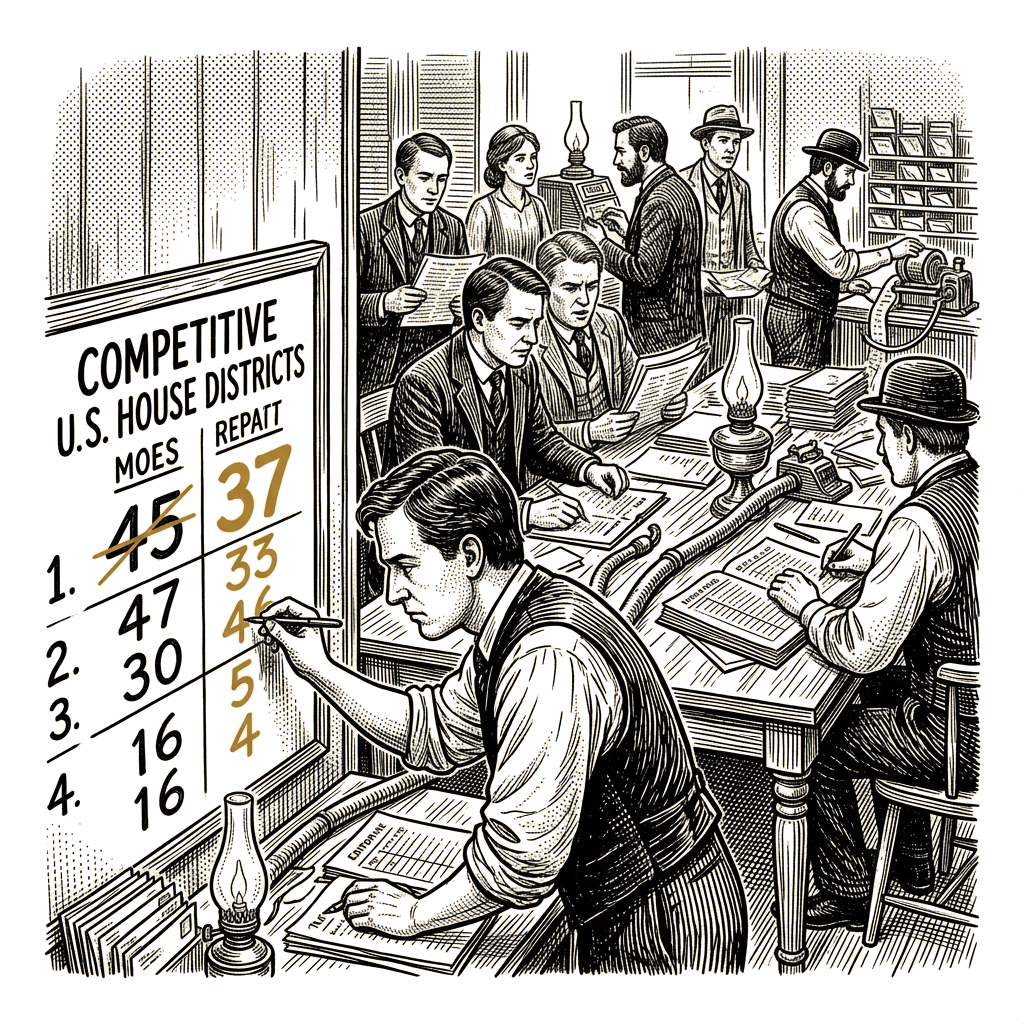
Competitive U.S. House districts fell from 45 to 37 over the past year, according to The Associated Press, narrowing the Nov. 3 midterm battlefield. AP defines a competitive district as one in which a presidential candidate won by no more than five percentage points in the previous election, a measure that captures geographic and partisan separation but not every possible House result. The evidence cited by AP supports a layered explanation: partisan remapping helps explain the faster recent contraction, while ideological polarization, declining split-ticket voting and Americans’ increasing tendency to live among like-minded neighbors help explain the longer decline. North Carolina’s 13th District provides a clear example of map design changing an electoral baseline, but AP’s reporting does not support assigning the entire national decline to remapping or any other single intervention. Scholars cited by AP also connect fewer competitive districts to greater polarization because primary-focused elections concentrate accountability among a comparatively small electorate.
What the competitive-district measure captures
The Associated Press reported that competitive seats are districts in which a presidential candidate won by five percentage points or fewer in the previous election. The measure identifies the geographic and partisan separation between electoral constituencies, but it does not capture every possible House result. Candidate strength, turnout, ticket splitting and district-specific conditions can change a congressional outcome without changing the presidential voting pattern that determines whether a district enters the competitive category.
AP attributed the longer erosion to several developments that occurred over different time horizons. Growing polarization, less frequent ticket splitting and residential sorting reduced the number of competitive seats over time, while recent partisan remapping helped accelerate the contraction. Studies cited in AP’s reporting found that, without partisan gerrymandering, the House would have roughly twice as many competitive seats as it has now.
A count from the 1970s identified 96 House seats that met the modern competitive-district definition in 1964. The supplied reporting does not include the underlying count for independent verification. The historical figure establishes the scale of the long-run decline but does not identify how much of it came from any single mapmaking decision.
Several quantitative findings in the reporting measure different phenomena and cannot be combined into one estimate. Unite America, an organization advocating alternatives to party primaries, calculated that 87% of representatives elected to the House in 2024 were selected by 7% of the country’s voters; the article does not supply the calculation’s methodology. Michael Bitzer, a political scientist at Catawba College, found that only 15% of North Carolina’s voting precincts could be classified as politically competitive; the report does not describe the classification method in enough detail to reproduce it. AP’s 45-to-37 district count, Unite America’s voter-share calculation and Bitzer’s precinct classification therefore describe different dimensions of the same broad pattern without establishing a single national measure.
The strategic stakes for both parties
The Associated Press reported that Republicans were counting on the smaller number of competitive seats to place a low ceiling on the number of Democratic gains in November. Democrats responded by expanding their list of potential targets and spending in Republican areas that ordinarily would not be competitive.
AP attributed the Democratic expansion to opposition to the unpopular war with Iran and anger over high prices. Those conditions may influence campaign spending, candidate attention and the competitiveness of marginal races, but they do not explain the underlying contraction in competitive districts. The decline in the partisan-geographic battlefield and the political environment facing candidates are related but analytically distinct.
Both parties are spending in districts their own supporters consider safe. Such spending may not change the officeholder immediately, but it can affect turnout, candidate visibility, local organization and the ability to discourage or encourage challengers. Because a safe-seat general election is unlikely to determine the winner, primary-focused investment may have its greater electoral effect over a longer horizon than at the immediate November contest.
Republicans face parallel trade-offs. Concentrating resources on benchmark competitive districts can protect a limited number of campaigns, while additional spending in safe districts can respond to dissatisfaction or deter potential challengers without producing an immediate pickup. Seat counts alone cannot evaluate either party’s allocation strategy. Short-term campaign spending also cannot be compared directly with procedural reform such as Wiley Nickel’s proposal for nonpartisan state redistricting systems: campaign spending affects votes in a particular race, while redistricting reform addresses the mapmaking process itself.
What North Carolina’s 13th District shows
The Republican-controlled North Carolina legislature remapped the 13th Congressional District by cutting Democratic voters out of Raleigh and adding rural counties extending toward the Virginia border. The resulting hourglass shape allowed Republican candidate Brad Knott’s campaign to reach substantially farther into rural North Carolina.
Democrat Wiley Nickel, described as a moderate, won the old district by about 9,000 votes in 2022. Two years later, Knott, described as a conservative, won the remapped district by more than 70,000 votes. AP reported that Donald Trump received 58% of the vote in the new district and characterized the result as turning one of the South’s last remaining competitive districts into a safe Republican seat.
Nickel decided not to seek reelection after reviewing election returns dating to 2016 and finding that no Democratic incumbent had held on in a district where Trump received at least 55% of the vote. That finding applied across districts rather than only to the 13th.
Nickel had introduced legislation requiring states to use a nonpartisan redistricting system and initially said he would run for the U.S. Senate because statewide seats cannot be gerrymandered. After former Gov. Roy Cooper announced a Senate campaign, Nickel switched to the Wake County district-attorney race. He won the Democratic primary and will take office in January. No Republican ran, although the article does not explain why. The uncontested race represents a separate dimension of partisan concentration outside congressional elections, but the source does not establish that partisan concentration caused the absence of a Republican candidate.
The large margin is consistent with a major electoral reset, but the source does not isolate the new map as the only operative factor. The 2022 and 2024 elections differed in candidate positioning and national political environment, while turnout remains an unmeasured influence. The relative contribution of each factor to the change from roughly 9,000 votes to more than 70,000 cannot be determined from the article.
The 13th District is therefore a strong temporal demonstration of how a map can alter an electoral result quickly. It is not a nationally representative estimate of redistricting’s share of the competitive-seat decline.
Comparing institutional responses
A bounded comparison of institutional responses places nonpartisan redistricting and broader participation in party nominations in effectively a tie, separated by 0.05 points. Neither approach dominates. Nonpartisan redistricting offers greater potential durability by constraining mapmaking, while broader nomination participation offers a more direct route to participation and accountability within each party.
The comparison assigns 25% of the weight to direct fit with the documented mechanisms, 20% to potential improvements in accountability, 15% each to symmetry and institutional legitimacy, actionability for November and durable reach, and 10% to source observability. The ratings are editorial judgments on a one-to-five scale, not measured effects. Source observability measures how clearly the article shows how an option operates; a higher score indicates visibility in the reporting, not demonstrated effectiveness.
| Institutional response | Direct fit | Accountability | Symmetry | November actionability | Durable reach | Source observability | Weighted score |
|---|---|---|---|---|---|---|---|
| Retain current mapmaking and primary practices | 2 | 1 | 1 | 5 | 1 | 5 | 2.25 |
| Nonpartisan redistricting | 5 | 4 | 5 | 2 | 5 | 3 | 4.15 |
| Broader participation in nominations | 5 | 5 | 5 | 2 | 4 | 3 | 4.20 |
| Safe-seat candidate and civic outreach | 2 | 3 | 4 | 5 | 2 | 2 | 2.95 |
The ranking is sensitive to modest changes in the ratings. Reducing nonpartisan redistricting’s durability score by one point, increasing broader nomination participation’s durability score by one point or reducing broader nomination participation’s accountability score by one point reverses the order of the two structural options.
Safe-seat outreach draws level with broader nomination participation when near-term actionability receives about 36% of the total weight and direct fit falls correspondingly. The evidence therefore supports considering two structural levers while treating outreach as a complementary near-term measure rather than a substitute for either form of institutional change. Broader nomination participation would affect both parties’ selection processes and widen the electorate inside each party.
The article does not specify the legal designs for nonpartisan mapmaking or broader nomination participation, and it does not establish that either approach—or candidate outreach—would restore the competitive-seat count recorded for 1964.
Campaign allocation in the 13th District
A complete campaign-allocation comparison requires at least six criteria: electoral outcome, campaign cost, organizational durability, breadth of representation, fit with local conditions, and the reversibility or durability of the underlying institutional change.
North Carolina’s 13th District has a clear partisan baseline favoring Knott. Barringer has a locally rooted biography and national visibility, giving him advantages in local fit and strategic attention, but those advantages do not settle his electoral odds.
The assessments from Mary Blank and Linwood Parker express skepticism from two local figures, but their judgments and AP’s selected voter interviews do not substitute for polling. The article supplies no comparable information about campaign costs, fundraising, turnout or district-level polling. The available evidence therefore does not support a numerical ranking of campaign allocations. The numerical scores in the institutional comparison apply only to structural options and are explicitly editorial; they do not establish the relative electoral return from spending in particular safe districts.
Barringer grew up in the district, returned to care for his mother and presented himself as willing to appeal across party lines. The interviews with Republican voters did not fit a single response pattern. Roxboro resident Linda Long saw no reason to vote for anyone other than a Republican, while retired engineer George Scott said he disliked Trump but expected to continue voting Republican. Those accounts indicate that dissatisfaction with national conditions does not automatically displace long-standing partisan preferences.
Institutions and community roles
The conflict described by AP involves state lawmakers, party committees, candidates, local voters, the news organization, political scientists, Unite America, the Indivisible chapter in Johnston County and residents of urban and rural North Carolina.
The community operates at three levels:
- The immediate level consists of household, friendship and workplace networks in places such as Raleigh, Roxboro, Franklinton and Johnston County.
- The intermediate level includes county officials, local campaign organizations, town leadership, candidates and the state legislature.
- The wider level includes statewide voters, national party committees and news organizations.
These levels do not necessarily share the same political outlook. The distance between central Raleigh and the district’s rural areas also represents a difference in social and economic context.
| Institutional role | Status and evidence | Gap or possible intervention |
|---|---|---|
| Provider | Active but conflicted as a mapmaker; material-response capacity is thin | The legislature supplies the map under partisan control, while no local institution is shown supplying a substantive response to documented grievances about prices and the war. Transparent, externally enforceable criteria could constrain unilateral changes. |
| Teacher | Active but limited | Ian Shapiro, Joshua Huder, Michael Bitzer, AP, Unite America, Blank’s chapter, candidate visits and local discussion explain polarization, primary selection and geographic sorting. No sustained cross-party civic program is reported. District- and precinct-level reporting should disclose calculation methods. |
| Bridge-builder | Partially active | Barringer’s outreach in conservative-leaning Johnston County and the meeting hosted by Mary Blank create cross-boundary contact. The effort is partisan and geographically narrow, and the reception shows the limits of contact without shared organizational trust. Recurring nonpartisan local forums could widen the role. |
| Mediator | Unfilled | No neutral facilitator is identified. Universities or civic bodies might provide facilitation, but the source does not establish that they can or will do so, and facilitation cannot replace neutral map standards or broader nomination access. |
| Arbiter | Unfilled | No independent adjudicator for map disputes is identified. The state legislature cannot fill the role because it was the interested actor that drew the district. Whether a court, commission or other body could adjudicate disputes cannot be established from the source. |
| Equalizer | Partially active | Unite America’s campaign for alternatives to party primaries and Indivisible’s local organizing address unequal access, but their reach is limited. National Democrats’ watch-list designation supplies visibility for Barringer without establishing that candidates received equal resources or information. Broader nomination access would affect both parties’ selection processes. |
| Healer | Partially expressed; no systematic mechanism | Barringer’s appeal to work together reflects the need to repair distrust, but no sustained cross-party repair, restorative or Indigenous or traditional dispute-resolution process is identified. Local forums could provide room for acknowledgment without substituting for institutional reform. |
| Witness | Active | AP reporting, academic research, election-return analysis, Unite America’s calculation and local testimony make seat and turnout patterns visible. Methodological transparency would strengthen this function. |
| Referee | Independent capacity absent; governing role conflicted | No neutral body with authority to settle the map dispute is identified. The partisan-controlled legislature controls mapmaking but cannot provide impartial enforcement. Neutral criteria and an independent enforcement mechanism would separate mapmaking from party control. |
| Peacekeeper | Not yet relevant | The article reports no violence, threats of violence or other imminent physical danger, so a protective intervention has no factual basis in the account. |
The most consequential institutional gaps concern resolution and control. Where one party can redraw the competitive map without neutral constraints, facilitated discussion may legitimize an unequal result rather than correct it. Independent map review and neutral enforcement therefore have greater corrective potential than facilitation alone.
Institutional standards should constrain future mapmaking by either party. AP documents an established practice of partisan mapmaking, but the article does not provide a comparative record sufficient to quantify either party’s effects.
What November can—and cannot—settle
AP reported that the battlefield may expand slightly because of unusual midterm conditions, but it remains narrow. Shapiro assessed that even a swing comparable to 2006 would not produce 40 seats changing hands and perhaps would produce about 20. That assessment is a forecast rather than a measured result.
National Democrats placed the Knott-Barringer race on a list of races to watch for a possible upset, giving Barringer visibility. Local assessments remained skeptical. Blank said she did not think Barringer could win, and Parker also discounted the Democrats’ chances.
A successful Barringer campaign would show that candidate appeal and local dissatisfaction can overcome a district’s structural disadvantage. One result would not demonstrate that the national map has become broadly competitive. Conversely, a Democratic nominee’s failure in the 13th District would not establish broad rejection of the party among primary voters because the electorate selecting the nominee is not the same as the November electorate.
AP’s reporting supports a narrow conclusion: partisan remapping raised the hurdle in North Carolina’s 13th District, while voter dissatisfaction, campaign spending and local organization may affect the result. The article does not provide the polling, campaign-cost and turnout evidence required for a definitive national seat forecast. November results will therefore be most informative as evidence about candidates, messages and local conditions rather than as a referendum on the country’s electoral structure.
The dispute’s framing and escalation
AP presents remapping as a recurring partisan practice rather than a development unique to one party. Parker said Democratic officials used gerrymandering to preserve legislative and congressional control until Republicans gained power in the 2010 wave, and that Republican mapmakers now use the same institutional tool. Parker approved the current map despite disliking gerrymandering and the polarization that has eroded bipartisan trust.
Parker’s account documents concern about a deteriorating bipartisan norm but does not quantify either party’s mapmaking effects. His testimony therefore cannot substitute for a comparative record or equate an individual’s account with the documented remap of the 13th District.
The reporting characterizes the dispute as institutional and identity-rooted as well as geographic. Available local initiatives can broaden recognition, supply local information and create contact, but they cannot replace representative institutions or determine how voters cast ballots.
Escalation signals appear in rhetoric, outside campaign attention and institutional polarization. AP reported that Republican spokesman Mike Marinella described the battlefield as “a knife fight in a dark alley,” AP described safe-seat Republicans as “running scared,” and Parker said Democrats’ hopes were “blowing smoke.” National attention has increased, but the source identifies no joint forum through which competing map claims can be deliberated. It also reports no new public symbolic marker, threat of exit or physical violence.
The contraction from 45 to 37 competitive districts is established; a single-cause explanation is not. The 13th District shows that map design can change an electoral result quickly, while the longer record and cited studies show that residential sorting and polarization can suppress competition even without partisan remapping. Broader nomination participation could widen the electorate inside each party, and candidate outreach could affect individual safe-seat races, but the source does not establish that any one mechanism would restore the competitive-seat count recorded for 1964.
Analytical techniques used in this piece
This analysis applies the methods below. Each links to a short, plain-English explainer you can read and reuse.
- Balanced Critique
- Weighs a proposal’s strengths and weaknesses evenhandedly.
- Multi-Criteria Decision Analysis
- Scores competing options against several weighted criteria at once.
- The Third Side
- Takes the vantage of the surrounding community that has a stake in resolving a conflict (Ury).