Summary
- The Guardian credited James Blair’s data, polling and voter-modelling approach with helping deliver Donald Trump’s 2024 victory; Roger Stone credited Blair’s interpretation and implementation of polling data within a broader strategy team.
- James Blair is applying that approach to Maga Inc’s reported $415 million midterm operation, where national resource concentration must be reconciled with low-propensity turnout, candidate viability, affordability, local execution and Trump’s absence.
- Blair’s leave and reported overseas advisory arrangement expose Maga Inc and the White House to disclosure, personnel-continuity and divided-attention concerns, without establishing a conflict of interest or an effect on campaign decisions.
- Blair’s 2024 operation establishes historical capability, not a demonstrated 2026 result; the available evidence supports neither assured Republican victory nor assured defeat.
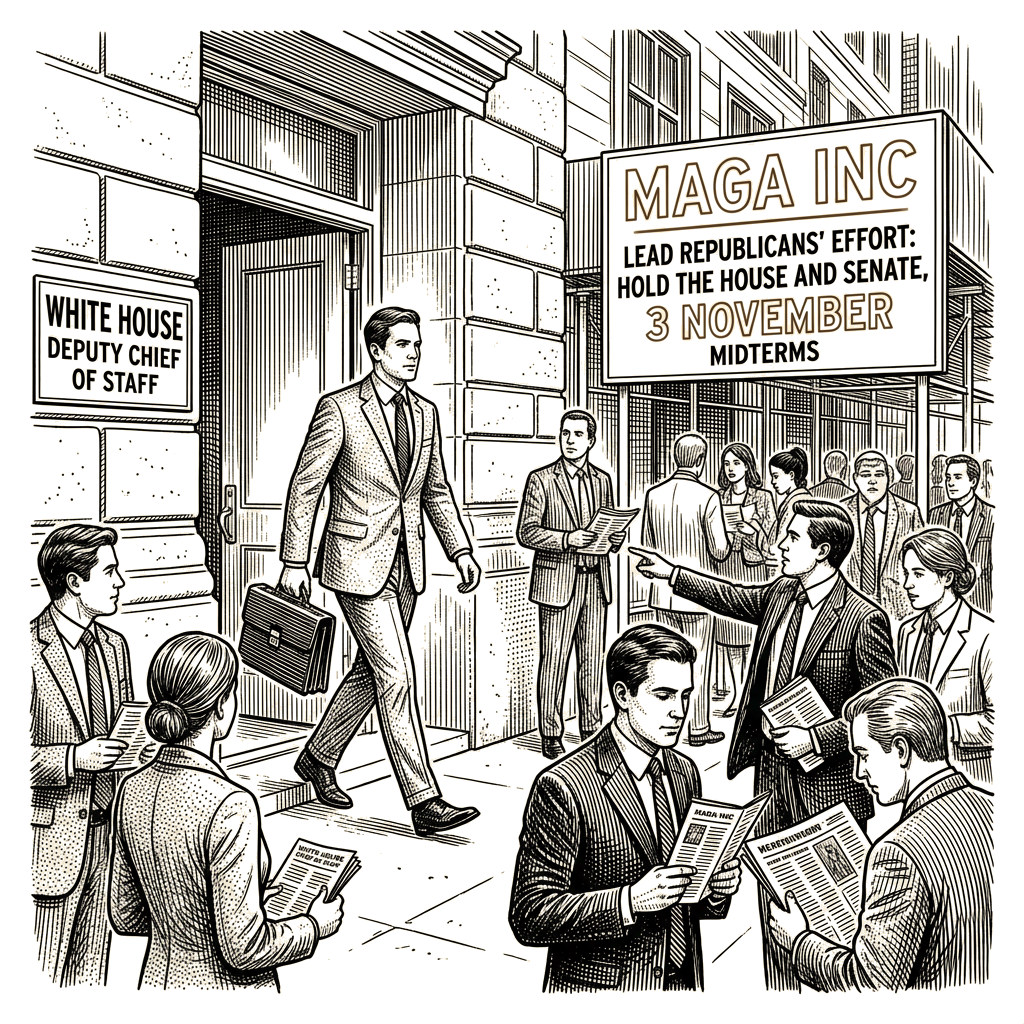
James Blair has stepped away from his White House role to run Maga Inc and lead the Republican effort to hold the House and Senate in the 3 November midterms. Donald Trump expects Blair to return after the election and described the absence as a “short” leave, although a former associate disputed that expectation. The Guardian credited Blair’s data, polling, voter modelling and outsourced turnout model with helping deliver Trump’s 2024 victory, but the reporting does not isolate Blair’s effect from Trump’s personal appeal, the wider strategy team or the different conditions facing a midterm campaign. The available evidence supports a conditional assessment: Blair’s operation can identify audiences, issue salience and resource opportunities, but whether the people represented in those models participate depends on coalition portability, turnout, affordability, message consistency, candidate viability, local execution, presidential behavior, disclosure and personnel continuity.
What the 2024 result establishes
The Guardian credited Blair’s data-driven approach with helping deliver Trump’s 2024 victory. Roger Stone also credited Blair’s ability to interpret and implement polling data, while placing him within a strategy team that included Susie Wiles, Chris LaCivita and pollster Tony Fabrizio. The 2024 result therefore establishes historical capability, but it does not establish a demonstrated midterm result.
The supplied reporting does not isolate Blair’s contribution from Trump’s personal appeal or the work of the wider team. It also provides no comparable performance under a midterm’s different turnout conditions, issue priorities and candidate-level competition. Blair and Trump publicly identified the same immediate objective: helping Republicans win in November. The reporting supports that shared objective without establishing either man’s private motives.
Blair’s 2024 operation used polling, voter modelling, digital-first mobilization and outsourced get-out-the-vote operations through independent super political action committees. Blair closed traditional field offices and reduced reliance on costly local field operations and heavy television advertising. The method offers scale: national data can indicate where contact, advertising and turnout resources may have the greatest effect without requiring every campaign to maintain a large field organization.
The 2024 assignment differed from the 2026 assignment. The presidential campaign pursued one outcome in an electorate aligned around Trump. The midterm operation must mobilize existing supporters, persuade voters without a presidential contest on the ballot and allocate money and attention among congressional candidates with different messages, markets and competitive conditions.
Who controls the operation and bears exposure
The interest map applies the Mitchell–Agle–Wood salience framework. High salience combines power, legitimacy and urgency; definitive combines power and legitimacy; dependent combines legitimacy and urgency; dangerous combines power and urgency without established legitimacy. Here, legitimacy means a recognized claim or representative standing, not approval of a political position. These classifications are analytical labels rather than statements from the source.
| Stakeholder | Salience classification | Evidence-supported interests and exposure |
|---|---|---|
| James Blair | High salience: power, legitimacy and urgency | Blair directs Maga Inc and the reported midterm effort and has been credited with the data-led strategy. His leave reduces direct White House supervision, while disagreement over whether he will return leaves his future position unsettled. The reporting does not establish a motive for greater autonomy or control over attribution of success or failure. |
| Maga Inc | Definitive: organizational power and legitimacy | The Guardian reported that Maga Inc had $415 million at the end of August, giving the organization material capacity to allocate money, contacts and turnout activity. The reporting does not identify the funding base, disclose the full allocation or establish individual supporters’ preferences. |
| Donald Trump | High salience: power, legitimacy and urgency | Trump remains the coalition’s dominant political figure, publicly shares the objective of Republican congressional control and controls much of the campaign’s presidential message. His public remarks also introduce the variable that Chris Whipple and Rick Wilson identified as a central constraint. The Guardian assessed that his unpopularity and individualized political style did not bode well for the midterms. |
| The White House | Definitive: institutional power and legitimacy | The administration retains formal responsibility for policy, personnel and legislative affairs. Blair’s departure and the reported questions about his foreign advisory work make staffing, disclosure and institutional continuity relevant to the administration as well as to the campaign. |
| Congressional Republican candidates | Dependent: legitimacy and urgency | Seat retention, access to national resources and competitiveness in close races define their immediate exposure. The Michele Tafoya funding dispute illustrates how a national allocation decision can affect a candidate’s local organization and prospects. Their formal power varies substantially by race. |
| State and local party organizations | Dependent: legitimacy and urgency | These organizations provide local nominations, endorsements and campaign infrastructure. National committees and outside spending can substitute for some of that activity, so their relevance varies with the resources candidates receive from national or private organizations. |
| Low-propensity coalition voters | Dependent: legitimacy and urgency | Blair identified this group as central to the coalition and harder to turn out in a midterm year. Affordability and gas prices are the principal economic concerns identified in the reporting. Their limited participation leaves the group with substantial electoral significance but limited formal institutional power. |
| Latino voters | Dependent: legitimacy and urgency | The Guardian connected Latino support gained in 2024 to coalition portability and reported that inflation and immigration enforcement could erode those gains. Their claim to inclusion in the political process is significant even though their formal institutional power is limited. |
| Unidentified financial backers and the wider outside-spending ecosystem | Dangerous: financial and electoral power with urgency, but no established composition or alignment | Their capacity can determine which races receive staff, contacts and spending. The reporting establishes the scale of Maga Inc’s reported funds and Blair’s reliance on outside contractors but does not identify the backers or establish their individual preferences. |
| Campaign staff | Dependent: legitimacy and urgency, with limited formal allocation power | Staff translate targeting decisions into field activity and need viable campaigns, manageable workloads and continued employment. The closure of traditional field offices shifted some responsibilities toward independent political action committees and contractors. |
| Independent turnout contractors | Dangerous: operational power and urgency, without demonstrated comparative effectiveness | Outsourced organizations execute much of the get-out-the-vote activity, but the reporting does not compare their contact or conversion rates with locally staffed work. Their ability to affect turnout is operationally important and empirically unresolved in the midterm context. |
| Opposing campaigns | Dangerous: electoral power and urgency, with contested legitimacy | Their messaging can test the Republican operation’s vulnerabilities, particularly on affordability and consistency of presidential messaging. The supplied reporting provides little detail about their internal resources, so their capacity cannot be evaluated on the same basis as Blair’s operation. |
| Anti-Trump Republicans | Dependent: legitimacy and urgency, with less certain institutional power | They represent a potential alternative within the wider Republican electorate. Rick Wilson’s critique that no data model could overcome the absence of a “steady hand at the tiller” is the only direct opposition perspective supplied. |
| The Republika Srpska government | Definitive within the client relationship: power and institutional standing | The New York Times, as relayed by The Guardian, reported that Blair and Chris LaCivita received substantial payments to advise the regional government before local elections. The government is identified as the client; the reporting does not establish how the advisory work affected local voters or institutions. |
| Local stakeholders in Republika Srpska | Dependent: legitimacy and urgency, with limited evidence in the supplied account | Local voters and officials have an interest in the elections and the reported outside intervention, but the article does not provide their views. Their role remains visible mainly through the government’s decision to retain Blair and LaCivita. |
The recurring conflicts are structural rather than reducible to private motives:
- National seat allocation can conflict with a marginal candidate’s need for money, contacts, volunteers and local visibility.
- The affordability message described by Chris Whipple can conflict with Trump’s own public priorities and variable remarks.
- Data-led efficiency can conflict with the local organization needed to execute a contact plan.
- Blair’s campaign responsibilities can conflict with his reported advisory obligation to an overseas client.
- Concentration around Blair and Trump leaves message, spending and candidate management dependent on continued cooperation between people whose authority and attention are not controlled by the data operation alone.
Where the model can break
Turnout and coalition portability
Blair described low-propensity voters as “the bread and butter of our coalition” and said they are harder to turn out in a midterm year. He also described Trump’s coalition as uniquely powerful but not “entirely transferable” to other Republicans. His formulation makes low-propensity mobilization a principal test: turnout is not merely a matter of identifying supporters, but of overcoming their lower participation in a year without Trump on the ballot.
The reporting supplies no comparison between presidential-election and midterm turnout baselines. Lower participation therefore cannot be distinguished from weaker persuadability using the cited evidence.
The Guardian connected the strategy’s reliance on 2024 Latino gains to coalition portability and reported that those gains appeared vulnerable amid anger over inflation and what it described as hardline immigration enforcement. Coalition portability is not the same as voter portability. If candidate-specific differences affect support, a single national assumption remains unvalidated for the races it is intended to guide.
For low-propensity and Latino voters, participation depends on a reason to believe that voting will produce responsive representation on material concerns. Their alternatives include abstention and support for another party; accurate identification in a voter file does not by itself overcome either response.
The Guardian reported that the redistricting push personally championed by Trump and Blair had appeared to fail in the short term in Texas and elsewhere. Redistricting operates before candidate selection, turnout and voter contact, and the reporting does not show a conversion from projected districts to votes.
Allocation and forecast stability
Larry Jacobs said national Republican groups under Blair’s influence declined to put major funding behind Minnesota Senate candidate Michele Tafoya despite close polling. He said the data did not support the race and stated: “close is not winning.” The organizations were trying to limit losses rather than pursue uncertain gains.
Under an expected-probability allocation rule, limiting losses can be coherent when money or attention is constrained. It also creates a threshold that affected candidates and local organizations have reason to contest.
A race that the model rates as unlikely can become winnable through candidate-specific contacts, local issues or a late political development. Withdrawing support may also reduce additional gains by reducing opportunities to win.
The possible feedback loop is conditional: withdrawal can remove contacts, volunteers, endorsements and visibility, which can then reduce a candidate’s projected prospects. The reporting does not establish that this sequence occurred in Tafoya’s campaign or that declining support was erroneous. It shows that national allocation and candidate viability can pull apart.
The operation also assumes that a forecast remains stable long enough for strategic action to affect the result. That assumption is less demanding when a presidential candidate leads by a wide margin than when chamber outcomes are decided by close contests.
Small polling errors, candidate controversies or changes in participation can alter marginal projections after resources have been committed. Blair’s data may identify changes earlier than a conventional operation, but the reporting provides no midterm test of how quickly the system updates allocations or distinguishes temporary poll movement from a durable shift.
Presidential behavior and issue consistency
Chris Whipple recalled Blair saying that Republicans needed to address affordability and gas prices even though Trump would talk about whatever he wanted. The Guardian likewise assessed that Trump’s unpopularity and individualized political style did not bode well for the midterms. Rick Wilson described the problem as the absence of a “steady hand at the tiller.”
Whipple’s recollection and Wilson’s assessment identify a constraint that analytics cannot remove by itself: data may identify which issues matter and whom to contact, but it cannot ensure consistent delivery of the identified message by the president whose support is central to the coalition.
Trump can function as both a mobilization asset and a source of political variance. If an opposing campaign emphasizes affordability and pairs it with changing presidential messaging, the Republican campaign can respond by addressing the issue, defending the president or altering its emphasis.
Blair’s data can identify audiences for those responses but cannot resolve the underlying conflict between a strategist’s documented policy priorities and the president’s public behavior. The relationship is therefore a coordination dependency rather than a prescribed division of authority: Blair’s operation supplies polling, targeting and turnout work; candidate teams supply local adaptation; national allocation rules determine which races receive resources; and Trump’s public remarks remain outside Blair’s direct control.
Recurring affordability messaging and greater message discipline would provide a more stable frame for the data operation, while variable remarks require that operation to absorb uncertainty it cannot fully control. The reporting does not prescribe this division of authority; the dependency follows from the distinct operating roles and constraints described by the participants.
Outsourced execution
The closure of traditional field offices and reliance on independent political action committees shifted turnout work away from conventional local structures. The reporting does not compare contact or conversion rates for outsourced and locally staffed work. If local relationships are important for reaching low-propensity voters, the outsourced model’s effectiveness in those districts remains unverified.
The 2024 result supplies no midterm-specific comparison showing whether the same execution model produces the same participation when Trump is absent from the ballot.
Foreign advisory work and personnel continuity
The New York Times, as relayed by The Guardian, reported that Blair and Chris LaCivita traveled to Republika Srpska and received substantial payments to advise the regional government before local elections. Trump described the men as outside consultants and said he would terminate them if he found a conflict of interest. Blair called the criticism ridiculous and counterproductive, said he and Trump were focused on helping Republicans win, and announced that he and LaCivita would donate their full fee to a future Trump presidential library.
Reuters reported that senior White House officials questioned the timing of the overseas work while Blair was responsible for the final stretch of the Republican campaign. The Guardian identified distraction from his political responsibilities as the larger concern.
Blair’s leave reduces direct White House supervision while he continues in the midterm role Trump publicly described as temporary. The reported advisory arrangement therefore creates personnel and credibility exposure without establishing misconduct. Donating the fees does not resolve divided attention, disclosure, recusal or whether campaign decisions could be affected by simultaneous foreign obligations. The reporting does not identify applicable rules or establish that the advisory work changed campaign decisions.
Trump retains other political operatives and advisers, including Wiles, Stephen Miller, LaCivita and Fabrizio; Blair has Maga Inc and his consulting practice; congressional candidates can seek outside fundraising and local organization; and voters retain the option not to participate. Those alternatives limit any one party’s leverage but do not replace cooperation among the president, the data operation and candidate teams.
The reporting describes Blair’s authority over data, spending, candidate selection and turnout while Trump remains the coalition’s dominant political figure. That concentration leaves message, spending and candidate management mutually dependent on Blair’s operational authority and Trump’s political backing. Disagreement over whether Blair will return establishes uncertainty around continuity, not the absence of a succession plan.
What 3 November could change
Maga Inc’s reported $415 million balance and Blair’s operating role give the national organization substantial capacity to concentrate money and contacts in races it regards as competitive. The reporting does not disclose the complete allocation, the accounting basis of the reported balance or the identities and preferences of the funders.
Blair’s absence creates additional management and oversight questions because he is continuing a major campaign role outside direct White House supervision while questions remain about his foreign work. Allocation of those resources creates expectations of seat-level performance, but the available reporting does not establish whether the operation’s financial capacity has been matched by effective local execution.
If national withdrawal reduces local participation in close races, and low-propensity voters are harder to mobilize without Trump, affected candidates could lose organizational capacity while already facing lower projected odds. The reporting does not establish the magnitude or timing of that effect.
The 3 November election will test more than the accuracy of Blair’s models:
- Whether Trump’s coalition can function without the president who assembled it.
- Whether Republicans can turn economic concerns into sustained participation.
- Whether national allocation can coexist with candidate-specific needs.
- Whether Blair can exercise influence while formally outside the White House.
If those elements work together, the 2024 operation can function as a chamber-defense system. If they do not, the data may still describe the electorate accurately without overcoming the political choices that determine whether the people in the model participate.
If Blair’s data-led practices become durable, they could strengthen the party’s analytical capacity. If Blair and Trump remain central to message, spending and candidate management, the same concentration leaves the system exposed to changes in personnel, presidential attention and coalition stability.
Wilson’s assessment captures one opposition view that stable political direction may remain a more immediate constraint than analytical capacity. The supplied reporting provides only one direct opposition perspective, so it cannot establish how broadly that view is shared. Disclosure rules, separation of duties and a clear personnel-continuity arrangement remain unresolved questions in the reported account rather than demonstrated failures.
How the evidence frames the contest
The reporting moves from Blair’s credited 2024 success to a test of whether that success transfers to a different objective and operating environment. It supports neither a guaranteed Republican victory nor a predetermined defeat.
The central claims remain attributed to their sources: Blair’s accounts of turnout and coalition portability; Whipple’s recollection of the affordability priority; The Guardian’s assessment of Trump’s political style; Wilson’s assessment of political consistency; and Jacobs’s account of the Tafoya funding decision.
The evidence does not isolate Blair’s contribution from Trump’s personal appeal, Wiles, LaCivita, Fabrizio or other factors. It supplies no underlying voter data, issue polling, field results, contact-rate comparison or comparable midterm performance.
The reporting does not establish that the Tafoya allocation decision was erroneous, that the foreign advisory work changed campaign decisions, that an actual conflict of interest arose, or that the model caused the reported weaknesses in candidate selection, redistricting or coalition maintenance.
Symmetric application is limited by the source base: the reporting is heavily weighted toward Blair, Trump and Republican operations, while Wilson supplies the only direct opposition perspective.
The supplied Guardian report remains the controlling source for Blair’s role, Maga Inc’s reported balance, the Tafoya funding account and the reported Republika Srpska payment arrangement. Independent corroboration for those details, and official-calendar corroboration for the 3 November date, was not supplied in the available evidence.
Analytical techniques used in this piece
This analysis applies the methods below. Each links to a short, plain-English explainer you can read and reuse.
- Interest Mapping
- Separates parties’ stated positions from their underlying interests (Fisher & Ury).
- Red-Team Assessment
- Models a capable adversary probing a plan for the seams they would exploit.
- Stakeholder Mapping
- Charts the parties to a situation — their interests, power, and alignments.