Summary
- John Thune campaigned with Ashley Hinson in northwest Iowa to support the Republican Senate majority, making the appearance both an election intervention and an indirect test of his leadership position.
- Hinson’s election would contribute to Republican Senate control and could add a future supporter in Thune’s secret leadership ballot, but the Associated Press account supplies no evidence that Thune’s appearance changed Hinson’s margin.
- Iowans at the campaign events emphasized childcare, economic conditions and farm-input costs, creating a political conversion problem for Thune’s national-party visibility and his support for preserving the filibuster.
- Senate Republicans’ reported lack of an announced challenger supports an expectation of continuity, but Republican losses could weaken Thune’s leadership position without requiring a formal challenge.
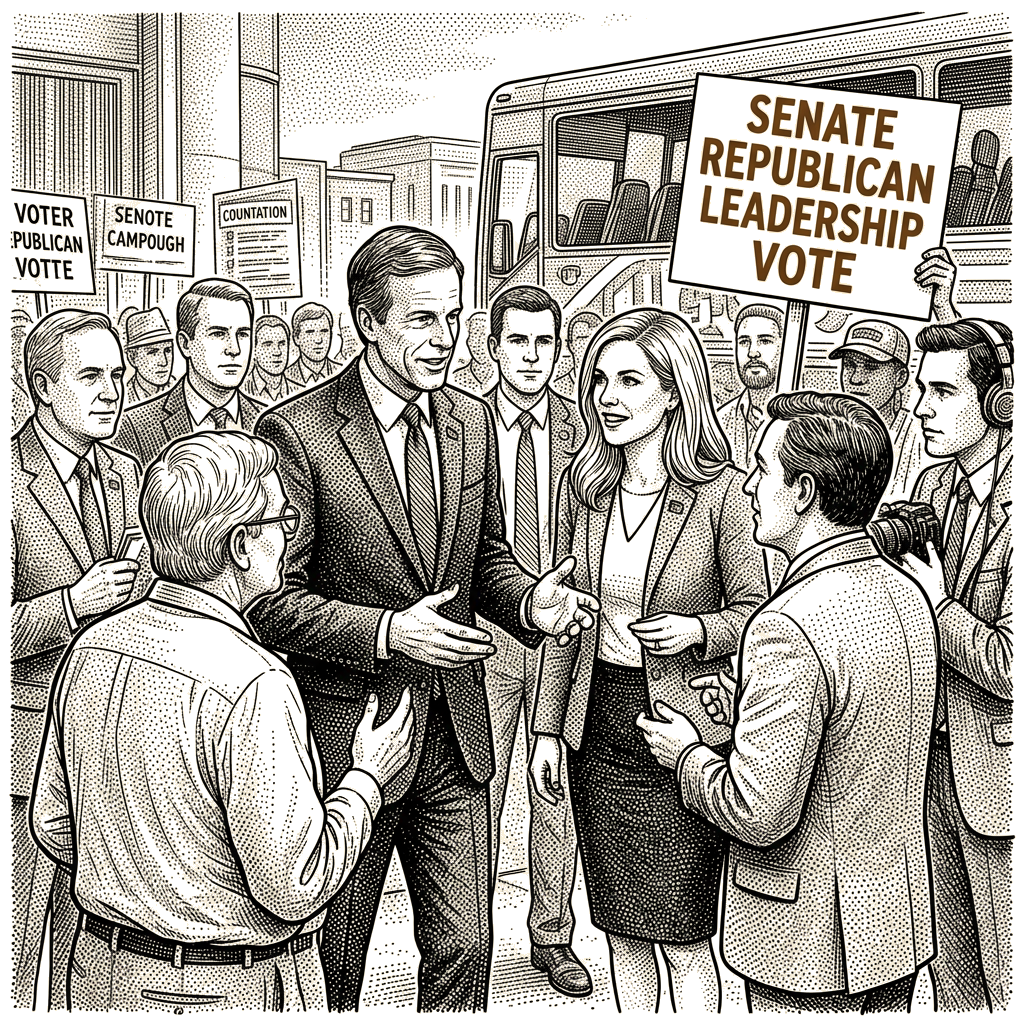
The Associated Press reports that Senate Majority Leader John Thune joined Republican Rep. Ashley Hinson in northwest Iowa on Friday as they campaigned for the Nov. 3 midterms, with Hinson challenging Democratic state legislator Josh Turek for retiring Sen. Joni Ernst’s seat. The visit combined Hinson’s need for national-party visibility with Thune’s need to defend the Republican majority that underpins his leadership role, but the account does not document an articulated, unified strategy linking the Iowa stop to Thune’s leadership campaign. Hinson’s result would contribute to Republican control and, if Hinson won, place another possible supporter in the Senate Republican conference’s post-election leadership decision. The causal claim remains conditional: the visit, public appearances and turnout appeal establish assistance, not proof that Thune changed Hinson’s margin or secured his own leadership. Voters at the events instead emphasized childcare, economic conditions and farm-input costs, while criticism of Thune’s support for the SAVE America Act and refusal to abandon the filibuster remained unresolved. After Nov. 3, Senate Republicans will decide by secret ballot whether to reelect Thune; the reported absence of a challenger makes continuity the stronger expectation, not a certainty.
The conditional exchange in northwest Iowa
The Associated Press account documents a full campaign itinerary rather than a coordinated strategy centered on the leadership contest. Thune and Hinson stopped for a Sioux City chamber of commerce luncheon, toured the Iowa Air National Guard’s refueling wing, attended a roundtable with local business owners and joined meet-and-greets at a packed high school football game. Hinson said she was grateful for Thune’s visit. During a joint interview on Hinson’s campaign bus, Thune said Hinson had to win for Republicans to retain the Senate majority. At the business roundtable, he asked attendees to help Hinson and emphasized turnout.
Those actions establish that Thune committed visibility and political capital to Hinson’s campaign. They do not establish that the appearance changed her position with voters. No polling, before-and-after measurement or other evidence in the account shows that association with Thune altered Hinson’s support. The proposed benefit would weaken if voters were responding primarily to Hinson’s record, local conditions or national economic developments. It would strengthen if the appearance helped organize undecided Republican voters or elevated issues the campaign had not previously emphasized.
The in-person stop itself supplied a stronger signal of support than a remote endorsement, but the Associated Press reporting provides no basis for translating that signal into a change in Hinson’s margin. The broader itinerary reinforces the point that Thune was willing to spend time with candidates in competitive states. The article reports that he campaigned with Republican Senate candidates in Nebraska, Georgia, North Carolina, South Carolina, Mississippi, Kentucky, Florida and Minnesota, and was headed to Ohio to assist Republican Sen. Jon Husted against former Democratic Sen. Sherrod Brown. Republican candidates in marquee Senate races had welcomed Thune’s help. That pattern demonstrates access to multiple campaigns and a willingness to commit political capital, not a demonstrated effect on any individual result.
The contest also combines two different time horizons. The election itself is a one-shot decision, while the Iowa Senate seat represents a six-year term. Hinson said Iowans were attentive to that longer period. Turek’s bipartisan positioning and Thune’s institutional experience could receive greater weight when voters evaluate governing capacity, while immediate anxiety over prices and farm costs could favor a different candidate. The Associated Press report does not establish how voters weighed those considerations.
Who benefits from the association
Hinson gained several potential advantages from the appearance. A nationally visible Republican leader supplied exposure, a turnout appeal and an association with national party leadership. Thune’s presence also signaled that Hinson had access to senior figures within the Republican conference. The benefit to Hinson remains undetermined because the account contains no measure of whether those advantages affected her electoral support.
Hinson also faced potential liabilities through her proximity to President Donald Trump and the Associated Press report that she voted with most Republicans against repeated Democratic attempts to stop the war in Iran. Voters who attribute broader dissatisfaction with the Republican party’s performance to Trump’s presidency or foreign policy could respond negatively to those associations. The reporting does not establish that voters made such an attribution.
Thune’s intervention could reinforce his own institutional position. Hinson’s election would help preserve the Republican majority, preserve his capacity to shape the chamber’s agenda and place another possible supporter in the conference if Hinson joined the Senate. The same intervention exposed Thune to the broader electoral map. Republican losses in states with close races could weaken the majority on which his leadership capacity depends, even if no senator formally challenged him.
Turek, a Democratic state legislator, presented himself to Iowans as a bipartisan voice in a contest the Associated Press places in a reliably Republican part of the state. That positioning could broaden his appeal among cost-focused and independent voters. The article supplies no polling showing a preference effect, and a campaign position is not a governing record.
Republican and Trump-aligned voters were central constituencies in the coalition described by the Associated Press account, although the reporting does not establish them as the definitive electoral core. Turek’s coalition would depend on voters prioritizing affordability, trade conditions and bipartisan conduct over party identity. Hinson’s coalition would depend on voters accepting national-party alignment while giving some weight to her local policy differentiation.
Hinson’s conduct supported a bounded distinction from unconditional alignment with Trump. The Associated Press reports that she appeared with Trump at a Sioux City rally, opposed increased beef imports and opposed a Russian agreement to import diesel fuel. Hinson also said she would support Trump when she believed he was right and challenge him when she believed he was wrong. That conduct distinguished her from a candidate offering only unconditional approval, but it did not establish a general separation from the president. Her reported votes on the Iran war and the fuel-price consequences associated with the conflict remained part of the available record.
The comparison with Turek was symmetrical. Turek also claimed a distinct approach through his bipartisan framing. The Associated Press account does not establish how either candidate’s claimed distinction would operate on the economic, trade or foreign-policy issues raised at the Iowa events.
Supporters of Turek staged a small protest outside one Hinson event. Valerie Conaway Cote, a Democrat from Sioux City, alleged that Hinson was doing Trump’s bidding and said Thune had become firmly aligned with Trump. Those were protest allegations, not established facts. The account separately established that Thune refused Trump’s demand to abandon the filibuster and that Hinson opposed certain Trump policies. Neither those differences nor the allegations establish which candidate voters trusted more.
Majority arithmetic and the filibuster dispute
The SAVE America Act required proof of citizenship for voters and voter identification nationwide. The Associated Press reports that Thune supported the bill but that the measure lacked a realistic path in the 100-member Senate while the filibuster remained intact because Republicans lacked the Democratic support needed for 60 votes. Thune’s support could not supply the votes the bill required.
Trump publicly pressed Thune to change the Senate’s rules and abandon the filibuster. Thune refused, citing the need to block Democratic legislation if Republicans lost power. Some participants in the Republican base blamed Thune for the bill’s failure. Trump’s public questioning of Thune’s leadership and the criticism from the Republican base created a visible conflict around his procedural position.
Thune’s refusal supplied an institutional rationale: the filibuster limited the ability of a future Senate majority to act unilaterally and therefore preserved leverage for Republicans if they lost control. The same position left the voter-legislation priority closest to his leadership challenge without the votes needed for passage. The procedure could consequently be understood either as a failure to deliver a priority or as a means of preserving future institutional leverage. The Associated Press account does not establish which judgment would predominate among Republican primary voters, nor does it establish whether those voters treated Thune’s support for the bill as evidence of broader policy agreement.
The issue salience at the Iowa events pointed in a different direction. Attendees did not ask Thune and Hinson about the SAVE America Act; they were focused mainly on childcare, the economy and farm-input costs. That suggests the legislation dispute was less salient for the observed audience, but the article does not establish the priorities of the full electorate.
Thune’s leadership position rests on two related foundations. Republican Senate control supplies the majority and institutional authority associated with his role, while his standing among Republican senators determines whether colleagues return him as leader. Wider Republican victories would support both foundations. Losses could weaken his position without requiring a declared challenger.
The Associated Press reports that Senate Republicans will meet in Washington a week after Nov. 3 and decide by secret ballot whether to reelect Thune. The account says no colleague had announced a challenge, describes Thune as well-liked among colleagues and reports strong support within the Republican conference. Republican Sen. Bernie Moreno of Ohio separately said he believed Thune had broad support. Those accounts support continuity as the strongest expectation from the reported facts, but the secret ballot prevents public endorsements from revealing the full distribution of conference opinion.
Moreno’s assessment of Thune’s support was informed testimony rather than proof of how senators would vote. Moreno also said Republican losses would be attributed principally to gas prices. That was one colleague’s assessment of voter attribution, not evidence establishing why Iowans or other voters would vote as they did.
A Nash-style interpretation of the leadership decision is possible only as an explicit set of assumptions because senators’ private objectives are not disclosed. If majority control, influence over the chamber’s agenda and institutional leverage after a partisan loss are modeled as senators’ objectives, continuity has a coordination advantage when no alternative candidate is available. A strict Nash conclusion would additionally require senators to expect that no available alternative could produce a better result. Dissatisfaction can generate a viable challenger, which would invalidate that condition.
Trump’s public questioning and criticism from the Republican base lowered confidence in broad support without producing an identified alternative. Moreno’s assessment and the reported absence of a declared challenger raised confidence in continuity without establishing it. The secret ballot leaves both conditions uncertain until senators vote.
The election-after-leadership sequence also strengthens Thune’s position relative to an earlier contest. Under a hypothetical pre-election arrangement, candidates could pair Thune’s campaign appearances and party unity with leadership votes. The weakness would be timing: candidates defeated in November could have extracted leadership commitments before their electoral influence was tested, while Thune would face the ballot before the value of his campaign leverage was known. The actual sequence delays the leadership decision until the election results are known and keeps the vote private. The Associated Press article does not establish that senators selected this sequence for strategic reasons.
Thune’s relationship with Trump continued despite their procedural disagreement. The Associated Press reports that Trump had said he liked Thune personally, and Thune’s office had released photographs of the majority leader and his grandchildren at the White House during a personal tour led by Trump. Those contacts demonstrate a continuing relationship, but the article provides no evidence that either the relationship or the procedural conflict produced a measurable electoral benefit.
Signals, uncertainty and legislative bargaining
The electoral contest operated under incomplete information. Hinson and Turek could not know how voters would balance affordability, party identity, Trump approval, the Iran war, Hinson’s stated willingness to disagree with Trump or other policy outcomes. Rally appearances, economic developments and selective policy disagreement therefore supplied partial signals rather than complete solutions to voter uncertainty.
Hinson and Turek competed directly for votes, and household and business conditions were more directly relevant to that competition than the Republican leadership contest. Thune’s assistance affected the electoral contest only if voters revised their assessments or increased turnout because of his presence. The Associated Press account establishes the assistance but not either voter response.
The campaign signals also carried different credibility structures. Thune’s refusal to abandon the filibuster was a costly signal of institutional commitment because it came with the legislative consequence of blocking the SAVE America Act. Hinson’s selective support for Trump was a relatively low-cost signal whose credibility would increase or decline with subsequent conduct. Thune’s predictions about the duration of the Iran conflict, an eventual solution and lower fuel prices depended on developments outside the candidates’ control. Moreno’s assessment of broad support could be tested only through the secret ballot.
The Associated Press reports that Hinson called for the Iran war to reach a successful and immediate end. Thune said the conflict was not going to be a long-term matter, predicted a solution soon and said fuel prices would eventually come down. Those statements were forecasts rather than guarantees.
The account also links the Iran conflict and Trump’s trade war to rising gasoline prices and pressure on Iowa farmers, while noting that voters also expressed frustration with high grocery prices. The reporting does not establish the relative causal weight of the war, trade policy, fuel prices and farm-input costs. The relationship among those developments is therefore documented as part of the political environment, but the source does not support assigning the voter frustration to any single factor.
Senate control was largely zero-sum, but legislative bargaining need not have been. Because the SAVE America Act required Democratic votes, a bipartisan coalition could have advanced an issue important to the Republican base while exposing Republican candidates to criticism from their own coalition. The Associated Press reported no such negotiations. Bipartisan cooperation remained an outside option rather than the reported equilibrium.
Consequences and available moves
If Republicans retained the Senate, Thune said the next legislative agenda could include guardrails for artificial intelligence, renewed attempts at housing and tax reform, permitting legislation and a broad bill regulating college sports. If Democrats won, Thune predicted two years of legislative paralysis while Trump remained in the White House. Those were prospective branches rather than settled outcomes.
Developments that could alter the strategic balance included a new leadership candidate, a sharp reversal in gasoline or farm-input costs, a development in the Iran conflict, Hinson’s election result or a broader shift in the Senate map. The article identifies several available strategic moves: Thune could emphasize institutional management rather than the blocked voter bill; Hinson could continue presenting her combination of Trump alignment and local policy differentiation; Turek could narrow his message around bipartisan economics; and Trump could intensify either party support or pressure on Thune.
Hinson’s potential election could reinforce Thune’s majority while also expanding the pool of Republican senators who might support his leadership. Whether either advantage affected voters would depend on whether Thune’s campaign visibility bridged the gap between the party concerns driving criticism of him and the childcare, affordability, farm-cost and foreign-policy concerns raised at the Iowa events.
The reported facts therefore identify leadership survival as a conversion problem rather than a direct contest with a named opponent. Thune would need to convert collegial support, campaign visibility and his procedural strategy into continued majority performance. The Associated Press account establishes the network of relationships and the resources committed to it, but it does not establish a causal effect on Hinson’s margin or a resolved distribution of senators’ leadership votes.
Evidence boundaries and contested interpretations
The source distinguishes documented conduct from contested interpretation. Campaign appearances, votes, policy statements, the filibuster position, the characterization of the Hinson-Turek race and the secret-ballot procedure appear as reported facts. Thune’s forecasts about the conflict and fuel prices, Moreno’s assessments of support and voter responsibility, and Conaway Cote’s allegation about Trump’s influence remain attributed to their speakers.
The account provides no polling or before-and-after evidence establishing that Thune’s appearance changed Hinson’s position, no evidence revealing how individual senators will vote in the secret ballot and no basis for determining the relative causal effects of the Iran war, trade policy, fuel prices and farm-input costs. The article also does not reveal senators’ private payoff ordering, so the leadership decision cannot be conclusively modeled as a Nash coordination game.
External verification remains unresolved for four article-supported particulars: the competitiveness of the Hinson-Turek race and its retrospective comparison with a previously expected tossup; the secret-ballot procedure and absence of a declared challenger; the SAVE America Act’s 60-vote threshold and filibuster constraints; and the individual Iran votes of Thune and Hinson. Those details remain attributable to the Associated Press account rather than independently corroborated within the available material.
Analytical techniques used in this piece
This analysis applies the methods below. Each links to a short, plain-English explainer you can read and reuse.
- Balanced Critique
- Weighs a proposal’s strengths and weaknesses evenhandedly.
- Relationship Mapping
- Extracts the network of ties among people, institutions, and entities.
- Strategic Interaction (Game Theory)
- Models a situation as a game — players, moves, payoffs, and likely equilibria.