Summary
- The federal criminal complaint alleges that Matthew Unglesbee deliberately relied on salt’s anthrax-like appearance to create perceived danger and prompt hazardous-materials responses.
- FBI investigators reported that preliminary testing found no biological or chemical toxin, while the published account supplied neither final laboratory findings nor the testing protocol.
- After staff at four congressional offices left the envelopes unopened, FBI weapons-of-mass-destruction personnel attended three offices and hazmat response teams attended two.
- The published account supplies no evidence of common authorship, coordination or dispatch between Unglesbee’s four mailings and the wider suspicious-mailing inquiry.
- The detention hearing’s occurrence and outcome remained unresolved in the published account.
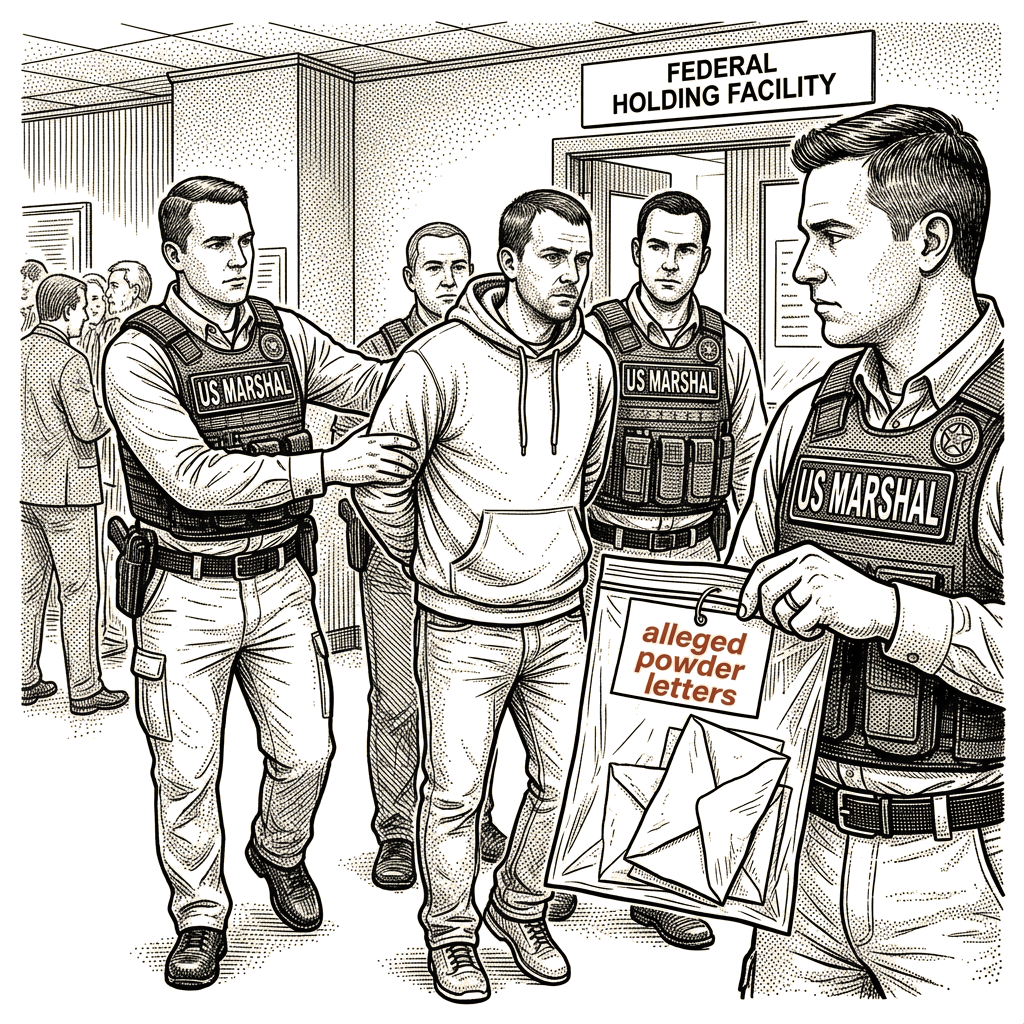
The Justice Department announced Matthew Unglesbee’s arrest Monday and unsealed an eight-page criminal complaint alleging that the 36-year-old mailed four envelopes containing white granules to members of Congress whose northern Illinois offices handled the mail. The complaint says Unglesbee identified the substance as salt, expected recipients to perceive it as anthrax and trigger hazardous-materials responses, and recognized that the recipients could not understand his conduct as a joke. Staff at all four offices left the envelopes unopened; FBI weapons-of-mass-destruction personnel attended three offices and hazmat response teams attended two. Preliminary testing found no biological or chemical toxin. Unglesbee remained in US Marshals’ custody Tuesday, his detention hearing was unresolved at publication, and the published account established no link between the four mailings and a wider inquiry.
The complaint separates material, perception and response
The federal charges against Unglesbee allege perpetrating a hoax and sending threatening communications through the mail. Those charges remained allegations before federal court when the article was published. The source does not provide the governing statutes, the complete evidentiary record or an adjudicated assessment of legal sufficiency.
The complaint’s account separates three propositions that have different evidentiary bases. The first concerns the material placed inside the envelopes. The second concerns what Unglesbee expected recipients to infer from its appearance. The third concerns how congressional offices and authorities responded without opening the envelopes.
According to the complaint, Unglesbee admitted sending four white, letter-sized envelopes to four unnamed members of Congress whose offices in northern Illinois handled the mail. Unglesbee wrote his name and Quincy home address on each envelope. Each letter reportedly contained a white granular substance and a handwritten message reading “ha ha.” A letter to an unnamed US senator also contained granules and read “Hah enjoy the gift.”
FBI task-force agent Charis Hobbs said in the unsealed complaint that Unglesbee told him the substance was salt because it “kind of looks like” anthrax. The complaint also attributed to Unglesbee an expectation that recipients would perceive the material as anthrax and cause hazardous-materials teams to respond. On the published record, sending and identity have the strongest support through the reported admission, return addresses and FBI recovery. The anticipated effect rests mainly on Unglesbee’s reported explanation, while the institutional response is described operationally in the article.
Preliminary testing did not reveal the presence of any biological or chemical toxin. The source does not independently confirm that the substance was salt, report final laboratory findings or provide the laboratory protocol. The preliminary result therefore establishes only the limited fact reported by investigators; it does not support a comprehensive safety determination or identify the material’s final composition.
Unglesbee reportedly claimed that he was joking while acknowledging that the recipients would not know he was joking. Those propositions can coexist, but the distinction bears directly on the alleged intent to create a threatening impression. The complaint states that Unglesbee anticipated congressional recipients would “take it serious” because the powder could be perceived as anthrax, which he said he knew would be dangerous and would cause hazmat teams to respond. Whether that expected response supports the charges, and whether the communications were intended to be perceived as threatening, remains for the court.
The complaint’s theory is that a communication can present an apparent threat through an intentionally alarming appearance even when preliminary testing detects no toxin. The article supplies the reported admissions, preliminary test result and operational response, but not a final laboratory finding, a defense response or a judicial finding on intent.
How uncertainty produced the institutional response
Staff members at all four congressional offices did not open the envelopes. After staff called authorities, FBI personnel trained in handling weapons of mass destruction and threats of biochemical toxins went to three offices, and hazmat response teams attended two. FBI agents then retrieved the communications bearing Unglesbee’s address.
That sequence establishes how the reported uncertainty generated a precautionary response. The non-opening of the envelopes, specialist deployments and hazmat attendance directly document institutional conduct after staff identified the mail. They do not independently establish Unglesbee’s purpose. Recipient testimony, office handling records and dispatch logs could test the proposed mechanism more directly by documenting what each office knew, when each office alerted the others and how the response unfolded.
The return address served as an operational link before physical seizure. Staff at the four offices could alert one another to mail bearing Unglesbee’s name without knowing what the envelopes contained. Internal office records could confirm the reported coordination. The same return address also gave investigators a basis for recovering the communications and searching Unglesbee’s home.
FBI Springfield field-office chief Ryan Presley said authorities were focused on “keeping our public institutions safe from intimidation.” He said: “Mailing unknown substances to congressional offices creates fear and disrupts the public institutions vital to our democracy. We, along with our partners, will remain vigilant in identifying and holding accountable those whose actions threaten to intimidate public officials or disrupt our democratic systems.”
Presley’s statement establishes an institutional rationale for the response, not an adjudicated finding about the charged conduct or the substance. For the four offices, the reported precaution produced a protective and emergency response even though preliminary testing did not reveal a biological or chemical toxin. The article does not quantify the resulting operational disruption or the effect on continuity of congressional work.
The evidence network and the wider inquiry
The four letters and their common return address form the hub of a cross-office network, with the congressional offices that handled them as spokes. Under Joseph Novak’s concept-mapping approach, the cross-link joins criminal-evidence categories with emergency-response behavior: the same four envelopes served as evidence in an alleged federal case and as triggers for a hazardous-materials response.
Investigators found another envelope at Unglesbee’s home. The envelope was empty, addressed to the Washington office of one of the same members of Congress and unsent. That finding documents an addressed communication that had not been mailed. It is relevant to whether preparation continued, but it does not establish an additional mailing.
Unglesbee told investigators that he mailed the four letters “after hearing someone in a restaurant mention the news story of other letters being sent.” His account supplies a possible sequence for his decision, but the link rests on his reported statement. A timeline showing that he could not have learned of the earlier reporting before mailing would weaken that account. Even a timeline supporting his account would explain the timing of his conduct without establishing common authorship or coordination with the other mailings.
Earlier in October, the FBI and US Postal Inspection Service said they were investigating multiple reports of suspicious letters sent to state officials and election offices across the country. The two sets of activity share a suspicious-mail subject, a period and a federal investigative connection, but the source establishes no common author, coordination or dispatch network. Evidence of coordinated composition, dispatch or funding could change the classification of the relationship. Unglesbee’s denial of participation and the absence of such evidence neither establish nor rule out a link.
The Postal Inspection Service’s inquiry may bear on how investigators characterize Unglesbee’s conduct as isolated or part of a wider pattern. The source does not establish a formal Postal Inspection Service role in classifying the four letters, however, and the wider inquiry therefore cannot be treated as proof of association.
The institutional sequence reported in the article proceeded from inter-office alerts to specialist and hazmat deployment, recovery of the communications, the search of Unglesbee’s home, US Marshals’ custody, federal prosecution and a scheduled federal-court proceeding. At publication, Unglesbee remained in US Marshals’ custody and his detention hearing was tentatively scheduled for the following Wednesday afternoon in federal court in Springfield.
The article does not establish whether the hearing occurred or how it ended. A later order releasing Unglesbee, narrowing his restrictions or extending detention would materially change the immediate balance among liberty, public protection and case preparation.
Stakeholders and the distribution of evidentiary weight
Under Mitchell, Agle, and Wood’s salience model—power, legitimacy and urgency—Unglesbee has limited institutional decision-making power, high legitimacy as the person directly charged and high immediacy because a detention hearing was scheduled. He is a dependent stakeholder whose reported admissions give him evidentiary leverage. His immediate legal interests include continued liberty and the characterization of the four mailings. The source contains no statement from Unglesbee or his counsel about detention, so the reasons for any challenge cannot be established.
The four members of Congress combine high power, legitimacy and urgency. Their staff have less formal power but high legitimacy and immediate urgency. Staff are dependent stakeholders and operationally important parties because they identified the mail, coordinated alerts, refrained from opening the envelopes and called authorities. Their operational concerns include staff safety, continuity of congressional work and procedures for handling suspicious mail. The source does not establish a uniform view among the unnamed recipients or staff.
The Justice Department, FBI Springfield, US Marshals and federal court hold high power, legitimacy and immediate or near-term urgency, making them definitive stakeholders during this phase. Their respective functions concern the investigation, announcement of action, custody and adjudication. Hazmat and weapons-of-mass-destruction personnel had high operational power and legitimacy and acute, time-dependent urgency. Their role was operational during the response rather than adjudicative.
The Postal Inspection Service has investigative authority and legitimacy, but its power and immediacy are less direct in this case. Its inquiry into other suspicious mailings may inform the characterization of Unglesbee’s conduct as isolated or pattern-based, subject to the evidentiary limits described above. State officials and election offices have high legitimacy, relatively low individual power and potentially high urgency when suspicious mail arrives, yet they appear only through an FBI summary.
The public has diffuse interests, low decision-making power and lower immediate urgency. Institutional disruption and emergency responses nevertheless create broader interests that are difficult to aggregate. If additional mailings are identified, additional recipients, office staff, responders and state or election institutions would become material stakeholders.
Applying the same evidentiary standard across the parties, Unglesbee’s statements are direct on some matters but reach the public through investigators. Agency accounts establish the operational sequence and institutional rationale but do not substitute for element-by-element proof. The congressional offices’ precaution explains the response without identifying the author of other mailings. No defense-side account appears in the source, and the offices’ conduct is known through investigators rather than through their own statements. Those absences limit comparison without resolving any disputed question in either direction.
The inquiry’s five unresolved questions
Under Douglas Walton’s pragmatic-dialectical theory, the governing dialogue type is inquiry: investigators seek facts capable of supporting or defeating the charges. Public persuasion and institutional deliberation are layered on top, but the source describes no negotiation or eristic exchange. Formal logical invalidity is not the principal concern in the published account, which contains no apparent formal contradiction. Unglesbee’s reported claim that he was joking can coexist with his acknowledgment that recipients would not know.
The more consequential risks are informal presumption and structural scope changes. Treating suspicion as proof of toxin would substitute a presumption for evidence. Treating expected anthrax perception as evidence of anthrax would change the scope of the claim. Treating common topicality as proof of association would introduce an unstated premise. Pragmatic-dialectical inquiry asks whether participants address relevant challenges and acknowledge the limits of their evidence.
Under Jaakko Hintikka’s question-dialogue approach, the inquiry can be organized around five questions: What was sent? Who sent it? What did the sender say he expected recipients to infer? What response followed? Is there evidence linking Unglesbee to the wider suspicious-mailing cluster?
The first four questions receive partial answers in the complaint. The fifth receives no affirmative answer because Unglesbee denied participation and no independent link was supplied. An unanswered question cannot support an affirmative inference.
The source supports three separate propositions: an alleged creation of apparent threat, preliminary evidence of no toxin and an unadjudicated criminal case. It does not support either a comprehensive safety determination or an adjudicated conclusion about intent.
The records needed to resolve the remaining questions
The full criminal complaint and laboratory documentation would be needed to resolve the material’s final composition and safety status. Federal-court docket records and any detention order would establish whether the hearing occurred and what it produced. Dispatch logs, agency releases and congressional-office handling records would independently document the response beyond the article’s account.
A defense response, the complete evidentiary record, first-person accounts from the four congressional offices and agency dispatch records could materially affect the assessment of intent, the response sequence and legal sufficiency. Final laboratory findings could refine the distinction between Unglesbee’s reported identification of the material as salt and the preliminary test result.
Evidence of common authorship, coordination, dispatch or funding could connect the four letters to the wider inquiry. Until such evidence or a final laboratory record appears, the published account documents the alleged sending, the precautionary response and preliminary evidence of no toxin, while final composition, legal intent, wider coordination and detention status remain unresolved.
Analytical techniques used in this piece
This analysis applies the methods below. Each links to a short, plain-English explainer you can read and reuse.
- Coherence Audit
- Tests whether an argument hangs together — spotting contradictions, gaps, and circular reasoning.
- Relationship Mapping
- Extracts the network of ties among people, institutions, and entities.
- Stakeholder Mapping
- Charts the parties to a situation — their interests, power, and alignments.
- Principal–Agent Problem
- An agent acting for a principal has its own interests, which can quietly diverge.