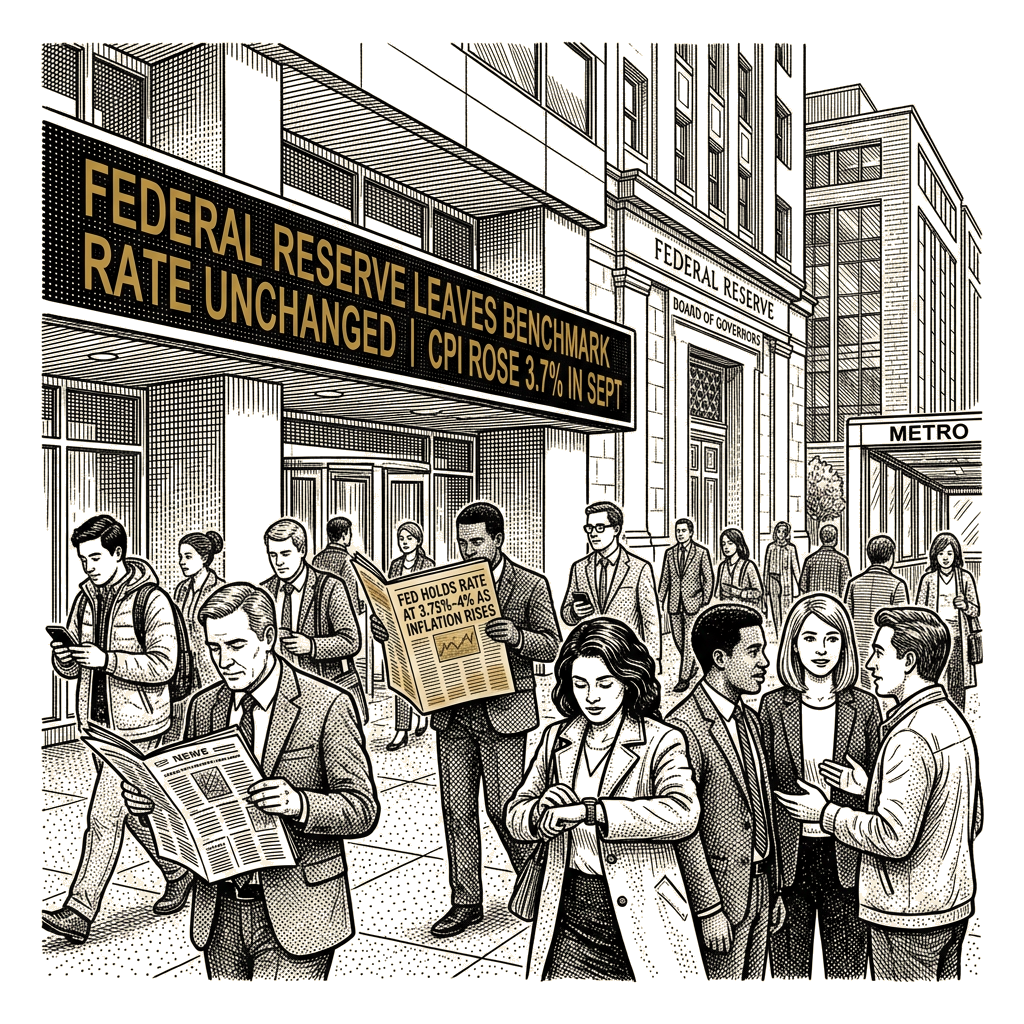
Wednesday’s report attributes the Federal Reserve’s decision to hold its benchmark rate at 3.75 to 4 percent to caution, and it connects that caution to the calendar. The decision “came less than a week before votes are to be tallied in the midterm election,” and the timing “may have contributed to the Fed’s caution.” The evidentiary support for that connection is a single statement about appearances. Dan North, a senior economist at Allianz Trade, is quoted saying, “It would be suspicious if there were a hike before the midterm.” The remark describes how a rate increase would have been received; it does not document that electoral considerations entered the committee’s deliberation. The report contains no record of communication to policymakers, no account of committee discussion, and no statement by any member linking the vote to the election. The committee’s own public words — “Inflation remains elevated” — and its renewed “pledge to deliver price stability” are reported, but the report’s causal emphasis falls on the perception claim.
The same evidence supports a reading the report does not weigh. Lisa Cook, a Federal Reserve governor, and Beth Hammack of the Cleveland Federal Reserve Bank voted for a quarter-point increase. The dissent establishes that a hike was a live option and that the majority’s hold was a choice made against a documented alternative. That evidentiary base, however, is confined to the October meeting: two dissents show a hike was under consideration, but they do not by themselves establish a majority path for December, and the report quotes no policymaker on the December plan. The report records the votes and moves to the election context without examining what the split implies for the December increase it describes as “widely expected.” The committee’s own description of conditions — “Inflation remains elevated,” with September prices rising 3.7 percent from a year earlier, a “bigger annual increase than in the previous month” — is consistent with the dissenting votes, a tension the report leaves unexplored.
The report’s numbers also contain an arithmetic it does not perform. The benchmark range is 3.75 to 4 percent; consumer prices rose 3.7 percent over the year. Using the report’s year-over-year consumer-price figure against the stated 3.75 to 4 percent range, the policy rate stands between roughly zero and 0.3 percentage points above the inflation rate, depending on the effective rate within the range. Under that crude inflation-adjusted proxy, the stance is near neutral. The report describes the expected December increase as “an effort intended to tamp down demand and bring prices under control.” If restraint is the objective, the operative measure is the inflation-adjusted rate; by the same calculation, a quarter-point December move would leave the real rate at roughly 0.3 to 0.55 percent. The report performs the equivalent calculation only for wages — 3 percent growth against 3.7 percent prices — and quotes Mark Zandi of Moody’s Analytics, who said, “Their purchasing power is actually declining.” The same calculation applied to the policy rate would show that the demand-tamping stance the report describes is milder than its nominal framing suggests.
The harder problem is mechanism. The report attributes the difficulty of the Fed’s price-stability goal to “a spike in energy prices tied to the U.S. war with Iran” — its most consequential causal claim, asserted without attribution. A war-driven energy shock is a supply-side price increase; demand restraint is only a partial response to it, and the report does not reconcile the cause it names with the remedy it assigns to December. The same tension runs through its treatment of artificial-intelligence investment, which it presents as evidence that parts of the economy are “less sensitive to higher interest rates.” North is quoted saying, “The A.I. companies don’t care what interest rate they have to pay.” The boom, the report notes, is simultaneously “pushing up prices for construction materials and electronic equipment.” The sector where demand is reported to be hottest is the sector where the Fed’s tool is reported to bite least — and that sector’s construction is itself part of the price increase the Fed is trying to contain.
Applied symmetrically, the timing logic runs both ways. If proximity to an election argues against a hike, the December meeting — which falls after the votes are tallied — is under that same logic the least politically exposed moment for a move. The report does not apply the inference in that direction, nor does it offer a reason why timing would cut one way and not the other.
None of this makes the decision itself misreported. The hold is a fact; the dissents are facts; the “Inflation remains elevated” statement is a fact; the 7.4 percent three-year high in mortgage rates and the four-year housing slump are reported facts. What the report does not establish is the causal connection its structure draws between the calendar and the vote. Its evidence for that connection is one source’s statement about suspicion. Its evidence against it — the committee’s stated rationale, the dissent structure, the real rate at roughly zero to 0.3 points above inflation, and the supply-side price pressures the report itself documents — appears in the same article.
Analytical techniques used in this piece
This analysis applies the methods below. Each links to a short, plain-English explainer you can read and reuse.
- Red-Team Advocate
- Argues the adversary’s case in full to expose what a plan underrates.