Summary
- The New York Times’ reporting documents Peltola campaign and Democratic Senatorial Campaign Committee staffer discussions of recruiting a second Dan Sullivan, but no reported communication links that discussion to Dan J. Sullivan’s decision to run.
- Dan J. Sullivan’s June denial — “Zero, none, zilch” — and the DSCC’s denial of involvement remain unrefuted by anything quoted in the article.
- The DSCC’s statement and the Times’s account of staffer texts are strictly reconcilable only if staffers acted outside institutional roles; the article preserves the two claims without reconciling them.
- The wire’s headline asserts the Peltola campaign’s discussion of recruiting as settled, while its body text marks the recruitment itself as appearance, describing “Democrats appearing to recruit Dan J. Sullivan.”
- Legal experts said the report “will have no impact on a lawsuit filed recently by the U.S. Department of Justice,” which President Donald Trump directed be filed to seek a halt to certification of a possible Peltola win.
The New York Times reported Wednesday that members of Mary Peltola’s campaign for Alaska’s U.S. Senate seat discussed recruiting another candidate named Dan Sullivan and “eventually landed on” retired schoolteacher Dan J. Sullivan of Petersburg, in a race that “could determine which party controls the chamber.” The account, based partly on interviews with Elisa Rios, the former campaign manager fired in August amid a campaign shake-up, approaches smoking-gun strength on one element — that campaign-side discussion of a same-name candidate occurred, with DSCC staffers on the text threads — but does not report a communication between the campaign and Dan J. Sullivan himself. On the published record, the central link of the coordination claim, that his candidacy was arranged, remains unestablished; his denial of contact and the DSCC’s denial of involvement are neither confirmed nor refuted by anything quoted in the article. The episode lands in a Senate race in which, as of Monday, 46,204 ballots had already been cast in Alaska, according to AP data, ahead of the Nov. 3 general election.
What the report says
The New York Times reported Wednesday that the Democratic campaign for Alaska’s U.S. Senate seat was involved in efforts to place on the ballot a candidate with the same name as Republican incumbent Dan Sullivan, “in a bid to confuse voters” in a race that “could determine which party controls the chamber.” The AP wire summarizes the Times’s description of the effort — the wire’s phrase is “in a bid to confuse voters”; the Times’s own wording is not reproduced in the portion of the wire quoted here. The newspaper said it obtained text messages between members of Mary Peltola’s campaign “discussing the recruitment of other people with the same name,” and the group “eventually landed on” a retired schoolteacher in the small fishing community of Petersburg named Dan J. Sullivan. The Times report said DSCC staffers were on texts with the Peltola campaign discussing the second Sullivan.
The account draws partly on interviews with Elisa Rios, the former campaign manager fired in August amid a campaign shake-up; the newspaper said she tried to retract her comments last week. The Peltola campaign did not respond to the AP’s request for comment.
Dan J. Sullivan made it through the state’s August open primary and is one of four candidates on the ranked-vote ballot for the Nov. 3 general election. Sen. Sullivan is marked on the ballot as the Republican incumbent; the other Sullivan is listed as Daniel J. Sullivan Jr., with no party affiliation. As of Monday, 46,204 ballots had already been cast in Alaska, according to AP data.
Dan J. Sullivan has long denied he was running at Democrats’ behest and has said he had no contact with Peltola’s campaign. “Zero, none, zilch,” he said in June after announcing his run. Democrats, including the DSCC, have repeatedly denied any such involvement. “The DSCC is not involved with Dan J. Sullivan,” the organization said in a statement Wednesday.
Testing the coordination claim
Three hypotheses can be tested against the published record. H1: the Peltola campaign, with DSCC participation, arranged Dan J. Sullivan’s candidacy to confuse voters. H2: he ran independently with no contact from the campaign, as he said in June. H3: campaign and DSCC personnel discussed recruiting a same-name candidate, and the effort reached the retired schoolteacher, without the record establishing that the contact produced his decision to run. A fourth variant worth holding separately is unsanctioned action by lower-level operatives acting without senior authorization, which would leave the campaign and the DSCC able to deny institutional involvement.
The reported text messages are the load-bearing evidence. They approach smoking-gun strength for the discussion element of H3 and constitute at minimum a strong hoop for any claim that no such effort existed. They are materially weaker against H1’s full claim: the account as reported describes campaign-side discussion and an effort that “eventually landed on” Dan J. Sullivan, but it does not report a communication between the campaign and Dan J. Sullivan himself. H1’s central link — that his candidacy was arranged — remains unestablished on this record, and H2’s specific assertion of zero contact is neither confirmed nor refuted by anything quoted in the article. Provisionally, on the published record alone, the self-initiation and unsanctioned lower-level accounts are the only hypotheses consistent with both the candidate’s denial and the DSCC’s statement; that ranking is an assessment of what is public, not a finding about what the texts contain. The elections official’s purpose finding is a legal conclusion about the filing, not a demonstration of who communicated with the candidate.
The DSCC’s statement sits against the Times’s account that its staffers were on the texts. Read narrowly — no involvement with that individual — the two claims are not strictly incompatible (a committee can deny institutional involvement while staffers act in personal capacity); read broadly — no involvement of any kind — the reported texts would weigh heavily against it. The article preserves both without reconciling them.
Two further pieces are straws in the wind rather than decisive tests. The Rios sourcing shows the limits of the account: the reported retraction attempt is consistent with either correction or coercion, and shifts confidence little in either direction. Dan J. Sullivan’s June denial is a self-report of a negative fact corroborated by nothing in the article. The candidate’s denial dates to June, the campaign shake-up to August, the report to Wednesday — and, as of Monday, 46,204 ballots had already been cast in Alaska, according to AP data, ahead of the Nov. 3 general election, so a portion of the vote was cast before the reporting surfaced.
The most diagnostic evidence not yet in the public inventory would be a contemporaneous communication, timestamped before Dan J. Sullivan’s filing, in which a Peltola campaign or DSCC participant asked or instructed him to run. Such a message would be decisive in a narrow sense: a pure self-initiation account treats it as incompatible, while a coordination account predicts it. Its absence would not clear the coordination hypothesis, because recruitment can occur orally or through intermediaries; the supporting record would have to come from the Times’s underlying texts, from Sullivan’s own communications, or from campaign records.
Who benefits
Beneficiary logic cuts in both directions: Peltola would benefit if a similarly named candidate pulled votes from the incumbent, while Sullivan would benefit politically from publicizing the episode. The reported presence of national committee staff in the texts is the element most explicable in light of the chamber-control stakes both campaigns are contesting. The symmetry means the existence of an interest cannot substitute for evidence of causation. The same framing logic applies to both campaigns’ public statements: the Sullivan campaign’s language of a plan to “deliberately confuse and deceive voters” assigns blame; the Peltola campaign and its allies’ denials minimize connection.
How this is being framed
The dominant frame treats the episode as an arranged scheme. Its clearest statement comes from Sen. Sullivan’s campaign. “Alaskans deserve the truth,” said Nate Adams, a spokesperson for Sen. Sullivan’s campaign. “Mary Peltola, her campaign and her senior advisers colluded with the DSCC, national Democrat lawyers and Alaska Democrat operatives to recruit candidates to deliberately confuse and deceive voters.” The frame performs four functions: the problem is defined as candidate recruitment engineered to mislead voters; the cause is attributed to the Peltola campaign with the Democratic Senatorial Campaign Committee and state party operatives as participants; the moral evaluation is encoded in the verb “colluded” and the phrase “deliberately confuse and deceive”; and the recommended treatment is disclosure — “the truth” — with a related remedy urged by Notre Dame law professor Derek Muller: “It’s a dirty campaign trick, and it’s good reason the Alaska Supreme Court should have permitted the candidate to have been removed from the ballot.”
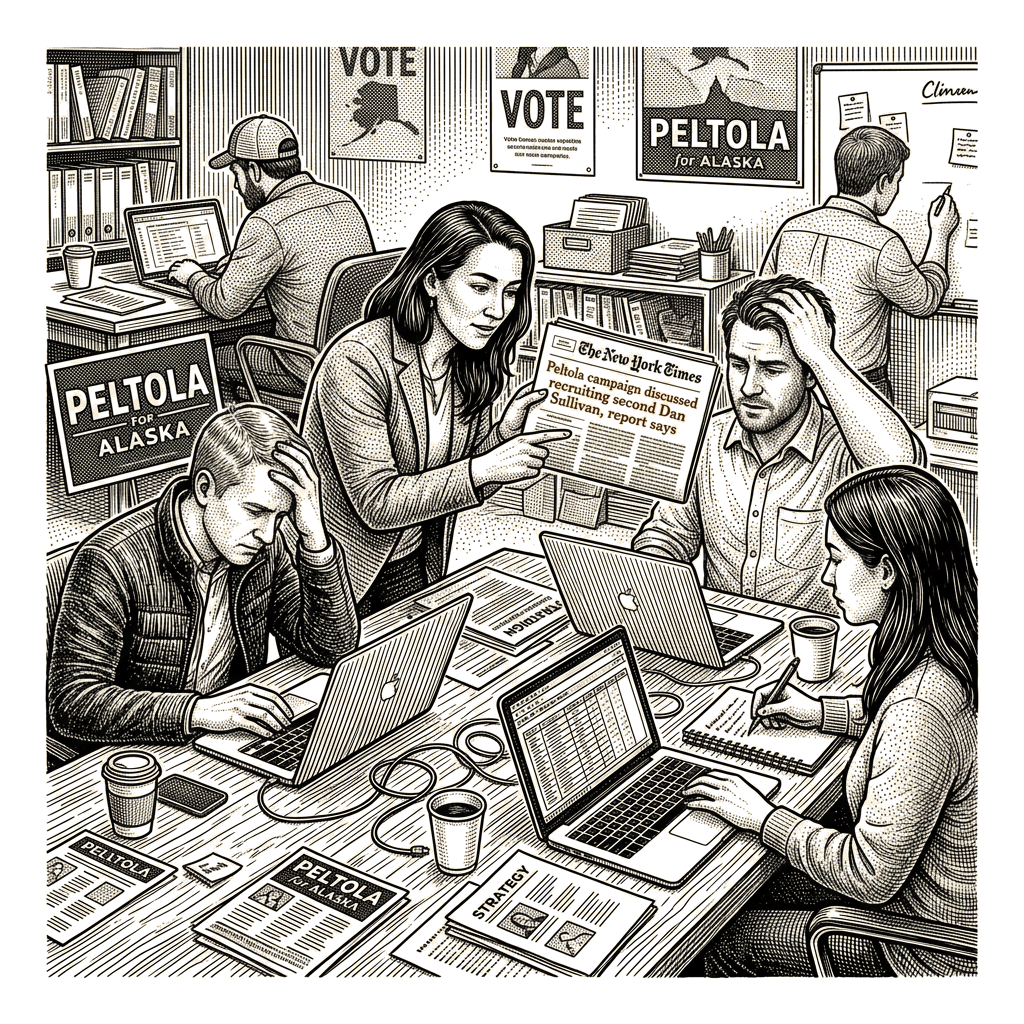
The wire headline, “Peltola campaign discussed recruiting second Dan Sullivan, report says,” places the Peltola campaign as grammatical subject of “discussed,” a verb reporting deliberation rather than an accomplished recruitment. The construction presupposes the recruiting conversation as having occurred — it asserts the discussion as settled and the campaign as its agent — while the trailing “report says” delegates the claim to the New York Times rather than to the wire; it does not assert that a second candidate was in fact recruited. The headline and the wire’s body text are differently hedged: the headline asserts the discussion, while the body marks the recruitment itself as appearance, describing “Democrats appearing to recruit Dan J. Sullivan.” The verb “colluded” encodes a coordinated act as complete and agent-bearing without specifying its scope.
A second frame sits in the state’s administrative record. The top state elections official ruled the candidacy was “filed with a purpose to confuse or mislead and to thereby compromise the ballot’s fairness or neutrality,” locating the harm in ballot administration rather than in party conduct. The Alaska Supreme Court did not sustain the disqualification when it ruled Dan J. Sullivan qualified, the U.S. Constitution setting out only age, citizenship and residency requirements; the article does not report the court’s reasoning.
A third frame is ballot formalism joined to voter agency: four candidates qualified through the state’s August open primary; the incumbent is marked as the Republican incumbent and the other Sullivan as Daniel J. Sullivan Jr., no party affiliation; and, in Muller’s words, “But now it’s in the hands of the voters, not litigation.” The article’s precedent reporting supports this frame’s generality — in 2024 a divided state Supreme Court allowed a man serving a federal sentence in New York to remain on the House ballot after the state Democratic Party sued to remove him, and the current challenges to ballot entries, from the elections official and from Sen. Sullivan’s campaign, likewise did not remove the candidates. What the coordination frame selects in is the text messages and the gap between denials and the report; what it selects out is that same-name and no-tie ballot entries have survived legal challenge in Alaska before this race.
Named framing scholarship supplies vocabulary for these mechanisms without resolving the factual dispute. Robert Entman’s definition of framing emphasizes selection and salience: the story’s forward placement selects the coordination allegation as the organizing fact, and the wire’s “in a bid to confuse voters” carries the intent claim inside the summary of the Times report rather than as a demonstrated fact. George Lakoff has written about how repeated labels activate associative frames; the repeated “Dan Sullivan” naming makes sameness the salient property, even though the ballot distinguishes the two candidates by suffix and party. Norman Fairclough’s critical discourse analysis attends to grammatical agency: the campaign is the subject of active verbs such as “discussed recruiting” and “landed on,” while the elections official’s finding is cast as “filed with a purpose.” Shanto Iyengar’s distinction between episodic and thematic framing applies: this story is episodic — one tactic, one race, with the 2024 prisoner-candidate case offered as a comparable episode rather than part of a broader account of ballot-access standards. Erving Goffman’s frame-analysis tradition treats primary frameworks; here the episode is keyed as a campaign tactic, which makes the candidate’s own account and the court’s ruling secondary. Jason Stanley has analyzed how not-at-issue content can carry propagandistic claims; in the wire’s framing, the confusion rationale is treated as settled at the level of the Times report, while the contested question is who, if anyone, was involved.
What happens next
Legal experts said the report “will have no impact on a lawsuit filed recently by the U.S. Department of Justice,” which President Donald Trump directed be filed to seek a halt to certification of a possible Peltola win, citing the presence of the second Dan Sullivan on the ballot. The Alaska Supreme Court’s qualification ruling and that assessment are exogenous to the coordination question: they concern remedy, not causation. The candidate remained on the ballot by court ruling; the remaining question is evidentiary, and it concerns how far the coordination discussion reached into Dan J. Sullivan’s decision to run — with the residual judgment, as Muller put it, resting “in the hands of the voters.”
Analytical techniques used in this piece
This analysis applies the methods below. Each links to a short, plain-English explainer you can read and reuse.
- Frame Audit
- Surfaces the frame an argument adopts and what that framing quietly includes or excludes.
- Process Tracing
- Reconstructs the step-by-step causal pathway of a specific historical event.