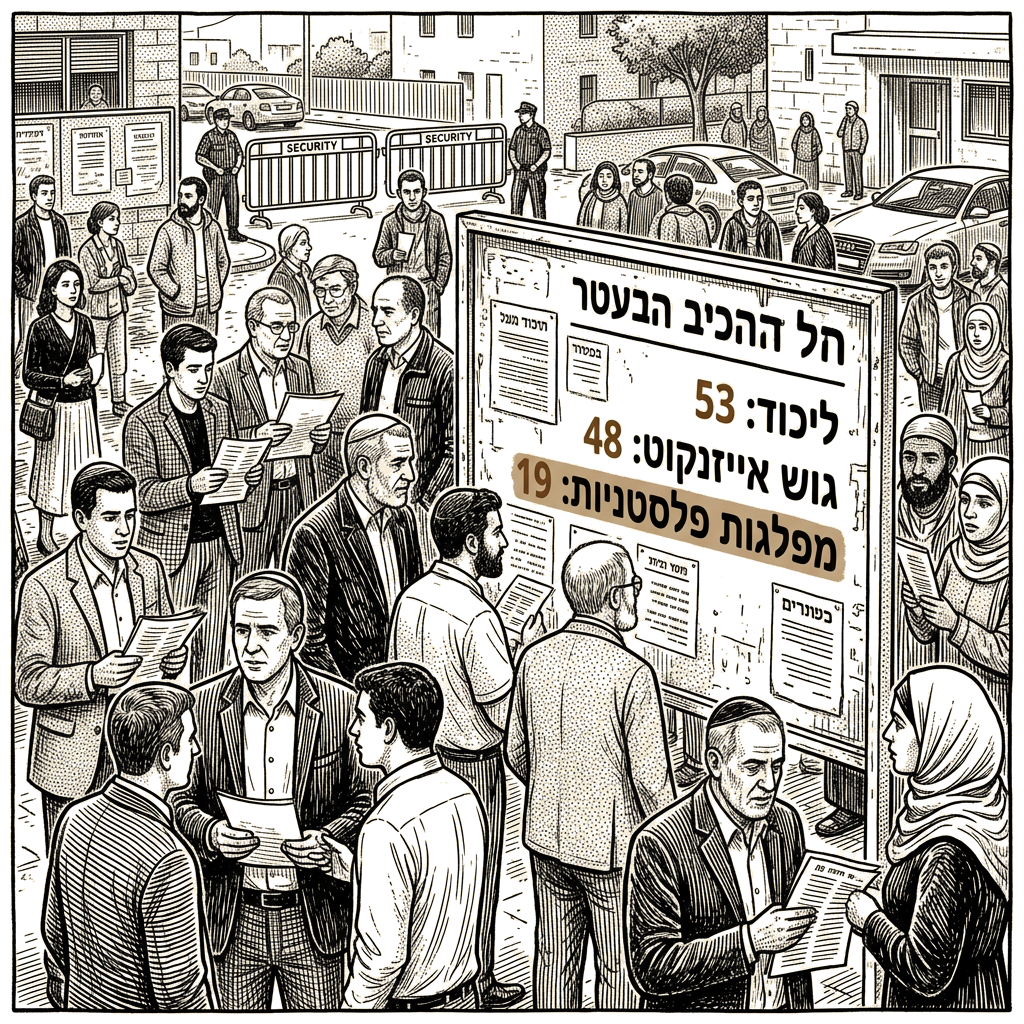
Israel’s final election results produce a governing arithmetic in which Benjamin Netanyahu’s right-wing bloc holds 53 seats, the opposition bloc led by Gadi Eisenkot holds 48, and Palestinian-led parties hold a record 19, against the 61 seats required for a Knesset majority — a threshold neither bloc’s reported seat total reaches. Forty-eight plus 19 reaches 67, which is why the Guardian’s reporting describes “a clear majority” as available to the Jewish Israeli opposition “only if it is prepared to make a governing pact with Palestinian Israeli parties.” The central analytical question is whether the parties’ positions can be descended to the interests beneath them, and whether a confidence-and-supply arrangement — the structure the arithmetic makes available, and the one Joint List leader Yousef Jabareen has said he is open to — can satisfy those interests without requiring the opposition to abandon the security-policy commitments that presently bar Joint List membership.
Positions and the interests beneath them
The opposition’s position descends to two interests, one confirmed and one inferred. The confirmed interest is displacement of Netanyahu: the opposition pledged a state commission of inquiry into the events of 7 October, and Eisenkot warned that Likud and Netanyahu “have embarked on a coordinated, organised campaign seeking to delegitimise the results of the election.” The inferred interest behind Eisenkot’s partner conditions is preservation of the bloc’s security-policy posture and governing identity. The inference rests on the stated mechanism on the other side: Jabareen has said the Joint List “could not join an Eisenkot-led government because of its support for Israel’s military operation in Gaza and southern Lebanon.” The article reports that Eisenkot “has not ruled out cooperating with Palestinians because of their race,” while laying out “conditions for any partner which are politically impossible for them to accept” — an effective bar. Which interest the conditions encode is falsifiable by the alternative structure: acceptance of Joint List confidence votes would disconfirm the identity-reading and confirm the policy-reading, since Joint List would supply parliamentary support without membership.
Netanyahu’s position descends to an interest in retaining power. The Guardian reported that he is pushing for a right-wing governing coalition and “would probably welcome new elections or a lengthy period of uncertainty during which he would stay on as caretaker prime minister.” The claim that Palestinian-led parties have “stolen the election” is reported as made “without providing evidence,” against the determinations of Israeli police and the central elections committee, which “have said there is no evidence of election fraud.” The reported purpose-direction of the campaign is electoral mobilization: claims about high turnout in Palestinian areas were made “in a bid to get his own voters out,” alongside a robocall “purporting to come from the prime minister” that the article reports as falsely claiming Palestinian party leaders had been caught with envelopes full of cash. One inference the article does not supply: that a state commission of inquiry poses a political risk to Netanyahu personally. The reported conduct is consistent with that interest — the article notes he was in charge on 7 October 2023, when Hamas attacks resulted in the deaths of about 1,200 people, the majority of them civilians, and reports that he “tried to shift blame on to the security services” — but the motive is inference, not sourcing.
Joint List’s position is the least ambiguous: no membership in an Eisenkot-led government because of the bloc’s support for the military operations, and confidence votes left open. The confirmed interests are opposition to those operations and, per the correspondent’s account of the electorate, the protection of Palestinian citizens from the pressures Graham-Harrison describes — voters this year were “watching ethnic cleansing in the West Bank, a genocidal war in Gaza, and are under huge pressure inside Israel from an openly racist government, which has allowed organised crime to soar, ramped up home demolitions, and targeted political speech.” Her account is explanatory of turnout rather than a statement of Joint List’s platform, but it tracks the party’s stated constraint: the electorate turned out to change the government’s course, and confidence-and-supply is the instrument that changes it without the party ratifying the operations its leadership opposes — influence without membership.
Ra’am’s position differs from Joint List’s on the membership question. Mansour Abbas “has signaled willingness to work with Jewish Israeli opposition parties,” and the party’s conduct is consistent: it joined Naftali Bennett’s government in 2021, the first time a Palestinian party entered an Israeli coalition, and its slate places a Jewish former chief of police as number two — “a signal of its commitment to working with Jewish Israelis and its desire to tackle organised crime,” which the article identifies as “a major issue for the Palestinian population.” Ra’am’s constraint is not membership; its interest is policy delivery, and the Bennett precedent carries the limit of that route: the pact “collapsed after 18 months, partly because of disagreements over the occupied West Bank.”
Herzog occupies the procedural position: he has urged politicians to keep an “open mind” before talks, and is expected to invite the party most likely to be able to form a government. His rebuke of the prime minister — “we must avoid tarnishing an entire community” — states the legitimacy condition of the process, as do the police and committee findings. Yair Golan, leader of the centre-left Democrats, told Israeli media on Thursday that he was meeting Eisenkot and others for initial talks, a sign that the bloc’s internal track is already moving.
The negotiation structure
Under the interest-based negotiation framework associated with Fisher and Ury, four elements are load-bearing. First, the people-problem is running on a track separate from the coalition arithmetic, and the reported conduct on that track is the delegitimization campaign. The claim that Palestinian-led parties have “stolen the election,” Smotrich’s call for “the arrest of Arab Israeli leaders,” and the robocall are not negotiating moves; they contest the standing of one set of participants. Smotrich, the article reports, “was swiftly accused of using smear tactics to cling to power.” Graham-Harrison characterized the tactic as “attempting to paint Palestinians as untrustworthy citizens with dual loyalties, a racist trope that also appears in antisemitic attacks.” The institutional responses — the police and committee statements, Herzog’s rebuke, the Qatari foreign ministry’s rejection of “ridiculous and dangerous” accusations of interference — are corrections to the relational track. Fisher and Ury’s Getting to Yes, the source of the framework used here, advises that a counterparty playing positional or manipulative games cannot be engaged on the merits alone and that other tools must supplement the negotiation; applied to the reported conduct, that caveat covers whoever negotiates with the campaign’s authors.
Second, the interest pattern supports differentiated options rather than a single coalition form. The framework’s integrative move — an option that serves more interests on more sides — is latent in the positions themselves: the separation of confidence support from cabinet membership. Jabareen “has left open the possibility of bolstering a minority government through confidence votes,” a structure that would give an Eisenkot government a 67-seat working majority through confidence votes from the 19-seat Palestinian-led bloc — the parties the report identifies as Joint List and Ra’am — without requiring the parties to join the cabinet or to ratify the military operations that Joint List’s leadership has said bar membership. Ra’am, with a different constraint profile, could take the fuller route — formal membership on the 2021 model — while Joint List supplies external support. Issue-based agreements are the natural currency of a Ra’am track: legislation and policing on organized crime, and the demolition and speech policies Graham-Harrison’s account identifies, are the deliverables that make participation legible to Ra’am’s constituents. A state commission of inquiry into 7 October would align the opposition’s pledged platform with an accountability interest Palestinian parties plausibly share; that alignment is inference, since the article does not report Palestinian parties demanding it. The genuinely opposed interests are fewer than the positions suggest: Netanyahu’s retention is zero-sum against the opposition’s displacement, and the ratification question is distributive only at the level of membership — which is why the confidence structure does not require resolving it.
Third, objective criteria for evaluating any proposal exist, and they are mostly institutional. The election arithmetic itself — the 61-seat threshold under the final results — is the governing standard; no party disputes the count, only its legitimacy. The police and central elections committee determinations are third-party standards against the fraud claims. Precedent supplies two reference points: the Rabin minority government of three decades ago, which Graham-Harrison described as “a rarely referenced precedent” for relying on Palestinian support, and the 2021 Bennett coalition, the only prior instance of Palestinian coalition membership. A survey taken as polls closed showed a “clear majority of opposition voters supported forming a government with Ra’am in order to unseat Netanyahu” — a democratic-legitimacy measure of what the opposition’s own electorate would accept.
Fourth, the BATNA asymmetry shapes where the reservation points sit. The opposition’s alternative to a governing pact is not a better coalition; it is Netanyahu remaining in office, which the Guardian reported he would probably welcome. A weak BATNA implies a low reservation point: accept the confidence-and-supply structure if it can be built without surrendering the policy red lines. Netanyahu’s BATNA is comparatively strong — caretaker status and new elections preserve his position — which makes obstruction rational on his side rather than erratic. Joint List’s BATNA is return to opposition, but the baseline has shifted: the article reports that many Palestinian citizens had boycotted prior elections “on the grounds that participating endorses a discriminatory system or because they felt their representatives had little leverage,” and that this year’s turnout was historic. The electorate’s demonstrated turn toward participation raises the cost to Joint List of an empty-handed return, while its stated constraint — no ratification of the operations — sets the party’s floor. The walk-away test on the opposition side is therefore precise: if a confidence-and-supply arrangement cannot be assembled without conceding the security-policy positions encoded in Eisenkot’s conditions, the bloc walks to the weak side of the asymmetry; if it can, the arrangement is the deal the arithmetic has already made available.
The connection map
The causal and structural relationships separate cleanly by type and direction. The load-bearing fact is structural: 53 plus 48 plus 19 equals 120 seats against a 61-seat threshold, making the opposition’s path to a 67-seat majority numerically dependent — directionally, one-way — on the 19 Palestinian seats; the relationship holds as of the final results and is falsifiable only by a seat-count change. The turnout claims bear a causal-mobilization function: the article reports they were made “in a bid to get his own voters out,” supplying a purpose that a mere correlation would not. Netanyahu’s request for a Shin Bet and central elections committee investigation is an influence attempt directed at institutional actors, and the police and committee findings of no evidence of election fraud are the observation that tests it. The claim that Palestinian-led parties have “stolen the election” and the institutional determinations stand in contradiction; both cannot hold, and the institutions have spoken. Eisenkot’s conditions exert a constraint on Joint List membership whose stated mechanism is the bloc’s support for the military operations — the reason Jabareen gives — which is what makes the confidence-vote structure the discriminating test. Precedent has an availability relationship to the options: Rabin’s minority government and Ra’am’s 2021 membership make the confidence-and-supply form institutionally known, while the Bennett pact’s collapse “partly because of disagreements over the occupied West Bank” marks the limit of the fuller membership route. The closing-poll finding is a correlational measure: a “clear majority of opposition voters” supporting a Ra’am government. And the inconsistency Graham-Harrison names — “if you trust Palestinian citizens to secure your campaign events why don’t you trust them to be part of your government?” — is an observed contradiction between the opposition’s reliance on Palestinian citizens in professional roles and conditions that exclude their parties; the contradiction dissolves, by observation, if the conditions prove satisfiable.
The deciding question
The decisive issue is whether the opposition’s conditions are policy constraints or identity bars. The confidence-vote structure is the instrument that reveals which, because Joint List can accept it without ratifying the operations and the opposition can accept it without governing alongside a party whose red lines it cannot meet. On the policy-reading, the deal is available at the price of accepting external support. On the identity-reading, the opposition walks to the weak side of the BATNA asymmetry, and the question recorded in the article’s sourcing — Graham-Harrison’s “What matters more: the desire to exclude Palestinians or the desire to get rid of Netanyahu?” — is answered by the arithmetic itself, which leaves no third option.
Analytical techniques used in this piece
This analysis applies the methods below. Each links to a short, plain-English explainer you can read and reuse.
- Interest Mapping
- Separates parties’ stated positions from their underlying interests (Fisher & Ury).
- Principled Negotiation
- Works a negotiation from interests, options, and objective criteria rather than positions.
- Relationship Mapping
- Extracts the network of ties among people, institutions, and entities.